

Home / Articles / Fullerene derivatives as nano-additives in polymer composites

Fullerene derivatives as nano-additives in polymer composites

Anastasia Vladimirovna Penkova 1
Anastasia Vladimirovna Penkova
, 
Steve F.A. Acquah 2
Steve F.A. Acquah
, 
Levon Borisovich Piotrovskiy 3
Levon Borisovich Piotrovskiy
, 
Denis Anatol'evich Markelov 1, 4
Denis Anatol'evich Markelov
, 
Anna Sergeevna Semisalova 5, 6
Anna Sergeevna Semisalova
, 
Harold Kroto 2
Harold Kroto
1 Saint Petersburg State University
2 Florida State University
3 Institute of Experimental Medicine, St. Petersburg
4 St. Petersburg National Research University of Information Technologies, Mechanics and Optics
5 Helmholtz-Zentrum Dresden–Rossendorf, Institute of Ion Beam Physics and Materials Research, Germany
6 Faculty of Physics, Lomonosov Moscow State University
Published 30 November 2016
54
Share
Cite this
GOST
 | 
Cite this
GOST
Penkova A. V. et al. Fullerene derivatives as nano-additives in polymer composites // Russian Chemical Reviews. 2016. Vol. 86. No. 6. pp. 530-566.
GOST all authors (up to 50)
Penkova A. V., Acquah S. F., Piotrovskiy L. B., Markelov D. A., Semisalova A. S., Kroto H. Fullerene derivatives as nano-additives in polymer composites // Russian Chemical Reviews. 2016. Vol. 86. No. 6. pp. 530-566.
RIS
 | 
Cite this
RIS
TY - JOUR
DO - 10.1070/RCR4712
UR - https://rcr.colab.ws/publications/10.1070/RCR4712
TI - Fullerene derivatives as nano-additives in polymer composites
T2 - Russian Chemical Reviews
AU - Penkova, Anastasia Vladimirovna
AU - Acquah, Steve F.A.
AU - Piotrovskiy, Levon Borisovich
AU - Markelov, Denis Anatol'evich
AU - Semisalova, Anna Sergeevna
AU - Kroto, Harold
PY - 2016
DA - 2016/11/30
PB - ANO Editorial Board of the journal Uspekhi Khimii
SP - 530-566
IS - 6
VL - 86
ER -
BibTex
 | 
Cite this
BibTex (up to 50 authors)
@article{2016_Penkova,
author = {Anastasia Vladimirovna Penkova and Steve F.A. Acquah and Levon Borisovich Piotrovskiy and Denis Anatol'evich Markelov and Anna Sergeevna Semisalova and Harold Kroto},
title = {Fullerene derivatives as nano-additives in polymer composites},
journal = {Russian Chemical Reviews},
year = {2016},
volume = {86},
publisher = {ANO Editorial Board of the journal Uspekhi Khimii},
month = {Nov},
url = {https://rcr.colab.ws/publications/10.1070/RCR4712},
number = {6},
pages = {530--566},
doi = {10.1070/RCR4712}
}
MLA
Cite this
MLA
Penkova, Anastasia Vladimirovna, et al. “Fullerene derivatives as nano-additives in polymer composites.” Russian Chemical Reviews, vol. 86, no. 6, Nov. 2016, pp. 530-566. https://rcr.colab.ws/publications/10.1070/RCR4712.
Views / Visits / Downloads
22 / 19 / 4

Abstract

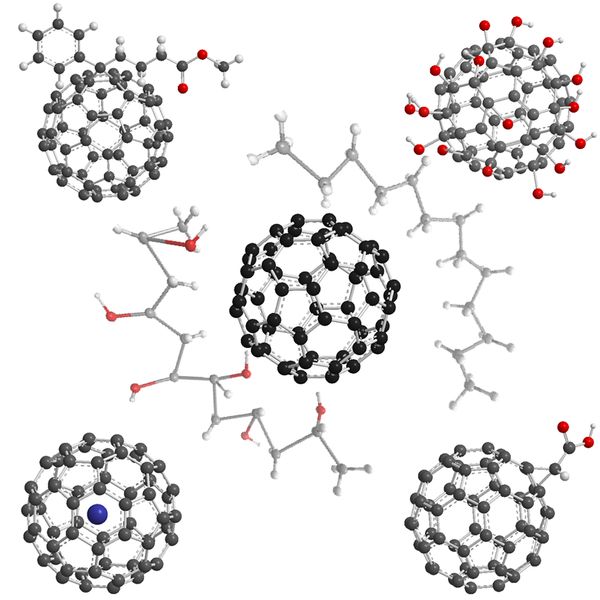
Since their discovery, fullerenes have become one of the most recognizable molecules in science. The 'beautiful molecule' described by Harold W.~Kroto has been subtly referenced in movie, and has adorned the covers of many science-based textbooks. The physical and chemical properties of fullerenes have generated a lot of interest in the science community with many opportunities to develop new avenues for scientific research. Difficulties in the commercial use of fullerenes (\textit{e.g}., $\mathrm{C}_{60}$) have likely been due to issues with solubility. Fortunately, the situation has improved over the last decade with research into fullerene derivatives. Once modified, fullerenes may have applications in a variety of areas including medicine, drug delivery, optoelectronics and electrochemistry. The addition of low concentrations of carbon nanoparticles to polymer matrices may result in significant changes in the function of polymer-based composite materials. This review will highlight the applications of fullerene derivatives as nano-additives for polymer composites. Various fullerene derivatives, \textit{viz}., water-soluble carbon nanoclusters modified with hydroxyl and carboxyl groups, as well as hydrophobic fullerenes (metallofullerenes and methanofullerenes) will be evaluated in regard to their potential impact on commercial applications, in particular, photovoltaic devices, fuel cells, membrane technology and biocompatible electroactive actuators. We, members of Harold W.~Kroto's research group in Florida and international collaborators, miss his exuberance and passion for engaging with young researchers, and we stand committed to preserving his legacy of science and outreach.

The bibliography includes 387 references.

Funders

Russian Foundation for Basic Research
15-58-04034
Ministry of Education and Science of the Russian Federation
СП-1153.2015.1
Marie Sklodowska-Curie Actions
269138