
Home / Articles / Magnetic isotopes as a means to elucidate Earth and environmental chemistry

Magnetic isotopes as a means to elucidate Earth and environmental chemistry

Anatolii Leonidovich Buchachenko 1, 2, 3, 4, 5
Anatolii Leonidovich Buchachenko
1 N. N. Semenov Institute of Chemical Physics, Russian Academy of Sciences, Moscow
2 Department of Chemistry, Lomonosov Moscow State University
3 Institute of Problems of Chemical Physics, Russian Academy of Sciences, Chernogolovka, Moscow region
4 P. G. Demidov Yaroslavl State University
5 Science Center in Chernogolovka of the Russian Academy of Sciences, Chernogolovka, Moscow Region
Published 30 November 2017
15
Share
Cite this
GOST
 | 
Cite this
GOST
Buchachenko A. L. Magnetic isotopes as a means to elucidate Earth and environmental chemistry // Russian Chemical Reviews. 2017. Vol. 87. No. 8. pp. 727-740.
GOST all authors (up to 50)
Buchachenko A. L. Magnetic isotopes as a means to elucidate Earth and environmental chemistry // Russian Chemical Reviews. 2017. Vol. 87. No. 8. pp. 727-740.
RIS
 | 
Cite this
RIS
TY - JOUR
DO - 10.1070/RCR4818
UR - https://rcr.colab.ws/publications/10.1070/RCR4818
TI - Magnetic isotopes as a means to elucidate Earth and environmental chemistry
T2 - Russian Chemical Reviews
AU - Buchachenko, Anatolii Leonidovich
PY - 2017
DA - 2017/11/30
PB - ANO Editorial Board of the journal Uspekhi Khimii
SP - 727-740
IS - 8
VL - 87
ER -
BibTex
 | 
Cite this
BibTex (up to 50 authors)
@article{2017_Buchachenko,
author = {Anatolii Leonidovich Buchachenko},
title = {Magnetic isotopes as a means to elucidate Earth and environmental chemistry},
journal = {Russian Chemical Reviews},
year = {2017},
volume = {87},
publisher = {ANO Editorial Board of the journal Uspekhi Khimii},
month = {Nov},
url = {https://rcr.colab.ws/publications/10.1070/RCR4818},
number = {8},
pages = {727--740},
doi = {10.1070/RCR4818}
}
MLA
Cite this
MLA
Buchachenko, Anatolii Leonidovich. “Magnetic isotopes as a means to elucidate Earth and environmental chemistry.” Russian Chemical Reviews, vol. 87, no. 8, Nov. 2017, pp. 727-740. https://rcr.colab.ws/publications/10.1070/RCR4818.
Views / Visits / Downloads
34 / 33 / 12

Abstract

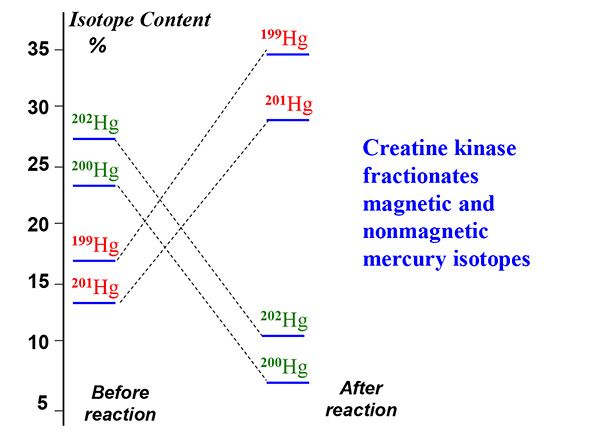
In Earth and environmental chemistry, magnetic isotopes provide a universal means to identify reaction mechanisms. Mass-independent fractionation of isotopes as a signature of a mechanism occurs by two ways: first, \textit{via} the magnetic isotope effect (MIE), which is controlled by magnetic, or hyperfine, coupling between unpaired electrons and magnetic nuclei in paramagnetic species (particularly, in radicals), and, second, via the nuclear volume effect (NVE), which is induced by the volume difference between isotopic nuclei. The MIE is the dependence of the reaction rates on the nuclear magnetic moment of reactants and fractionates magnetic and nonmagnetic isotopes, whereas NVE fractionates isotopes with different nuclear volumes. Both effects, MIE and NVE, are supposed to coexist in condensed phases. A decisive test for their differentiation is illustrated by the example of radical pairs with mercury nuclei. In contrast to MIE-induced bidirectional fractionation controlled by the direction of coherent spin conversion of the radical pair (triplet--singlet or vice versa), the NVE induces unidirectional, universal isotope fractionation, which is almost independent of the reaction mechanism. In contrast to MIE which exhibits inversion of the fractionation sign depending on the spin multiplicity of reactants, NVE is incompatible with the inversion of the fractionation sign. The MIE is an unambiguous indicator of the radical mechanisms and dominates in chemical reactions, whereas NVE prevails in nonchemical processes. Chemical scenarios of MIE-induced oxygen, sulfur, iron, silicon, tin, mercury, germanium and uranium isotope fractionation in photostimulated and dark reactions are analyzed in terms of reaction mechanisms including reactions in living organisms. In conclusion, some restrictions, uncertainties and problems in Earth and environmental chemistry are discussed.

Bibliography --- 92 references.

Funders

Russian Science Foundation
14-23-00018

References

1.
rcr_87_8_727_bib1
Lawler
Ind. Chim. Belges , 1971
2.
rcr_87_8_727_bib2
Buchachenko
Dokl. Akad. Nauk USSR , 1976
3.
rcr_87_8_727_bib3
Buchachenko
Russ. J. Phys. Chem. , 1977
5.
Magnetic Isotope Effect:  Nuclear Spin Control of Chemical Reactions
Buchachenko A.L.
Journal of Physical Chemistry A , 2001
6.
Recent advances in spin chemistry
Buchachenko A.L.
Pure and Applied Chemistry , 2000
7.
Mass-Independent Isotope Effects
Buchachenko A.L.
Journal of Physical Chemistry B , 2013
8.
New Possibilities for Magnetic Control of Chemical and Biochemical Reactions
9.
rcr_87_8_727_bib9
Buchachenko
2009
10.
rcr_87_8_727_bib10
Buchachenko
2015
13.
Temperature dependence of the isotope chemistry of the heavy elements.
Bigeleisen J.
Proceedings of the National Academy of Sciences of the United States of America , 1996
14.
Second-order correction to the Bigeleisen–Mayer equation due to the nuclear field shift
Bigeleisen J.
Proceedings of the National Academy of Sciences of the United States of America , 1998
15.
Frontiers of stable isotope geoscience
Eiler J.M., Bergquist B., Bourg I., Cartigny P., Farquhar J., Gagnon A., Guo W., Halevy I., Hofmann A., Larson T.E., Levin N., Schauble E.A., Stolper D.
Chemical Geology , 2014
16.
Mercury Isotopes in Earth and Environmental Sciences
Blum J.D., Sherman L.S., Johnson M.W.
Annual Review of Earth and Planetary Sciences , 2014
19.
Oxygen Isotopes in Meteorites
Clayton R.N.
Annual Review of Earth and Planetary Sciences , 1993
21.
HISTORY AND APPLICATIONS OF MASS-INDEPENDENT ISOTOPE EFFECTS
Thiemens M.H.
Annual Review of Earth and Planetary Sciences , 2006
22.
rcr_87_8_727_bib22
Thiemens
Proc. Nat. Acad. Sci. , 2013
23.
Anomalous or Mass-Independent Isotope Effects
24.
rcr_87_8_727_bib24
Weston
2006
25.
Unexpected variations in the triple oxygen isotope composition of stratospheric carbon dioxide
Wiegel A.A., Cole A.S., Hoag K.J., Atlas E.L., Schauffler S.M., Boering K.A.
Proceedings of the National Academy of Sciences of the United States of America , 2013
28.
The magnetic isotope effect and oxygen isotope selection in chain processes of polymer oxidation
Buchachenko A.L., Fedorov A.V., Yasina L.L., Galimov E.M.
Chemical Physics Letters , 1984
31.
Magnetic and Classical Oxygen Isotope Effects in Chain Oxidation Processes: A Quantitative Study
Buchachenko A.L., Yasina L.L., Belyakov V.A.
The Journal of Physical Chemistry , 1995
32.
Photo-oxidation of Water by Molecular Oxygen: Isotope Exchange and Isotope Effects
Buchachenko A.L., Dubinina E.O.
Journal of Physical Chemistry A , 2011
33.
Triple-isotope composition of atmospheric oxygen as a tracer of biosphere productivity
Luz B., Barkan E., Bender M.L., Thiemens M.H., Boering K.A.
Nature , 1999
35.
Fractionation of oxygen and hydrogen isotopes in evaporating water
Luz B., Barkan E., Yam R., Shemesh A.
Geochimica et Cosmochimica Acta , 2009
36.
Mass-independent fractionation of oxygen isotopes during H2O2 formation by gas-phase discharge from water vapour
Velivetskaya T.A., Ignatiev A.V., Budnitskiy S.Y., Yakovenko V.V., Vysotskiy S.V.
Geochimica et Cosmochimica Acta , 2016
37.
rcr_87_8_727_bib37
Miller
Proc. Nat. Acad. Sci. USA , 2002
39.
rcr_87_8_727_bib39
Miller
2012
40.
Magnetic isotope effect
STEP E.N., TARASOV V.F., BUCHACHENKO A.L.
Nature , 1990
42.
rcr_87_8_727_bib42
Wakasa
1998
43.
rcr_87_8_727_bib43
Oduro
2012
45.
Evidence of magnetic isotope effects during thermochemical sulfate reduction
Oduro H., Harms B., Sintim H.O., Kaufman A.J., Cody G., Farquhar J.
Proceedings of the National Academy of Sciences of the United States of America , 2011
46.
Mass independent sulfur isotope signatures in CMs: Implications for sulfur chemistry in the early solar system
Labidi J., Farquhar J., Alexander C.M., Eldridge D.L., Oduro H.
Geochimica et Cosmochimica Acta , 2017
47.
Mass-dependent and -independent signature of Fe isotopes in magnetotactic bacteria
Amor M., Busigny V., Louvat P., Gélabert A., Cartigny P., Durand-Dubief M., Ona-Nguema G., Alphandéry E., Chebbi I., Guyot F.
Science , 2016
48.
Oxygen and Iron Isotope Studies of Magnetite Produced by Magnetotactic Bacteria
Mandernack K.W., Bazylinski D.A., Shanks W.C., Bullen T.D.
Science , 1999
49.
The nuclear field shift effect in chemical exchange reactions
Fujii T., Moynier F., Albarède F.
Chemical Geology , 2009
51.
Buchachenko Anatolii Leonidovich, Roznyatovsky Vitaly A, Ivanov Vladimir Leonidovich, Ustynyuk Yuri Aleksandrovich
Mendeleev Communications , 2005
52.
Magnetic Isotope Effect in the Photolysis of Organotin Compounds
Buchachenko A.L., Ivanov V.L., Roznyatovsky V.A., Ustynyuk Y.A.
Journal of Physical Chemistry A , 2006
53.
rcr_87_8_727_bib53
Wakasa
J. Phys. Chem. , 1993
55.
29Si magnetic isotope effects in the photolysis of silyl ketones
Step E.N., Tarasov V.F., Buchachenko A.L.
Chemical Physics Letters , 1988
56.
Magnetic isotope and magnetic field effects on the silicon oxidation
Koplak O., Morgunov R., Buchachenko A.
Chemical Physics Letters , 2013
57.
Magnetic and spin effects in photoreduction of uranyl salts
Buchachenko A.L., Khudyakov I.V.
Accounts of Chemical Research , 1991
58.
rcr_87_8_727_bib58
Landolt-Börnstein
1990
59.
rcr_87_8_727_bib59
Buchachenko
Dokl. Phys. Chem. Akad. Nauk , 2007
60.
Inversion of the sign of the magnetic isotope effect of mercury in photolysis of substituted dibenzylmercury
Buchachenko A.L., Ivanov V.L., Roznyatovskii V.A., Vorob’ev A.K., Ustynyuk Y.A.
Doklady Physical Chemistry , 2008
63.
Small-scale studies of roasted ore waste reveal extreme ranges of stable mercury isotope signatures
Smith R.S., Wiederhold J.G., Jew A.D., Brown G.E., Bourdon B., Kretzschmar R.
Geochimica et Cosmochimica Acta , 2014
64.
rcr_87_8_727_bib64
Huang
Atmos. Chem. Phys. , 2016
65.
Mercury isotopic composition of hydrothermal systems in the Yellowstone Plateau volcanic field and Guaymas Basin sea-floor rift
Sherman L.S., Blum J.D., Nordstrom D.K., McCleskey R.B., Barkay T., Vetriani C.
Earth and Planetary Science Letters , 2009
66.
Benefits of Regulating Hazardous Air Pollutants from Coal and Oil-Fired Utilities in the United States
Sunderland E.M., Driscoll C.T., Hammitt J.K., Grandjean P., Evans J.S., Blum J.D., Chen C.Y., Evers D.C., Jaffe D.A., Mason R.P., Goho S., Jacobs W.
Environmental Science & Technology , 2016
68.
Sources and fate of mercury pollution in Almadén mining district (Spain): Evidences from mercury isotopic compositions in sediments and lichens
Jiménez-Moreno M., Barre J.P., Perrot V., Bérail S., Rodríguez Martín-Doimeadios R.C., Amouroux D.
Chemosphere , 2016
69.
rcr_87_8_727_bib69
Zhang
Tectonophysics , 2014
72.
Mass-independent fractionation of mercury isotopes in the environment
Ghosh S., Xu Y., Humayun M., Odom L.
Geochemistry, Geophysics, Geosystems , 2008
74.
Modeling nuclear volume isotope effects in crystals
Schauble E.A.
Proceedings of the National Academy of Sciences of the United States of America , 2013
75.
Mercury isotope fractionation during liquid–vapor evaporation experiments
Estrade N., Carignan J., Sonke J.E., Donard O.F.
Geochimica et Cosmochimica Acta , 2009
77.
Strontium Isotope Effect in Liquid-Liquid Extraction of Strontium Chloride Using a Crown Ether
NISHIZAWA K., SATOYAMA T., MIKI T., YAMAMOTO T., HOSOE M.
Journal of Nuclear Science and Technology , 1995
78.
An Anomalous Isotope Effect of 235U in U(IV)-U(VI) Chemical Exchange
Fujii Y., Nomura M., Okamoto M., Onitsuka H., Kawakami F., Takeda K.
Zeitschrift fur Naturforschung - Section A Journal of Physical Sciences , 1989
79.
Anomalous Isotope Fractionation in Uranium Enrichment Process
FUJII Y., NOMURA M., ONITSUKA H., TAKEDA K.
Journal of Nuclear Science and Technology , 1989
80.
Mass Dependence of Uranium Isotope Effects in the U(IV)−U(VI) Exchange Reaction
Nomura M., Higuchi N., Fujii Y.
Journal of the American Chemical Society , 1996
83.
Modulation of Messenger RNA Metabolism in Experimental Methyl Mercury Neurotoxicity
Kuznetsov D.A., Richter V.
International Journal of Neuroscience , 1987
84.
Spin Biochemistry:  Magnetic Isotope Effect in the Reaction of Creatine Kinase with CH3HgCl
Buchachenko A.L., Kouznetsov D.A., Shishkov A.V.
Journal of Physical Chemistry A , 2004
85.
Photomicrobial Visible Light-Induced Magnetic Mass Independent Fractionation of Mercury in a Marine Microalga
Kritee K., Motta L.C., Blum J.D., Tsui M.T., Reinfelder J.R.
ACS Earth and Space Chemistry , 2017
86.
Mercury Pollution in Amapá, Brazil: Mercury Amalgamation in Artisanal and Small-Scale Gold Mining or Land-Cover and Land-Use Changes?
Adler Miserendino R., Guimarães J.R., Schudel G., Ghosh S., Godoy J.M., Silbergeld E.K., Lees P.S., Bergquist B.A.
ACS Earth and Space Chemistry , 2017
89.
Isotopic study of mercury sources and transfer between a freshwater lake and adjacent forest food web
Kwon S.Y., Blum J.D., Nadelhoffer K.J., Timothy Dvonch J., Tsui M.T.
Science of the Total Environment , 2015
90.
Absence of Fractionation of Mercury Isotopes during Trophic Transfer of Methylmercury to Freshwater Fish in Captivity
Kwon S.Y., Blum J.D., Carvan M.J., Basu N., Head J.A., Madenjian C.P., David S.R.
Environmental Science & Technology , 2012