Abstract
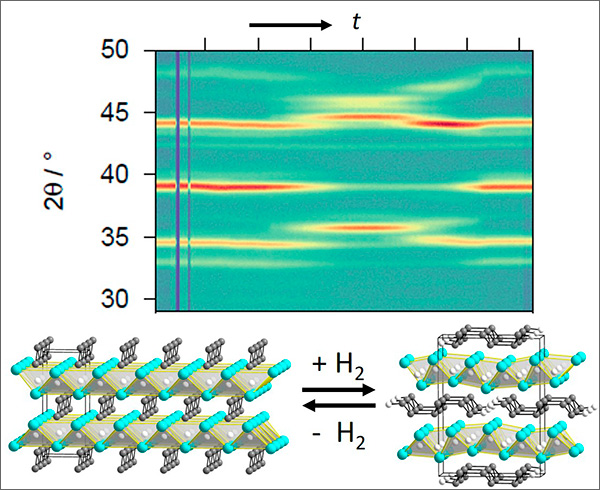
The knowledge of reaction pathways in the preparation of solids is usually rather scarce, which hinders synthesis planning and process control. This is particularly true for metastable compounds, which are a challenge for chemical synthesis, especially in the solid state. \textit{In situ} studies can help in exploring the energy landscape around their local minimum by investigating formation and decomposition. Screening the multi-parameter space in synthetic chemistry is much more efficient using \textit{in} as compared to \textit{ex situ} methods. Studying solid--gas reactions \textit{in situ} is demanding due to the oftentimes harsh conditions as for temperature and gas pressure. Examples are given for a variety of solids and applications, \textit{e.g}., metal hydrides (hydrogen storage, hydrogenation--decomposition--desorption--recombination), intermetallics (heterogeneous catalysis), metal nitrides, nitride oxides and oxides (magnetic materials, photocatalysts). Many new metastable compounds with intriguing properties were discovered by such \textit{in situ} studies in flowing or static gas atmosphere ($\mathrm{H}_2$, $\mathrm{Ar}$, $\mathrm{NH}_3$, air) at elevated pressures and temperatures using a variety of \textit{in situ} methods such as X-ray and neutron powder diffraction, thermal analysis, environmental scanning electron microscopy, Raman, NMR, UV-VIS and X-ray absorption fine structure spectroscopy. The potential of unravelling reaction pathways of solid--gas reactions for improving syntheses and controlling chemical processes is demonstrated.
Bibliography --- 48 references.
Funders
References