
Keywords
Abstract
In view of the growing demand for highly functional hybrid polymers for electronics, medicine and smart materials, the relevance of studies of thermoplastic polyurethane-urea siloxanes has substantially increased; however, systematic data in this field are virtually absent. For the first time in the past 10 years, this review presents a comprehensive analysis of the advances in the field of linear segmented thermoplastic polyurethane-, polyurea-, and polyurethane-urea-siloxanes (TPU-Si). The key relationships between the synthesis methods, structure, and properties of materials, including problems of hydrolytic stability and microphase separation, are analyzed. A unique feature of the paper is in the original overview tables that compare more than 400 compounds and their physicochemical characteristics, which forms the basis for targeted design of materials. The review integrates chemical synthesis, computer simulation, and applied aspects, offering researchers and engineers an effective tool for the development of new polymers for robotics, biomedicine, and additive technologies.
The bibliography includes 224 references.
1. Introduction
Over the past few decades, polyurethanes, polyurethane-ureas, and polyureas have been among the most rapidly growing classes of polymers. The possibility of deliberate variation of properties not only by changing the chemical composition, but also by controlling the structure of the synthesized macromolecules was demonstrated most vividly in relation to this class of materials. This resulted in the appearance of new types of functional materials, including thermoplastic elastomers, interpenetrating polymer networks, and hybrid systems.[1-5] The relatively fast practical implementation of these innovations distinguishes these polymers from both traditional engineering materials (polyamides, polyimides) and structurally simpler, large-scale polyolefins. Other important benefits of these block copolymers include the high reactivity of the isocyanate groups and the polycondensation mechanism of increasing the molecular weight of the target products. The synthesis is usually a two-stage process: first, prepolymer is formed from diisocyanate and a hydroxyl/amine oligomer (with controlled formation of the NCO groups) and, second, the chain is elongated using short-chain diols or diamines to give hard and soft segments. The above features account for extensive use of polyurethanes in the production of elastoplastics for large-scale manufacturing, free-standing (ultrathin) films,* paint-and-lacquer materials, adhesives, and sealants used in construction, mechanical engineering, and light industry. According to various estimates, global polyurethane production is approaching 30 million tons per year.
Despite these unique achievements and the vast range of polyurethane types and brands documented in numerous papers, patents, reviews, monographs, and specialized collections, this research area is still expanding. This is due to both combinatorial potential of this class of polymers and materials based on them and the desire to circumvent their main weak spot: the high toxicity of isocyanates and the use of phosgene synthesis for the industrial production of isocyanates.[6]
Further development of thermoplastic polyurethanes (TPU) is promoted by their active use in 3D printing, in particular in FDM processes.[7][8] In this application segment, not only the basic advantages of TPU are in demand, but also, probably, their key feature: sharp transition between the highly elastic state and the viscoelastic state. Of particular value is the fact that this transition occurs in a narrow temperature range amounting to a few tens of degrees (glass transition temperature Tg from –120 to –50°C for PDMS segments and melting temperature Tm = 150 – 220°C for urethane segments), which can be easily adjusted. Owing to the possibility of controlling stress–strain performance of the elastomers, it is possible to obtain not only materials characterized by a high mechanical modulus, but also materials with uniquely low mechanical modulus. This opens up extensive prospects for the applications of TPU in robotics, which is the primary consumer of polymer materials in the high-tech sector.
Over the past decade, a clear trend has emerged in the field of TPU development: the focus has shifted away from traditional, mass-market applications of TPU toward so-called smart materials, which should be more reasonably classified as high-tech materials or materials meeting a broader range of non-traditional, sometimes mutually exclusive requirements. The purpose of this review is to analyze this particular trend of molecular design of TPU, which is gaining increasing importance for two reasons: first, due to environmental restrictions for mass-market applications of TPU and related necessity of the search for TPU with the lowest environmental impact index both during the manufacture (starting with the production of monomers) and during the use and disposal stages; and, second, due to the appearance of new practical applications of polymer materials subject to much more complex technical requirements.
A unique feature of TPU-based block copolymers is that they combine chemically different moieties in the molecule; therefore, polyurethanes and polyureas maintain both high elasticity of soft segments and good strength characteristics caused by intermolecular interactions of hard segments as well as high stability to chemical impacts and wear. Due to the similarity of the nature of intermolecular interactions, microphase separation, and manifested properties, polyurethanes, polyurethane-ureas, and polyureas are commonly termed polyurethanes (TPU)[9][10] and are practically utilized in the same fields.[11-14]
Among the wide variety of copolymers containing urethane and urea moieties, we have focused our research on linear polyurethane-siloxanes (TPU-Si). Also, TPU-Si include thermoplastic, segmented urethane-polydimethylsiloxane, urethane-urea-polydimethylsiloxane, and urea-polydimethylsiloxane elastomers. Oligo/polydimethylsiloxanes (PDMS) serve as flexible blocks in these copolymers; owing to high molecular chain flexibility and hydrophobic properties, they are in demand in various fields ranging from construction, mechanical engineering, agriculture, and environmental protection to medicine, cosmetics, pharmaceutical industry, and household chemistry.[15-17] In the field of innovations, these materials are used for implant production,[18-21] targeted drug delivery,[22] development of tactile sensors,[23][24] fabrication of protective coatings,[25] and soft lithography technology.[26][27] Another key factor in the wide use of polysiloxanes is the possibility of varying their chemical composition by introduction of organic substituents (methyl or phenyl) and/or functional groups (carboxyl,[28][29] vinyl, aminopropyl, and other groups).[30] However, the modest mechanical properties of PDMS substantially limit their use in certain fields where high strength is a necessary condition.[31-33] This challenge is addressed using a number of approaches such as chemical cross-linking of polymer chains, which increases the rigidity and improves mechanical strength of the materials,[34-36] addition of fillers (e.g., silica, carbon nanotubes, or graphene) that enhance the material wear resistance and toughness.[37-39] It is worth noting that the introduction of functional fillers such as magnetic particles provides control of the mechanical properties over a wide range by using external magnetic fields,[40] and the introduction of organic functional groups into PDMS, for example, those capable of forming hydrogen bonds, makes it possible to improve phase separation, which enhances the mechanical properties of materials.[41-46]
Neither polysiloxanes nor polyurethanes taken separately allow a structure and property control at a level that can be achieved for copolymers based on these components. Therefore, polyurethane-siloxane copolymers have a great potential for the development. The hybrid materials such as TPU-Si play a key role in modern applications. The level of control of material properties can be illustrated by self-healing coatings that are capable of spontaneous recovery after mechanical damage.[47-51] These coatings are successfully used for corrosion and biofouling protection.[52-54] Recently developed polyurethane-siloxanes are employed for the fabrication of electronic skin, an innovative material that mimics tactile sensations and can be used in robotics and medicine.[55-60] Modified siloxanes can be used to obtain complex structures with a high level of detail and functionality, which is utilized in 3D printing.[61-65]
This review gives analysis of the achievements related to the preparation and application of TPU-Si over the past decade. The latest reviews on siloxane-containing TPU were published about ten years ago.[9][34] These publications examine in detail the dependences of the reaction rate and the properties of the resulting macromolecules on the copolymerization conditions and the reactivity of various monomers; the effect of diisocyanate chain length and symmetry on the morphology; and quite a few other aspects of TPU synthesis. Over the past period, the chemistry of TPU-Si has markedly changed owing to the appearance of new synthetic methods and improvements in polymer properties. The previous studies built a solid foundation for further development and application of these materials in various fields. A major issue in the synthesis of TPU-Si with the desired properties is to select appropriate functional groups, to utilize structurally pre-organized oligomers, and to optimize the reactant ratio and the synthesis protocol and conditions. In this promising field of polymer materials science, our attention is concentrated on the control of the properties of TPU-Si through the formation of a specified structure.
We arranged this review as a step-by-step exploration starting with the general principles of the design of segmented polyurethanes and moving toward specific features of siloxane-containing thermoplastics, with a focus on previously unsystematized structure – property relationships. To this end, we compiled more than 400 compositions into a set of tables for the first time. This not only reveals the key trends (the influence of PDMS end groups, diisocyanate symmetry, and the molecular weight of the soft segment), but also clearly demonstrates the fragmentary nature of the existing data, especially regarding computer simulation and fundamental characterization. In addition, we considered the evolution of synthetic approaches from classical isocyanate chemistry to phosgene-free and click-methods, as well as modern strategies for the introduction of dynamic bonds to endow materials with self-healing properties. The review is concluded with an analysis of the proposed practical applications ranging from protective coatings and biomedical implants to flexible electronics and 3D printing. As a result, the most promising lines for further fundamental and applied research are defined.
* Thin (0.1 – 200 μm) layers of substances that are not supported on a hard substrate than can be stretched, deformed, and, in some cases, spontaneously rupture under critical loads.
2. From classical systems to siloxane-containing copolymers
Thermoplastic polyurethanes represent a unique block-copolymer platform obtained by the polyaddition reaction of compounds containing isocyanate groups (–NCO) with compounds containing hydroxy or amino groups, polyols and amines, with active hydrogen atoms. A key feature of TPU is the microphase separation, which is caused by thermodynamic incompatibility of hard and soft segments in the molecule and is enhanced by the formation of hydrogen bonds between the chains, which allows fine variation of the properties of the final product, giving rise to a large array of materials ranging from soft elastomers and elastic foams to hard plastics and adhesives.
In segmented TPU, the classification of segments into hard (HS) and soft (SS) segments is based on their glass transition temperature and mechanical characteristics: hard segments have high glass transition temperature (above 80°С)[66-69] and are responsible for the material strength, whereas soft segments have a low glass transition temperature (from –123°С to –40°С)[70] and are responsible for elasticity. Most often, HS is composed of diisocyanate and low-molecular-weight chain extenders, the nature and content of which in the copolymer determine the key characteristics of the product. The formation reaction of standard polyurethanes based on diols has a moderate rate; therefore, polycondensation can be more easily controlled in this case. The use of diamines provides fairly fast synthesis of polyureas with the formation of strong urea bonds. The difference between the amine and alcohol reactivities toward, for example, aromatic isocyanates is a key factor: the reaction with an aliphatic amine proceeds several orders of magnitude faster (100 000) than the reaction with a hydroxyl group (100). This difference provides the possibility of controlling the reaction kinetics by using substituted amines to retard the formation of urea and ensure a more controlled reaction. The combined use of diols and diamines results in the formation of polyurethane-ureas in which the presence of urea groups considerably increases the hardness and thermal stability of the material, owing to strengthening of the hydrogen bond network. The significant reactivity difference between amino and hydroxy groups makes it possible to selectively control the polycondensation. This provides the possibility of adjusting the structure of the whole block copolymer, without disrupting the formation of hard urea domains with extensive hydrogen bond network, by choosing the order of addition of reactants, for example, by using the prepolymer method.[71]
The soft segments (SS) are most often formed by polyether-polyols such as polycaprolactone (PCL), polytetramethylene glycol (PTMG), polypropylene glycol (PPG), polyhexamethylene glycol (PHMG), and polyethylene glycol (PEG),[72-74] the length of which is also an important parameter determining the properties of materials. As regards the synthesis of polyureas, SS based on polyethers can be adapted for this process. The terminal hydroxyl groups of polyols can be converted to amino groups by reductive amination.[75][76]
There are two main synthetic methods that offer different degrees of control over the structure. The two-stage method implies the initial formation of NCO-terminated prepolymer followed by the addition of a chain extender (usually, 1,4-butanediol[77] or ethylenediamine[78-80]), which allows precise control of the length and composition of the segements. The possibility of separate control of segment formation is a considerable benefit of polyurethane chemistry. The one-stage method in which all components are mixed simultaneously is fast but offers fewer options for controlling the polymer structure and molecular weight.
To obtain regular and monodisperse segments, it is necessary to thoroughly control the stoichiometry, catalysis, temperature, and the order of component mixing. Polymers with ordered HS crystallize and form domains that act as thermally reversible physical cross-links in a soft elastomer matrix. These materials, known as thermoplastic polyurethane elastomers, exhibit the unique property of a sharp and predictable phase transition within a narrow temperature range. At temperatures above the melting point of the domains, the material behaves like a thermoplastic: it flows and can be processed by injection moulding or extrusion. On cooling below this temperature, the domains are hardened, thus converting the material into a cross-linked elastomer with high elasticity and strength comparable to those of vulcanized rubber.
The possibility of precise tuning of the transition temperature by varying the HS length and chemical nature (the choice of aromatic or aliphatic isocyanates and the type and length of the chain extender) is a unique technical advantage of polyurethanes. Thus, this not only makes it possible to design materials with specified performance characteristics, but also provides the processibility of materials, which meets the most stringent requirements of modern equipment and applications.
Linear segmented copolymers containing PDMS moieties in the polymer backbone and urethane, urea, or urethane-urea segments (TPU-Si) appeared quite recently; they are complex copolymers strictly classified as block copolymers, if for no other reason than that they a priori have a soft segment. Hard segment is formed upon the reaction between diisocyanate monomers, diols/diamine oligomers, and monomeric bifunctional chain extenders. TPU-Si represent block copolymers consisting of alternating hard and soft segments chemically bound along the macromolecular chain. The segment hardness is determined by the structure of chain extender that is incorporated between diisocyanates, while the SS flexibility is specified by the molecular parameters of oligo/polysiloxanes. The variation of the type of functional groups and the SS length and the structure and reactivity of the chain extender and diisocyanate constitute the set of parameters that serve for the control of the structure and properties of the resulting copolymers over a very wide range. The use of various types of starting compounds (e.g., two different diisocyanates[8][71] or two different chain extenders[81][82]) in the copolymer synthesis results in the formation of a disordered sequence of segments, which makes this product a random block copolymer.
As in the case of classic TPU, the use of incompatible segments results in a microphase-separated morphology. This structure representing a distribution of microphase units (for example, solid-state highly polar polyurea HS distributed among nonpolar PDMS SS) has a crucial effect on the properties of the polymer. The compatibility of the segments determines the copolymer morphology: to achieve the optimal characteristics, it is preferable to use initially incompatible segments. This provides a high degree of phase separation. For example, the Hildebrand solubility parameters of the urethane [37.2 (J cm–3)1/2] and urea [45.6 (J cm–3)1/2][83] groups are much higher than the solubility characteristics of PDMS [15.6 (J cm–3)1/2][46] or polyisobutylene (PIB) [16.4 (J cm–3)1/2].[84] A copolymer involving polyethylene oxide, which has a solubility parameter of 20.2 (J cm–3)1/2,[85] would show a much poorer phase and microphase separation, since polyethylene oxide is more compatible with the urethane/urea groups.
Analysis of a large number of studies shows that a promising method for the synthesis of TPU-Si is to combine different types of oligomers within a single polymer chain, which provides flexible control over chain architecture and final properties. Primary attention in these studies is paid to the use of oligo- or polydimethylsiloxane as a modifying agent that considerably improves the microstructure and macroscopic properties of thermoplastic polyurethanes based on traditional polyols. The introduction of PDMS-containing segments does not improve the thermodynamic compatibility of the components, but leads to the formation of a more ordered and finer three-phase microstructure by suppressing crystallization and enhancing microphase separation processes. These structural changes have a beneficial effect on the mechanical properties of the material, particularly on the elongation at break, thus endowing the material with increased flexibility and strength.[86-88]
These hybridization strategies are successfully applied in combination with not only polytetramethylene oxide (PTMO/PTMG),[82][88-93] but also other polyols, including PCL,[94-96] polycarbonate diol (PCDL),[97-99] PPG,[100] and polyhexamethylene oxide (PHMO).[81][101]
It should be mentioned that the siloxane blocks applicable for these systems are not limited to PDMS. It is used most often because of ready availability and enormous production volume, whereas polydiethylsiloxanes,[102-104] polymethylphenylsiloxanes,[105-107] and polymethyl-γ-trifluoropropylsiloxanes[30][108][109] remain in the shadow of this highly popular counterpart. Presumably, the economic feasibility of the hard segment based on ladder-like polyphenylsilsesquioxane[110-112] would markedly expand the scope of practical applications for TPU-Si in the future, but this may require a revision of existing approaches and development of new approaches for their synthesis; this issue is addressed in subsequent Sections.
3. Simulation of TPU-Si copolymers
A systematic literature search revealed a very small number of studies dealing with the computer simulation of TPU-Si, with the existing studies being fragmentary. This is due to the high complexity of building models that would simultaneously take into account the diversity of chemical composition and the influence of intermolecular interactions on the structure and functional properties of materials.
The physical basis behind the unique properties of TPU-Si depending on the nature of hard segments was investigated by computer simulations of these systems at various spatial and temporal scales. At the most fundamental level, quantum mechanical calculations are used most often to analyze the electronic structure of molecules. This enables the study of chemical reactions, the properties of individual molecules, and intermolecular interactions with high accuracy. This approach is even more important in view of the possible emergence of new polysiloxane components that were considered in the previous Section. However, due to increase in the complexity of this method following an increase in the number of atoms in the system, it is currently applied only to small systems such as monomers or short oligomers. Quantum mechanical calculations have been carried out[113][114] to study the nature of arising hydrogen bonds and the role of hydrogen bonds in the microphase separation phenomenon observed in block copolymers based on hard urethane/urea segments and various SS including polysiloxanes. Calculations of the interaction energies in model urethane and urea compounds clearly demonstrated, first, the formation of strong intermolecular hydrogen bonds between both urethane and urea segments, with the hydrogen bond energy being approximately 18% higher in the urea segments than in the urethane ones. Second, the interaction between urea and siloxane groups was negligibly weak, while the hydrogen bonds between urea and ether groups were very strong, being much stronger than the urethane – urethane interactions. The results led to the conclusion that the nature of SS influences its compatibility with urethane and urea moieties, in particular, they accounted for the microphase separation in the urea/urethane – PDMS copolymers, which is responsible for their unique mechanical properties.
Molecular dynamics simulations using both atomistic and coarse-grained models and also their combinations have been used to study microscopic behaviour of systems composed of multiple polymer chains. The molecular dynamics simulation is based on the numerical solution of Newton’s equations of motion for atoms (or, in coarse-grained models, for larger units composed of groups of atoms) that make up the polymer.
A key element of atomistic molecular dynamics is the choice of the force field, that is, a set of parameters that describe the interaction potentials between atoms. PDMS are simulated using various force fields, each describing certain aspects of their structural and dynamic properties. For example, CFF91 force field[115][116] was used by Balazs and co-workers,[117] COMPASS[118] was applied in a number of studies,[119-121] and the use of PCFF force field[122] was reported by Mohamed and co-workers[123] and by Kramarenko and co-workers.[123-125] As regards polyurethane, Neez and co-workers[126] employed the AMBER force field,[127][128] Gao and co-workers[129] used PCFF, Ilavský and co-workers[130] reported the use of CFF91, and a number of authors[131-133] employed COMPASS. The choice of a force field for simulation is determined by not only the chemical composition of the system, but also structural characteristics and physicochemical effects that have to be investigated. For example, for amorphous systems, it is important to adequately describe the interatomic interactions at high density, while for crystalline materials, accurate representation of the interaction energy in the crystal lattice is critically important. Although there are examples of urethane and siloxane simulation using one and the same force field, selection of an appropriate force field to simulate TPU-Si block copolymers is a challenging task and requires certain substantiation. Furthermore, atomistic simulation is time-consuming and applicable only to small systems and provides information at small spatial and temporal scales. The atomistic simulation of TPU-Si systems was reported by Yillgor and co-workers[134][135] and used, first of all, as a tool for determining interaction parameters needed for building coarse-grained models in which groups of atoms are replaced by simpler interacting elements in order to increase the spatial and temporal scales of the simulation and study the microphase separation, which is impossible at the atomistic level.
Yillgor and co-workers[134] investigated model urea-polysiloxane copolymers based on stoichiometric combinations of α,ω-aminopropyl oligo/polydimethylsiloxanes with the number-average molecular weight in the range from 700 to 15 000 Da and bis(4-isocyanatocyclohexyl)methane. The content of urea-based hard segments in the copolymers varied in the range of 1.7 – 34 mass %. Atomistic simulations were performed both for single copolymer chains of various compositions and for systems consisting of 16 chains of pure or urea-containing silicone oligomers placed in periodic cells constructed for minimum-energy geometry. It was shown that the radius of gyration of single chains decreases with increasing content of urea-based hard segments, which is due to the strong tendency of urea segments to aggregate. The interaction energies between HS and SS were calculated to estimate the mixing energy and determine the Flory – Huggins interaction parameters, which confirmed the incompatibility of the system components. The system morphology was further studied using the Flory – Huggins parameters and the method of dissipative particle dynamics (DPD). A combined system simulation on different scales demonstrated the presence of microsegregation in the silicone-urea copolymers even at low content of urea segments (1.7 mass %). It was shown that this phenomenon is due to pronounced differences in the solubility and polarity parameters of the siloxane and urea segments, which increase the mixing energy, and to the formation of urea domains with strong hydrogen bonds within the siloxane matrix. It was shown that the equilibrium morphology of the system considerably depends on the copolymer composition and on the content of urea hard segments. When the content of hard segments is high (20 – 25 mass %), gyroid and labyrinth structures are formed, whereas at lower contents, spherical or cylindrical aggregates are formed by urea segments.
Molecular dynamics simulations using coarse-grained models were performed to study the equilibrium morphologies of microphase-separated structures formed in thermoplastic polyurethanes with two different SS (Fig. 1, Fig. 2).[135] The model TPU systems included combinations of soft segments with different molecular weights, PTMO, polyhexyl ethyl carbonate (PHEC), PDMS, and PIB, and hard segments based on urethane repeating units obtained from methylenediphenyl diisocyanate (MDI) (25 – 50 mass %). Using DPD simulation, it was shown that changes in the composition and length of SS and HS may induce an appreciable change in the microstructure. Hydrophobic soft segments such as PIB and PDMS facilitated microsegregation, whereas more hydrophilic segments such as polyhexyl ethyl carbonate and PTMO showed a better compatibility with hard segments due to the formation of hydrogen bonds with urethane groups.
![[{"id":"dfKvNqdBtO","type":"paragraph","data":{"text":"Model of microphase separation in TPU systems based on urethane HS with M<sub>n</sub> = 1000 and chemically diverse SS (polyhexyl ethyl carbonate PHEC, PTMO, PDMS, PIB). The microphase morphology as a function of molecular weight and HS content is represented as isosurfaces of urethane segments (in red). The inner part of the isosurface is uniformly coloured grey (cell dimensions of 24 × 24 × 24 nm).<sup>135</sup> Elsevier B.V., 2016."}}]](/storage/images/resized/P2yo4xvirmcAaTbPRGqp56AMRibC7l3qoXtVBSX8_xl.webp)
![[{"id":"FwBctK3LR_","type":"paragraph","data":{"text":"DPD model of microphase separation in the systems: (<i>a</i>) PDMS1500 – PTMO1500 and (<i>b</i>) PDMS1500 – PHEC1500 (urethane is shown in red, PTMO is shown in green, and PHEC is blue) (cell dimensions of 24 × 24 × 24 nm).<sup>135</sup> Elsevier B.V., 2016."}}]](/storage/images/resized/ZNSbVSrP0dHTqJB4ApEJB70VnsWTvb4ozSWjvYyJ_xl.webp)
The strength of intermolecular interactions was determined by calculating the Flory – Huggins interaction parameters based on the results of atomistic simulation. It was shown that the interactions between urethane hard segments are much stronger than the interactions between HS and SS, which is due to strong hydrogen bonds between the urethane groups. The study also emphasized the importance of the chemical nature, polarity, and molecular weight of SS for the formation of an equilibrium morphology.
The presence of two chemically distinct SS in block copolymers was shown to be an important factor determining the size and morphology of the resulting microphases, offering new possibilities for tuning TPU properties. While DPD simulation effectively captures the influence of composition and interaction parameters, the role of crystallization in the formation of the microsegregated morphology cannot be fully addressed by this method.
Bao and co-workers[136] used the molecular dynamics simulation based on the bead – spring model as a supplement to experimental studies of the TPU-Si block copolymers to gain more in-depth understanding of the mechanisms of formation of supramolecular structures in polymeric materials. The effective attraction between the urethane segments, resulting from the cooperative formation of hydrogen bonds, was simulated by introducing specific types of beads with controlled attraction potentials, which formed so-called dynamic bonds. The simulation provided understanding of how the polymer chain architecture and the presence of dynamic bonds affect the hierarchical self-assembly into supramolecular structures. It was shown that TPU-Si block copolymers can form supramolecular nanofibres when the overall molecular weight is below the critical entanglement molecular weight (designated by Me or Mc) of the polymer. Since the model is general, the results can be extended to other systems with dynamic stickers, which is important for the understanding of the design principles of biomimetic functional materials and the development of materials with a wide range of mechanical properties in the future.
Thus, although coarse-grained models are effective for analysis of large-scale processes, in some cases they fail to adequately reproduce features of the fine structure that play a decisive role in the formation of macroscopic properties of a material. This restricts the use of these methods to address the problems that require a highly accurate description of intermolecular interactions. The atomistic simulation appears to be the most promising approach. The current level of computational technology makes it possible to study increasingly large systems encompassing key aspects of the structural organization and dynamics of polymer chains and also provides detailed description of the most important structural features, such as the nature of hydrogen bonds, segment polarity, and the interactions between HS and SS.
4. Synthetic approaches
4.1. Methods for the synthesis of TPU-Si
Like standard TPU copolymers, TPU-Si are synthesized, most often, by polycondensation (polyaddition) reaction using two main protocols. Both of them are based on the reaction of diisocyanates with oligo/polydimethylsiloxanes having amine or hydroxyl terminal groups.[82][137-140] Furthermore, the hydroxyl group may be either bound to a silicon atom via a hydrocarbon radical (alcohol group, Si – R – OH) or directly attached to a silicon atom (silanol group, Si – OH). This minor difference is of crucial importance not only due to the fact that alcohols and silanols possess different reactivities, in particular toward isocyanates, but mainly because of the fact that the Si – O – C bond is hydrolytically less stable, which is often overlooked by researchers. The same is true for amines and silylamines, respectively.
The first protocol, in which all components, that is, diisocyanate, an SS-containing telechelic polymer, and a chain extender, are mixed simultaneously in specified stoichiometric ratios and then react, is called the one-shot protocol and is depicted in Scheme 1. Although this single-step process is technically simple, the random nature of the chemical reactions precludes precise control of the HS length and distribution within TPU-Si. This is because isocyanate can selectively react with both SS and the chain extender, or it may not react at all. This polyaddition protocol is rarely used because, like any polycondensation reaction, it requires strict compliance with the rule of functional group equivalence in order to produce a high-molecular-weight polymer.
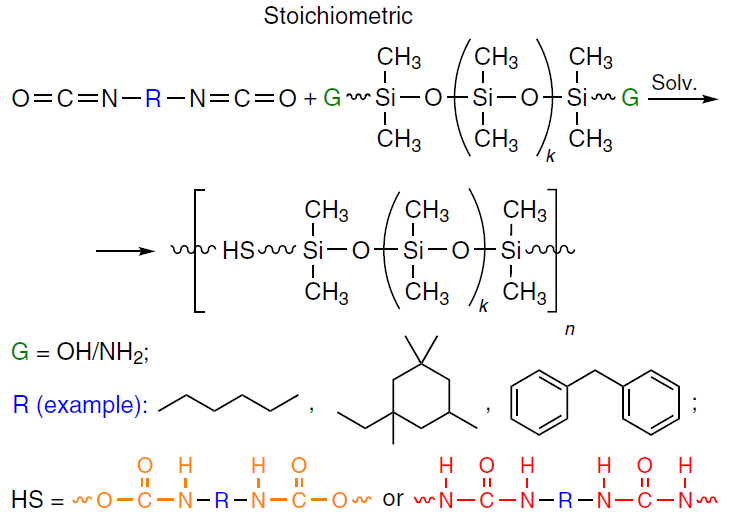
The second ‘prepolymer’ protocol consisting of two stages is preferable.[38][62][63] In the first stage, an excess of diisocyanate reacts with SS oligomer to give prepolymer with isocyanate groups at the ends of the macromolecule. This is followed by the chain extension stage, in which the prepolymer reacts with a chain extender (a short diol, diamine, or isocyanate) to form a high-molecular-weight segmented TPU-Si, as shown in Scheme 2. In this case, it is possible, first, to obtain more uniform SS and HS distribution along the chain and, second, to build up a greater molecular weight.[9]
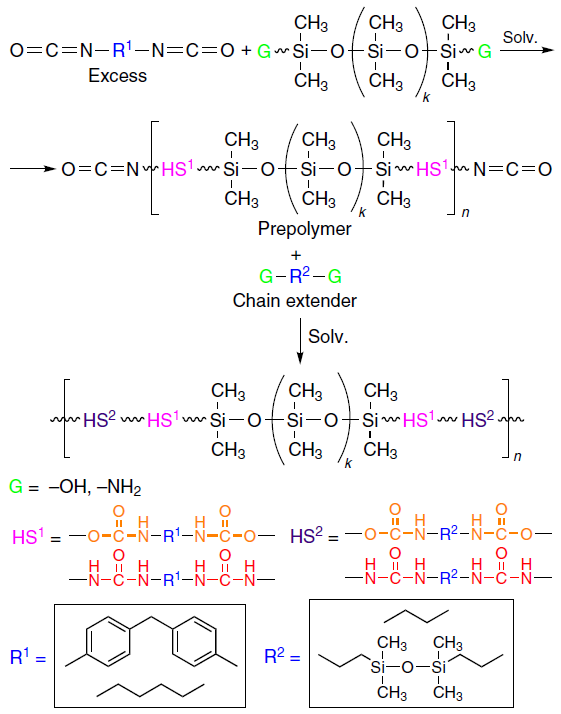
As mentioned above, segmented TPU-Si copolymers can be represented by the following structures: polyurethane-siloxanes, polyurea-siloxanes, and polyurethane-urea-siloxanes. Below we consider these structures in more detail.
4.1.1. Polyurethane-siloxanes
Most often, linear polyurethane-siloxanes are prepared using two key components that form segments composed of urethane and oligo/polydimethylsiloxane moieties (Scheme 3).[141-143] In most cases, the synthesis involves a third component, a low-molecular-weight chain extender (characteristics of all reactions and materials analyzed for this purpose are summarized at the end of Section 4.1.1).[144-146]
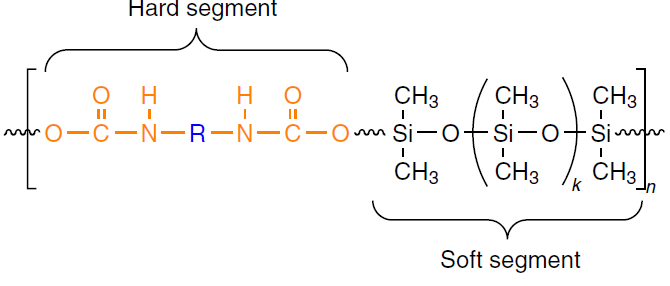
The general structure corresponds to block copolymers ~ABABA~, where A is a urethane segment and B is a siloxane segment. This segment alternation considerably improves the mechanical and physical properties of the material, making it more resistant to deformation and environmental impacts.
In polyurethane-siloxanes, non-covalent interactions can occur when a hydrogen atom at a nitrogen atom interacts with an electronegative oxygen atom in the urethane group of a neighbouring macromolecule, similar to what takes place in polyamides. Thus, urethane groups form monodentate (single) hydrogen bonds, which enhance the interaction between the chains (Scheme 4).
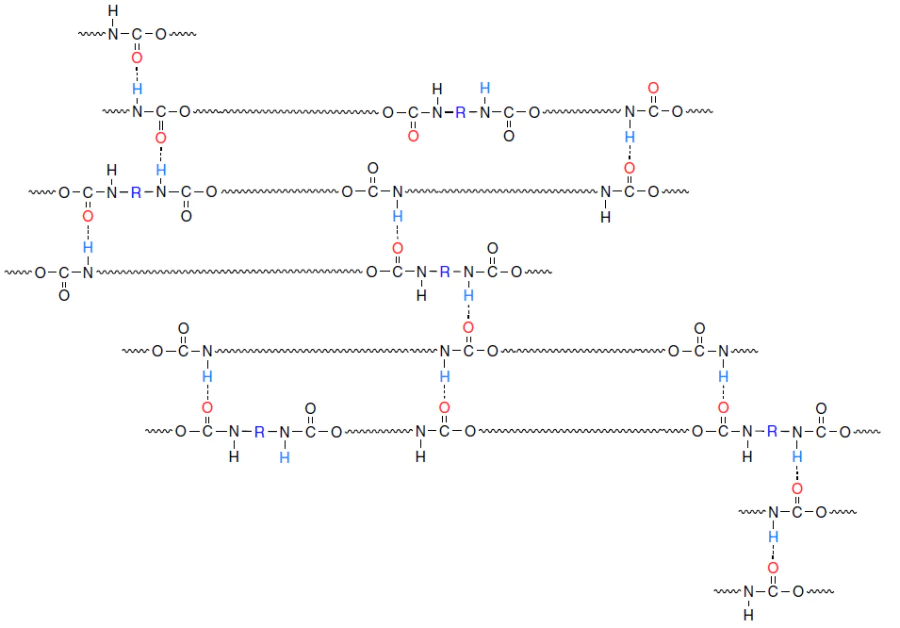
The synthesis and properties of urethane-siloxane block copolymers attract considerable attention, apparently, due to the extensive studies of traditional polyurethanes and ready availability of polysiloxane telechelics with silanol terminal groups, which were previously considered to be appropriate substitutes for standard polyols. Nevertheless, there is a problem associated with the synthesis of urethane-siloxane copolymers: the lack of stability of terminal hydroxyalkyl groups in PDMS oligomers. It was found that terminal hydroxypropyl or hydroxybutyl groups can react with the terminal silicon atoms of PDMS oligomers in the presence of strong acids and bases to give stable cyclic siloxane structures, and thus the functional properties of these terminal groups are lost.[34][70] After cyclization, the hydroxyalkyl groups can no longer participate in the formation of urethane bonds with isocyanates, which reduces the efficiency of copolymer synthesis. This mechanism seems rather odd, in view of the fact that silanol functional groups react much more readily with one another to release water, which is responsible for the poisoning of the water-sensitive isocyanate groups and ultimately leads to an imbalance of functional groups in the system.
In addition, there is a problem of a large solubility difference between PDMS and urethane/urea components, which complicates the choice of a suitable solvent for the reaction. Both of the above problems account for the formation of copolymers with uncertain structures and low overall molecular weight and, hence, result in the formation of low-quality materials.
The third problem is that polyurethane-siloxane copolymers derived from polysiloxanes with silanol end groups undergo fast hydrolysis and degrade under the action of water and alcohols due to the instability of the –Si – O – C – NH– bonds.[46] [147] Nevertheless, there are publications describing the synthesis of copolymers of this type. For example, the research team headed by Ristić [148] prepared a series of copolymers with these bonds. The obtained polyurethane-siloxane samples showed outstanding molecular weight characteristics (up to 8.6 × 10⁶ Da with Đ = 1.02) and excellent mechanical properties (relative elongation at break of up to 1600%). Due to the lack of detail in the synthesis description, it is impossible to say with certainty what precautions were taken to prevent the degradation of the hydrolytically unstable –Si – O – C – NH– groups during the synthesis and testing, which raises questions about the durability of this material. A similar problem of bond stability can be observed in some other studies.[143] [146][149-152]
An original method for the introduction of alcohol groups at the ends of PDMS was proposed by Andrianov and Makarova.[153] Unlike known methods, the authors did not just carry out hydrolysis, but used cyclic 2,2-dimethyl-1,4,2-dioxasilinane (CH3)2Si(CH2OCH2CH2O) as a key reagent functioning as a molecular chain termination agent. This approach allowed targeted synthesis of oligomers with a specified length carrying hydroxy groups on both ends of the molecule, which is a challenging task in siloxane chemistry. Subsequently, Andrianov et al.[154][155] reported thermally stable urethane-siloxane elastomers with controlled properties that were not prone to Si – O – Si or Si – C bond cleavage. Although this method was proposed back in 1960, it still has not been widely accepted; therefore, many of the difficulties discussed above remain relevant.[156-158]
There is also the issue of reactivity of the starting compounds. Thus, owing to the much higher nucleophilicity of amines compared to alcohols, urea formation reactions proceed almost instantaneously at room temperature, whereas urethane formation takes place at elevated temperatures (50 – 100°C) and usually in the presence of a catalyst. Also, it is important that primary amines and alcohols react much faster than their secondary analogues due to their higher nucleophilicity. Similarly, aromatic isocyanates are more electrophilic than aliphatic ones, which makes them more reactive toward alcohols. The reactions are accelerated by using various catalysts, e.g., tertiary amines, usually triethylamine[8][100] and triethylenediamine,[57][95][136] which actively catalyze the reaction of isocyanate groups with water, and/or organometallic compounds, mainly divalent and tetravalent tin/bismuth compounds (e.g., tin caprylates and laurates, dibutyltin dilaurates),[89-92] [159] which actively catalyze the reaction of isocyanates with hydroxyl groups. Trialkylphosphines and metal (e.g., Bi, Fe, Sn, etc.) salts are also used as catalysts.[61] As the reaction goes on and the concentration of urethane bonds increases, side reactions start to occur. In particular, the N – H groups of urethanes that have already been formed react with isocyanates to give allophanate groups (O – CO – N – CO – NH). These groups are formed in small amounts, since urethane groups have low reactivity; however, their presence in the system should not be neglected.[9][160] The most effective approach to preventing the formation of allophanate groups is to combine controlled reaction conditions (temperature, stoichiometry, time) with the use of selective catalysts. The current studies in the field of catalysts for polyurethane synthesis are directed toward fabrication of systems that provide high selectivity of the main reaction with minimized catalysis of side reactions, including the formation of allophanates.[161][162]
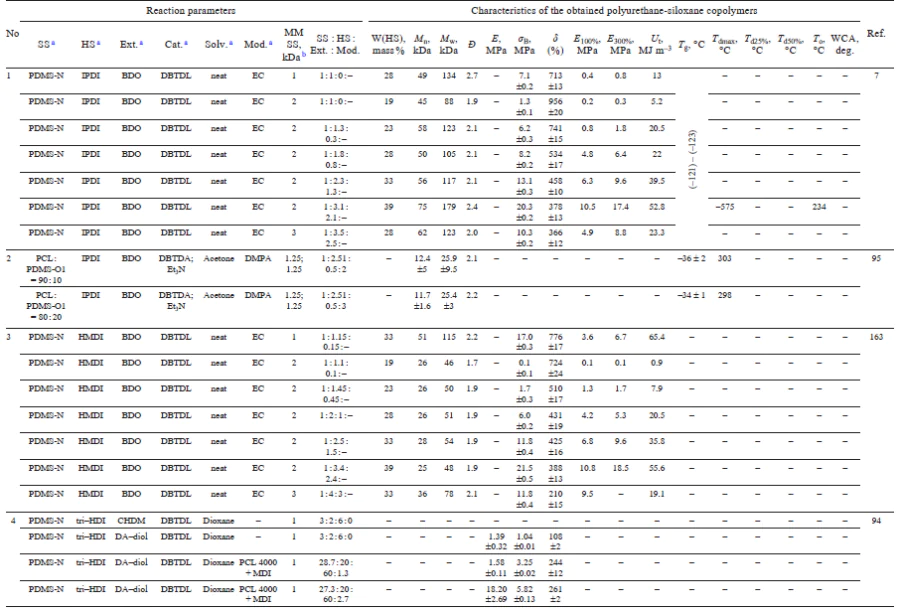
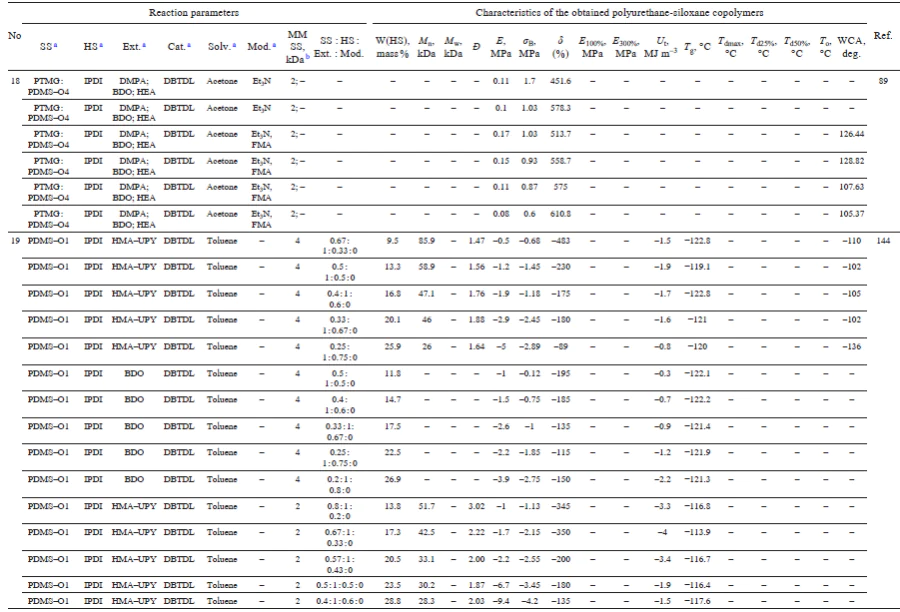
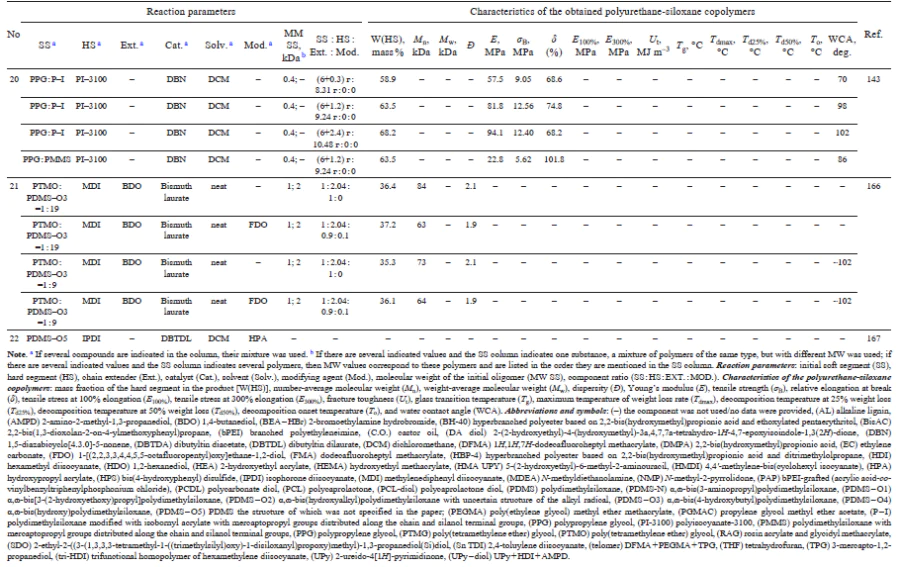
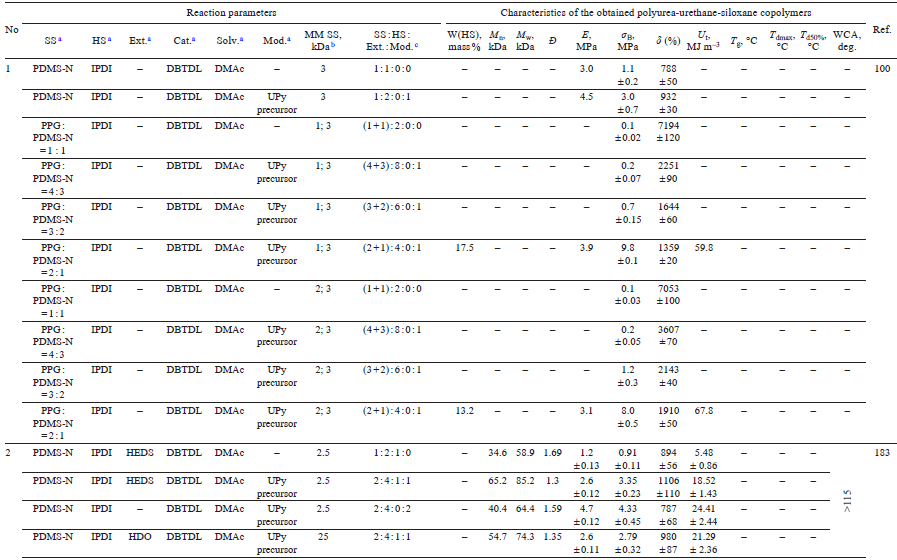
For clarity and easy identification of the synthesis conditions – property relationships, we have compiled all reaction parameters and the characteristics of the polyurethane-siloxane copolymers obtained to date in Table 1[163-167].
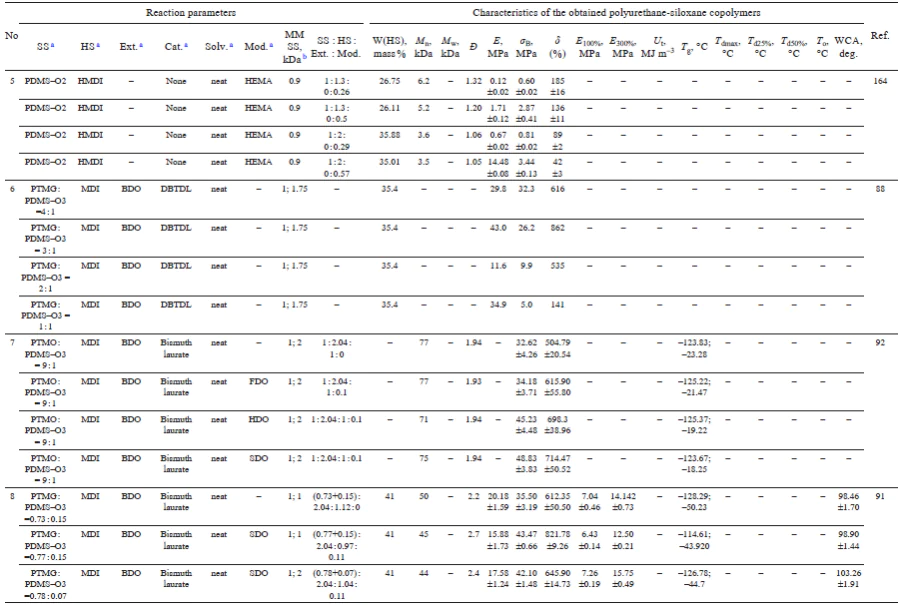
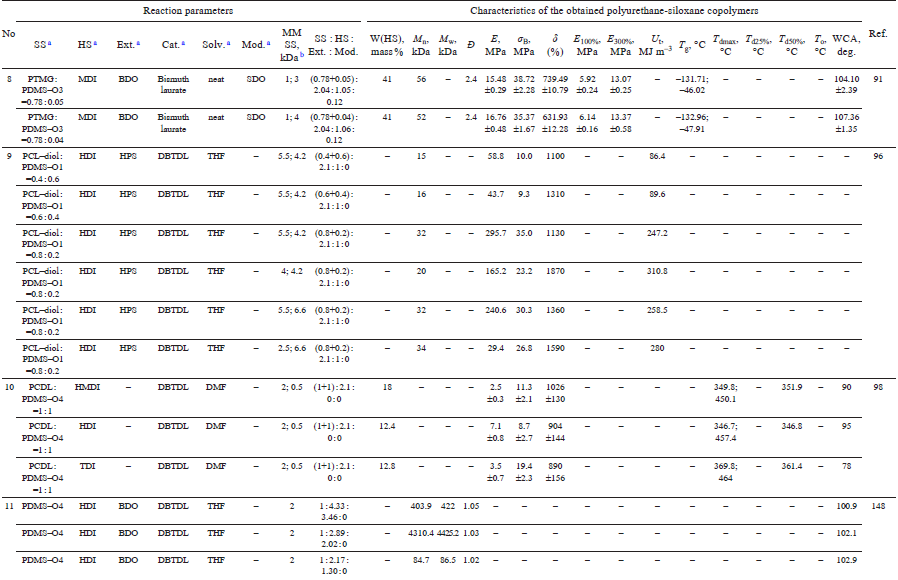
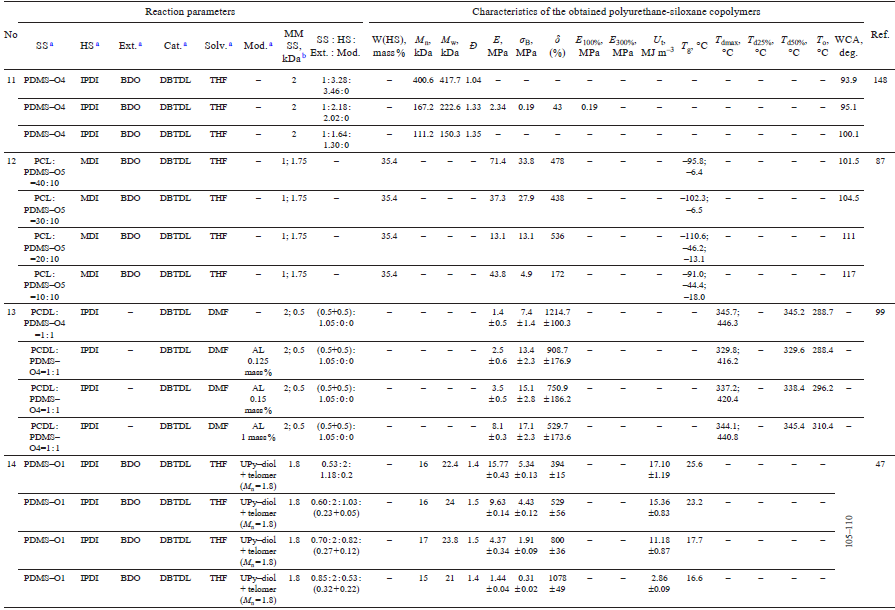
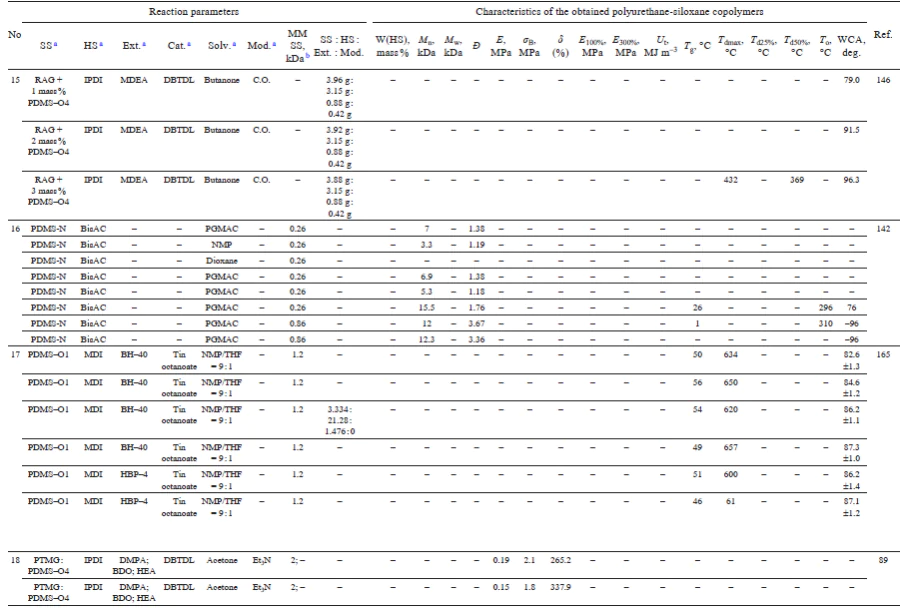
4.1.2. Polyurea-siloxanes
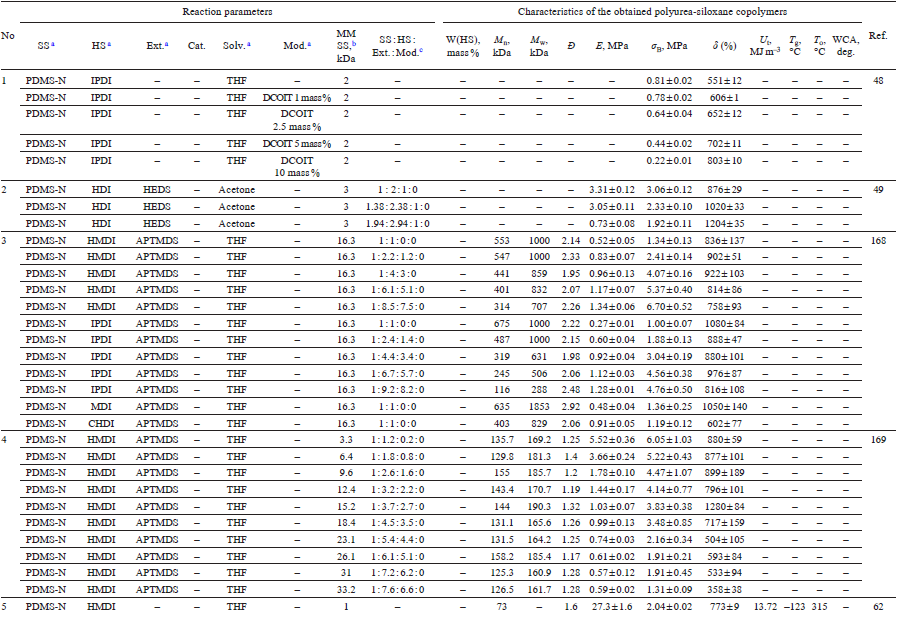
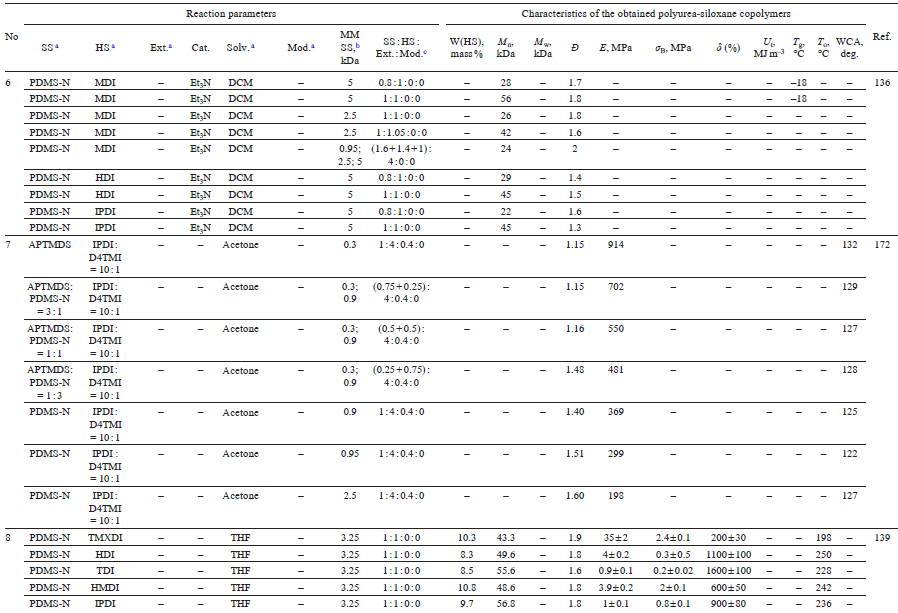
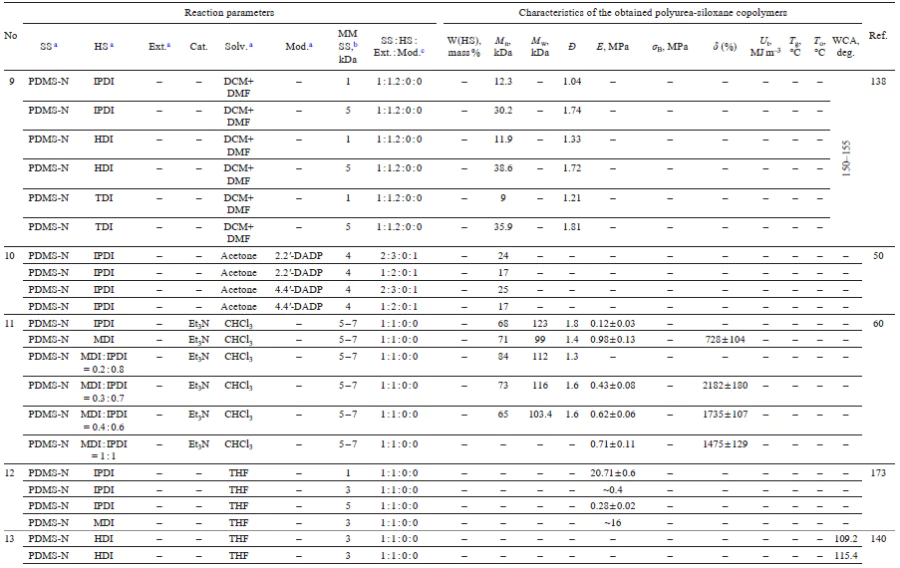
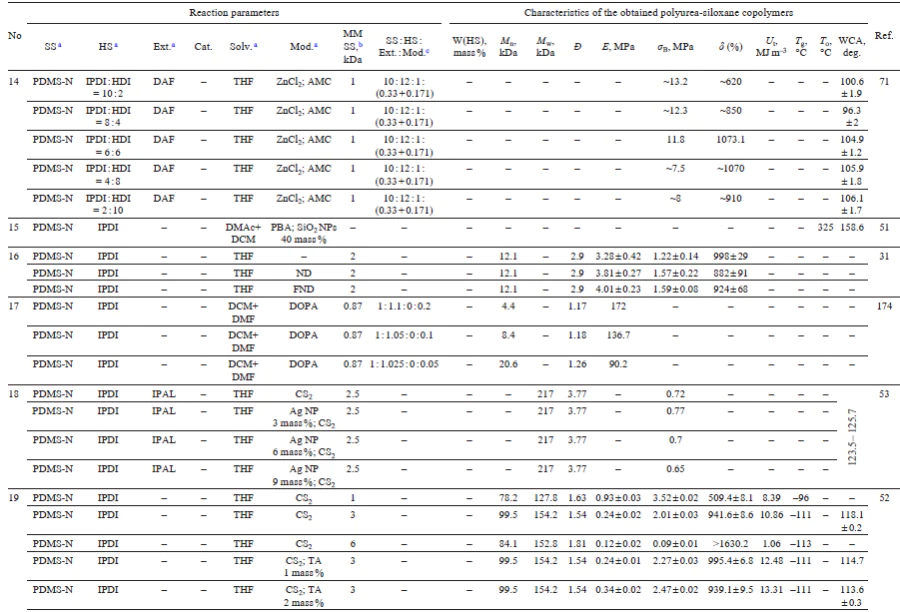
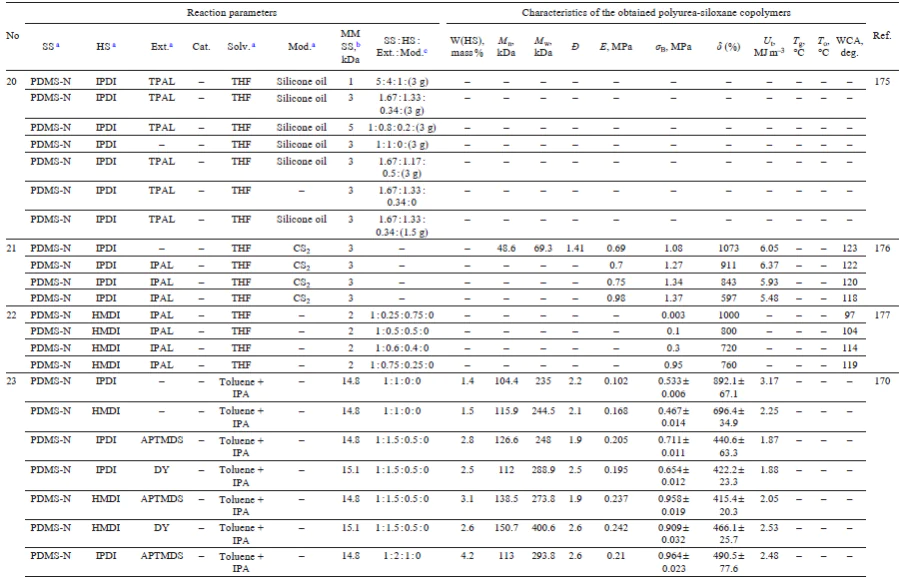
Polyurea-siloxanes are segmented copolymers containing both urea and polysiloxane groups in the molecule. The urea (carbamide) groups are described as –NH – C(O) – NH–, with two hydrogen atoms being able to form hydrogen bonds with acceptors such as oxygen or nitrogen atoms (Scheme 5). Most often, polyurea-siloxanes are formed by two segments, although chain extenders are also often used (see Table 8)[168-181]; the most popular extender is 1,3-bis(3-aminopropyl)-1,1,3,3-tetramethyldisiloxane.[159][168-170]
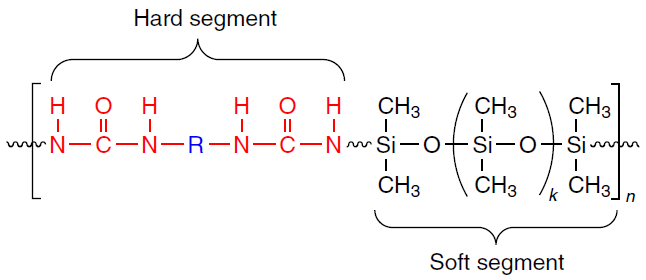
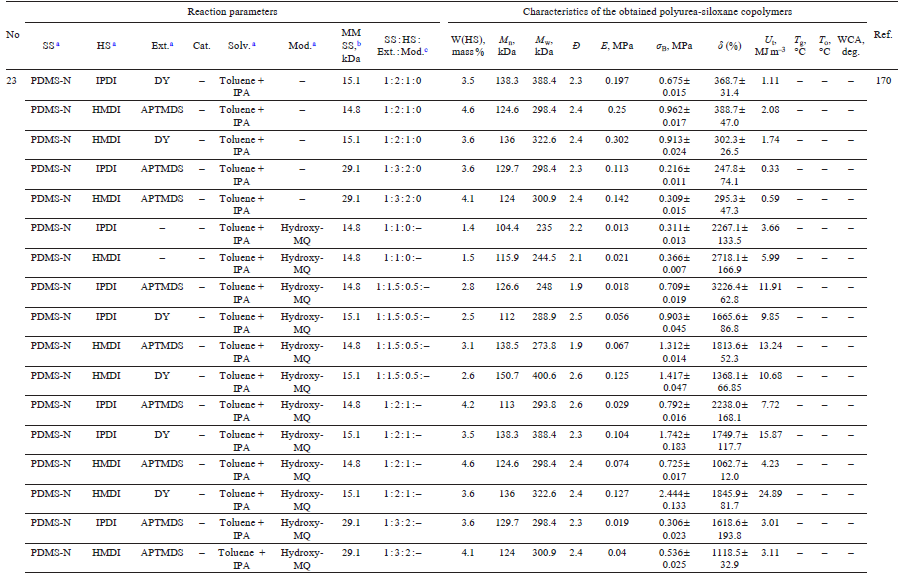
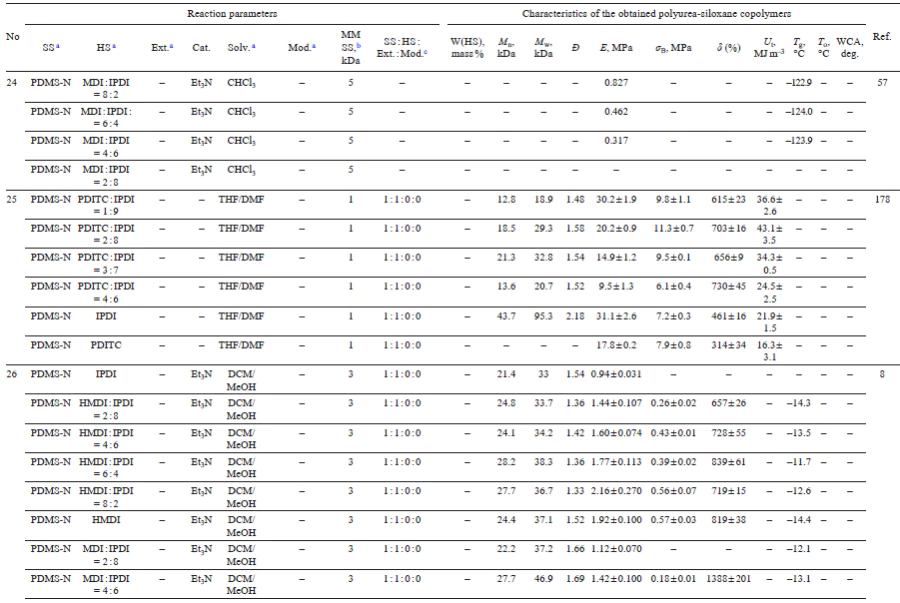
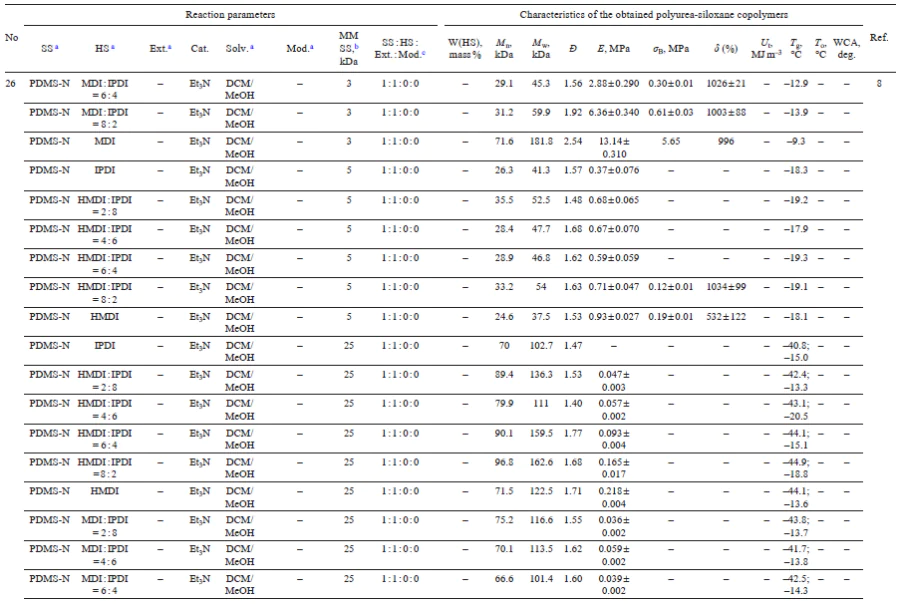
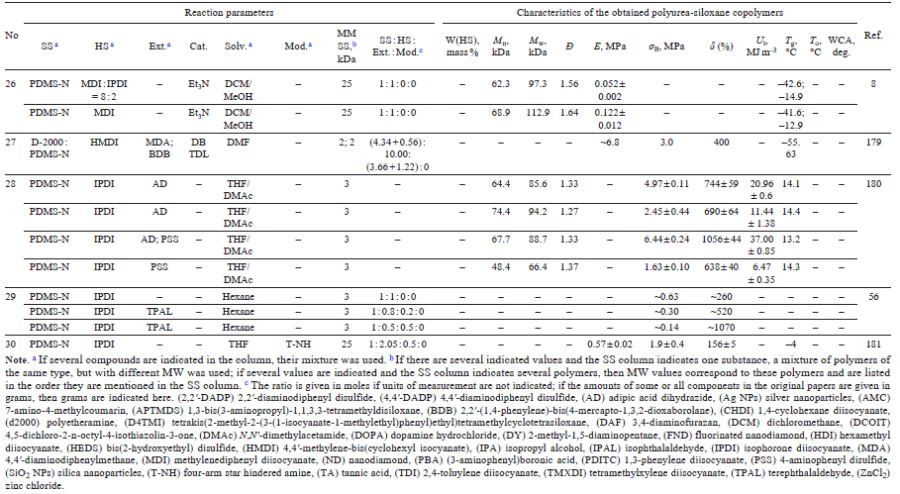
A key feature of these polymers is the ability to form a complex network of hydrogen bonds. Owing to the presence of two hydrogen atoms in each urea moiety, they act as bidentate ligands capable of forming both intramolecular and intermolecular hydrogen bonds, which ensure a stronger interaction between polymer molecules (Scheme 6).
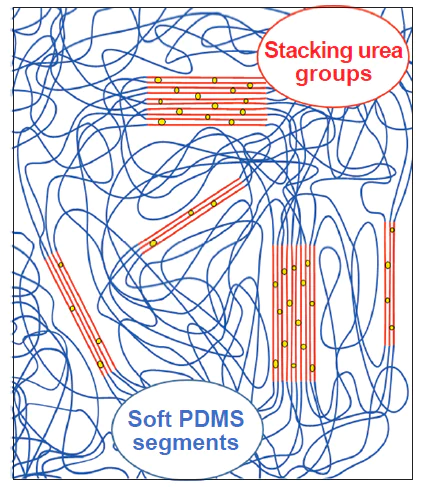
The combination of carbamide and polysiloxane units in the polyurea-siloxane molecules provides an opportunity for the formation of a more stable and stronger network compared to that for monodentate polyurethane-siloxanes. This intricate structure gives rise to a better polymer architecture and endows the polymer with enhanced stability and structural integrity, thus making it particularly suitable for applications that require high strength and resistance to external impacts.
A major challenge in the synthesis of these copolymers is the formation of by-products. Similarly to urethanes, which form allophanate groups, ureas can also react with isocyanates to form biuret groups. The formation of biuret groups (like the formation of allophanate groups) upon the addition of isocyanates to compounds containing active hydrogen is thermally reversible. However, the equilibrium constant for biuret formation is an order of magnitude higher than the equilibrium constant for the formation of the allophanate group.[171] In the synthesis of copolymers, this brings about a risk of obtaining structures with irregular cross-links instead of the desired linear macromolecules.
For clarity and easy identification of the synthesis conditions–property relationships, we have compiled all reaction parameters and the characteristics of the polyurea-siloxane copolymers obtained to date in Table 8.
4.1.3. Polyurethane-urea-siloxanes
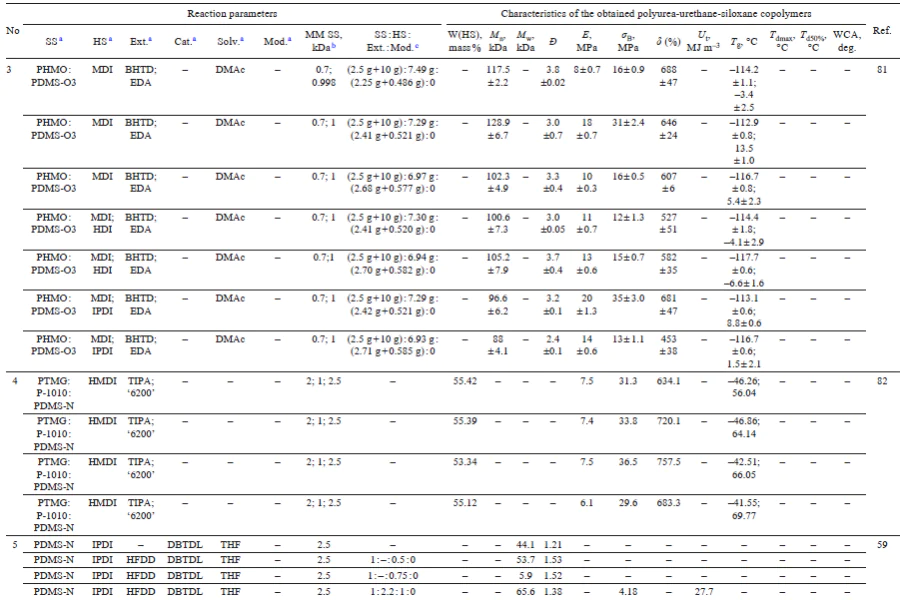
Polyurethane-urea-siloxanes (PUS) are segmented thermoplastic elastomers combining urethane and urea moieties chemically bound along the macromolecular chain (Scheme 7). The urea groups in the chain are formed most often by using α,ω-bis(3-aminopropyl)polydimethylsiloxane;[61][82][97] hydroxyl-functionalized PDMS are used more rarely.[55] [93][182] The alternating system of segments is generated in the synthesis using glycols and chain extenders with carbamide terminal groups (Table 17).[81][90][176][183-187]
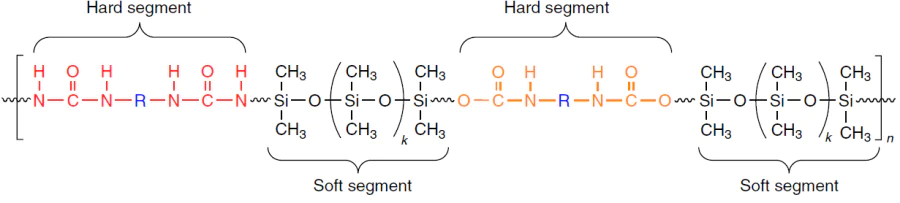
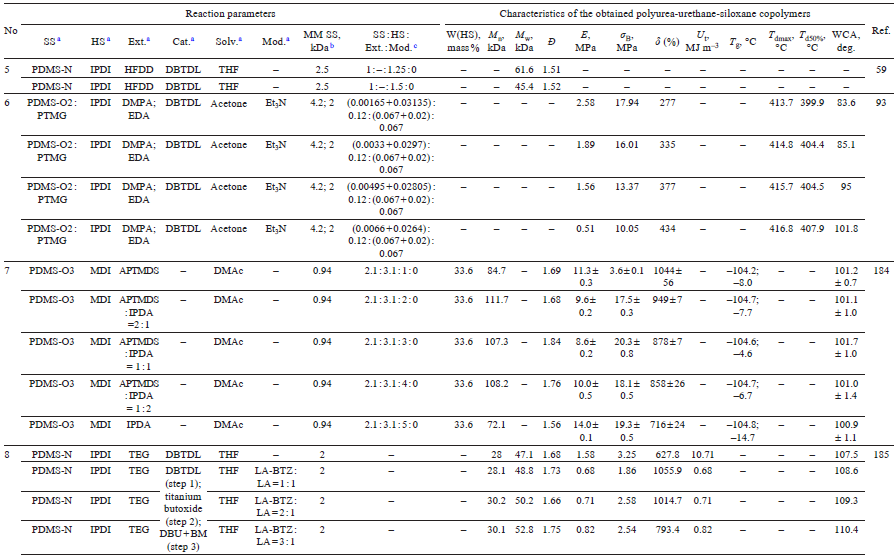
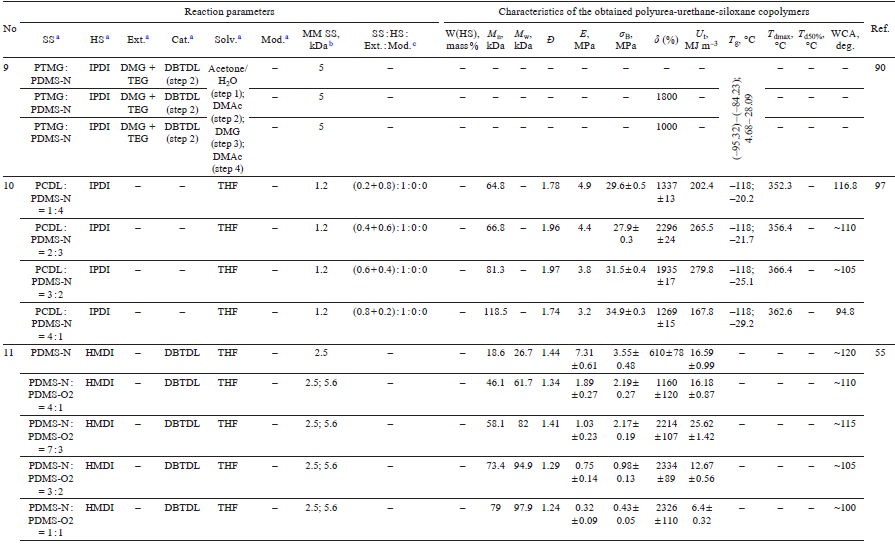
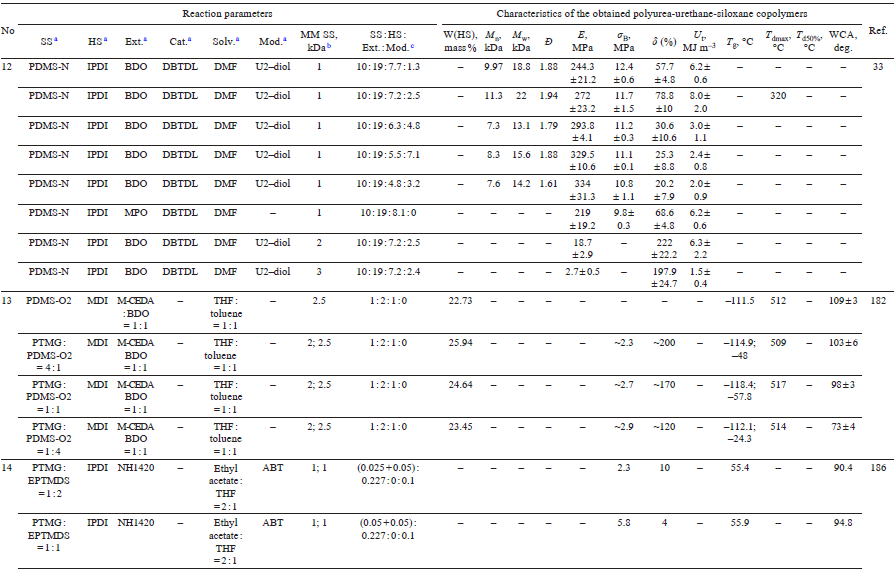
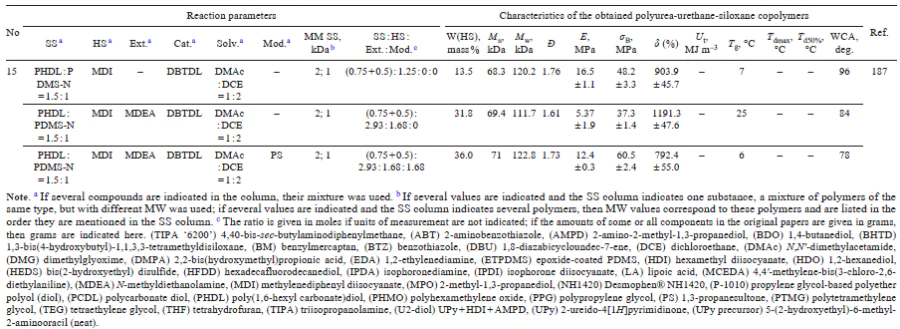
Hard segments containing urea groups form stronger hydrogen bonds than those containing urethane groups, which results in a better phase separation and enhanced mechanical properties.
4.2. Alternative synthesis strategies
Despite the versatility, the classic isocyanate chemistry is associated with a number of serious drawbacks. They include high toxicity and water sensitivity of isocyanates, which account for the strict requirements for the synthesis and processing conditions. However, the main problem lies in the industrial production of isocyanates, which still uses phosgene. The key drawbacks of using the phosgene method include the toxicity of phosgene itself, the formation of a large amount of hydrogen chloride, the necessity of conducting the process at high temperature, which rules out the use of low-molecular-weight compounds. In addition, conducting the process at elevated temperatures leads to the formation of by-products such as urea, which complicates purification of the final product.[6][75]
Therefore, alternative phosgene-free methods that are safer and more environmentally friendly are being actively developed. Isocyanates can be synthesized by the rearrangement of nitrogen-containing carboxylic acid derivatives; however, this approach in its classic form is mainly applicable in laboratory practice. For example, the Curtius rearrangement is unsuitable for industrial-scale production and does not comply with the green chemistry principles, because of the high toxicity and explosiveness of azides. The Hofmann (amides) and Lossen (hydroxamic acids) rearrangements under standard conditions require stoichiometric amounts of toxic and corrosive reagents (e.g., Br2 or anhydrides) and involve the formation of large amounts of waste.[188][189]
A highly promising trend is to replace phosgene by carbon dioxide (CO2). This approach is based on a reaction involving phosphazenes, which react with CO2 to form isocyanates. This procedure is characterized by a wide choice of substrates and furnishes isocyanate derivatives, including heterocyclic compounds, in good yields (70 – 95%). The main challenge for improving this method is to find alternatives to triphenylphosphine (because of its low reactivity and difficulty of separation of the formed oxide) to prepare high-purity products.[190][191]
Currently, the reductive carbonylation of nitroarenes using carbon monoxide (CO) is considered to be most promising. This approach makes it possible to obtain isocyanates directly from nitro compounds without the amine formation step. Despite the thermodynamic advantage, direct one-step carbonylation has not yet been implemented in industry, because of contamination of the final product with highly toxic remainder of the catalyst. The two-step process in which the nitroarene is first carbonylated in the presence of alcohol to give N-phenylcarbamate, which subsequently decomposes on heating to give the target isocyanate, was recognized to be more practically feasible and safe. This approach makes it possible to avoid the problem of toxic impurities and is considered to be the most realistic alternative to the phosgene method. Although the reductive carbonylation does not require phosgene and the yields at the carbamate formation step can reach 90 – 99%, the purity of the final isocyanate (especially aliphatic isocyanate or that obtained by the one-step method) remains a bottleneck of the process. The success of this method directly depends on the development of an effective catalytic system for the thermal decomposition step that would provide both a high yield (potentially > 90%) and high selectivity, minimizing the formation of isocyanate dimers, polymers, and other side products that decrease the purity of the target product.[188][192]
There are alternative methods for the preparation of TPU-Si. Diisocyanates are known to be the key components for the production of both polyurethane-siloxanes and polyurea-siloxanes. However, the reactivity of isocyanates toward nucleophiles, including water, brings about some difficulties. In particular, the reaction of isocyanates with water produces carbon dioxide, which is useful for foaming but shortens the shelf life of the products and complicates the use of water-based two-component systems.[193][194] These problems are addressed by development of alternative approaches that minimize the contact of isocyanate reagents with aqueous media or by using absolutely isocyanate-free systems. For example, the use of blocked isocyanates that are activated only under definite conditions reduces the undesirable side reactions.[195]
One of the most extensively studied isocyanate-free methods for the synthesis of TPU-Si involves the addition reaction between bis-cyclic carbonates and diamines, which gives rise to so-called polyhydroxyurethane-siloxanes (PHUSi). Various synthetic approaches are summarized in Table 23.
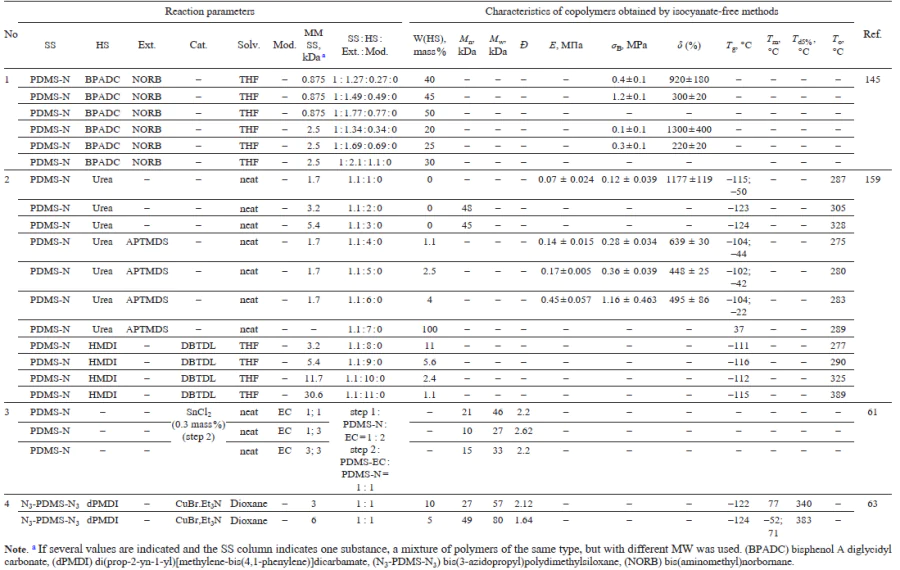
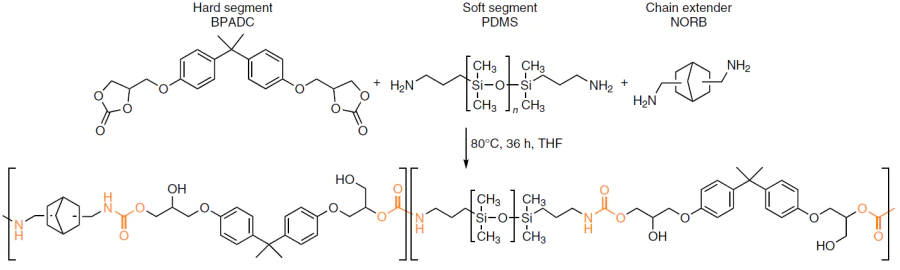
Currently, there are several varieties of this approach. Torkelson and co-workers[145] synthesized a series of copolymers using bisphenol A diglycidyl carbonate (BPADC) as HS, which was mixed with amino group-terminated PDMS telechelic as SS and bis(aminomethyl)norbornane (NORB) as a chain extender (Scheme 8). The study has shown that, owing to the thermodynamic incompatibility of HS and SS, the resulting PHUSi compounds were capable of highly efficient phase separation and formation of strong hydrogen bonds between the urethane groups. A unique feature of the synthesized PHUSi was high elasticity at temperatures below –100°C and the absence of a yield point in tensile tests; as a result, the elongation at break reached 1000% (No. 1, Table 23).
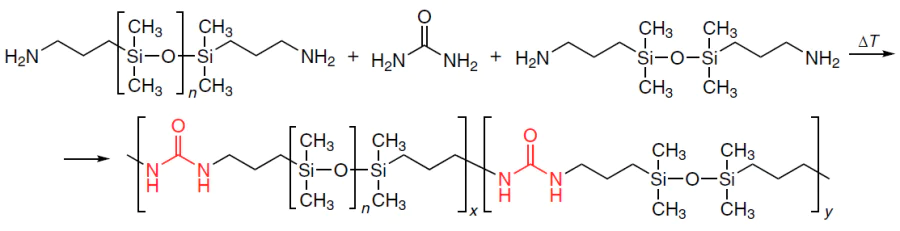
To avoid the use of isocyanates, not only cyclic carbonates, but also ordinary urea can be used. Long and co-workers[159] described a new high-temperature synthesis of segmented polyurea-siloxanes using PDMS with terminal amino groups, urea, and disiloxane diamine chain extender in a melt (Scheme 9). It is noteworthy that this method is simple to implement and requires not only no isocyanates, but also no solvents or catalysts; the only by-product is ammonia, which makes the process more environmentally friendly in the repeated use. The resulting copolymers are characterized by high molecular weights, optical transparency, and mechanical flexibility. The data for the prepared polyurea-siloxane copolymers (No. 2, Table 23) show that the elongation at break (up to 1180%) is comparable with that found for analogous materials with urea units (No. 8 in Table 8 and No. 11 in Table 17), while the area of the hysteresis loop remains moderate as the HS content increases. Despite the environmental and toxicological advantages of the synthesis of polyurea-siloxanes using urea, this approach has several drawbacks such as the absence of a bulky hard segment, which leads to a low tensile strength (up to 1 MPa) and the lack of possibility of producing polymers with a high content of hard segments due to a sharp increase in the viscosity of the mixture. That is why this method cannot yet be considered for the industrial production of copolymers possessing various properties.
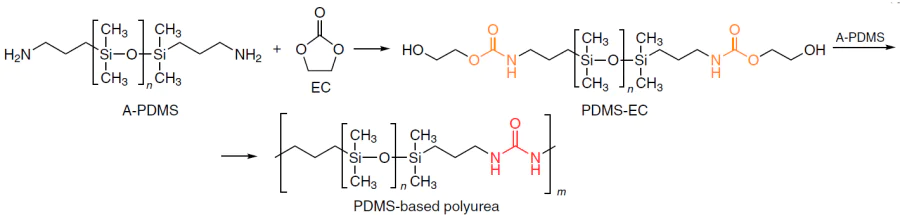
Zhang and co-workers[61] developed PDMS-based polyurea adhesives using the ring-opening reaction between ethylene carbonate and PDMS telechelic with aminopropyl terminal groups (Scheme 10). The products exhibited high adhesive strength and long-term stability at extremely low temperatures, e.g., in liquid nitrogen (–196°C). The authors were able to achieve a uniform distribution of urea groups along the backbone by using transurethanization between the PDMS telechelic with hydroxyalkylurethane groups and aminopropyl PDMS telechelic; this prevented too early curing and maintained the PDMS fluidity at low temperature. This feature allowed the adhesives to effectively penetrate into substrates by forming strong interfacial hydrogen bonds. The adhesion strength to steel upon immersion into liquid nitrogen reached 20.6 MPa and decreased only to 15.8 MPa even after 60 days of storage. In addition, the adhesives exhibited photoluminescence and good impact strength, which makes them promising for use in extreme environments, such as outer space and polar regions (No. 3, Table 23).
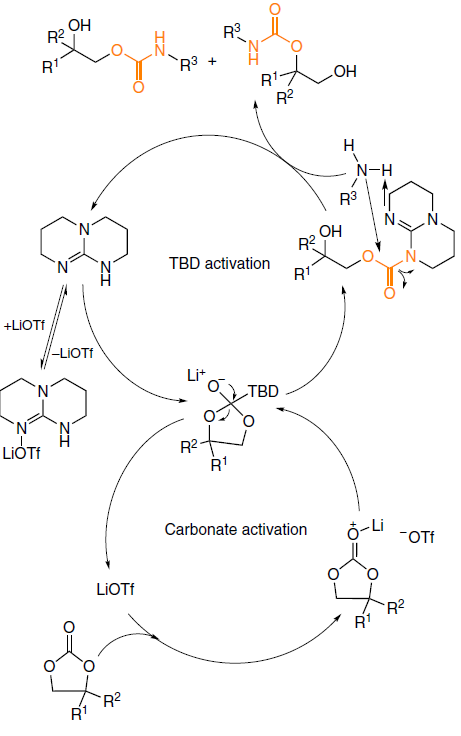
Despite the simplicity of synthesis using readily available and inexpensive cyclocarbonates, their reactivity toward aminolysis is low at ambient temperature. The reactivity increases and the reaction time decreases in the presence of Lewis acid — organic Lewis base catalytic systems,[196] which activate the electrophile (carbonate) and nucleophile (amine) (Scheme 11).[197] A lithium salt, such as lithium triflate or lithium tetrafluoroborate, can act as the Lewis acid, while the Lewis base can be represented by a cyclic amine [e.g., triazabicyclodecene (TBD)] or a cyclic guanidine.
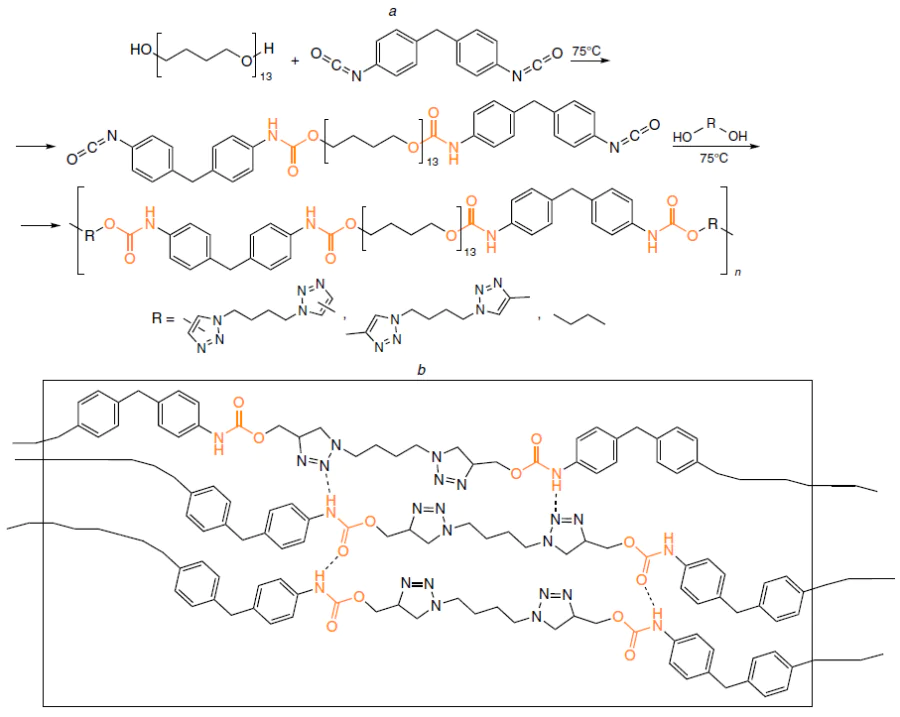
All of the synthesis methods described above mainly imply the use of the classic polyaddition reaction of diisocyanates and oligo/polymeric diols/diamines to give urethane and urea groups between HS and SS. Click-chemistry methods (in particular, copper-catalyzed azide–alkyne cycloaddition, CuAAC) have not gained popularity for the synthesis of TPU-Si due to the difficulty of functionalization of compounds for the synthesis. However, the CuAAC reaction is of interest in the context of polymer chemistry, as the introduction of triazole rings into the macromolecular chains of TPU and TPU-Si is expected to improve the properties of the products. Non-covalent interactions, such as hydrogen bonds, between the triazole rings and amide or urea moieties would enhance the intermolecular interactions. This, in turn, would improve the mechanical properties, thermal stability, and other characteristics of the materials. Currently, the application of click chemistry in the synthesis of TPU and TPU-Si is in the early stage of research. In order to elucidate the feasibility of using CuAAC for the synthesis of polyurethane-based materials, Wang and co-workers[198][199] investigated the effect of insertion and content of 1,2,3-triazole rings in the polymer chain on the morphological, structural, thermal, and mechanical properties of the materials (Scheme 12a). It was highlighted that the triazole rings particularly improve the mechanical properties of polyurethane elastomers by enhancing the microphase separation and intermolecular interactions. Indeed, additional dipole – dipole interactions and hydrogen bonds increase the tensile strength and Young’s modulus compared to those of conventional TPU based on aliphatic polyols and a similar diisocyanate (Scheme 12b).
Nevertheless, the detected decrease in the thermal stability with increasing proportion of HS raises the question of importance of the balance between mechanical properties and thermal stability, especially in those cases where a combination of strength and thermal stability is required. The incorporation of PDMS into the chain structure could help to resolve this issue. A new approach to the synthesis of TPU-Si copolymers using azide – alkyne cycloaddition has been developed for this purpose (Scheme 13).
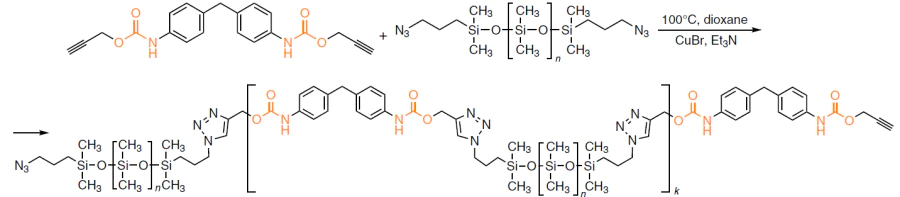
Milenin and co-workers[63] identified an intricate influence of the structural modifications of copolymers on their properties in combination with thermal effects, which is reflected in No. 4 of Table 23. The introduction of PDMS into triazole-containing polyurethane leads to increase in the thermal and thermooxidative stability of the material and may give rise to appropriate rheological properties of a polymer melt, which opens up prospects for 3D printing with this polymer. Meanwhile, an increase in the length of the polysiloxane segments can lead to a slight decrease in the melting point and elastic modulus. The implementation of this approach became possible due to the development of methods for the synthesis of azide-functionalized PDMS with a controlled molecular weight.[41][200][201]
Table 1,Table 8,Table 17,Table 23 summarize the properties of linear copolymers based on polyurethane-siloxanes, polyurea-siloxanes, and polyurea-urethane-siloxanes that possess thermoplastic and elastic properties. The tables provide data on the types of starting compounds used for the synthesis of copolymers, the employed catalysts, molecular weight characteristics, as well as the mechanical and thermal properties of the resulting materials. The collected data make it possible to follow certain trends in copolymer synthesis. Although the authors of these studies did not specify some characteristics of copolymers, we have endeavoured to compile the most significant data that are frequently mentioned in the studies for this class of materials. It should also be borne in mind that the pronounced variability of the components used as modifiers or enhancers can have a substantial effect on the final properties of the resulting materials. In addition, direct comparison of various characteristics of copolymers is hampered because of the dependence of properties on the objectives of the synthesis and the intended applications.
Nevertheless, analysis revealed a few consistent patterns that were reproduced irrespective of the type of copolymer (urethane, urea, urethane-urea) or the synthesis method. First of all, the crucial role of the chemical nature of the terminal groups of the polysiloxane soft segment is evident. The use of α,ω-bis(3-aminopropyl)-polydimethylsiloxane consistently ensures higher number-average and weight-average molecular weights and much narrower dispersity compared to those achieved using hydroxyl-containing analogues. This trend is manifested in all tables and is apparently due to the above-described thermal instability of the hydroxyalkyl terminal groups, whereas the amino groups remain reactive throughout the entire process of synthesis.
Another trend is the influence of the molecular weight of the starting polysiloxane oligomer on the mechanical properties of the final copolymers. An increase in the length of the polysiloxane segment inevitably leads to a decrease in Young’s modulus and tensile strength; however, it is simultaneously accompanied by a considerable increase in the relative elongation at break. The threshold is observed at a molecular weight of approximately 3000 Da: further increase in the molecular weight leads to a decline in the mechanical properties while maintaining high elasticity, as documented in the data on urethane, urea, and mixed systems.
The mass fraction of the hard segment serves as a universal regulator of the balance between the strength and elasticity in all of the copolymer classes. An increase in the proportion of hard segments regularly increases the strength and toughness of the material, but at the same time reduces the ability to undergo pronounced deformations. Analysis of the whole set of data demonstrates that the optimal balance corresponding to the maximum fracture toughness is achieved within a relatively narrow range of mass fractions of the hard segment, from 30 to 40 mass %. Any deviation from this range leads to deterioration of either strength or strain characteristics.
The type of isocyanate component is also consistently correlated with the properties, irrespective of the copolymer class. Aromatic diisocyanates such as methylenediphenyl diisocyanate and toluylene diisocyanate provide higher strength characteristics, but give materials with a less hydrophobic surface. Conversely, alicyclic isocyanates, particularly IPDI and HMDI, are inferior to their aromatic analogues in terms of strength; however, they provide the formation of copolymers with much higher contact angles and increased chain flexibility.
The addition of disulfide-based chain extenders is a frequently used approach giving similar results for all of the systems considered here. This invariably leads to increase in elasticity of the materials and endows the materials with self-healing properties, but this comes at the cost of a noticeable decrease in the strength characteristics and some broadening of the molecular-weight distribution.
The influence of the catalytic system and the nature of the solvent is also manifested as general trends applicable to various classes of materials. Dibutyltin dilaurate regularly shows the best results regarding high molecular weights and narrow dispersity, especially for the bulk synthesis. Conversely, the use of triethylamine is associated with wider molecular-weight distribution, which is manifested as inhomogeneous mechanical characteristics throughout the whole bulk of the material.
The above literature analysis indicates that research in this field remains fragmentary, especially in comparison with thoroughly studied polyurethanes, for which numerous structural types have been developed and characterized. The correlations identified in this review are consistently reproduced (confirmed in quite a few studies); however, they are scattered and require further verification using a broader set of samples. The present review fills the existing gap by providing a systematic account and critical analysis of the available data. Thus, in the research area dealing with TPU-Si, unexplored aspects, in particular, the influence of each parameter on the thermal, mechanical, and other performance characteristics currently predominate over the established structure – property relationships.
5. Properties of TPU-Si
As has already been noted, TPU, in particular TPU-Si addressed in this review, consist of SS and HS and additionally may contain chain extenders and modifiers. In what follows, each of these parts will be considered separately, with a focus on their distinctive features.
The siloxane segments endow the material with elasticity and flexibility. Therefore, it can stretch and then restore the original shape. As a rule, two key parameters of SS that directly influence the copolymer properties are investigated, namely, the nature of the segment and the molecular weight of the starting oligomer. In order to evaluate the effect of using PDMS with terminal hydroxyl groups instead of organic diols, Zong and co-workers[87] prepared a series of copolymers with invariable HS content (35.4 mass %) and variable PDMS to PCL ratio. An increase in the proportion of polysiloxane segments led to more active microphase separation caused by much greater thermodynamic incompatibility with HS compared to caprolactone, to the formation of two separate amorphous phases with different glass transition temperatures (Fig. 3), and to increasing hydrophobicity of the material, which is clearly demonstrated by the water contact angles (No. 13, Table 1).
![[{"id":"lfh6x5khF9","type":"paragraph","data":{"text":"DSC curves of polyurethane-siloxane copolymers with various contents of polysiloxane SS: TPU-000, pure PCL; TPU-129, 12.9 mass % PDMS; TPU-162, 16.2 mass % PDMS; TPU-215, 21.5 mass % PDMS; TPU-323, 32.3 mass % PDMS.<sup>87</sup> Springer Nature, 2022."}}]](/storage/images/resized/eHkSndaoIRKNsbzjBA6B0X7pMIsQcWOEuaDVYKnO_xl.webp)
According to Table 1,Table 8,Table 17,Table 23 PDMS with the molecular weight between 500 and 5000 Da are commonly used;[48][90][98][145] among them, oligomers with molecular weights in the 1000 – 2000 Da range are encountered most often.[61][71][166][187] Finally, PDMS with molecular weights from 10 000 to 30 000 Da is used more rarely.[96][159][202]
Lorenz and co-workers[169] investigated the effect of the molecular weight of the initial PDMS on the transparency and mechanical properties of polyurea-siloxane elastomers. An increase in the SS molecular weight led to a decrease in the Young’s modulus [from 5.6 MPa for Mn(PDMS) = 3000 Da to 0.6 MPa for Mn(PDMS) = 32 000 Da] and the ultimate tensile strength and a decrease in the area of the hysteresis loop in the stretching – recovery cycle. Meanwhile, the elongation at break varied ambiguously: the greatest value was achieved for Mn(PDMS) = 15000 Da; on further increase in the molecular weight, this value decreased; as the molecular weight increased from 3000 to 12 000 Da, the elongation varied in the 800 – 900% range (Fig. 4) (No. 4, Table 8). The increase in the PDMS molecular weight affected the material transparency in a similar way: when the molecular weight was up to 18 000 Da, the transmittance for visible light was above 90% and then it markedly decreased.
![[{"id":"_FMmYDqybd","type":"paragraph","data":{"text":"Plots for the dependence of the mechanical properties of PDMS-HMDI copolymers on the SS molecular weight: Young’s modulus (<i>a</i>); ultimate tensile strength (<i>b</i>); and relative elongation at break (<i>c</i>).<sup>169</sup> Elsevier B.V., 2018."}}]](/storage/images/resized/4vxYR3iyDaDJlq1drIoZOyEjw11EaPAlcBPnIxMD_xl.webp)
An increase in the molecular weight of PDMS can lead to more pronounced microphase separation in block copolymers.[34][91] This occurs due to the fact that longer PDMS chains increase the incompatibility with HS, thus promoting phase separation. As a result, the SS glass transition temperature decreases, since longer chains have greater flexibility and mobility, which lowers the temperature of material transition from a glassy state to a more mobile elastic state. Simultaneously, this leads to a decrease in the HS content, which, in turn, decreases the hysteresis loop.[159][169][203] The decrease in the hysteresis loop is important for applications that require a high degree of recovery after deformation such as in damping materials or elastic components. The improved recovery also reduces the fluidity, which means that the material will better retain its dimensions and shape under prolonged stress. In the case of polyurethanes based on PDMS and other SS, e.g., polypropylene oxide,[204] an increase in the SS molecular weight induces similar effects.
It should be emphasized that the critical entanglement molecular weight of SS is an important factor influencing certain properties of copolymers such as melt viscosity, tensile behaviour, and degradation mechanisms. This parameter defines the molecular weight at which the polymer chains begin to physically intertwine to form an entangled network. For example, in the case of PDMS with aminopropyl terminal groups, the Me value can vary from 24 500 to 34 500 Da depending on temperature.[136] [205] However, TPU-Si are synthesized most often using PDMS with molecular weights in the range of 1000 – 5000 Da; therefore, the number of studies involving the weight region around Me is moderate. In particular, the interaction between SS chains was found to affect the elongation at break and the ultimate tensile strength of the copolymers. The tensile strength depends not only on Me , but also on the content of the polyurea hard segment.[205] In another study, it was also shown that SS entanglement considerably decreases the hysteresis loop and favours fast recovery of the copolymer shape. The increase in the number of entanglements of PDMS chains with increasing molecular weight in combination with a high concentration of hydrogen bonds increases the TPU-Si tensile strength.[203]
The terminal functional groups of oligo/polydimethylsiloxane telechelics used in the synthesis may be different (see Table 1,Table 8,Table 17,Table 23). Most often, bis(3-aminopropyl)oligo/polydimethylsiloxanes are used (for the formation of urea bonds).[33][57][145] Other options include compounds with silanol groups such as standard α,ω-dihydroxy oligo/polydimethylsiloxanes;[89][99][146][148] hydroxyalkyl groups, for example, α,ω-bis(4-hydroxybutyl)oligo/polydimethylsiloxane[88][91][92] and other bis(hydroxyalkyl)oligo/polydimethylsiloxane derivatives.[55][93][164][182] Compounds with hydroxyalkoxypropyl groups such as α,ω-bis(6-hydroxyethoxypropyl) oligo/polydimethylsiloxanes are widely employed.[95][144][165][184] The introduction of these groups, which are more polar than hydroxyalkyl groups, enhances the compatibility of non-polar PDMS with other components of the reaction mixture.
In order to modify the PDMS polarity, Wang et al.[7][163] adapted a previously developed method for the synthesis of oligo/polymers with terminal hydroxyurethane groups[206] to be used for preparing siloxane substrates. The method is based on the reaction of aminopropyl-terminated PDMS with ethylene carbonate (Scheme 14).

The formation of urethane bonds at the ends of the polysiloxane chain during this reaction leads to increasing polarity of the prepolymer. This, in turn, enhances intermolecular interactions through hydrogen bonds and improves the thermodynamic compatibility with diisocyanates, which ultimately has a beneficial effect on the mechanical properties of the final products. Owing to the optimized phase separation in these systems, the resulting materials surpass in strength other non-modified siloxane polymers. Studies of the effect of the HS content and the number-average molecular weight confirmed the outstanding mechanical properties and stability of TPU-Si upon repeated use compared to other polyurethane-siloxane copolymers given in the Table (No. 1 and No. 3, Table 1).[7][163]
Apart from polydimethylsiloxanes, polysiloxanes with other substituents, such as phenyl-substituted ones, can be incorporated into the copolymer molecule. Phenylsiloxanes have higher thermal and oxidative stability than the methyl analogues, as the side-chain Si – Ph bonds are more stable to thermal decomposition than the Si – Me bonds. The introduction of phenyl groups (as methylphenylsiloxane or diphenylsiloxane) into the siloxane chain allows deliberate modification of the copolymer properties. This not only increases the thermal stability, but also increases the glass transition temperature and improves compatibility with organic solvents. When the content of phenyl groups is low (~5 – 20 mol.%), their bulk effect disrupts ordering of the PDMS chains by suppressing their crystallization, which is manifested as a decrease in the melting temperature and enthalpy of the PDMS phase, an increase in the elasticity and solubility of the material, and improvement of the processability.[46][207][208]
The replacement of PDMS by polyphenylsiloxane endows the material with an enhanced hardness, since bulky aromatic groups hinder the rotation and bending of the polymer chain. A vivid example of the efficiency of this approach is the use of ladder-like polyphenylsiloxane as a modifier for the polyurethane matrix.[209] Owing to the rigid structure and numerous reaction centres, this polymer switches from being a passive additive to an active multifunctional filler. This induces a sharp increase in the tensile strength (up to 3.0 MPa at 50% content of the additive), steel adhesion (more than 20 MPa), and coating hydrophobicity (115.9°). Thus, the key performance characteristics increase by more than an order of magnitude compared to those for a composite containing 10 mass % ladder-like polysiloxane. Although this particular case concerns modification of a network rather than a linear structure, this principle demonstrates the pronounced potential of phenylsiloxanes, which opens up prospects for similar studies involving linear polymers. Despite the high potential of phenyl-containing siloxanes, the interest in incorporating polymethylphenyl- and polydiphenylsiloxanes into urethane or urea copolymers remains low. Nevertheless, the few publications in this field indicate that this area holds great promise. For example, the introduction of phenyl groups into the polysiloxane component of a polyurea copolymer furnished a material with a high refractive index (up to 1.4346), similar to that of the natural lens of the eye.[169][210] This provided the necessary optical power for the production of thin and effective accommodative intraocular lenses that also retained the required mechanical properties (elasticity, softness) and optical transparency.
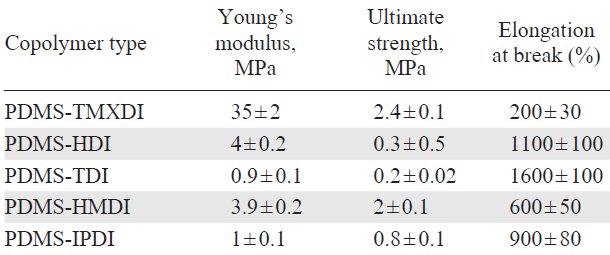
Hard segments are formed upon the reactions of diisocyanates with diol and/or diamine oligomers, including urethane and urea groups, which ensure the structural integrity and resistance to damage and mechanical stress. Table 24 gives the chemical structures of diisocyanates, often used in the synthesis of polyurethanes. The degree of symmetry in the initial diisocyanate has a key effect on the thermomechanical data of the final thermoplastic polymer. It was proved that copolymers containing HS based on symmetrical diisocyanates (aromatic or aliphatic, such as MDI, CHDI, or mPDI) exhibit more pronounced microphase separation and a higher degree of crystallinity than their analogues based on less symmetrical diisocyanates (IPDI and TDI).[8][9][60][139][168][170] Earlier studies indicate that the diisocyanate structure is of prime importance for all copolymer systems.
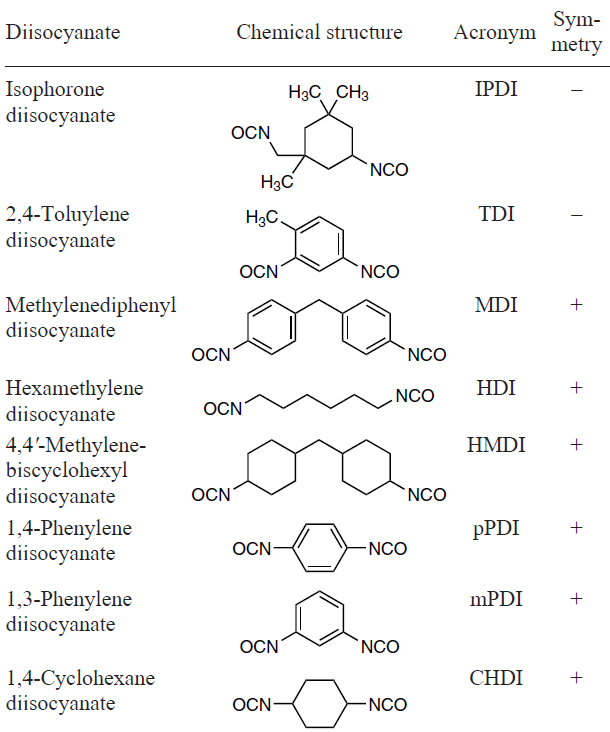
Chazeau and co-workers[139] carried out a detailed study to elucidate the difference between the properties of polyurea-siloxanes prepared from five commercial diisocyanates: HDI, TDI, 1,3-bis(1-isocyanato-1-methylethyl)benzene (TMXDI), IPDI, and HMDI. The PDMS-TMXDI and PDMS-HDI copolymers exhibited a pronounced microphase separation, giving rise to nodules connected to one another in the case of TMXDI and filament structures for HDI. This accounts for the fact that PDMS-TMXDI polyurethane copolymers had the highest Young’s modulus and the smallest relative elongation among the obtained samples (Table 25). The Young’s modulus of PDMS-HDI is commensurable with that of PDMS-HMDI, but the former is capable of greater elongation without break: this is attributable to greater segment hardness and high dynamics of interactions between the hard segments. Meanwhile, PDMS-HMDI does not form a well-defined structure, which is probably attributable to the presence of several stereoisomers, while smaller elongation is caused by the hardness of the segment rather than by the ability to form domains (No. 8, Table 8).
Lorenz and co-workers[168] investigated the effect of the content and structure of diisocyanates on the transparency and mechanical properties of elastomers. The authors found that the Young’s modulus and tensile strength depend linearly on the HS content, whereas the effect of HS concentration on the hysteresis loop for polymer stretching is non-linear (Fig. 5). The size of the hysteresis loop is directly related to definition of the application field of the resulting material and is caused by energy loss during repeated stretching and recovery. During these processes, the polymer morphology markedly changes and the energy loss is converted into heat: the wider the hysteresis loop, the more heat is accumulated. When the HS content increases to 10 mass %, the area of the hysteresis loop decreases. Further increase in the HS content leads to a sharp increase in the hysteresis loop for the first stretching–recovery cycle and virtually invariable hysteresis in the subsequent cycles. The authors also demonstrated a pronounced effect of isocyanate structure: in the case of copolymer based on more symmetrical CHDI, the hysteresis loop at 100% strain was markedly smaller than that of the IPDI – based copolymer; however, when the strain was 300%, the situation changed, which was apparently due to the disruption of the ordered structure of more crystalline CHDI. The transparency of all polymers decreased with increasing HS content: when the HS concentration was 1 – 2 mass %, the transmittance was up to 93% in the wavelength range of 450 – 750 nm and 50 – 70% in the mid-UV range. An exception was provided by the PDMS-MDI copolymer, which showed the ability to absorb UV light in the 200 – 300 nm range, while maintaining the transparency comparable with that of copolymers produced from other diisocyanates, which may be used, for example, for the manufacture of artificial lenses (No. 3, Table 8).
![[{"id":"OboWSdN_vX","type":"paragraph","data":{"text":"Mechanical characteristics of PDMS-HMDI polymers with varying HMDI content: (<i>a</i>) stress – strain curves and area of mechanical hysteresis for relative elongations of 0 – 100%; (<i>b</i>) area of the hysteresis loop for the 1st and 10th stretching – recovery cycle for 100% elongation; (<i>c</i>) stress – strain curves for elongations from 0 to 300%; (<i>d</i>) area of the hysteresis loop for the 1st and 10th stretching – recovery cycle for 300% elongation.<sup>168</sup> MDPI (Basel, Switzerland), 2021."}}]](/storage/images/resized/tQNtCbPSAzpCHoHBSejVO58XHKub1aNKPLgUpe86_xl.webp)
The variability of the methods used to prepare TPU-Si makes it possible to combine not only different SS units within a single polymer chain, but also different HS units. Bao and co-workers[60] developed polyurea-siloxane elastomers that exhibited remarkable characteristics (No. 11, Table 8), owing to the thoroughly elaborated structure based on alternation of MDI and IPDI. This alternation ensures a balance between strong and weak hydrogen bonds, which play a key role in the formation of the supramolecular structure. The strong non-covalent MDI – MDI bonds act as crack-propagation blockers, thus making the material resistant to damage and incisions. Meanwhile, weaker MDI – IPDI and IPDI – IPDI bonds are capable of dissipating the strain energy, which increases the impact strength (up to 12 000 J m–2) and the relative elongation at break (up to 2182%). These features make the material particularly well-suited for applications that require high strength and resistance to mechanical damage. The self-healing under water, which is possible owing to the presence of numerous groups capable of hydrogen bonding, is also an important feature, which opens up opportunities for using this material in marine and other wet environments.
The incompatibility between segments leads to microphase separation, which depends not only on the nature of the HS and SS, but also on other factors. Hard segments are uniformly distributed along the chain, together with SS, thus forming a network structure cross-linked by hydrogen bonds. Thus, the block copolymer can be considered to be a nanocomposite material in which HS act as reinforcing fillers in a soft matrix. The secondary forces such as hydrogen bonds between urea HS play a key role in the formation of the microstructure of macromolecules: they provide a more compact arrangement of HS and shorter distances between domains compared to those in similar urethanes. The microphase separation in polymers has a substantial effect on the mechanical and physical properties, including thermal, optical, and adhesive properties, and serves as a powerful tool for achieving controlled material characteristics. All the above fully applies to TPU-Si and makes it possible to achieve outstanding macroscopic properties such as chemical stability, high strength and ageing resistance.
Apart from the symmetry of diisocyanates, the SS molecular weight, and incompatibility of different segments, the final properties of the copolymers depend appreciably on quite a few other factors. These factors include: the nature of the groups responsible for intermolecular interactions (urethane or urea), HS chemical structure and chain length, contents of SS and HS in TPU-Si,[145] and process conditions (solvent, catalyst, etc.)[72][98][148][196][211][212] In addition, the effect of heat treatment conditions, that is, the temperature and duration of heating, also should not be neglected.[213-215]
Chain extenders are used to modify the molecular structure of TPU, particularly to increase the molecular weight, which improves the polymer properties, for example, increases the melt viscosity,[168] and influences mechanical properties such as shear strength and elasticity. The chain extenders and modifiers widely used in practice include numerous linear [49][59][81][183] and branched[47][92][98][165] aliphatic and aromatic low-molecular-weight[96] diols (HO – R – OH) or triols,[82][94][96][146] and diamines (H2N – R – NH2).[168][169][184] The most popular chain extenders usually contain two to six carbon atoms in the molecules.[7][93][163][183]
The choice of a particular chain extender also affects the morphology of the resulting material. Wang and co-workers[184] investigated the change in the TPU-Si surface morphology for the use of various ratios of two chain extenders: 1,3-bis(3-aminopropyl)-1,1,3,3-tetramethyldisiloxane (APTMDS) and isophoronediamine (IPDA). According to analysis of AFM images, the use of pure IPDA leads to the formation of more clearly defined HS domains and attests to a sharper microphase separation compared to that for APTMDS or mixtures of these compounds in various proportions (Fig. 6). In addition, as the IPDA proportion increases, the tensile strength increases from 3.6 to 19.3 MPa (No. 7, Table 17), which is attributable to a more rigid structure of this extender compared to the flexible disiloxane segment.
![[{"id":"fsyAFCgMhg","type":"paragraph","data":{"text":"with different molar ratios of chain extenders: PUU-1, APTMDS : IPDA = 1 : 0; PUU-2, ATMDS : IPDA = 2 : 1; PUU-3, APTMDS : IPDA = 1 : 1; PUU-4, ATMDS : IPDA = 1 : 2; PUU-5, APTMDS : IPDA = 0 : 1.<sup>184</sup> Copyright Wiley Periodicals LLC, 2024."}}]](/storage/images/resized/qKe306xks5APkDaUoIVblqk4xYfCv8pcrvJKOKsE_xl.webp)
One of the key advantages of TPU-Si is that they can be used as matrices for various fillers and that the copolymers can be easily modified. Professor’s Tan research team addressed the effect of various branched organic modifiers, including alkyl- (HDO),[92] trisiloxane- (SDO),[91] and perfluoroalkyl-containing (FDO)[166] molecules, on the microphase separation (No. 8, No. 9, and No. 22, Table 1). The use of these agents, especially in the case of SDO, improved the mutual solubility of HS and SS, which neutralized the negative impact of PDMS on the mechanical properties, related to the siloxane chain flexibility, and increased the tensile strength and elongation at break. Furthermore, the domain size decreased, and a larger proportion of PDMS was exposed to the material surface, which ensured high resistance to oxidation by preventing reactive oxygen species (ROS) from attacking the urethane groups (Fig. 7).
Self-healing is an important feature that is meant to be improved by TPU-Si modification. Strictly speaking, any polymer in this family has, in one way or another, the potential for self-healing due to intermolecular physical interactions between the urethane and urea moieties, which form hydrogen bonds. In addition, physical self-healing is modified by combining different mechanisms using introduction of various groups capable of reversible bond cleavage/re-formation (Scheme 15). For example, the addition of chain extenders containing various types of dynamic bonds is being considered. Compounds that can undergo the Diels – Alder (DA) reaction and retro-DA reaction can be used for this purpose. When such moieties are present in the molecule, heating of a damaged site of the material induces retro-DA reaction, while when the formed dienophile and conjugated diene moieties in different chains approach one another, common DA reaction takes place to give new covalent bonds, which results in healing of the material (No. 22, Table 1).[167]
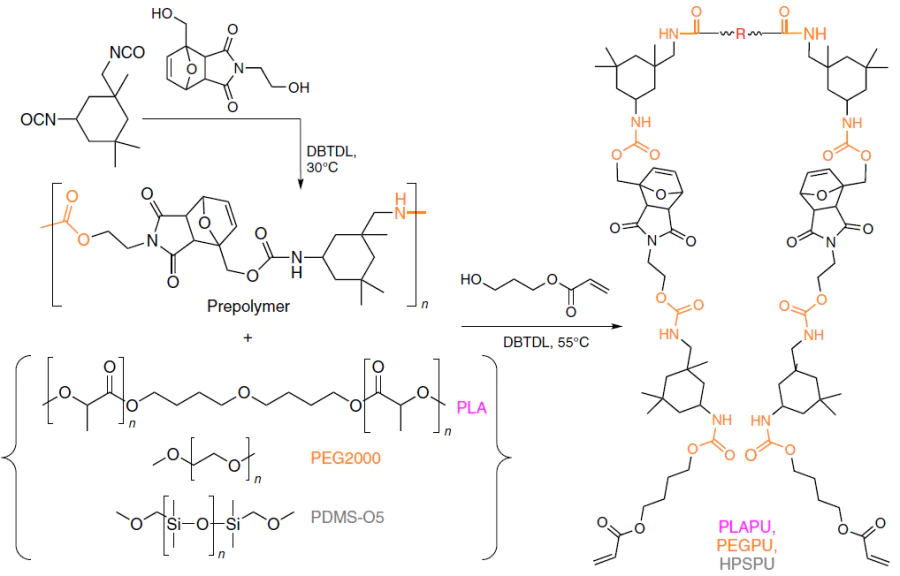
The methods used to introduce these groups vary. Thus, apart from the use of diols containing groups able to undergo the Diels – Alder and retro- Diels – Alder reactions, there are data[216] on the introduction of reactive groups, such as maleimidopropyl groups, into polysiloxanes (Scheme 16).
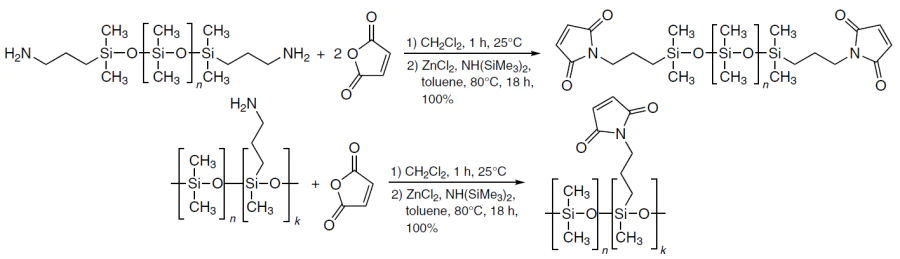
Another popular dynamic group is the disulfide bridge. A combination of physical cross-linking via hydrogen bonds between HS with chemical cross-linking via various disulfide-containing moieties may give materials with high tensile strength that are capable of self-healing and recyclable. Owing to this set of properties and the presence of shape memory effect, these materials can be considered, for example, as biomaterial scaffolds for the design of artificial tissues (Scheme 17) (No. 9, Table 1).[96]
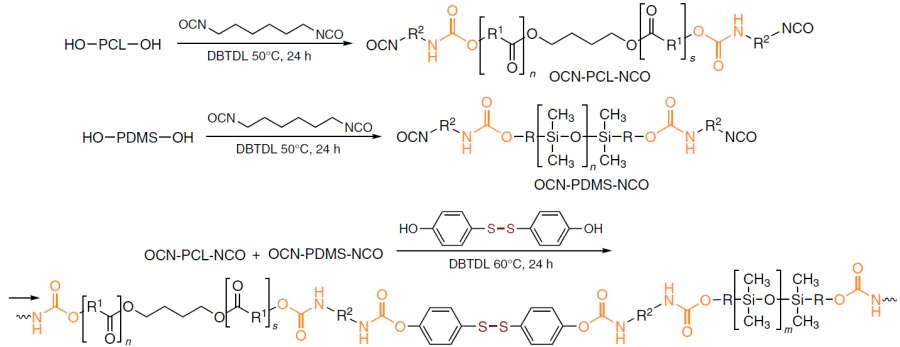
Another cross-linking method widely used in polymer production is the formation of Schiff bases. Since the reaction between amino groups and carbonyl groups is easily reversible, materials the chains of which are cross-linked by imine bonds tend to self-heal and are easily recycled. Examples of these materials are elastomers exhibiting antibacterial properties[44] and protective coatings[175-177][217] (Scheme 18).
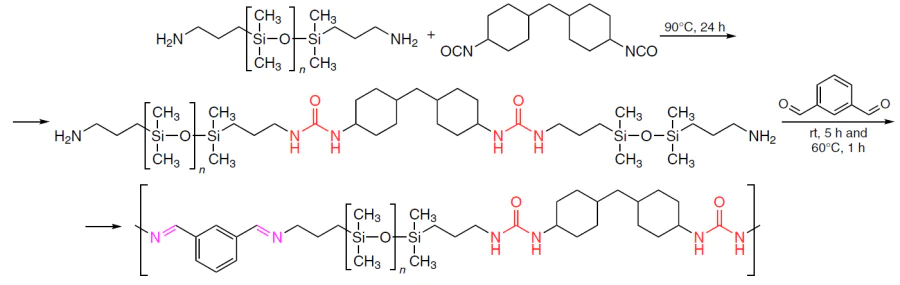
The basic properties of polyurethane-siloxanes involve a unique combination of elasticity, mechanical strength, chemical resistance, and thermal stability. The monodentate nature of the urethane bonds provides materials characterized by flexibility and good solubility in organic solvents. This simplifies the synthesis and deposition of coatings and, hence, these polymers are versatile for extrusion and injection moulding.
The high mechanical strength and thermal stability of polyurea-siloxanes are due to the bidentate nature of the hydrogen bonds formed by their carbamide groups. This results in the formation of a stronger spatial network, but decreases the solubility and requires the use of special highly polar aprotic solvents for processing.[218]
Hybrid systems, polyurethane-urea-siloxanes, may achieve the optimal balance of properties.[8] [57][71][81][178] A combination of urea hard segments and urethane soft segments produces a composite-like structure in which strong bidentate bonds prevent crack propagation, while weaker monodentate bonds dissipate the strain energy, thus ensuring both high strength and flexibility.[97]
A key benefit of the whole group of materials is the possibility of strict control of the properties through variation of the ratio between hard and soft segments, which opens up broad prospects for the design of materials with specified characteristics for particular applications. Thus, the choice between polyurethane-siloxanes, polyurea-siloxanes, or their hybrid forms is determined by the requirements of particular application ranging from flexible coatings to high-strength composites.
Analysis of the collected data indicates that the resulting compounds have not been adequately studied: for 43% of the copolymers, basic molecular-weight characteristics have not been investigated, while analysis of mechanical properties shows that data on either the Young’s modulus or tensile strength and relative elongation are missing, or that no mechanical tests have been conducted at all. Furthermore, most publications mention copolymers for which only a single glass transition temperature has been determined, although even in samples with lower segment hardness and a lower content of hard segments, microphase separation is often observed and two glass transition temperatures are detected.
Generally, most publications address specific set of properties required for practical use such as adhesion to materials,[48][50][57][61][82][179][183] corrosion resistance,[71][140][146][185] and toxicity,[7][97][169][219] while paying little attention to fundamental characteristics (strength, morphology, thermomechanical properties), which complicates their use to identify general trends and reproduce the investigation results.
6. Applications
Owing to the set of properties inherent in both polyurethanes and siloxanes and easy introduction of various modifiers and additives, polyurethane-siloxane, polyurea-siloxane, and polyurethane-urea-siloxane copolymers are extensively used in various industrial sectors.
A common application of these compounds is the fabrication of various coatings. Previously, a number of research teams have analyzed the latest trends in the manufacture of protective coatings for various purposes based on polysiloxanes,[220] including urethane-siloxane copolymers. However, since then, this class has markedly expanded through the use of new approaches and modifiers.
Ran and co-workers[138] prepared a series of superhydrophobic coatings based on polyurea-siloxane copolymers; the coatings were deposited by spraying and had water contact angles of 150 – 155° (Fig. 8). It was noted in a number of studies that high hydrophobicity of the material is largely due not only to low surface energy of the siloxane segments in the copolymer, but also to the deposition method. In the opinion of the authors, spraying gives a multitude of microdroplets, each containing hydrogen-bonded nano-sized TPU-Si fibres. During fast evaporation of the highly volatile solvent, the bonds between the urea moieties rearrange to give spherical structures non-uniformly distributed over the substrate surface, thus forming high surface roughness. Further testing of the mechanical and chemical stability of copolymers demonstrated that the hydrophobic properties decrease only slightly: after 60 cycles of abrasive action, 20 h of exposure in water, and 24 h of exposure in various corrosive environments, the contact angle remained at ~150° (No. 9, Table 8).
![[{"id":"AFxHFw_SKe","type":"paragraph","data":{"text":"Schematic diagram of the spray deposition of hydrophobic coatings.<sup>138</sup> Elsevier B.V., 2023."}}]](/storage/images/resized/bu9XXQZPQX7zA88y5gOcvNYBmioYhO2noH4xFWEE_xl.webp)
Liu and co-workers prepared new antifouling materials consisting of polyurea-siloxanes as a matrix mixed with various amounts of organic antifoulants such as 4,5-dichloro-2-n-octyl-4-isothiazolin-3-one (DCOIT)[48] and perfluoroalkyl-modified nanodiamonds (FND).[31] The resulting composites had self-healing properties and good adhesion to metal surfaces; they also performed well in fouling tests under static conditions for 6 months (with DCOIT) and 4 months (with nanodiamonds), even when the antifoulant concentrations was 1 – 2.5 mass %. After 180 days in a marine environment, the PDMS-IPDI/DCOIT-coated panels (2.5 mass % and more) were found to bear a negligibly low number of fouling organisms, which were easily washed off, as opposed to surfaces coated with pure TPU-Si and let alone uncoated surfaces. The concentration of the antifoulant affects the mechanical properties of the material, and these experiments demonstrated the possibility of using low concentrations of antifoulants, which gave a material with both good mechanical stability and good fouling resistance (Fig. 9) (No. 1, Table 8).
![[{"id":"xTKa-cJsgN","type":"paragraph","data":{"text":"Schematic diagram of the manufacture of coatings with different antifouling agents.<sup>48</sup> Royal Society of Chemistry, 2017."}}]](/storage/images/resized/joFJWIwjMETQsc6KJjo3GZ7wzkAgi5b8Utxnf4Nj_xl.webp)
Professor Zhang’s research team prepared[173] an anti-icing agent based on a polyurea-siloxane copolymer containing isophorone diisocyanate as HS and PDMS of various chain lengths (Fig. 10). This material demonstrated high transparency (up to 95%) similar to that of ordinary glass, low adhesion to ice, and a high water contact angle, which makes it a promising protective coating for various surfaces where high light transmittance is important, such as aircraft windshields and windows, solar panels, sensors, etc. An important advantage over existing anti-icing agents is self-healing via the formation of hydrogen bonds, which restores up to 80% of the original mechanical properties in only 30 min at room temperature, and the possibility of recycling the material by dissolution in an organic solvent and casting a new film (No. 12, Table 8).
![[{"id":"vYSo2doPRY","type":"paragraph","data":{"text":"Appearance of a glass coated with a TPU-Si-based anti-icing film (<i>a</i>); transmittance curves for pure glass (green curve), glass coated by a PDMS-based sample with a molecular weight of 3 kDa (blue curve), and glass coated by a PDMS-based sample with a molecular weight of 5 kDa (red curve) (<i>b</i>); illustration of the processing of damaged film by dissolution and casting a new film (<i>c</i>).<sup>173</sup> Elsevier B.V., 2020."}}]](/storage/images/resized/FWMM9ZyPQhsEsOmb2EgFnrao7TA0ta1rlxocWRwp_xl.webp)
Professor Wang’s research team decided[186] to use a hybrid approach simulating the Macedonian phalanx strategy for the design of a new antifouling coating based on the polyurethane-siloxane copolymer (Scheme 19). The authors combined two popular strategies used to produce coatings of this type. The first one is the defensive strategy in which the polymer structure has mobile side chains that are eliminated, together with the attacking agent and washed away by water, with the coating surface remaining smooth. And the second one is the offensive strategy in which the coating serves as a matrix for various anti-fouling agents exhibiting antibacterial and other related types of activity. In this case, a polysiloxane with terminal epoxy groups acts as a buckler, while an aminobenzothiazole that is added to siloxane with epoxide ring opening is a spear. The reaction leaves two free hydroxyl groups and thus allows the subsequent condensation in the presence of isocyanates to give copolymers. The material obtained in this way is amphiphilic, because of lower surface energy of polysiloxane chains, and resembles raising the buckler in a phalanx during defence. Meanwhile, the benzothiazole spear inhibits the adhesion of diatoms, exhibits activity against certain types of bacteria, and prevents molluscs from fouling the surface (No. 14, Table 17).
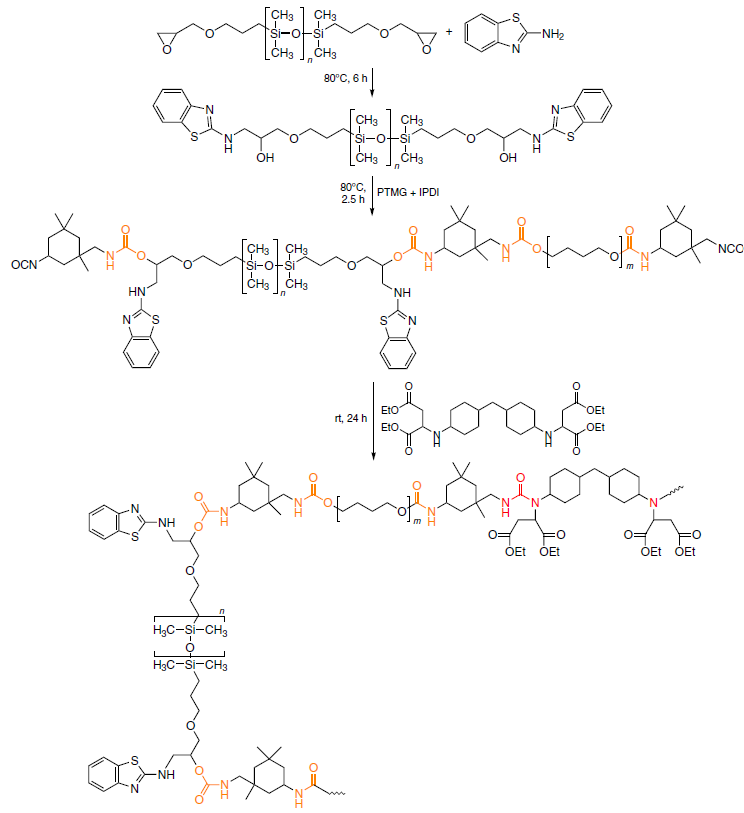
One more application of urethane-siloxane and urea-siloxane copolymers is the development of damping materials. Tang and co-workers[164] obtained polyurethane-urea-siloxane copolymer containing methacrylate groups to be used in 3D printing (Fig. 11). The polyurethane-siloxane prepolymer obtained in the first stage was immersed into a solution of a chain extender, and then diamines present in the mixture reacted with the isocyanate groups remaining in the backbone to give new urea moieties; on exposure to UV light in the presence of a photoinitiator, the methacrylate groups reacted with the double bonds, resulting in both physical and covalent cross-linking and in a sharp increase in the strength characteristics of the elastomer foam thus formed. The samples had a greater damping effect than the commercial ethylene vinyl acetate foam, with their foam being 2.5 times thinner (No. 5, Table 1).
![[{"id":"OshtfAzS-D","type":"paragraph","data":{"text":"Schematic picture of 3D printing of cross-linked polyurethane-urea-siloxane under UV irradiation.<sup>164</sup> Elsevier B.V., 2024."}}]](/storage/images/resized/w8Pj3XkJez3ycX1iKsZw1BypcPftjGQiNqdMsHNN_xl.webp)
Owing to the biocompatibility and biostability of TPU-Si, a major and important line of research is the development of materials for various implants. An illustrative example is the development of heart valves. In a series of works, Gunatillake and co-workers[81][221-223][220] performed a detailed study of the properties of polyurethane-urea-siloxane copolymers, which are now manufactured under the brand name LifePolymer™ (Fig. 12). Owing to the combination of good in vivo stability and elasticity (relative elongation of 760%) inherent in polysiloxanes, as well as high mechanical properties (tensile strength of 38.3 MPa, Young’s modulus of 28.7 MPa, and a tear energy threshold of 291 J m–2), inherent in polyurethanes, it was possible to manufacture a heart valve consisting of this material alone. The valve properties (No. 3, Table 17) were not inferior to those of long-used commercial analogues such as the Elast-Eon series of elastomers, in particular E2A.
![[{"id":"OZhOG8EKgN","type":"paragraph","data":{"text":"Photograph of a heart valve made of LifePolymer™.<sup>222</sup> Wiley Periodicals LLC, 2021."}}]](/storage/images/resized/o4McJNhFgqk8zjivsPYcqz8rPZ2D9wv68wQM1LbZ_xl.webp)
Sharma et al.[141] prepared a series of siloxane-modified polyurethanes by in situ cross-linking in a compounder. After that, the samples were modified with various quaternary salts to endow the material with bactericidal properties (Scheme 20). The mechanical properties of these composites were comparable to or exceeded those of natural tissues in the human urinary system; in combination with their antibacterial properties and bioinertness, the obtained composites are promising biomaterials for the design of artificial urinary tissues.
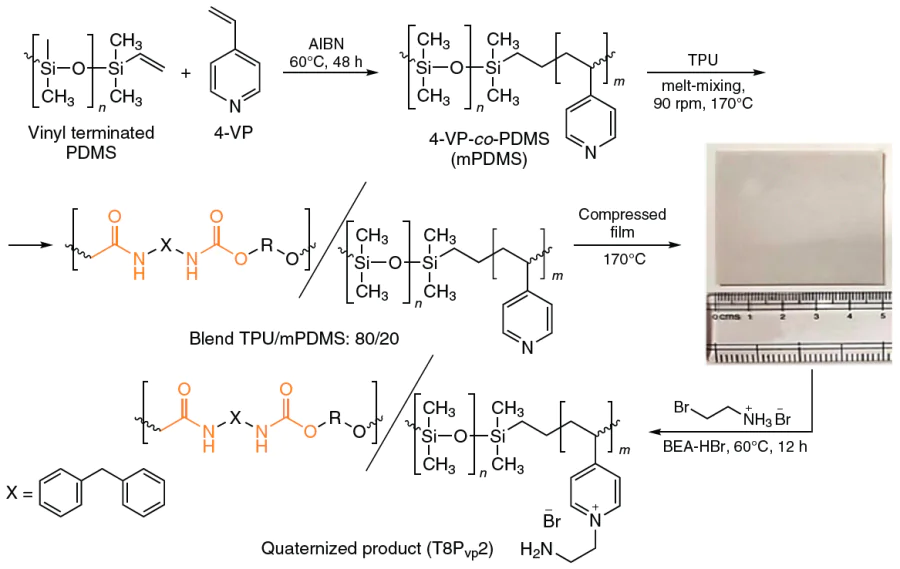
Apart from heart valves, there are many other devices that come into contact with blood, such as balloon catheters, stents, and artificial blood vessels, which are subject to additional requirements. In addition to in vivo stability, compatibility, and good mechanical characteristics (high tensile strength), they must possess antifouling and antithrombotic properties to prevent platelet deposition on the device walls, non-specific protein adsorption, and, hence, blood clotting. Also, they should have good lubrication properties to ensure easy passage of the device to the surgical site. Professor Zhou’s research team obtained a zwitter-ion sulfobetaine polycarbonate-urethane-urea-siloxane (SSiPCUU) copolymer by introducing the N-methyldiethanolamine chain extender into the initially prepared polycarbonate-urethane-urea-siloxane (SiPCUU). This afforded the amine-containing polymer (MSiPCUU), which was subsequently modified with sulfobetaine (Scheme 21).[187] The resulting material had a tensile strength of 51.5 MPa and an elongation at break of up to 601% when immersed in water; it also had improved creep resistance compared to a similar polymer, but without sulfobetaine. This enhancement of characteristics was due to additional physical interactions between the zwitter-ion groups, in addition to the existing hydrogen bonds between the urethane and urea groups. The reduced coefficient of friction, caused by the formation of a structured hydration layer on the sample surface composed of anions and cations of ionic groups, and the transparency above 75% for all visible wavelengths imply the applicability of the resulting polymer in the design of various medical devices (No. 15, Table 17).
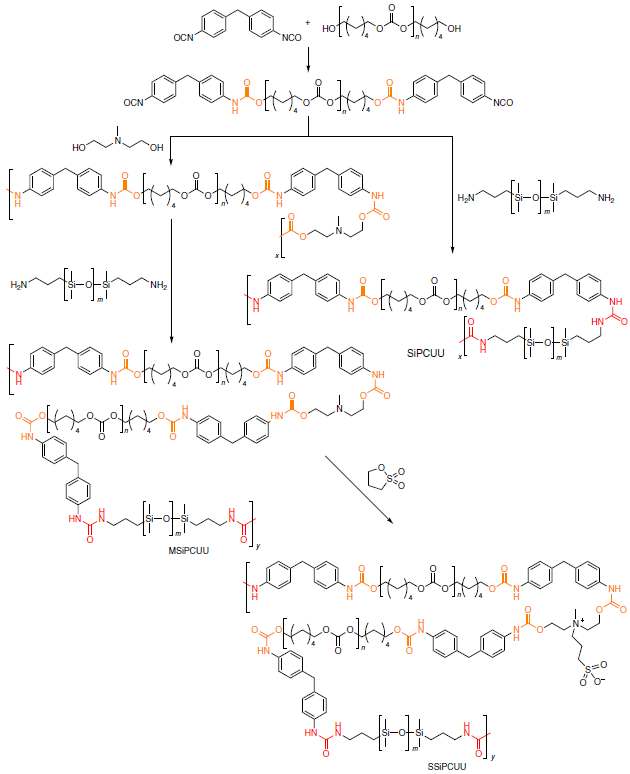
Materials of this type often possess self-healing behaviour because of hydrogen bond rearrangement. However, the rate of purely physical interactions is often insufficient, especially as regards medical applications. Another approach to the production of self-healing material was reported by Professor Xia and co-workers.[94] They developed TPU-Si using a diol with a 3a,4,7,7a-tetrahydro-2-(2-hydroxyethyl)-4-(hydroxymethyl)-4,7-epoxy-1H-isoindole-1,3(2H)-dione moiety, able to undergo the Diels–Alder reaction, as a chain extender. Therefore, the two-stage heating involves the successive retro-DA reaction and the subsequent recovery of the structure. In order to improve the mechanical characteristics and endow the material with the memory effect, the authors used biocompatible PCL as an additional modifier (No. 4, Table 1). The subsequent studies in vivo in which the obtained material was used as a postoperative wound dressing showed that the number of fibroblasts estimated by the CCK-8 method increased with time, and no statistically significant differences were found between the PDMS/PCL-DA-PU-10% sample and the control groups; this indicated the absence of cytotoxic effect and good cell proliferation on the surface of the material. Thus, the use of this composite accelerates wound healing and prevents the exudate formation in the wound (Scheme 22).
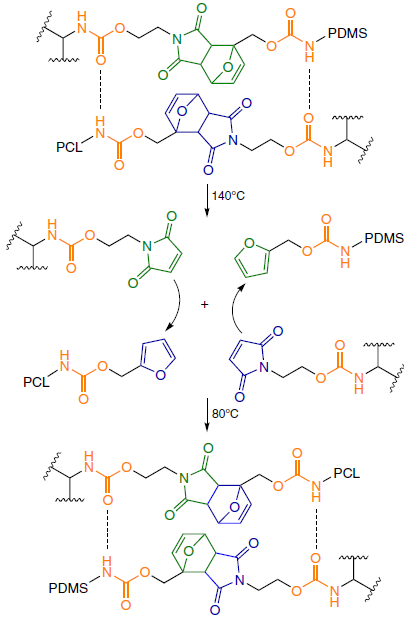
The biocompatibility, low toxicity, and engineering simplicity of introduction of active agents are also necessary features of materials for drug delivery systems, including microspheres. First of all, polyamide-urea-siloxane microspheres were obtained from dicarboxy-functionalized PDMS and IPDI telechelics using a microfluidic device with coaxial capillaries without a solvent (Fig. 13). This gave microparticles with a narrow size distribution and the diameter d = 600 μm, in which the bridging urea groups were formed upon cross-linking of the obtained IPDI polyamidosiloxane prepolymers. Unfortunately, the authors barely studied the properties of the resulting particles.[219]
![[{"id":"SBieIRVSKW","type":"paragraph","data":{"text":"Schematic picture of the synthesis of PDMS-IPDI microspheres in a microfluidic device. The prepolymer droplets produced in the first stage migrate from the inner capillary into the middle one, thus forming a droplet in a droplet of the other phase.<sup>219</sup>"}}]](/storage/images/resized/UcQppqxXpDsAdblxGUVMt9paXNHKRwyYZtEesBn4_xl.webp)
Using precipitation polymerization from an acetone solution of APTMDS and IPDI in the presence of water (Scheme 23), Professor Feng’s research team[224] synthesized a copolymer the backbones of which contained urea moieties as 2 – 6 mm microspheres with smooth surface, low dispersity (1.02 – 1.09), and high thermal stability (Td5% > 300°C). The microsphere size mainly depended on the reactant ratio and solution concentration: as the proportion of APTMDS increased, the diameter decreased from 6.11 to 2.49 μm, but the monodispersity of the resulting particles deteriorated, and the yield decreased from 57.70% to 28.94%. An increase in the content of water in the solvent system also led to a decrease in the particle size. An increase in the concentration of monomers in the solution resulted in an increase in the microsphere diameter and the yield and increase in the dispersity.
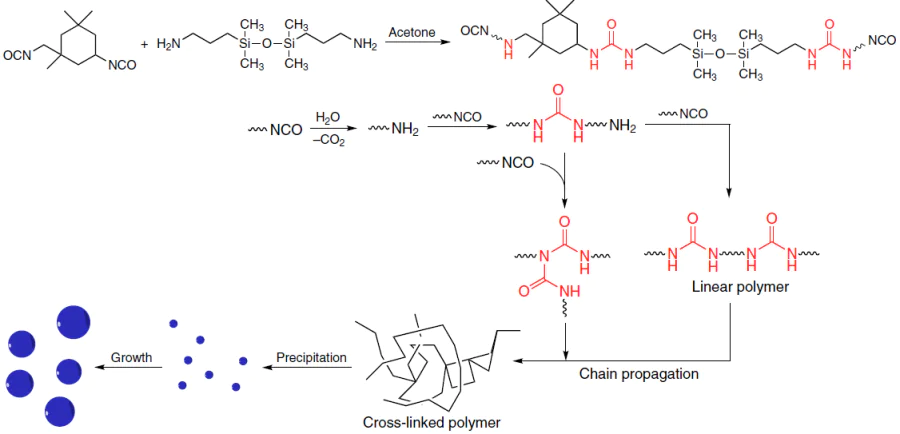
A detailed study was performed by Gojzewski, Vancso, and co-workers,[172] who also used the acetone/water system and the precipitation polymerization method, but different proportions of siloxane components, APTMDS, PDMS of various lengths, and tetra[2-methyl-2[3-(1-isocyanato-1-methylethyl)phenyl]ethyl]tetramethylcyclotetrasiloxane (D4TMI) (cross-linking agent), for the subsequent filling of the polyethylene glycol diacrylate matrix (Scheme 24). The authors obtained 0.8 – 1.8 mm microspheres with a particle dispersion of 1.15 – 1.60, WCA of 127 – 132°, decomposition onset temperature of 338°C, and Young’s modulus of up to 900 MPa (No. 7, Table 8). All the foregoing, in combination with their excellent solubility in acrylic resins, suggests the applicability of these materials as microfillers in the production of new polymer composites, for example, for extra strong protective coatings. One more benefit is the possibility of fine tuning of the properties of hybrid systems by varying particle sizes and characteristics and the amount of the particles introduced into the matrix.
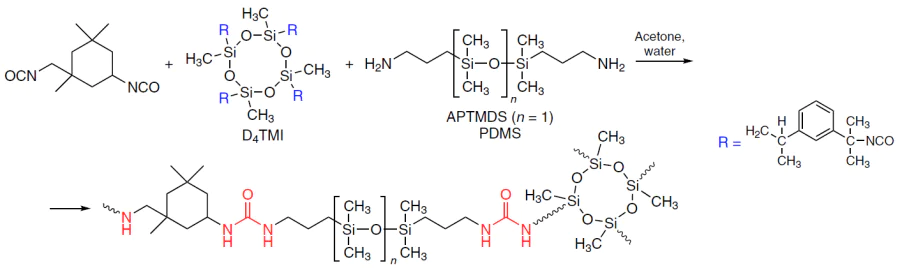
A special place belongs to TPU-Si suitable for 3D printing, which accelerates manufacturing processes of diverse products and makes them cheaper. This research area has only started to be developed; therefore, there is currently little data available. Wang and co-workers[7] utilized prepolymer method and bulk polymerization to obtain polyurethane-siloxanes based on unsymmetrical isophorone diisocyanate, which showed a high tensile strength of up to 20.3 MPa and relative elongation of up to 900% (No. 1, Table 1). A distinctive feature of the approach used in this study is the introduction of additional urethane bonds at the SS ends via the reaction of aminopropyl PDMS telechelic with ethylene carbonate (Scheme 25). This resulted in increasing number of groups able to form hydrogen bonds and more regular structure, which substantially improved the mechanical characteristics. Since the cross-linking is physical rather than covalent, the material is a thermoplastic and can be recycled many times without significant deterioration of the properties. Furthermore, in the authors’ opinion, low cytotoxicity inherent in TPU-Si and the proven ability to recover shape, together with the possibility of using this composite for 3D printing, make the material potentially applicable for fabrication of artificial heart valves and other medical devices.
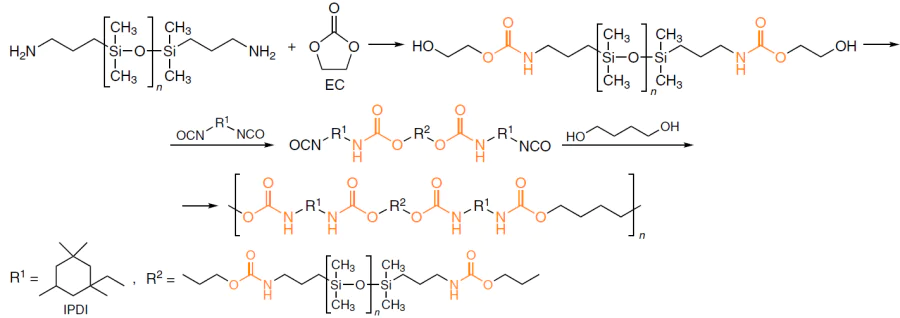
Yet another application of TPU-Si is the production of adhesives. Yan et al.[82] studied the effect of introduction of a polysiloxane component into polyurethane-tetramethylene glycol block copolymer for the development of a polyurethane-urea-siloxane adhesive (Fig. 14). The resulting polyurethane-urea-siloxane with various contents of the siloxane moiety had high hydrophobicity, elasticity, thermal and moisture resistance, and good adhesion to aluminium and PET, which exceeded these values for many commercially available polyurethane analogues, and also high mechanical characteristics: tensile strength of 36 MPa and relative elongation of 750% (No. 4, Table 17). Considering the high adhesive strength, flexibility, and resistance to moisture and heat, these materials can be considered to be promising binders for aluminium – polymer laminated structures used, in particular, in the packaging of lithium-ion batteries.
![[{"id":"AdbEP7jTfr","type":"paragraph","data":{"text":"(<i>a</i>) Appearance of supported polyurethane-urea-siloxane coatings with various siloxane contents (the defects in the coating are circled in red); (<i>b</i>) structure of the outer layer of the aluminium – plastic coating; (<i>c</i>) samples: (1) control sample without heating; (2) after heating for 4 h in deionized water at 60°C; (3) after heating for 72 h. In the initial state, the cohesive destruction is observed (the presence of adhesive remainder on the aluminium surface), whereas after wet heat treatment (60°C, 4 and 72 h), the destruction becomes adhesive, which is caused by weakening of the interfacial interaction because of hydrolysis. Long-term treatment also causes surface darkening due to the oxidation of the aluminium foil.<sup>82</sup> Wiley Periodicals LLC, 2024."}}]](/storage/images/resized/37edRdpqouDkLwQjAW1X8QeECdTPoOorASgV0tDz_xl.webp)
Li and co-workers[183] synthesized supramolecular TPU-Si copolymers containing urethane, urea, and disulfide groups, together with the 2-ureido-4[1H]-pyrimidinone (UPy) moieties, which can be regarded as ‘quadrodentate’ ligands capable of generating a hydrogen bond network between one another exceeding in density all the above examples. The introduction of UPy increased the tensile strength and Young’s modulus of the material at the cost of deteriorated self-healing behaviour compared to samples with a lower UPy content. This outcome is attributable to the high thermodynamic stability of the UPy dimer (Scheme 26). This drawback was addressed by using a hybrid approach: the authors introduced both UPy moieties and dynamic disulfide bonds into the polymer. This allowed them to achieve a tensile strength of 3 MPa, a relative elongation of approximately 1100%, and self-healing of up to 97% upon heating to 60°C for 4 h. In addition to self-healing behaviour and mechanical properties, the authors also studied the possibility of using this compound for the manufacture of a highly efficient (above 95%) foam for the separation of mixtures of nonpolar liquids with water and a hot-melt adhesive. The material showed strong adhesion to various substrates (steel, aluminium, glass), which was preserved in harsh acidic and alkaline media, under water, at temperatures down to – 20°C, and after a self-healing cycle, making the material suitable for various industrial applications (No. 2, Table 17).
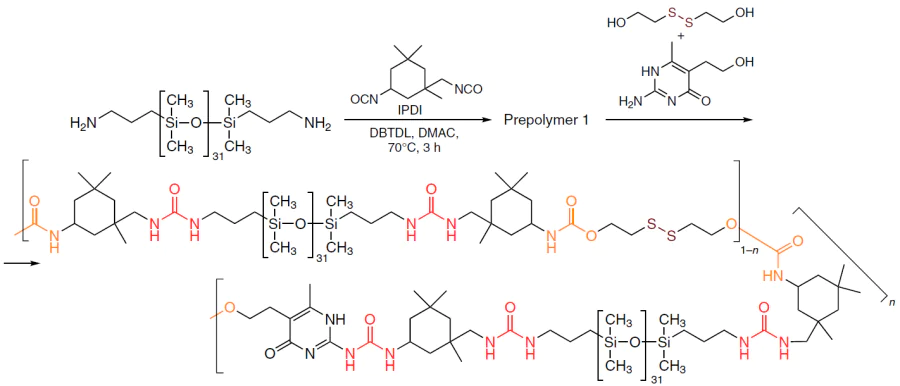
In recent years, devices with flexible displays have become increasingly popular. A flexible display module consists of several functional layers bound together by clear viscoelastic films (CVF), which are subject to specific requirements: high transparency, low elastic modulus, and low glass transition temperature and, at the same time, good stress relaxation, adhesion, and recoverability after loading – unloading cycles. Xia and co-workers[170][202] prepared a set of polyurea-siloxane-based CVF materials with silicone resins.The use of PDMS as SS resulted in transparent films (light transmittance > 94%) that had a low Young’s modulus (13 – 127 kPa), while demonstrating high creep resistance with a recovery ratio of more than 85% (No. 23, Table 8). The films remained stable under repeated cyclic deformation, withstanding up to 200 000 folding – unfolding cycles. The possibility of fine tuning of properties by varying the HS content and chemical nature, the chain extender type (siloxane or carbocycle), and PDMS molecular weight makes these materials promising for use in flexible electronics (Scheme 27).
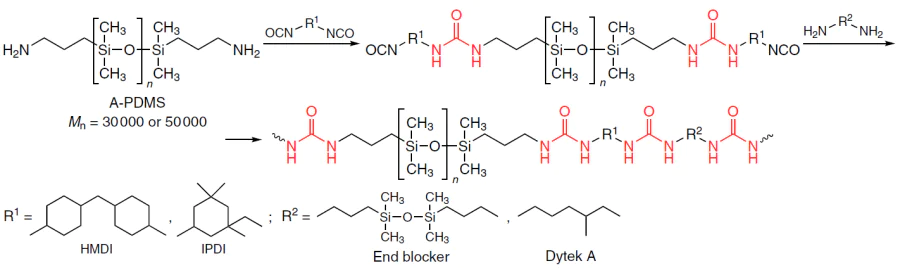
In addition to flexible displays, all these groups of materials are candidates for use in other flexible electronic devices, such as deformable sensors that convert mechanical impact (pressure, deformation) into electrical signals. Li and co-workers[180] manufactured a self-healing polyurea-siloxane-based elastomer containing aminophenyl disulfide and adipic dihydrazide for the formation of disulfide bonds and additional hydrogen bonds in order to develop a dual-function sensor that responds to changes in the applied pressure (Scheme 28). The introduction of disulfide bridges decreased the self-healing time of the material, while maintaining high toughness (approximately 37 MJ m–3), tensile strength (6.44 ± 0.24 MPa), and relative elongation (1056 ± 44%) as well as multiple recyclability (No. 28, Table 8).
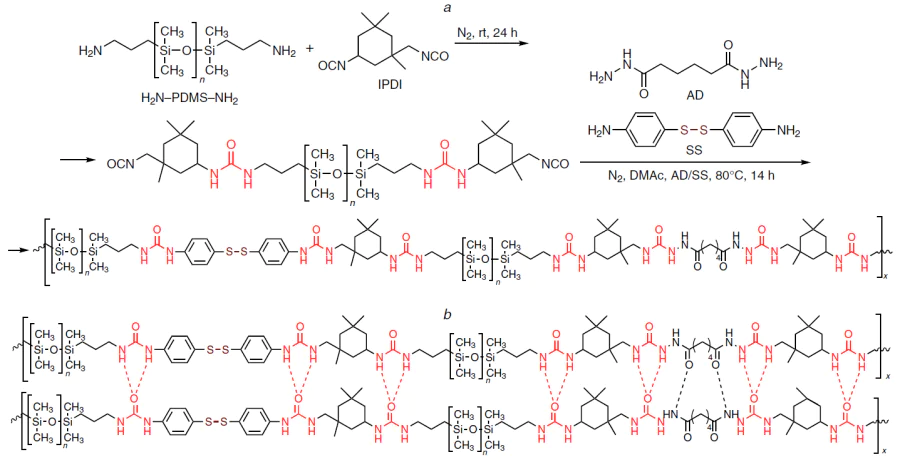
In addition, TPU-Si copolymers are attracting attention for the development of triboelectric nanogenerators (TENG), potential components of electronic skin, and other sensors. A few types of TPU-Si copolymers differing in the self-healing mechanisms and network structure have been described:
(1) imine cross-linked polyurea-siloxane TPU-Si. By varying the ratio between hydrogen bonds and dynamic imine bonds, it is possible to control the balance between mechanical strength and self-healing rate: an increase in the proportion of covalent bonds enhances the chain mobility and accelerates the self-healing (full healing in ~2 h), but decreases the strength. The triboelectric nanogenerators demonstrated an elongation of over 760%, self-healing capabilities, and stable performance as motion sensors (Scheme 29) (No. 29, Table 8);[56]
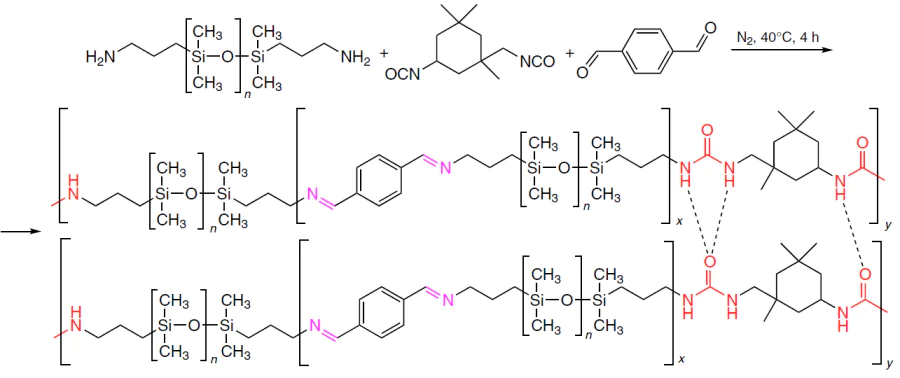
(2) polyurethane-urea-siloxane TPU-Si using hexadecafluorodecanediol as a chain extender, which resulted in high strength, hydrophobicity, and chemical resistance of the products, did not change the triboelectric effect (compared to that of samples without the chain extender), and preserved the self-healing capability. This TENG is capable of detecting both body movement and changes in the movement speed or water leakage, and self-healing after deformation fully restores the electrical output characteristics (Scheme 30) (No. 5, Table 17);[59]
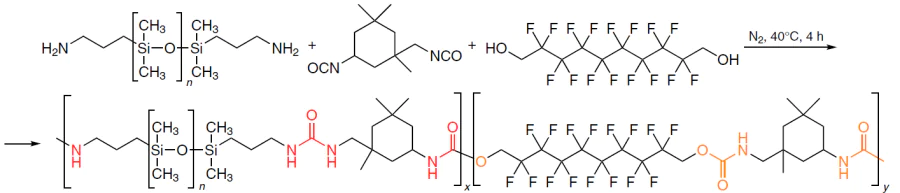
(3) polyurea-siloxane utilizing sterically hindered urea bonds as a self-healing mechanism (Scheme 31). The self-healing mechanism implemented in this case involves reversible exchange reactions in sterically hindered urea groups. These bonds can reversibly dissociate and re-form on heating, which enables rapid healing (>95% at moderate temperatures) and multiple recyclability. The material showed good mechanical strength (up to ~ 1.7 – 1.9 MPa), elasticity, and high triboelectric characteristics (up to ~ 169.9 V cm–2); this allows the use of this material in durable, self-healing TENG (No. 30, Table 8).[181]
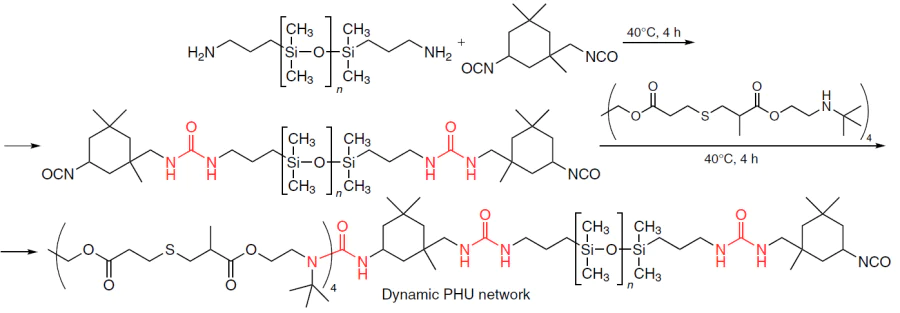
Analysis of recent publications in this field demonstrates a clear evolution of TPU-Si: they are switching from being passive protective coatings to functional platforms for high-tech devices. The combination of siloxane hydrophobicity with the possibility of introducing dynamic bonds provides for the design of self-healing materials, sensitive components for flexible electronics, and triboelectric nanogenerators that remain operational under cyclic stress. In our opinion, of particular importance is the progress in biomedicine. The strength of polyurethane segments coupled with PDMS biocompatibility makes TPU-Si a leading candidate for the development of long-lasting implants such as heart valves. Thus, the results of numerous studies dealing with TPU-Si development and effective application in various fields show that these copolymers have become a tool the chemical structure of which can be tailored to address particular engineering tasks ranging from cryoadhesion to smart electronic skin.
7. Conclusion
TPU-Si are a unique class of materials combining the best properties of polyurethanes and polysiloxanes. Their key benefits, including high mechanical strength, elasticity, hydrophobicity, heat resistance, and the possibility of fine tuning of their properties by varying their structure and composition, open up broad prospects for application in various industrial sectors.
The tables presented in this review, which summarize data on the synthesis and properties of TPU-Si, may serve as a useful reference source that reflects not only the achievements, but also the main currently existing drawback in this field: the lack of systematic research. Numerous empty cells present in the tables clearly illustrate the insufficient amount of experimental data, thus emphasizing the need for further basic research in this field, including computer simulation of such systems.
An important development area is advancement of methods for TPU-Si synthesis. The prepolymer method offers advantages over one-stage synthesis by providing better control over the structure of the final product. Of particular interest are isocyanate-free methods, e.g., those based on cyclic carbonates, which increase the environmental friendliness of the process. Another promising trend is the use of click-chemistry, specifically azide – alkyne cycloaddition, to modify the properties of materials.
The functional properties of TPU-Si make them promising candidates for the development of innovative materials. The self-healing capability of TPU-Si provided by dynamic bonds (Diels – Alder reactions, disulfide bridges, and imine groups), as well as hydrophobicity and anti-icing and antibacterial properties make it possible to develop durable and wear-resistant protective coatings and structures.
The expansion of the scope of applicability of TPU-Si also appears to be promising. In medicine, biodegradable TPU-Si with controlled degradation rates and biocompatibility could be used as temporary implants or in smart dressings with programmable drug release. In the energy sector, TPU-Si-based triboelectric nanogenerators, which possess high flexibility and resistance to extreme conditions, hold great promise for flexible electronics and autonomous sensors. In the environmental sector, TPU-Si coatings combining hydrophobicity and anti-adhesion properties can be used to protect marine structures from fouling without the addition of toxic components. Environmental performance of the production processes also remains a key focus, including the use of renewable raw materials and the improvement of recycling methods.
The future research into TPU-Si is expected to focus on several key areas. First, this is development of new methods for the synthesis: development of catalysts for isocyanate-free reactions, study of the influence of the structures of starting compounds on the properties of the final polymers, and the use of dynamic bonds to regulate the self-healing and recycling properties. The second research area is to control the properties of TPU-Si-based materials by using nanofillers such as graphene, nanodiamonds, and molecular fillers (MQ copolymers), and polysilsesquioxanes. The third area is the development of photo- and thermosensitive materials for smart coatings and sensors.
Finally, this is scaling up of the processes: adaptation of laboratory methods such as, for example, 3D printing for industrial production and standardization of properties for specific applications of the materials in various fields.
In an era of strict product certification and stringent regulatory frameworks, it is very important to have a detailed description of the properties of functional materials and full reproducibility of materials and their properties, which is not the case for most of the considered publications. The publications discussed in this review largely describe applied studies and offer little insight into generalization to provide fundamental views on the structure – property relationships. The number of gaps attests to the need for a thorough investigation of the TPU-Si properties.
Thus, TPU-Si represent a promising class of hybrid materials with a pronounced potential for innovative applications. The subsequent research in this field would open up opportunities for the development of functional polymers designed to address complex engineering challenges in medicine, power engineering, protective techniques, and related industries. The versatility, adaptability, and customizable properties of TPU-Si make them a key polymer material for the near future.
The authors would like to express their special gratitude to A.M.Muzafarov for his invaluable assistance in preparing this manuscript. We would like to thank the Russian Science Foundation for financial support (Grant No. 23-43-00057, Sections 2, 4, and 5). We are also grateful to the Government of the Tula Region for financial support (Resolution No. 899 dated December 30, 2021) within the framework of Agreement No. 11 dated September 7 2022, with L.N.Tolstoy Tula State Pedagogical University on the program of the World-Class Research and Education Center TulaTech, dated August 10, 2022 (Sections 1, 3, 4).
8. List of abbreviations and symbols
AL — alkaline lignin,
AMPD — 2-amino-2-methyl-1,3-propanediol,
APTMDS — 1,3-bis(3-aminopropyl)-1,1,3,3-tetramethyldisiloxane,
BDO — 1,4-butanediol,
BEA-HBr — 2-bromoethylamine hydrobromide,
BH-40 — hyperbranched polyester based on 2,2-bis(hydroxymethyl)propionic acid and ethoxylated pentaerythritol,
BisAC — 2,2-bis(1,3-dioxolan-2-on-4-ylmethoxyphenyl)propane,
bPEI — branched polyethyleneimine,
BPADC — bisphenol A diglycidyl carbonate,
C.O. — castor oil,
CHDI — 1,4-cyclohexane diisocyanate,
COMPASS — condensed-phase optimized molecular potentials for atomistic simulation studies,
CFF91 — consistent force field 91,
CuAAC — copper-catalyzed azide–alkyne cycloaddition,
DBN — 1,5-diazabicyclo[4.3.0]-5-nonene,
DBTDA — dibutyltin diacetate,
DBTDL — dibutyltin dilaurate,
DCM — dichloromethane,
DCOIT — 4,5-dichloro-2-n-octyl-4-isothiazolin-3-one
DFMA — 1Н,1Н,7Н-dodecafluoroheptyl methacrylate,
DMPA — 2,2-bis(hydroxymethyl)propionic acid,
DPD — dissipative particle dynamics,
EC — ethylene carbonate,
FDO — 1-[(2,2,3,3,4,4,5,5-octafluoropentyl)oxy]ethane-1,2-diol,
FMA — dodecafluoroheptyl methacrylate,
HBP-4 — hyperbranched polyester based on 2,2-bis(hydroxymethyl)propionic acid and ditrimethylolpropane,
HDI — hexamethyl diisocyanate,
HDO — 1,2-hexanediol,
HEA — 2-hydroxyethyl acrylate,
HEDS — bis(2-hydroxyethyl) disulfide,
HEMA — hydroxyethyl methacrylate,
HMA-UPY — 5-(2-hydroxyethyl)-6-methyl-2-aminouracyl,
HMDI — 4,4'-methylene-bis(cyclohexyl isocyanate),
HO-PDMS-OH — α,ω-dihydroxypolydimethylsiloxane (or another diol-terminated PDMS),
HS — hard segment,
IPDI — isophorone diisocyanate,
MDEA — N-methyldiethanolamine,
MDI — methylenediphenyl diisocyanate,
mPDI — 1,3-phenylene diisocyanate,
MSiPCUU — siloxane poly(carbonate urethane urea) with N-methyldiethanolamine chain extender
NH2 – PDMS – NH2 — α,ω-bis(3-aminopropyl)polydimethyl siloxane,
NMP — N-methyl-2-pyrrolidone,
NORB — bis(aminomethyl)norbornane,
PAP — bPEI-grafted (acrylic acid-со-vinylbenzyltriphenylphosphonium chloride),
PCFF — polymer consistent force field,
PCL — polycaprolactone,
PCL-diol — polycaprolactonediol,
PCDL — polycarbonate-diol,
PDMS — polydimethylsiloxane,
PEG — polyethylene glycol,
PEGMA — poly(ethylene glycol) methyl ether methacrylate,
PHMG — polyhexamethylene glycol,
PHMO — polyhexamethylene oxide,
PHUSi — polyhydroxyurethane siloxane,
PIB — polyisobutylene,
PI-3100 — polyisocyanate-3100,
P-I — polysiloxane modified with isobornyl acrylate with mercaptopropyl groups distributed along the chain and terminal hydroxyl groups,
PMMS — polydimethylsiloxane with mercaptopropyl groups distributed along the chain and silanol terminal groups,
PPG — polypropylene glycol,
pPDI — 1,4-phenylene diisocyanate,
PTMG — polytetramethylene glycol,
PTMO — polytetramethylene oxide (the same as PTMG),
RAG — rosin acrylate and glycidyl methacrylate,
SDO — 2-ethyl-2-((3-(1,3,3,3-tetramethyl-1-((trimethylsilyl)oxy)-1-disiloxanyl)propoxy)methyl)-1,3-propanediol(Si)diol,
SiPCUU — siloxane poly(carbonate urethane urea),
SS — soft segment,
SSiPCUU — sulfobetaine-modified siloxane poly(carbonate urethane urea)
TBD — triazabicyclodecene,
TDI — 2,4-toluylene diisocyanate,
TENG — triboelectric nanogenerator,
TPG — 3-mercapto-1,2-propanediol,
TPU — thermoplastic polyurethane,
TPU-Si — segmented thermoplastic polyurethane-, polyurea-, or polyurethane-urea siloxane,
tri-HDI — trifunctional homopolymer of hexamethylene diisocyanate,
UPy — 2-ureido-4[1H]-pyrimidinone,
UPy-diol — UPy + HDI +AMPD,
DA — Diels – Alder reaction.
Mathematical and physical symbols:
δ — relative elongation at break,
E — Young’s modulus,
E100% — tensile stress at 100% elongation,
E300% — tensile stress at 300% elongation,
Mc, Me — critical entanglement molecular weight,
Mn — number-average molecular weight,
Mw — weight-average molecular weight,
Đ — dispersity (Mw /Mn),
σB — ultimate tensile strength,
Td25% — decomposition temperature at 25% weight loss,
Td50% — decomposition temperature at 50% weight loss,
Tdmax — maximum temperature of weight loss rate,
Tg — glass transition temperature,
To — decomposition onset temperature,
W(HS) — mass fraction of the hard segment,
WCA — (water) contact angle.
References