Keywords
Abstract
Nowadays, it’s impossible to imagine the metallurgical industry without hydrometallurgical processes. This is due to the need to processes with lower metal content and stricter environmental standards. Therefore, the search for new technological approaches to metal extraction has become increasingly important. The trend in the development of hydrometallurgical processes is changing. Previously, the primary focus was on finding new sorbents, extractants, flotation reagents, ionic liquids, etc., to improve extraction efficiency. However, as technological saturation reached, the most effective and stable reagents were identified, and the research shifted toward combining the best materials with methods of physical impact. At that time, significant attention was paid to photocatalytic reactions that could be applied to hydrometallurgical technologies. This opened a new era in separating metals from solid and liquid sources of natural and artificial origin. Photocatalytic approaches were also widely used to address environmental challenges related to the degradation of additional reagents used in hydrometallurgical processes. These reagents include flotation reagents, extractants, and leaching solution components such as cyanide and thiosulfate ions, and are highly toxic pollutants of soil, air, and groundwater. In this review, we examine the use of photocatalytic reactions in hydrometallurgy and discuss key trends in the development of this industry from 2015 to 2026. The review covers different metals that can be most efficiently recovered using photocatalytic reactions. In addition, the challenges are considered related to degradation of additional hydrometallurgical reagents. The use of the photocatalytic approach enables to degrade flotation reagents such as xanthate, octadecylamine, and morpholine; extractants such as tributylphosphate; and components of leaching solutions such as cyanide and thiosulfate ions. This review helps to assess which of the stateof-the-art hydrometallurgical technologies can be changed or significantly improved using a photocatalytic approach.
The bibliography includes 179 references.
1. Introduction
Modern hydrometallurgy is believed to have started with the development of the Bayer process for aluminum and the McArthur – Forest process for gold[1] at the end of the 19th century. The next major stage in the development of hydrometallurgical processes can be considered the discovery and implementation of methods of extraction and adsorption on ion-exchange materials, which presumably dated back to the mid-20th century.[2] By the 1950s, autoclave leaching processes for sulfide ores began to develop, and electrochemical metal leaching processes and microbiological metal leaching processes using various microorganisms also came into use. Nowadays, it’s hard to imagine the metallurgical industry without hydrometallurgical processes, since ores with lower metal content have to be processed and environmental standards are becoming increasingly stringent.
The development of hydrometallurgy as a field of science and industry is impressive in its speed and, at times, unpredictability. The fact is that the formation of its development vector is influences by a large number of factors, viz., the development of microelectronics, energy, the defense industry, mechanical engineering, as well as new demands in the field of environmental protection. As a result, the demands of consumers, manufacturers, and governments are reflected in the stock market prices of metals and stimulate the development of certain areas of hydrometallurgy, while slowing down and rendering other areas of development irrelevant.
In hydrometallurgy, there are many approaches that should be considered as a classic for specific types of natural and artificial metal sources. For example, sulfuric acid is used for heap leaching of copper,[3] the cyanide solution is used for leaching gold,[4] xanthate is used for flotation of sulfide copper ore.[5][6]
The ‘classic’ approaches were developed for most metals, and they are well-optimized and balanced. It is difficult to create a more effective technology based solely on optimizing previous approaches or synthesizing new reagents. This is why, over the past decade, there has been a growing trend of using photocatalytic reactions to improve the efficiency of hydrometallurgical processes. Photoreactions can intensify the separation and concentration of precious metals such as Au, Pt, Re, Rh, Pd, and Ag, as well as enhance the extraction of lithium and several heavy metals, including Hg, Cd, Pb, Ni, Cu, Co, Mn, etc. Many publications also address the photocatalytic treatment of solutions containing metal oxoanions, such as V, Cr, and U, to improve their separation from other solution components. To increase the efficiency in hydrometallurgical processes many chemical reagents for separation and concentration are used. The main reagents include extractants, flotation reagents, and leaching solution components. These reagents are usually toxic pollutants. Degrading organic reagents and deactivating inorganic reagents under irradiation in the presence of a photocatalyst can significantly reduce environmental damage. This review considers the use of photocatalysts in hydrometallurgy, and the main accent was made on the photocatalytic reactions that can enhance the efficiency of hydrometallurgical metal extraction from solid and liquid sources without additional damage for environment. In addition, the key trends in the development of this industry from 2015 to 2026 was highlighted. The review considered different metals and challenges related to degrading additional hydrometallurgical reagents such as flotation reagents xanthate, octadecylamine, and morpholine; extractants, e.g., tributyl phosphate (TBP); and components of leaching solutions such as cyanide and thiosulfate ions. As a rule, the photocatalysts are recyclable and not toxic materials and all photoreaction products have less toxic compare with initial substances, so they do not cause additional harm to the environment. This review presents the some state-of-the-art hydrometallurgical technologies, which can be improved by photocatalytic reactions and demonstrates new ideas for the photocatalyst applications.
1.1. Use of different reagents in the corresponding hydrometallurgical step
The hydrometallurgical production of metals and their compositions is proposed to occur at the stage of an aqueous solution in one or several steps of the process. Hydrometallurgical approaches to metal production can be conveniently illustrated by the example of electronic waste[7] and spent catalysts[8] recovery, as they contain many different types of metals (Fig. 1).
![[{"id":"UzqAuGHV9j","type":"paragraph","data":{"text":"Hydrometallurgical recovery of electronic wastes and spent catalysts"}}]](/storage/images/resized/WFsnM759lzzu3WRrPh5cP0dRnbVIYAAFrs2WHBAG_xl.webp)
The first step in the hydrometallurgical recovery of metals from solid raw materials is leaching with acids, alkalis, or specific leaching reagents, such as sodium cyanide, sodium thiosulfate, thiourea, or halide solutions (mostly chlorine). After leaching, the metal must be separated from other metals and components in the solution. This is accomplished through ion exchange, membrane separation, adsorption, extraction, and selective deposition. Ion exchange and adsorption use ion exchange resins and selective or collective sorbents, respectively. Extraction separation is based on the distribution of metal ions between different immiscible phases of the solution.[9] In the third step, the metal must be recovered from the purified solution by electrolysis, deposition with specific reagent or only hydroxyl anions, hydrolytic precipitation, evaporation or crystallization, etc.
However, sometimes hydrometallurgical process alone is unsufficient to reach the required degree of purity. In that case, additional steps are necessary, such as concentrate dissolution, refining, and recrystallization.
1.2. Hydrometallurgical metal recovery from solid and liquid sources using photoreactions
The use of photocatalysts in hydrometallurgical processes can significantly accelerate the recovery of certain metals or group of metals. Fig. 2 shows the application of photocatalysts in hydrometallurgy, providing the examples for metals, such as chromium,[10] manganese,[11] platinum,[12] rhenium,[13] copper,[14] palladium,[15] and gold.[16] The first stage of the photocatalytic reaction is the absorption of light, followed by excitation and the formation of electron – hole pairs (Eq. (1)):

![[{"id":"o-WjmFPUsB","type":"paragraph","data":{"text":"Application of photocatalyst in different stages of hydrometallurgical processes. DDTC is diethyldithiocarbamate."}}]](/storage/images/resized/1C2APBkc2bkNiwpvGGndSmgIGuSNQv3PSthK4xIw_xl.webp)
Furthermore, electrons are involved in reduction processes, while holes participate in oxidation processes. If there are no substances with which the electrons and holes can react, they recombine. This means that both processes occur simultaneously. One process can be considered beneficial, performing the necessary task, while the second process is complementary and scavenges species with the opposite charge. At times, both processes (oxidation and reduction) can be considered beneficial,[17] but sometimes the addition of sacrificial agents is required to enhance the rate of the useful process.[18][19]
The oxidation process is useful in the case of photocatalytic leaching (Eq. (2)):

and in the case of photocatalytic oxidation followed by precipitation (Eqs (3) and (4)):

The reduction process involving electrons is beneficial in the case of photocatalytic deposition (Eq. (5)):
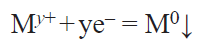
photocatalytic adsorption (Eq. (6)):

and photocatalytic reduction followed by the precipitation (Eqs (7) and (8)):

Photocatalytic deposition is one of the well-studied hydrometallurgical approaches to the metal recovery from solutions using photocatalysts.[20] Therefore, the corresponding section of the scheme in Fig. 2 can be additionally divided into three subsections depending on the type of solution for metal deposition. Photocatalytic deposition can be carried out directly from ionic species, complex compounds or metal – extractant compositions. In all cases, the ionic form of equation corresponds to the Eq. (5).
In the following sections of the review, the detailed examples and features of photocatalytic reactions used in hydrometallurgical processes will be considered.
1.3. Most promising photocatalysts for hydrometallurgical applications
Fig. 3[21-23] shows the most convenient forms of photocatalysts that can be used for hydrometallurgical recovery of metals. Fig. 3a demonstrates the device for applying of nanosized titanium dioxide powder, along with its scanning electron microscopy (SEM) image (see Fig. 3b) and photo (see Fig. 3c). Although this form of photocatalyst is not ideal for large-scale metal recovery processes, it is well-suited for photoleaching of precious metals. This is due to the fact that it eliminates the use of hazardous, highly corrosive reagents and requires only a single stage of photocatalyst separation from the stock solution. Additionally, impurities of precious metals enhance the photocatalyst performance, and it can serve for a long period without replacement. The design of photoreactor for powdered photocatalyst consists of a tank equipped with a stirrer and a lamp. However, a significant amount of additional equipment is required for this simple photoreactor to separate and recover the photocatalyst.
![[{"id":"1BiWC406GJ","type":"paragraph","data":{"text":"Examples of different forms of photocatalysts: photocatalysis equipment using powdered photocatalyst (<i>a</i>), SEM image of TiO<sub>2</sub> powder (<i>b</i>), photograph of TiO<sub>2</sub> powder (<i>с</i>); variant of application of granulated photocatalyst (<i>d</i>) on a large scale photoreactor in a flow mode (<i>e</i>);<sup>21</sup> floating photocatalyst in pellet (<i>f</i> ) and rod (<i>g</i>) forms.<sup>22</sup> Floating spheres filled with photocatalyst (<i>h</i>).<sup>23</sup> Copyright (<i>d – h</i>) belongs to Elsevier."}}]](/storage/images/resized/dlfQP4K7MnkgblcCfFfy1NCwr4qeGUUfewquOz4r_xl.webp)
Granular photocatalysts are the most convenient form, as no additional equipment is needed to separate the solution from the photocatalyst (see Fig. 3d ). The main disadvantage of granular photocatalysts is their small surface area compared to powdered photocatalysts. However, this disadvantage can be offset by their ability to operate in a flow mode and the potential for application in large-scale photoreactors (see Fig. 3e). This type of photocatalyst can also be easily removed from the photoreactor after its service life is over.
For hydrometallurgical applications of photocatalysts operating under natural sunlight, floating materials covered with photocatalytic particles,[24] placed on the surface of the pond containing production solutions, are ideal (see Fig. 3f,g). This method is particularly suitable because it requires no additional electricity and can use all available solar energy during the day. Enriching the pond surface with oxygen also increases the efficiency of the photocatalytic reaction. Additionally, this type of photocatalyst can be easily removed from the pond surface using skimmers or other mechanical removal methods. This explains the rapid growth in the number of publications on floating photocatalysts.[22][23][25-27]Fig. 3h shows floating photocatalyst microspheres combined with a plastic sphere net to create larger granules that can be removed from the surface faster without loss of the photocatalyst.
Other types of photocatalysts can also be used in some hydrometallurgical stages, but they have a number of disadvantages and are less versatile when considering the features of hydrometallurgical processes. For example, membrane photocatalysts[28] are promising materials for water treatment. However, hydrometallurgical technologies require handling large flows of liquids containing high concentrations of metals and impurities. This makes membrane and thin fiber photocatalysts fragile and short-lived, reducing their versatility.
In all cases, photocatalytic reactions are driven by chemical interactions between the components of the solution. This is why the reaction rate is highly temperature-dependent, making the use of photothermocatalysts[29] preferable to photocatalysts in most hydrometallurgical methods. Photothermocatalysts are a category of photocatalysts that can interact not only with ultraviolet (UV) and visible light, but also with infrared (IR) irradiation. Absorption of IR irradiation with a photothermocatalyst increases the temperature of the solution and, consequently, the rate of chemical reactions. Among photothermocatalysts, the most promising materials for hydrometallurgical applications are those based on carbon[30] and carbon doped with titanium dioxide.[31-33]
Fig. 4a[34] shows the heat distribution of the photothermocatalyst NC600 prepared from nitrogen-doped carbon. Fig. 4b shows the heating rate of the photothermocatalyst in the quartz reactor in deionized (DI) water and in the air by irradiation[30] and the dissipation rate of the large amount of heat generated during the photothermal conversion of NC600 into the water solution. Fig. 4c shows the rate of increase of the photothermocatalyst surface temperature from 20°C to 97°C during irradiation as observed by an infrared camera, followed by its cooling in the absence of irradiation.
![[{"id":"_l9JIC8Wnr","type":"paragraph","data":{"text":"Photothermal conversion performance of NC600: Thermal images of NC600 upon illumination (<i>a</i>);<sup>30</sup> Temperature increase of NC 600 catalyst in DI water and in air in a quartz reactor (<i>b</i>);<sup>30</sup> Change in temperature of NC 600 suspension depending on illumination, as observed using an infrared thermal camera (<i>c</i>);<sup>30</sup> Solar irradiance energy spectrum (<i>d</i>), schematic diagram of a general photothermal catalyst (<i>e</i>).<sup>34</sup> Copyright belongs to Elsevier. DI is deionized water."}}]](/storage/images/resized/YP1auYGa61f1R6beh8ERKWZLMEqc7RaETNl9xtrO_xl.webp)
Photothermocatalysts are typically composite materials with separate photocatalytic and IR absorption centers. Fig. 4e shows the general scheme of the different functional elements of the photothermocatalyst.
In this scheme, the light absorber layer is located under the photocatalytic layer because the penetration ability of IR irradiation is much higher than that of visible light and UV irradiation. Fig. 3d shows the full spectrum of natural sunlight and the part of the spectrum that is not used if material does not contain a light-absorbing layer. In most cases, the use of photothermocatalysts instead of photocatalysts increases the rate of the photocatalytic reaction, which ultimately improves the efficiency of the hydrometallurgical process.
1.4. Types of photoreactors suitable for hydrometallurgical applications
Nowadays, a large number of photoreactor types of varying designs and power are available,[35-37] from laboratory to industrial scale.[38][39] However, not all of them can be recommended for hydrometallurgical applications. Those suitable for hydrometallurgy are shown in Fig. 5.
![[{"id":"o-e4uC7-QD","type":"paragraph","data":{"text":"Photo of a solar nano photocatalytic CTR (<i>a</i>); a simple schematic of a single glass tube batch reactor (<i>b</i>); capillary microphotoreactor packed with TiO<sub>2</sub>-coated glass beads (<i>c</i>).<sup>38</sup> Copyright belongs to Elsevier. Fluidized bed shallow pond reactor (<i>d</i>); schematic drawing of packed bed reactor system (<i>e</i>); schematic drawing of flat plate column reactor (<i>f</i> ).<sup>39</sup> Copyright belongs to the MDPI, license CC BY 4.0. Typical reactor layout for an inclined plate collector (left) and double skin sheet photoreactor (right) (<i>g</i>).<sup>36</sup> Copyright belongs to the American Chemical Society. CTR is circular trough reflector."}}]](/storage/images/resized/mY3KOH1PUisLNhIRPmeR4uI3kLTwg951VgNTYI9j_xl.webp)
Fig. 5a,b show a tubular flow reactor that can use a powdered photocatalyst in suspension. Fig. 5c demonstrates the most universal type of photoreactor with a granular photocatalyst base made of silica oxide covered by titanium dioxide. Fig. 5d shows an open-pond photoreactor with a floating photocatalyst, which is used in the fluidized bed shallow pond reactor. The floating photocatalyst consists of ceramic spheres coated with a photocatalyst. This photocatalyst has a density of 1 g mL–1, so it can be easily suspended in the entire volume of the solution. The recommended depth of the fluidised bed shallow pond reactor is 5 cm. Fig. 5e shows a vertical plane photoreactor for artificial irradiation with device for enriching water with air. Fig. 5f shows the reactor with a heavy granular photocatalyst located at the bottom of the pond, and Fig. 5g shows a plane photoreactor operating under natural sunlight. The plane photoreactor can use granular photocatalysts or film-based photocatalysts.
For hydrometallurgical applications, plane, tubular and pond-type photoreactors are the most suitable. The catalysts used in these photoreactors may take different forms: fibers, films, granules, or powder. Each form has its own advantages and disadvantages. For example, fibers are prone to fouling due to their high filtration ability. They are also prone to increased degradation because of a polymeric substance in their composition that degrades particularly rapidly under irradiation.[40]
Film photocatalysts are difficult to apply, exhibit low metal adsorption, and require a support with good adhesion.[41] Granular photocatalysts (floating or heavy) have low surface areas and a low concentrations of photocatalytic centers relative to their volume.[42] These types of photocatalysts can be useful for various hydrometallurgical solutions at different stages.
The most versatile photoreactor and photocatalyst for all hydrometallurgical processes is a tubular flow photoreactor with a granular photocatalyst. This photoreactor has a simple design and is easy to service and maintain. It has no size limitations. The photoreactor design is similar to an adsorption column, with the only difference being the thickness of the loading layer and the need to provide access for irradiation of the photocatalyst surface.
Like other photoreactors, tubular photoreactors can use natural sunlight. In this case, the quartz tube must be located outside the photoreactor. Photoreactors that use artificial irradiation, such as a xenon lamp, are manufactured with an inner quartz tube because the circulation of the solution in this case also serves to cool the lamp.
Even pond-type photoreactors can be equipped with artificial light lamps, but their design suggests using natural sunlight as the primary source of irradiation. The main disadvantage of pond-type photoreactors is their dependency on the day – night cycle. This prevents them from being used as continuous reactors, so they should be used as batch reactors.
2. Applications of photocatalytic reactions in hydrometallurgy
2.1. Photoleaching
Leaching is the first stage of hydrometallurgical metal recovery based on the treatment of raw materials with alkalis, acids, or special leaching reagents. Choosing the appropriate leaching solution allows for the extraction of metals from the solid phase with high selectivity and efficiency. The use of strong acids for leaching provides a high degree of leaching, but also results in a combined concentrate of all the metals present in the initial raw material. As a rule, extracting metals from such concentrate is a difficult task. Using a highly concentrated alkali solution produces a final solution enriched with silica and phosphorus. Such solutions also require separation from impurities and a large amount of acid for neutralization. Therefore, a lot of attention is paid to the development and improvement of leaching processes. Using photocatalysts during the leaching process creates a high oxidation potential in the solution. This allows different metals to be extracted into the leaching solution without the use of strong alkalis or acids. This approach helps to dissolve even poorly soluble precious metals (PM).
2.2. Leaching of precious metals in the presence of photocatalysts
Traditional methods of extracting precious metals include leaching silver and gold with a cyanide solution[43] and leaching platinum group metals with chlorine.[44] All precious metals dissolve in a mixture of nitric and hydrochloric acid, a property that is used in the refining process.
The use of photocatalytic reactions helps to avoid the use of concentrated acids and highly toxic reagents. The possibility of extracting silver (Ag), gold (Au), palladium (Pd), platinum (Pt), rhodium (Rh), ruthenium (Ru), and iridium (Ir) from electronic waste (e-waste) using the TiO2 photocatalyst and such solvents as dichloromethane (DCM) and acetonitrile was reported.[45] An approach was also demonstrated to dissolve platinum and palladium in the presence of TiO2 in an ethylene glycol solution.[46] The mechanism of gold and platinum photoleaching was suggested (Fig. 6).[47] In addition, DCM in Scheme Fig. 6b can be replaced by ammonia chloride.
![[{"id":"uYsLGzxKzs","type":"paragraph","data":{"text":"Mechanism of photoleaching of Au in MeCN (<i>a</i>) and Pt in a mixed solution of MeCN and DCM (<i>b</i>).<sup>47</sup> Copyright belongs to Wiley."}}]](/storage/images/resized/3DurHeZm04k3BDtePNPgQZyjpMk9GpRxCdfJ4qaD_xl.webp)
The main feature of photoleaching is the homolytic bond splitting under irradiation, which produces radicals, e.g., O2– •, •CH2CN (see Fig. 6a) and •CHCl2 (see Fig. 6b). The presence of these radicals increases the leaching activity of the solution, significantly accelerating the metal dissolution. The photoleaching approach helps to achieve a high degree of PM leaching in ammonia halide solutions. Photoleaching of PM in solutions of ammonia chloride,[47] bromide,[12] and iodide[48] has been reported.
Nowadays, photoleaching is only attractive for extracting PM due to technological difficulties such as the use of a nano-sized photocatalyst, a long leaching period (about 12 hours and more), and the absence of special photocatalytic devices. However, once these issues are resolved, this approach will become more promising and applicable to other metals.
2.3. Photodeposition
Photocatalytic deposition of metals from hydrometallurgical solutions is one of the well-studied technological approaches to the metal recovery.[20] This method is based on reducing and precipitating a zero-valent metal from the solution. Therefore, this method is applicable to metals with a standard redox potential of less than 1.3 V in an acidic medium. Additionally, these metals must be inert to water in their zero-valent state.
The ionic form of the metal after leaching influences the efficiency of photodeposition. Metal deposition may be hindered by the formation of a stable complex or composition with the extractant. The main advantage of this method is that no additional reagents are required for precipitation, and a single step is required to produce the final pure metal powder or concentrate. However, in a real system, one step is sometimes insufficient. After deposition, the precipitate must be separated from the photocatalyst.
2.4. Photodeposition of metals from ionic compounds, complexes and extractants
During the acid leaching process, metals dissolve in the solution from solid raw materials and are present in the form of the corresponding ions. Then, the metal ions can be precipitated as a powdered metal. An example of this process is the deposition of mercury from a solution in the presence of a photocatalyst consisting of a polyoxometalate (POM),[49] titanium dioxide doped with silver,[50] and zinc oxide.[51] Other examples of photodeposition have been reported, such as precipitation of silver on zinc oxide[52] and the photocatalytic deposition of copper[14] and lead.[53]
Some publications recommend first degrading the complex ion, and then precipitating the corresponding metal. This approach is common in the deposition of precious metals. For example, it is used for photodeposition of gold from chloride,[54] thiosulfate,[55] and cyanide[56] complexes.
The extraction process involves distributing metals between two immiscible phases. once the metal is extracted from the solution, it is distributed between two immiscible liquids, polar and nonpolar. Typically, the leaching solution is polar, so the metal moves to the nonpolar phase in the form of a composition with the extractant. After that, it must be reextracted from this composition with the extractant.
The extractant must be returned to the extraction circle, and the metal must be precipitated as a final product or concentrate. Different approaches and reagents are used to separate metals from their compositions with extractants. A photocatalytic approach is one example of a non-reagent method. A good example is photodeposition of palladium from its composition with DDTC as the extractant.[45]
Photodeposition can be used for challenging tasks such as separation of Rh, Pd, and Pt. It was found that the photocatalytic reduction degree of Rh depends on the pH of the medium (Fig. 7a)[57], and this property can be used to separate it from Pt and Pd. Fig. 7b shows the general scheme of the separation process, which uses the photoreduction of Rh and the photodeposition of Pt and Pd on the surface of titanium dioxide.
![[{"id":"SabC1t9s_o","type":"paragraph","data":{"text":"Rate of photocatalytic reduction of Rh(III) at different pHs (<i>a</i>), plausible scheme of separation of Pt, Pd, Rh (<i>b</i>).<sup>57</sup> Copyright belongs to SAIMM, license CC BY 4.0."}}]](/storage/images/resized/ClG6a5HYEaoLY2PXd6sb5F7D4QeR57McVTCvZNf1_xl.webp)
2.5. Phenomenon of photoadsorption
Photoadsorption is the process by which metal ions are adsorbed onto a sorbent surface under irradiation. This typically occurs on the highly developed surface of a photocatalyst. Quantitatively, photoadsorption is equal to the difference in the sorbent’s adsorption capacity with and without irradiation.[10] This difference can be explained by various reasons.
First, the oxidation state of the element and its ionic form change in solution during the photocatalytic reaction. Consequently, the sorbent adsorption capacity toward this ion also changes. Second, photogenerated species can destroy complexes and hydrate shells of ions, which can simplify and accelerate adsorption. Third, the photocatalyst can also act as a sorbent in the photoadsorption process, and its surface can change when exposed to irradiation. New adsorption sites and terminal groups[58] can form on the photocatalyst’s surface. The structure and properties of the double electric layer (DEL) can also change and affect adsorption capacity. Since photoadsorption is a difficult, multistage process that takes place in a heterophase system, the reasons for differences between adsorption with and without irradiation are sometimes unclear. Therefore, it is appropriate to consider the quantitative and qualitative characteristics of photoadsorption as the difference in adsorption capacity with and without irradiation. Photocatalytic and photoadsorption sites can be the same or different, depending on the type of material. For example, a composite based on montmorillonite doped with titanium dioxide[59] has different adsorption and catalysis sites. Once the sorption capacity is exhausted, the catalytic site can function as before. However, if the catalytic and adsorption sites are the same,[60] the photocatalyst will lose its photoadsorption capacity very quickly due to the surface contamination. Desorption from such materials is also more difficult.
If metals are reduced and absorbed on the catalyst surface in a zero-valent form, the process should be more accurately considered as photodeposition.
2.6. Photoadsorption of different metal ions
The phenomenon of photoadsorption has not been widely covered in the literature, and research in this field is typically focused on wastewater treatment.[60] However, extraction of various metals from solutions using photoadsorption has been described. Two of the most interesting examples of this type of research include photoadsorption of lithium on iron phosphate modified with titanium dioxide[61] and on nano-sized titanium dioxide.[62] Photoadsorption of uranium on titanium dioxide nanotubes, followed by electrooxidation with precipitation has also been reported,[63] as well as photoadsorption of uranium on titanium dioxide bronze to separate uranium from rhenium.[13]
Photoadsorption has been well studied for the heavy metals such as chromium,[59][60] cadmium,[64][65] and lead.[66][67] However, for these metals, photoadsorption is irreversible and can only be used for water treatment. Furthermore, the photosorbent is disposable. This Section focuses on approaches that allow the metals to be desorbed from the sorbent after photoadsorption, making the sorbent reusable.
One typical approach to adsorption in hydrometallurgy can be described briefly as follows: adsorption, followed by desorption into a more concentrated solution, and then precipitation. An example of photoadsorption is the adsorption of vanadium onto titanium dioxide microspheres.[68] Selective desorption of vanadium is shown in Fig. 8a, and the efficiency of different desorption reagents is shown in Fig. 8b. Fig. 8c,d show photoadsorption at different pH values. The first separation stage is photoadsorption of vanadium at a pH 9 (see Fig. 8d ). During this stage, vanadium can be selectively separated from chromium. The second stage is desorption, during which vanadium can be selectively desorbed from the sorbent. According to Fig. 8b, the sorbent can be regenerated from chromium-containing residue by a nitric acid solution.
![[{"id":"fHzzjE-Hac","type":"paragraph","data":{"text":"Selective desorption of V<sup>5+</sup> (<i>a</i>). Cyclic experiments with selective desorption of V<sup>5+</sup> and Cr<sup>6+</sup>(<i>b</i>). Photocatalytic degradation of high concentration vanadium–chromium mixed wastewater, pH 7 (<i>c</i>) and pH 9 (<i>d</i>).<sup>68</sup> Copyright belongs to Elsevier."}}]](/storage/images/resized/xnneUHUIrOHXTTnUP5BgT7au06C7UOuDfxNmI2Jc_xl.webp)
2.7. Photooxidation and reduction in hydrometallurgy
Assuming that the separation of electrons and holes occurs during the photocatalytic reaction, two parallel processes of oxidation and reduction occur in the solution. This means that the metal can be involved in reduction and oxidation processes depending on its properties and the reaction conditions. Metals can be part of different insoluble compositions that can be used for extraction from solutions. Sometimes, it is necessary to increase or decrease the oxidation degree of metals. In hydrometallurgy, hydroxide is the most suitable form for the precipitation of metals except for precious and alkali metals. After the thermal destruction of metal hydroxides, the corresponding oxides can be produced. The metal oxide can be used as the final product or reduced to pure metal.
2.8. Photooxidation and photoreduction with subsequent precipitation
Numerous articles and reviews have described the photoreduction of chromium in the presence of photocatalysts.[69-74] However, fewer papers consider chromium photoreduction followed by precipitation.[75][76] Once Cr(VI) is photoreduced to Cr(III), the Cr3+ ions are highly active and tend to remain on the photocatalyst surface or adsorb thereon. Retaining them in solution is difficult.
In addition, Cr(III) is difficult to precipitate at concentrations below 0.1 M, even in alkaline media, since the formation of hydroxo complexes hinders precipitation.[77][78] The precipitated particles are not opaque flakes, but rather look like a highly dispersed gel. In general, the photocatalytic reduction reaction with chromium precipitation corresponds to Eqs (9) and (10):

The same method can be used to reduce vanadium(V) to vanadium(IV),[79] which is then precipitated as a hydroxide or oxalate.[80] Another example of an application involving photoreduction followed by precipitation concerns uranium.[81] After reduction of U(VI) to U(IV) through photoreduction, it can be deposited as a hydroxide or hydrated oxide.[82]
Photocatalytic oxidation of metals, followed by precipitation, is applicable to manganese.[83] The first step is oxidation with a photogenerated hole, as shown by Eq. (11). After that, the methahydroxide produced by this reaction, forms the brown precipitate MnO₂ by disproportionation, as shown by Eq. (12).

In Fig. 9, efficiencies of the manganese photocatalytic and biological oxidations are compared.[11]
![[{"id":"Sz7g7KC3xW","type":"paragraph","data":{"text":"Comparison of Mn<sup>2+</sup>(aq.) oxidation rates based on microbial processes, nitrate photolysis, and photocatalytic oxidation on hematite and goethite. The oxidation rates for both previous abiotic/biotic studies and photocatalytic oxidation are calculated based on the Mn(III) equivalent.<sup>11</sup> Copyright belongs to Elsevier. ASW is artificial sea water."}}]](/storage/images/resized/d0Flsj1BmRo0aWmSwKrS9dKJJQ6l4i3jSqyNtQHN_xl.webp)
2.9. Application of photodegradation in hydrometallurgy
In addition to water, hydrometallurgical processes require a variety of organic and inorganic reagents. The main reagents include leaching solution components, flotation reagents, extractants, and complexing agents. Leaching solutions may contain acids, alkalis, and specific reagents, such as thiosulfate, thiourea, and cyanide, as well as their combinations. The most common flotation reagents are xanthates, dodecyl morpholines, and oleic acid. The list of extractants is very long, but the most common are TBP, di-2-ethylhexyl phosphate (D2EHPA), and diethyldithiocarbamate (DDC). Complexing agents include ethyldiamine tetraacetic acid (EDTA), nitrilotriacetic acid (NTA), and diethylene tetramine pentaacetic acid (DTPA). The articles describing the photodegradation of several reagents commonly used in hydrometallurgy are summarized in Table 1[84-102][103-112].
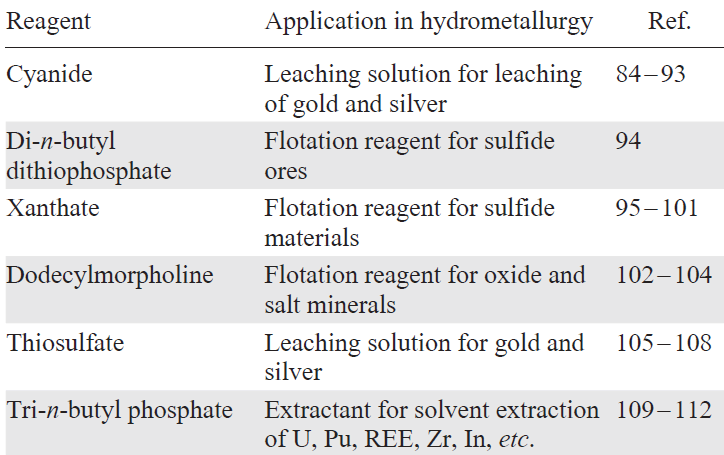
Degradation of this reagents is related to the protection of environment and cannot affect directly the efficiency of hydrometallurgy metal recovery. However, there are the steps that required the decomposition of complex ions to improve the efficiency of metal extraction.
2.10. Degradation of M-complexes
In hydrometallurgy, complexing agents are used for various purposes. In some cases, they enhance the efficiency of metal leaching. In other cases, they mask other metals and prevent them from precipitating with the target metal. However, after leaching or masking the metal with a complexing agent, it is necessary to destroy the metal complex in order to precipitate the target metal. Photodegradation is a convenient method for this purpose. The method of destroying the cobalt complex followed by precipitating mixed cobalt oxides has been proposed.[113] The same approach was used to degrade cyanide complexes of cobalt[114] and nickel,[115] as well as to destroy copper complexes with EDTA.[116]
In the process of destroying the complex in the solution, the ligand can serve as a sacrificial compound, which can significantly increase the rate of the photocatalytic reaction. For example, when destroying the iron cyanide complex, the cyanide ions serve as a sacrificial agent.[93] This helps to reduce and precipitate ions from the solution (Fig. 10).
![[{"id":"G25yI9gqVX","type":"paragraph","data":{"text":"Possible mechanisms for the [Fe(CN)<sub>6</sub>]<sup>3−</sup> photocatalytic degradation in the absence of sacrificial agents.<sup>93</sup> Copyright belongs to the Royal Society of Chemistry, license CC BY 4.0. CB is conduction band, VB is valence band."}}]](/storage/images/resized/sGelfRmC3zsitLVxSKrYNwDXsShvnuI6pFyxFOUk_xl.webp)
The reaction of iron-cyanide complex degradation corresponds to the Eq. (13):

In this example, the ligand acts as a sacrificial agent that helps to recover the metal from the corresponding complex ion. Zero-valent iron is very active in an aqueous solution, so it cannot precipitate in this form without a capsulating agent. However, gold can precipitate in a zero-valent state from a cyanide complex ion.[117] As discussed above, the photocatalytic reaction potential is insufficient for reducing the couple Au(CN)–4/Au. However, when the oxidation of cyanide ions is taken into account, the full redox reaction can occur.
2.11. Hypothetical scheme for the use of photocatalysts in hydrometallurgical extraction of precious metals, chromium and vanadium
Fig. 11 presents three schemes for the hydrometallurgical recovery of precious metals, vanadium, and chromium, as well as the types and forms of photocatalysts. These approaches can be applied on an industrial scale, as all the necessary data and materials are available.
![[{"id":"E2_q8CwHpp","type":"paragraph","data":{"text":"Scheme of hydrometallurgical extraction of metals using photocatalytic approach: photoleaching of precious metal M (<i>a</i>), photoreduction of Cr(VI) following by the precipitation (<i>b</i>), photooxidation of vanadium followed by hydrolytic precipitation (<i>c</i>). BOF is basic oxygen furnace."}}]](/storage/images/resized/K7s1qESOmBxAH4HCVlMzLkmgPrXkTbNTVKNekAWl_xl.webp)
Fig. 11a demonstrates an extended version of the method proposed in the study.[118] This method is applicable to the photoleaching of precious metals from various sources containing them in a zero-valent state. Additionally, this approach can be considered selective because the precious metals are primarily leached. The solvent can also be regenerated and reused after vacuum evaporation.
Fig. 11b illustrates the production of chromium concentrate by photocatalytic reduction.[119] This method is applicable for the precipitation of Cr(III) compounds from wastewater after ammonia dichromate deposition and from electroplating wastewater.[120][121] Here, a floating photocatalyst and natural sunlight are used, since chromium compounds are inexpensive, and metallurgical plants produce over 1000 m3 of wastewater daily. Therefore, a large amount of wastewater must be treated with light in the presence of a photocatalyst for Cr(III) concentrate production.
Fig. 11c shows the application of photocatalyst beads in a flow photoreactor for vanadium photoreduction followed by precipitation. In this example, the raw material is steel vanadium slag from the second stage of the duplex process. This slag is not used as a source of vanadium because traditional technology based on soda leaching[122][123] cannot be applied thereto due to its high calcium concentration. During vanadium leaching with sulfuric acid, vanadium passes into solution in different oxidation states (+3, +4, and +5). This solution cannot be used directly for hydrolytic precipitation of vanadium.[124] However, all vanadium can be oxidized from oxidation states +3 and +4 to +5 in the leaching solution using a photoreactor with photocatalyst beads. The photooxidation of vanadium can be accelerated by bubbling air through the solution. After all vanadium in the solution has been oxidized, it can be precipitated by thermohydrolysis, separated from most impurities, and concentrated into a solid precipitate. Using one of the traditional approaches, pure vanadium pentoxide can be produced from this precipitate.[125]
All of the examples in Fig. 11 used a titanium dioxide-based photocatalyst. For photocatalytic materials to be versatile, they must be resistant to alkalis and acids, active over a wide range of wavelengths (250 – 550 nm) and relatively insensitive to changes in temperature (20 – 90°C). Therefore, a titanium-based photocatalyst[126][127] is very convenient for hydrometallurgical applications. Additionally, composites based on titanium dioxide and carbon are also worth mentioning.[31][32][128][129] These materials contain additional impurities and can scavenge infrared irradiation, accelerating the photocatalytic reaction, and are referred to as photothermocatalysts.
Titanium dioxide – polymer composites are also promising, but preference should be given to the most inert polymeric matrix, such as polypropylene[130] or polyethylene.[131] At the current stage of the development of photocatalytic materials, photocatalysts with complicated structures or containing precious metal catalysts are not suitable for real hydrometallurgical processes.
3. Emerging trends
3.1. Prospects for the development of photocatalytic leaching processes
Methods for improving the efficiency of leaching of different metals using photocatalysts have been described. For instance, a high degree of copper leaching from chalcopyrite can be achieved by a photocatalytic reaction.[132] The reaction generating sulfate radicals corresponds to Eq. (14):[132]

The degree of copper leaching from chalcopyrite can be enhanced by rising of concentration of hydrogen peroxide in the solution.[133] The hydrogen peroxide is produced by the interaction between photogenerated oxygen radicals with protons (Eq. (15)) or by the reaction of hydroxyl radicals (Eq. (16)).

The same method was applied to sulfuric acid leaching of copper from copper slag.[134] This demonstrates that photoleaching can be effective for different raw materials. An investigation[135] found that the leaching of lithium from lithium iron phosphate significantly increased using a photocatalytic reaction. It can be assumed that the photoleaching method can be recommended for extracting different metals from various natural and artificial raw materials. The metals that can be extracted from the corresponding raw materials by photoleaching are listed in Table 2[136-153][154-158].
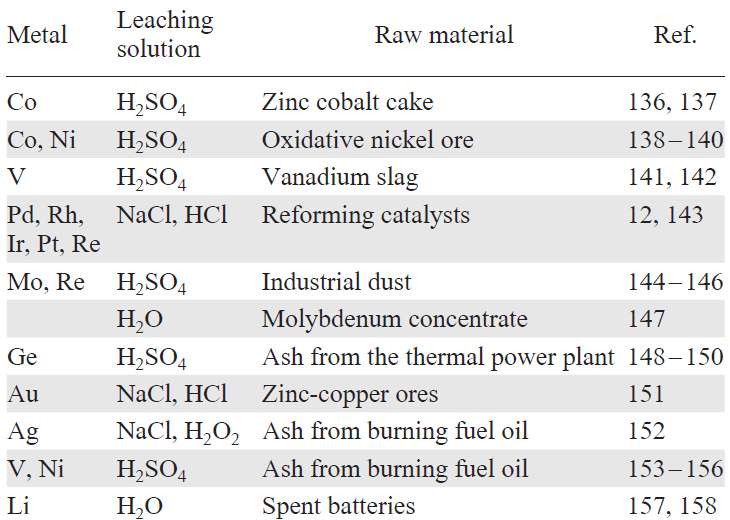
The large number of metals that can be extracted by photoleaching demonstrates the potential of this method for further investigation and application. This method reduces reagent consumption, enhances extraction efficiency and minimizes the negative environmental impact. However, it has its own features and limitations. It requires specialized equipment, such as a photoreactor,[20][35][159-161] and also electricity sources for irradiation, as not all countries have enough sunlight. The photocatalyst has a limited service life and must be replaced periodically. All of these limitations must be taken into account, but they do not diminish the advantages of this approach.
3.2. Perspective of development of photodeposition
Photodeposition of precious metals from solution shows promise because it can help precipitate metals without the use of traditional cementation agents, such as zinc dust[162] or iron powder.[163] A key area of investigation is the search for new photocatalysts and photocatalytic devices for their applications. The development trend will be related to the separation of metals, such as platinum group metals, based on their rate of photodeposition and their ability to undergo photodeposition under different wavelengths and intensities of irradiation. This approach can help solve the task of separating platinum group metals and also separating silver from gold.
Fig. 12 shows the metals that can be reduced on a titanium dioxide photocatalyst according to their standard redox potential. The redox potential values were taken from publications.[164][165]
![[{"id":"GvZp-fkajo","type":"paragraph","data":{"text":"Illustration of redox properties of photocatalyst TiO<sub>2</sub> with relevant redox couples. FB is flat band."}}]](/storage/images/resized/CbcalnSbwBJZyTQXOFMYcZnEOnFs3tJNMcln9u11_xl.webp)
According to the data in Fig. 12, photodeposition of metals from chloride complexes is easier than that from cyanide complexes. Photodeposition for other metal groups is currently unattractive because traditional deposition methods are more efficient. For this reason, rapid development of photodeposition for non-precious metals is unlikely in the near future.
3.3. Development of photoadsorbents
The example of vanadium photoadsorption[68] demonstrated the application of this method for separation and concentration. However, nanomaterials are not convenient for industrial, reusable applications. Each separation operation of a solution and a highly dispersed powder requires a lot of circulation water, time, filtration equipment, and tanks. From this point of view, the application of photoadsorption in hydrometallurgy requires more convenient granular, floating, fiber, or membrane photocatalytic materials. These materials do not require filtration and can operate in flow-through mode.
The main limitation to the widespread use of photocatalytic materials stems from a contradiction: on the one hand, the photocatalyst must have a high surface area, and its most effective form is a nano-sized powder; however, on the other hand, it must be inert under operating conditions, reusable, and capable of operating in a flow mode. One way to resolve this contradiction is to improve the design of photocatalytic devices to compensate for the low surface area of granules through flow mode and the high efficiency of large-scale devices.
The second way is to increase the surface area of the granules exposed to irradiation. In the case of photocatalyst granules only the surface is involved in photoadsorption, while the material bulk is excluded from the process. For this reason, developing a material with photoconductive properties is a promising approach. If the granular photocatalyst possess a photoconductive ability in addition to photocatalytic one, then its bulk can be used in addition to its surface. This could significantly increase the attractiveness of this technology. Materials of this type has already been described in the literature, e.g., titanium dioxide-coated silica dioxide waveguide[166] or with indium oxide nanorods.[167] However, these types of materials have not yet been used in hydrometallurgical applications in a flow mode. Another trend toward simplifying the use of powdered photocatalyst applications is the synthesis of magnetic photocatalysts, which can be extracted from solutions using a magnetic separation method.[168][169] There is also a trend toward creating composite photosorbents, in which the catalytic and adsorption centers are separated. These materials can retain their photocatalytic function even when their adsorption capacity is fully exhausted.[59][170]
3.4. Development of hydrometallurgical processes based on the photoredox reactions
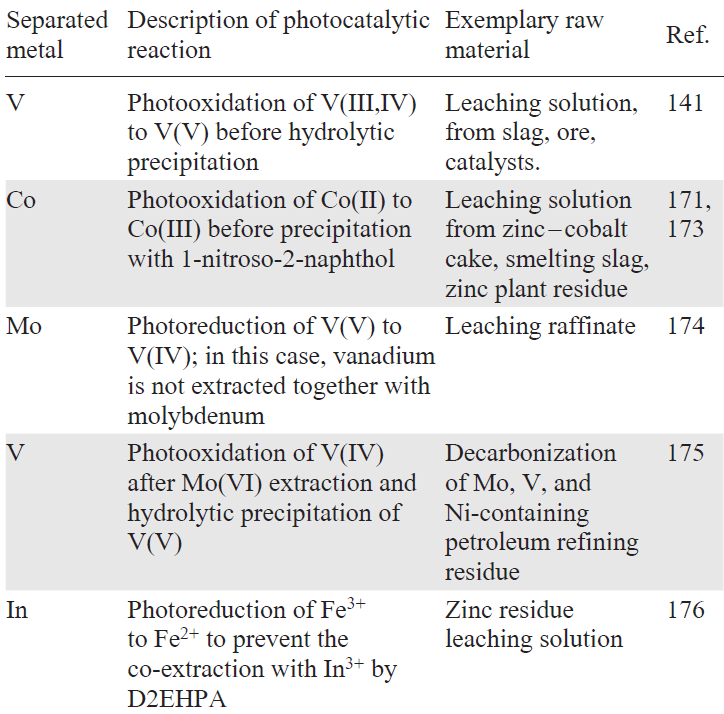
Different technologies require changing the oxidation state of metals to enhance their separation and concentration efficiency. For example, vanadium exists in slag at different oxidation states, and when leached with sulfuric acid, it passes to the solution in similar oxidation degrees (+3, +4, and +5).[141] However, for the hydrolytic precipitation of vanadium, all the vanadium must be in the +5 oxidation state. In this case, the photooxidation approach is also applicable. The photooxidation reaction of V(III) and V(IV) to V(V), followed by hydrolytic precipitation, corresponds to Eqs (17) and (18).

In the case of cobalt leaching from zinc–cobalt cake,[171]the cobalt is predominantly dissolved in the +2 oxidation state. However, for selective precipitation with 1-nitroso-2-naphthol,[172]all cobalt must be in the +3 oxidation state. Therefore, applying photooxidation to the cobalt leaching solution can increase the efficiency of Co(III) precipitation (Eqs (19) and (20)).

Table 3[173-176] summarizes the examples where photooxidation or photoreduction can increase the efficiency of hydrometallurgical extraction using the specified raw materials.
3.5. Prospects for the application of photodegradation in hydrometallurgy
The photocatalytic degradation of the cyanide complex enables the simultaneous solution of several tasks, viz., destruction of the metal complex, metal release, degradation of the toxic ligand, metal reduction, and precipitation. This makes the approach very promising for application. The titanium dioxide-based photocatalyst has a band gap energy in the range of +3.0 to –1.0 eV in the pH range of 1 to 12, with a flat band potentials (Vf.b.) of –0.2 to –1.0 eV. It means that, depending on the conditions, most complexes with organic and inorganic ligands can be degraded using a photocatalytic approach. Table 4[177-179] presents the inorganic complex ions that can be destroyed by a photocatalytic reaction in the presence of titanium dioxide due to a change in the oxidation state of the central metal atom.

The complex ions shown in Table 4 are formed by leaching metals from the corresponding raw materials. Using a photocatalytic approach helps destroy the complexes and facilitate subsequent metal recovery.
4. Conclusion
The present review covers recent advances in applying photocatalysts to hydrometallurgical tasks. In this area of research, there is ample data to begin integrating the developed approach into real industries. Using photocatalysts in hydrometallurgy can increase the efficiency of traditional processes, reduce the need for additional reagents, and minimize environmental impact. This review shows that the photocatalytic approach is not versatile and is primarily based on the ability to change the oxidation state of a metal without the use of additional reagents. However, the ability to control the oxidation state is sometimes crucial and facilitates the selective and efficient recovery of metals. At present, the mechanisms of photocatalytic reactions have been well studied, and many different photocatalytic materials have already been synthesized. Therefore, in the near future, following the development of large-scale photocatalytic devices that use artificial and natural sunlight, photocatalysts will be widely implemented in hydrometallurgy.
This work was supported by the National Natural Science Foundation of China (Grant No. W2512010, 22374033), and Open Project of State Key Laboratory of Urban-rural Water Resources and Environment, Harbin Institute of Technology (ZD202520).
5. List of abbreviations
D2EHPA — di-2-ethylhexyl phosphonic acid,
DCM — dichloromethane,
DDTC — diethyldithiocarbamate,
DEL — double electric layer,
DI — deionized water,
DTPA — diethylenetriaminepentaacetic acid,
EDTA — ethylenediaminetetraacetate,
IR — infrared (radiation),
M — metal,
MeCN — acetonitrile,
NTA — nitriletetraacetic acid,
PM — precious metal,
TBP — tributyl phosphate,
UV — ultraviolet irradiation.
References