
Keywords
Abstract
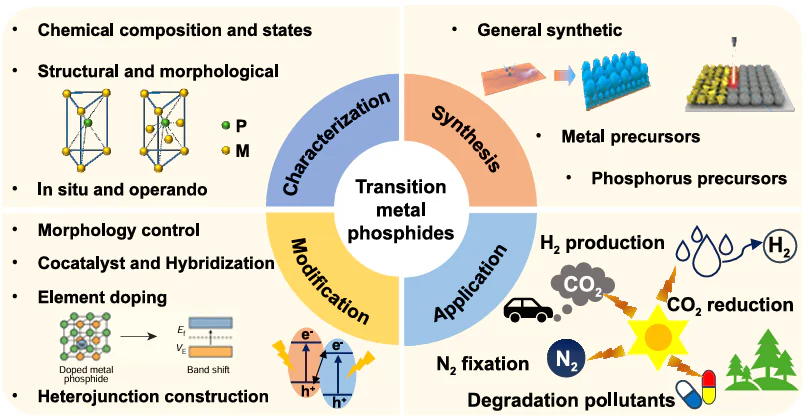
The global energy crisis and environmental pollution have greatly accelerated the development of sustainable technologies for renewable energy conversion and environmental remediation. Among them, photocatalysis has emerged as a promising strategy for solar-to-chemical energy conversion. Transition metal phosphides (TMPs), including representative materials such as Ni2P, CoP, FeP, and MoP, have attracted extensive attention as highly efficient photocatalysts and cocatalysts because of their tunable electronic structures, metallic conductivity, abundant active sites, and favorable hydrogen adsorption/desorption. Recent studies have demonstrated that TMP-based photocatalysts can achieve remarkable photocatalytic rates and apparent quantum efficiencies through rational interface engineering, heterojunction construction, and morphology regulation. This review comprehensively summarizes the recent progress in TMPbased photocatalysts for energy- and environment-related applications. Various synthesis strategies are discussed, and the effects of phosphorus and metal components on photocatalytic performance are analyzed. Furthermore, the fundamental mechanisms governing photocatalytic activity are highlighted, supported by both theoretical and experimental evidence. Particular emphasis is placed on optimization strategies for enhancing catalytic efficiency. In addition, the relationship between structural properties and photocatalytic performance is elucidated, and key challenges and future research directions are identified. This review provides new insights into the rational design and fabrication of advanced TMP-based catalysts and aims to accelerate their practical applications in energyrelated photocatalysis.
The bibliography includes 156 references.
1. Introduction
Increasing environmental pollution, extensive fossil-fuel consumption, and the depletion of fossil-energy resources have created an urgent demand for sustainable and clean energy technologies.[1-3] In this regard, significant research has focused on improving the efficient utilization of solar energy, which is regarded as the most practical and inexhaustible renewable resource.[4-6] Photocatalysis offers an effective strategy for utilizing solar energy to drive reactions such as hydrogen production, carbon dioxide reduction to value-added fuels, and the degradation of pollutants.[7] Therefore, the rational design of highly efficient photocatalysts is of great importance for addressing current energy and environmental challenges.[8][9]
To date, a wide range of photocatalytic materials, including metal oxides,[10-13] metal sulfides,[14][15] graphitic carbon nitride (g-C3N4),[16-18] and metal-organic frameworks (MOFs),[19] have been extensively investigated. However, the photocatalytic performance of these semiconductor materials is often limited by rapid recombination of photogenerated charge carriers and sluggish surface reaction kinetics. Consequently, cocatalysts are commonly introduced to promote charge separation, accelerate interfacial redox reactions, and improve overall photocatalytic efficiency.[20][21] Among the various cocatalysts investigated, transition metal phosphides (TMPs) have emerged as particularly attractive candidates because of their earth abundance, tunable electronic structures, excellent electrical conductivity, and remarkable catalytic activity. Consequently, TMPs have been widely integrated with semiconductor photocatalysts to enhance the efficiency and stability of photocatalytic energy-conversion processes.
In recent years, substantial progress has been achieved in the development of TMP-based photocatalytic systems through heterostructure construction, heteroatom doping, defect engineering, and interface engineering.[22-24] Nevertheless, several fundamental issues remain unresolved, including the identification of the true catalytic active sites, the dynamic evolution of phosphorus species under reaction conditions, and the establishment of universal structure – activity relationships. A systematic understanding of these issues is essential for the rational design of highly efficient and durable TMP-based photocatalysts. However, despite the rapidly growing number of studies on TMP-based photocatalysts, a comprehensive and critical review focusing on their structural design principles, photocatalytic mechanisms, and structure – performance relationships is still lacking.
In this review, we comprehensively summarize recent advances in TMP-based photocatalysts. We first discuss the synthesis strategies and structural design principles of TMPs, followed by their applications in photocatalytic hydrogen evolution, CO2 reduction, pollutant degradation, and other solar-energy-conversion processes. Particular attention is devoted to structure – performance relationships, interfacial charge-transfer mechanisms, and the synergistic roles of metal and phosphorus species. Finally, the remaining challenges and future research directions are highlighted to provide guidance for the rational design of next-generation TMP-based photocatalysts.
2. Structural characteristics of metal phosphides
TMPs represent a class of interstitial compounds in which transition metal (M) atoms coordinate to P to form a triangular prism configuration. This unique structure endows them with a hybrid character arising from covalent, ionic, and metallic interactions. Virtually all transition metals can react with phosphorus to yield the corresponding TMPs (Fig. 1a). The bonding characteristics between M and P are governed primarily by their electronegativity difference and the M : P stoichiometric ratio. Due to higher phosphorus electronegativity (2.1) in comparision with other transition metals, charge redistribution occurs from the metal to the P center, resulting in electron redistribution within the metallic lattice (Fig. 1b). For example, the pronounced electronegativity contrast between Zn and P gives rise to a highly ionic Zn – P bond, making ZnP prone to hydrolysis.[25] In contrast, TMPs with smaller electronegativity differences typically exhibit mixed covalent-ionic bonding, which contributes to their notable thermal stability, chemical robustness, and mechanical strength.
![[{"id":"sAn40pEUn0","type":"paragraph","data":{"text":"Composition, electronic properties, and crystal structures of TMPs. Fragment of the Periodic Table showing the experimentally documented TMPs of transition metals in Groups IIIB – IIB (marked in purple) (<i>a</i>). Correlation between the P 2<sub>p3/2</sub> binding energy, P K-edge absorption position, and the electronegativity gap (Δχ) for mono-, bi-, and trimetallic phosphides (<i>b</i>). Reproduced from Li et al.<sup>25</sup> with permission from Elsevier. Representative crystal configurations of metal-rich phosphides. Purple spheres denote transition metal atoms, while green spheres indicate phosphorus atoms (<i>c</i>). Reproduced from Ishaq et al.26 with permission from Wiley."}}]](/storage/images/resized/x20x4lldO7HvnFDHNba3K3dpkeucKsiMVB3XnpNY_xl.webp)
Stoichiometrically, TMPs can be broadly classified into metal-rich (M : P ≥1) and phosphorus-rich (M : P < 1) phases. Metal-rich phosphides generally exhibit metallic conductivity, whereas phosphorus-rich phases often exhibit semiconducting properties. In metal-rich compounds, excess metal atoms occupy positions adjacent to the lateral faces of the phosphorus-centered trigonal prisms, increasing the coordination number of phosphorus from six to nine and transforming the coordination geometry into a tetradecahedron. Different arrangements and stacking modes of these fundamental structural units give rise to a rich diversity of crystal structures. As shown in Fig. 1c, MoP adopts a WC-type hexagonal structure composed of stacked phosphorus-centered trigonal prisms.[26] VP crystallizes in a hexagonal NiAs-type structure, in which adjacent prisms are shifted diagonally by half of the lattice parameter. β-NbP and β-TaP possess the NbAs-type structure, which resembles that of VP but differs in the stacking sequence of the trigonal prisms. MnP and NiP crystallize in orthorhombic structures, where phosphorus atoms form one-dimensional chains in MnP and P – P dimers in NiP.26 To date, numerous TMPs have been synthesized, including YP, TiP, ZrP, VP, NbP, RuP, CrP, MoP, WP, MnP, Fe2P, Co2P, Ni2P, Cu3P, and ZnP2 , providing a broad structural platform for catalytic applications.
The metal-to-phosphorus (M : P) stoichiometric ratio plays a pivotal role in determining the electronic structure, surface chemistry, and catalytic properties of TMPs. Different stoichiometric phases, such as CoP and Co2P or Ni2P, Ni12P5, and Ni5P4, exhibit distinct crystal structures, coordination environments, and surface charge distributions, leading to markedly different catalytic behaviors. In general, metal-rich phosphides possess stronger metallic characteristics and higher electrical conductivity, facilitating charge transport and interfacial electron transfer during photocatalytic reactions.[27] For instance, Co2P typically exhibits faster electron-transfer kinetics than CoP owing to its higher metal content. Among nickel phosphides, Ni2P has been widely recognized as one of the most efficient cocatalysts for photocatalytic hydrogen evolution because of its balanced conductivity and near-optimal hydrogen adsorption free energy.[28] In contrast, phosphorus-rich phases such as Ni5P4 expose more phosphorus-related active sites and possess modified electronic structures that are favorable for proton adsorption and desorption.[29] Intermediate phases such as Ni12P5 can simultaneously provide adequate electrical conductivity and abundant catalytic sites, demonstrating that subtle changes in phosphide stoichiometry can significantly influence catalytic performance.
Beyond regulating the intrinsic properties of TMPs, the M : P ratio also plays an important role in governing interfacial electronic interactions with semiconductor supports. Different phosphide phases possess distinct work functions and surface charge distributions, which influence the formation of Schottky barriers, built-in electric fields, and charge-transfer pathways at heterojunction interfaces. Consequently, appropriate stoichiometric regulation can promote charge separation and accelerate interfacial electron migration in TMP/semiconductor photocatalysts.[30][31] Furthermore, density functional theory (DFT) calculations have demonstrated that phosphorus content effectively modulates the d-band center of transition metals, thereby optimizing the adsorption energies of key reaction intermediates involved in photocatalytic hydrogen evolution and CO2 reduction reactions.[32] These findings demonstrate that precise control over phosphide stoichiometry provides an effective strategy for tailoring the electronic structure, interfacial charge-transfer behavior, and catalytic activity of TMP-based photocatalysts.
The structural diversity and tunable electronic properties arising from phosphide stoichiometry endow TMPs with several intrinsic advantages over other transition-metal compounds, particularly for applications in catalysis. First, the majority of TMPs possess metallic or semi-metallic conductivity, enabling rapid electron transport and efficient interfacial charge transfer. Second, their non-layered crystal structures expose abundant active crystal facets, providing a high density of accessible catalytic sites.[33] Third, TMPs generally exhibit excellent chemical stability over a broad pH range, unlike transition-metal oxides that readily dissolve under acidic conditions or transition-metal sulfides that often suffer from reduced activity in neutral and alkaline media.[34]
Compared with transition-metal nitrides and carbides, TMPs can also be synthesized under relatively milder conditions with lower energy consumption and fewer environmental concerns. Moreover, although pure transition metals possess excellent electrical conductivity, their catalytic activity is often limited by unfavorable adsorption energies for reaction intermediates. Incorporation of phosphorus effectively modifies the electronic structure of the metal centers, thereby optimizing the adsorption/desorption behavior of key intermediates and improving catalytic efficiency.[35] Owing to these advantages, TMPs have emerged as promising alternatives to noble-metal catalysts for photocatalytic water splitting and other energy-conversion reactions. These unique structural and electronic characteristics have enabled TMPs to become versatile catalytic materials for photocatalysis, electrocatalysis, thermocatalysis, and electrochemical energy storage.
3. Synthesis of transition metal phosphides
Precise engineering of TMPs with well-defined structure –property relationships is crucial for catalytic performance, but rational design remains challenging due to the limited understanding of crystallization and phase transformation, which hinders control over nucleation and growth. Conventional TMP synthesis predominantly relies on phosphidation of metal precursors at elevated temperatures (typically 600 – 1000°C) under inert atmospheres, often requiring prolonged reaction times and substantial energy input, thereby limiting scalability and phase controllability. Recent advances have enabled milder, more versatile single- and multi-phase synthetic routes through rational precursor selection.[36-38] This section summarizes representative metal precursors and recent progress in the TMP synthesis and passivation strategies (Fig. 2).
![[{"id":"DiM5Kq90ik","type":"paragraph","data":{"text":"Representative synthetic strategies for TMPs"}}]](/storage/images/resized/gRGtFWERGQbC0yoOWLV45QRTUVP2wpEvRhBut8WS_xl.webp)
3.1. General synthetic methods
3.1.1. Electrodeposition
Electrodeposition methods typically employ two- or three-electrode systems, with NaH2PO2 serving as one of the most commonly used phosphorus sources. In the electrodeposition process, H2PO2– not only serves as the phosphorus precursor but also participates in the reduction of metal ions, enabling the in situ formation and deposition of metal phosphides on conductive substrates. Owing to its operational simplicity, rapid fabrication, low cost, and low energy consumption, electrodeposition has become an attractive strategy for preparing TMP catalysts. Nevertheless, the morphology, crystallinity, and catalytic performance of the resulting TMPs are highly dependent on deposition parameters, including the deposition mode, applied potential/current density, electrolyte composition, reaction temperature, and deposition duration. Therefore, precise regulation of these parameters is essential for the rational construction of well-defined TMP nanostructures.
Ju et al.[39] reported a one-step electrodeposition strategy for fabricating Fe/NF and Px-doped Fe/NF catalysts on nickel foam (Fig. 3a). Electrodeposition was performed in a choline chloride/ethylene glycol (ChCl/EG, 1 : 2 molar ratio) deep eutectic solvent containing FeCl3 · 6 H2O and different concentrations of NaH2PO2 using a conventional three-electrode system. Under an applied potential of 0.95 V and a charge density of 15 C cm−2 at 333 K, phosphorus incorporation promoted the formation of a porous, interconnected nanosheet architecture in the Px-doped Fe/NF electrode (Fig. 3b – d ), which improved electrolyte accessibility and facilitated bubble release during water splitting. Tian et al.[40] further developed an ordered core-shell poly(styrene sulfonate)-polypyrrole (PSS – PPy)/Ni – Co – P structure on copper foil through electrodeposition combined with interfacial polymerization (Fig. 3e). The Ni – Co – P precursor was first electrodeposited on copper foil in an electrolyte containing NiSO4 · 6 H2O, CoSO4 · 7 H2O, NaH2PO2 · H2O, and sodium acetate using a conventional three-electrode configuration at –1.0 V (vs. Ag/AgCl). Subsequently, the as-prepared Ni – Co – P electrode was alternately immersed in a pyrrole (Py)/PSS solution and a potassium persulfate (KPS) oxidant solution, enabling interfacial oxidative polymerization of pyrrole to form a conductive PSS – PPy shell uniformly coating the Ni – Co – P surface. Experimental characterization and DFT calculations revealed that the PSS – PPy coating enhanced electrical conductivity through its conductive polymer framework, improved hydrophilicity owing to the hydrophilic sulfonate groups of PSS, and modulated the electronic structure via interfacial charge redistribution, thereby significantly enhancing hydrogen evolution reaction (HER) activity. Guo et al.[41] employed a two-step electrodeposition strategy to fabricate layered CoMo phosphide particles with crystalline – amorphous hybrid structures on nickel foam substrates (Fig. 3f ). The electrodeposition was carried out in an electrolyte containing Co(NO3)2 · 6 H2O, Na2MoO4 · 2 H2O, NaH2PO2 · H2O, NH4Cl, and NaCl using a typical three-electrode system. Sequential deposition at –1.2 and –1.5 V enabled the formation of CoMo – P/NF catalyst with abundant heterointerfaces. The resulting Co/CoMoP2@CoMoO4 heterostructure induced significant electronic redistribution, optimized the Gibbs free energy for hydrogen adsorption/desorption, and therefore enhanced HER and oxygen evolution reaction (OER) catalytic performance.
![[{"id":"Xjc7NFFuBs","type":"paragraph","data":{"text":"Representative synthesis strategies and morphological characterization of Fe-, Ni – Co-, and CoMo-based phosphide catalysts. Schematic illustration of the preparation of Fe/NF and Px-doped Fe/NF catalysts via one-step electrodeposition strategy. NF is nickel foam (<i>a</i>). Scanning electron microscopy (SEM) images of NF (<i>b</i>), Fe/NF (<i>c</i>), and P<i>x</i>-doped Fe/NF (<i>d</i>). Reproduced from Ju et al.<sup>39</sup> with permission from Wiley. Schematic illustration of the synthesis of PSS – PPy/Ni – Co – P/CF (<i>e</i>). Reproduced from Tian et al.<sup>40</sup> with permission from Elsevier. Schematic illustration of the preparation process of CoMo – P/NF (<i>f</i>). Reproduced from Guo et al.<sup>41</sup> with permission from Elsevier."}}]](/storage/images/resized/bFleDYJmD6d0qBjP4Kny3aM3h0hEJBWilofsf69M_xl.webp)
3.1.2. Solvothermal method
The solvothermal method, using organic solvents as the reaction medium, was developed on the basis of conventional hydrothermal synthesis to construct nanomaterials with tunable structures, morphologies, and physicochemical properties. Compared with hydrothermal systems, the solvothermal medium provides more effective control over precursor solubility, reaction kinetics, and crystal growth behavior, making this strategy particularly attractive for the synthesis of TMPs with tailored nanostructures. In TMP fabrication, phosphorus-containing compounds are commonly used as phosphorus sources and can undergo reduction or disproportionation to generate reactive phosphorus species. Typically conducted at 120 – 220°C for 6 – 24 h, the solvothermal method offers relatively mild reaction conditions, a facile synthesis procedure, and low cost, making it one of the most widely adopted routes for preparing TMP-based catalysts. Nevertheless, its reliance on organic solvents may raise environmental and sustainability concerns, highlighting the importance of solvent recycling and the development of greener solvothermal synthesis strategies.
Fan et al.[42] fabricated a bifunctional electrocatalyst by anchoring Ru single atoms (SAs) onto a cactus-like NiCoP nanoparticles (NPs) grown on a nickel foam (Ru SAs@NiCoP/NF) (Fig. 4a). In a typical synthesis, Ni(NO3)2 · 6 H2O and Co(NO3)2 were used as metal precursors, while CH4N2O and NH4F acted as structure-directing agents during the solvothermal growth process at 120°C for 6 h. The resulting precursor was subsequently annealed in air to form NiCo2O4/NF, followed by phosphidation using NaH2PO2 at 300°C under N2 atmosphere to produce NiCoP/NF with a cactus-like morphology. Finally, Ru single atoms were anchored onto the NiCoP surface by immersing the sample in a RuCl3 solution. Scanning electron microscopy and transmission electron microscopy (TEM) observations revealed that the hierarchical cactus-like architecture composed of one-dimensional nanoneedles embedded within two-dimensional nanosheet frameworks was well preserved after phosphidation and Ru loading (Fig. 4b – d ). DFT calculations revealed that phosphorus-rich sites promoted the atomic dispersion of Ru species and induced interfacial electronic redistribution, thereby optimizing the d-band center of neighboring Ni/Co active sites. The synergistic interaction between Ru and NiCoP facilitated water dissociation and optimized hydrogen adsorption/desorption kinetics, thereby significantly enhancing HER activity.
![[{"id":"SZet7AW_WC","type":"paragraph","data":{"text":"Morphology evolution and synthesis of TMP-based nanostructures and Ru single-atom-decorated TMP catalysts. Schematic illustration for the synthesis of Ru SAs@NiCoP/NF (<i>a</i>). SEM images of Ru SAs@NiCoP/NF (<i>b, c</i>). TEM image of the Ru SAs@NiCoP (<i>d</i>). Reproduced from Fan et al.<sup>42</sup> with permission from Wiley. Exfoliation and transformation of bulk black phosphorus crystals into 2D TMPs (<i>e</i>). HRTEM images of phosphorene sheets after reaction for 0 min (<i>f</i>), 20 min (<i>g</i>), and 60 min (<i>h</i>). Reproduced from Yang et al.<sup>43</sup> with permission from Wiley."}}]](/storage/images/resized/XLWawYIHjZkBKtJ1ZUaZQVofM7USVmtGkng4Jfv7_xl.webp)
The solvothermal strategy has also proven effective for constructing two-dimensional TMP nanostructures. Yang et al.[43] systematically investigated the formation mechanism of two-dimensional TMPs using phosphorene nanosheets as sacrificial phosphorus templates (Fig. 4e). In a typical synthesis, cobalt(II) acetylacetonate, nickel(II) acetylacetonate, or mixtures of cobalt(II) and iron(III) acetylacetonates were reacted with phosphorene dispersions in N,N-dimethylformamide (DMF) under solvothermal conditions (180°C, 5 h), producing a series of two-dimensional TMP nanosheets, including Co2P, Ni12P5, and bimetallic CoxFe2−xP. High-resolution transmission electron microscopy (HRTEM) was employed to monitor the structure evolution during the solvothermal process (Fig. 4f – h). Initially, phosphorene exhibited a well-defined crystal structure. After 20 min of reaction, lattice defects and phosphorus vacancies gradually emerged, while the two-dimensional framework was mostly preserved. As the reaction proceeded for 60 min, new lattice fringes corresponding to Co2P appeared at the phosphorene interface, indicating the gradual conversion of phosphorene into TMP nanosheets. The phosphorene lattice eventually disappeared in the final product, suggesting that Co2P formation followed a conversion-growth mechanism involving the progressive incorporation of metal species into the phosphorene framework.
Overall, the solvothermal method provides an effective platform for regulating TMP crystal structure, morphology, and interfacial architecture, thereby improving catalytic performance. The ability to construct hierarchical nanostructures, single-atom-decorated systems, and two-dimensional phosphides highlights the versatility of this strategy. Nevertheless, TMP NPs synthesized under solvothermal conditions remain susceptible to aggregation and growth during reaction and post-treatment processes, which may reduce active-site dispersion and hinder large-scale applications. Therefore, further optimization of solvent media, nucleation dynamics, and support interactions remains essential for the development of highly stable and scalable TMP catalysts.
3.1.3. Temperature-programmed reduction method
TMPs can be synthesized via the temperature-programmed reduction (TPR) method, in which metal precursors, such as metal oxides, hydroxides, nitrates, or chlorides, are mixed with phosphorus-containing compounds and subsequently reduced under hydrogen atmosphere. Common phosphorus sources include ammonium phosphates, phosphites, and hypophosphites. TPR ensures excellent controllability and relatively simple operation, enables the formation of highly dispersed phosphide phases, making it one of the most widely adopted approaches for TMP preparation. In 1998, Li et al.[44] reported the synthesis of single-phase MoP through a TPR route, establishing the foundation for subsequent studies. Since then, a variety of phosphides, including Ni2P,[45] MoP,[46] and bimetallic phosphides such as CoNiP, CoMnP, and CoCuP,[47] have been successfully synthesized using this strategy.
The physicochemical properties of TPR-synthesized TMPs are strongly dependent on synthesis parameters, including reduction temperature, precursor composition, heating rate, hydrogen flow rate, and support characteristics. These factors critically influence the reduction behavior of phosphate intermediates, particle growth, phase evolution, and surface properties of the resulting phosphides. For example, Pan et al.[48] synthesized SiO2-supported bimetallic Ni – Mo phosphides through a TPR process using NH4H2PO4, (NH4)6Mo7O24, and Ni(NO3)2 as the phosphorus and metal precursors. The catalyst precursor was prepared by incipient wetness impregnation of SiO2 with an aqueous solution containing NH4H2PO4 , (NH4)6Mo7O24, and Ni(NO3)2, followed by drying at 120°C and subsequent H2 reduction. H2-TPR analyses revealed that catalysts reduced at lower temperatures contained mixed NiMoP2, Ni2P, and MoP phases, whereas only Ni2P and MoP phases were observed after reduction at higher (600, 700, 800°C) temperatures. Increasing calcination temperature weakened Ni – Mo interactions and promoted particle sintering, leading to larger phosphide crystallites and lower surface metal-site density. Among the prepared catalysts, the sample synthesized at 600°C exhibited the best catalytic performance in methyl laurate deoxygenation. In addition, the introduction of Ni – Mo bimetallic components improved the dispersion of active phosphide species and enhanced catalytic utilization efficiency.
Beyond conventional oxide-supported systems, TPR has also been used to construct advanced carbon-supported phosphide nanostructures. Lee et al.[49] applied a TPR strategy to the synthesis of MoP/NCNT – NGR, in which ~10 nm MoP NPs were uniformly dispersed on a composite support composed of N-doped carbon nanotubes (NCNTs) and graphene nanosheets (NGR). Hydrogen-assisted annealing at 650°C effectively suppressed nanotube aggregation and graphene restacking, thereby facilitating homogeneous dispersion of MoP nanoparticles and improving structural stability. Simultaneously, the TPR process enabled in situ nitrogen doping of the carbon framework, thereby increasing conductivity and specific surface area.
The superiority of TPR-synthesized phosphides has been demonstrated through direct comparison with the sample synthesized by liquid-phase synthesis method. Zhang et al.[50] synthesized Ni2P/SiO2 by TPR method (Ni2P/SiO2 – TPR) using Cu and Ni phosphate precursors and compared it with a liquid-phase-synthesized sample (Ni2P/SiO2 – LP) prepared using trioctylphosphine (TOP) as the phosphorus source. Although both methods produced hexagonal Ni2P, the TPR-derived catalyst exhibited a significantly smaller average particle size (7 nm) than the liquid-phase counterpart (25 nm), resulting in higher nanoparticle dispersion and a greater number of exposed catalytically active sites. Catalytic evaluation further demonstrated that Ni2P/SiO2 – TPR exhibited higher conversion efficiency and turnover frequency during the hydrodeoxygenation of 2-methylfuran. X-ray photoelectron spectroscopy (XPS) analysis revealed a higher surface P : Ni ratio for the TPR-prepared catalyst, which was proposed to optimize the electronic structure of the active sites and contribute to its superior catalytic activity.
3.1.4. Organic phosphidation method
The organic phosphidation method involves the synthesis of transition metal phosphides through the reaction of metal precursors with phosphorus-containing reagents in organic solvents at relatively high temperatures, typically in the range of 200 – 350°C, depending on the phosphorus source and solvent system. By adjusting preparation parameters, such as M : P ratio, transition-metal phosphide NPs with diverse morphologies and architectures, including nanorods, nanowires, and nanoflowers, can be readily synthesized with uniform size and high crystallinity. Park et al.[51] successfully synthesized FeP nanowires through a hot-injection process. A preformed Fe-trioctylphosphine (Fe-TOP) complex, in which TOP served as a phosphorus source and coordinating ligand, was rapidly injected into trioctylphosphine oxide (TOPO) preheated to 360°C, followed by aging at the same temperature for 30 min to produce highly crystalline FeP nanowires with an average diameter of ~12 nm and a length of about 500 nm. Zhang et al.[52] used triphenylphosphine (TPP) as a phosphorus source to synthesize Co2P nanostructures via a thermal decomposition route. In a typical synthesis, cobalt(III) acetylacetonate and TPP were dissolved in oleylamine (OAm), and the reaction mixture was heated up to 280°C under nitrogen atmosphere, yielding highly crystalline Co2P nanostructures with nanorod- and flower-like morphologies.
Despite the numerous advantages of the above synthesis strategies, including relatively uniform particle size, controllable crystal phases, and good crystallinity, several inherent limitations still restrict their practical application. Many TMP synthesis processes require elevated temperatures (typically 300 – 900°C, depending on the synthesis strategy), which can readily induce nanoparticle aggregation, structural collapse, and loss of active surface area. In addition, precise control over morphology, particle dispersion, and interfacial structure remains challenging, particularly for multicomponent or hierarchical systems. Some methods also suffer from complicated procedures, limited scalability, and insufficient reproducibility, which hinder large-scale production and practical implementation. Therefore, the development of more efficient, controllable, and scalable synthetic strategies for TMPs remains a critical research direction for future studies.
3.2. Metal precursors
3.2.1. Soluble metal precursors
Soluble metal salts are widely used as metal precursors for the synthesis of TMPs in liquid-phase systems. Compared with conventional solid-state methods, solution-based strategies are typically carried out at lower reaction temperatures (generally below 300°C) under atmospheric pressure or mild autogenous pressures (typically ~0.1 – 5 MPa, depending on the solvent system and reaction temperature), offering improved compositional homogeneity and better control over particle size and morphology. Common metal precursors include metal chlorides, nitrates, and sulfates, which can readily react with phosphorus-containing species in solution to form TMP nanostructures.
Among these approaches, photochemical deposition has emerged as an effective strategy for the in situ growth of TMP cocatalysts on semiconductor surfaces. For example, Liu et al.[53] used soluble CoCl2 as a cobalt precursor and NaH2PO2 as a phosphorus source to achieve the in situ photochemical deposition of amorphous CoP on ZnIn2S4. In a typical synthesis process, ZnIn2S4 powder was dispersed in distilled water containing CoCl2 and NaH2PO2 , followed by Ar purging to remove dissolved oxygen before irradiation. Under UV-vis light irradiation from a 300 W Xe lamp, photogenerated electrons induced the reduction of Co species and the simultaneous phosphidation process on the ZnIn2S4 surface, leading to the formation of amorphous CoP cocatalysts. After the reaction, the resulting product was washed with ethanol and distilled water and dried under vacuum. The resulting CoP-modified ZnIn2S4 exhibited enhanced interfacial charge separation and improved photocatalytic hydrogen evolution activity compared to pure ZnIn2S4 and 1 wt% Pt/ZnIn2S4 samples.
3.2.2. Metal coordination complexes
Metal coordination complexes play a pivotal role in the synthesis of metal phosphides, as coordination interactions can effectively regulate the structure and morphology of precursors and further influence on the crystal growth, phase composition, and catalytic performance of the resulting phosphides during subsequent phosphidation processes. For instance, Lu et al.[54] transformed Co – MOF into CoNi – MOF via an ion-exchange strategy, in which Ni2+ ions gradually etched the Co – MOF framework and induced the formation of CoNi – MOF precursors with a nanobox-like morphology. Subsequent low-temperature phosphidation of the CoNi – MOF precursor yielded uniformly structured CoNiP nanoboxes, highlighting the important role of coordination interactions in morphology regulation and structural evolution. Kong et al.[55] reported a strategy for synthesizing Cu3P NPs supported on N,P-codoped carbon nanosheets (Cu3P/CNS) using a metal-organic porous framework (MOPF) as a self-sacrificial template (Fig. 5a). Specifically, by exploiting the coordination interaction between 1,3,5-triaza-7-phosphaadamantane (PTA) ligands and Cu(NO3)2, a Cu/PTA –MOPF-1 precursor was initially obtained. TEM observations (Fig. 5b) revealed its two-dimensional nanosheet morphology. Moreover, the 31P NMR spectrum (Fig. 5c) exhibited a downfield shift relative to pristine PTA, confirming the coordination between Cu2+ ions and the phosphorus atoms of the PTA ligands. Without the introduction of an additional phosphorus source, direct thermal treatment of the precursor enabled the formation of Cu3P NPs supported on N,P-codoped carbon nanosheets (Cu3P/CNS).
![[{"id":"8m8x832HZu","type":"paragraph","data":{"text":"MOF-derived synthesis of TMP-based composites and their structural characterization. Scheme for the transformation of Cu/PTA – MOPFs to Cu3P/CNS composites (<i>a</i>). TEM image of the Cu/PTA–MOPF-1 precursor (<i>b</i>). <sup>31</sup>P NMR spectra of pristine PTA and the Cu/PTA–MOPF-1 precursor (<i>c</i>). Reproduced from Kong et al.<sup>55</sup> with permission from Wiley. The scheme of preparation of TMPs and TMPs@UiO-66-NH<sub>2</sub> (<i>d</i>). TEM images of Ni<sub>2</sub>P@UiO-66-NH<sub>2</sub> (e) and Pt@UiO-66-NH<sub>2</sub> (<i>f</i>). Reproduced from Sun et al.<i>56</i> with permission from Wiley."}}]](/storage/images/resized/rwDjm6R9JQF2QDregkSGtUrGhscqQmPGcRDwrZBb_xl.webp)
Sun et al.[56] encapsulated monodisperse Ni2P nanoparticles into UiO-66-NH2 to construct a Ni2P@UiO-66-NH2 photocatalyst for H2 evolution (Fig. 5d). TEM characterization confirmed that the TMP NPs were uniformly dispersed within the MOF matrix (Fig. 5e). For comparison, Pt NPs with sizes below 10 nm were synthesized, and a similar approach was used to prepare Pt@UiO-66-NH2 , which also exhibited excellent dispersion inside the MOF particles (Fig. 5f ). The Ni2P@UiO-66-NH2 composite exhibited significantly higher photocatalytic H2 evolution activity than pristine UiO-66-NH2 and the corresponding physical mixture of Ni2P and UiO-66-NH2 . Guo et al.[57] designed a metal-gel precursor consisting of Zn/M (M=Co, Fe, and Ni) bimetallic clusters and guanosine, in which guanosine acted as an N,P-bidentate ligand to coordinate with metal ions and to form a three-dimensional network. Subsequent pyrolysis at 800°C for 2 h under an Ar atmosphere converted the metal-gel precursor into Zn/M phosphides embedded in N,P-codoped carbon aerogels. Yang et al.[58] prepared a supramolecular gel containing CoCl2, graphene oxide, and phytic acid, where phytic acid served as a phosphorus-containing ligand to coordinate to Co2+ ions and construct a stable supramolecular network. Controlled thermal treatment (800°С, 900°С, 1000°С) under Ar/H2 atmosphere produced various cobalt phosphide nanocrystals, including CoP, CoP – Co2P, and Co2P. These nanocrystals were encapsulated within P-doped carbon and further integrated with P-doped graphene, yielding CoP – Co2P@PC/PG, CoP@PC/PG, and Co2P@PC/PG hybrid materials.
3.2.3. Metal hydroxides
Metal hydroxides, characterized by their simple preparation methods, adjustable morphology, and composition, hold vast application potential in the synthesis of nanomaterials. Layered double hydroxides (LDHs) are ideal precursors for the synthesis of bimetallic phosphides. Xia et al.[59] prepared NiCo – LDH nanosheets on ultrathin g-C3N4 via a controlled chemical coprecipitation method. During the phosphidation process at 300°C, NiCo-LDH was in situ converted to NiCoP composite nanoparticles, possessing Schottky heterojunction that enabled efficient photocatalytic NO oxidation. Dong et al.[60] synthesized P-doped reduced graphene oxide (PrGO)-encapsulated NiCoP hollow microspheres through a multistep hydrothermal-phosphidation strategy. As illustrated in Fig. 6a, Ni/Co glycerate microspheres were first uniformly dispersed in a GO suspension, followed by hydrothermal treatment to form rGO-wrapped Ni – Co carbonate hydroxide hollow microspheres. Subsequent phosphidation with NaH2PO2 via chemical vapor deposition converted the precursor into PrGO/NiCoP while preserving the hollow architecture. SEM images (Fig. 6b – d ) reveal that the wrinkled PrGO nanosheets form a three-dimensional interconnected conductive network tightly wrapping the NiCoP hollow spheres, whereas the directly mixed NiCoP/rGO sample lacks this interconnected morphology. Elemental mapping (Fig. 6e) further confirms the homogeneous distribution of Ni, Co, P, C, and N, with phosphorus detected in both the NiCoP hollow spheres and the graphene framework, demonstrating successful P doping of rGO.
![[{"id":"Ysm4xqAwFw","type":"paragraph","data":{"text":"Schematic illustration of the synthesis process and structural characterization of PrGO/NiCoP hollow microspheres. Formation process of PrGO/NiCoP (<i>a</i>). SEM images of PrGO/NiCoP of different scale (<i>b – d</i>). Elements mapping of PrGO/NiCoP (<i>e</i>). Reproduced from Dong et al.<sup>60</sup> with permission from Elsevier."}}]](/storage/images/resized/xJURs0lE8xIb83OsWw9RnrkteC3ClbMLtKNokV0w_xl.webp)
Li et al.[61] synthesized ultrathin NiFeP nanosheets anchored on three-dimensional sponge-like graphene (SG) through hydrothermal growth of NiFe layered double hydroxide (NiFe – LDH) nanosheets from an aqueous precursor solution containing Ni(NO3)2, Fe(NO3)3, urea, and sodium citrate, followed by phosphidation with NaH2PO2 (Fig. 7a). During the hydrothermal process, ultrathin NiFe – LDH nanosheets were uniformly grown on the interconnected SG framework, forming an integrated porous precursor architecture. Subsequent phosphidation converted the hydroxide precursor into crystalline NiFeP while preserving the nanosheet morphology. XRD, SEM, and TEM analyses confirmed the successful formation of crystalline NiFeP nanosheets with a porous architecture uniformly anchored on the interconnected SG framework (Fig. 7b – d ). HRTEM images exhibited clear lattice fringes with an interplanar spacing of 0.222 nm, corresponding to the crystalline NiFeP phase (Fig. 7e), whereas the selected-area electron diffraction (SAED) pattern displayed sharp diffraction spots, indicating the high crystallinity and phase purity of the obtained NiFeP nanosheets (Fig. 7f ). Lu et al.[62] developed a self-supported FeCoP/NiFe–LDH heterostructured electrode by electrodeposition. The FeCoP component provided highly active HER sites, whereas the NiFe – LDH layer served as an efficient OER catalyst, enhancing overall water-splitting performance. Porous TMP nanostructures can also be fabricated by exploiting the different chemical properties of metal ions in LDH precursors. For example, CoAl – LDH nanosheets grown on carbon paper (CoAl – LDH/CP) were first phosphidized using NaH2PO2 as the phosphorus source and subsequently subjected to alkaline etching to selectively remove Al species, yielding porous CoP nanosheets supported on carbon paper (p-CoP/CP) (Fig. 7g). Compared with conventional CoP nanosheets, the p-CoP sample exhibited a rough, hierarchically porous morphology composed of interconnected nanosheet subunits with uniformly distributed nanopores (Fig. 7h – k). Such a porous architecture exposes more catalytically active edge sites and facilitates electrolyte penetration and mass transport, thereby improving catalytic performance.
![[{"id":"L4eB1XsX-P","type":"paragraph","data":{"text":"Fabrication and structural characterization of porous and supported TMP-based electrodes. Schematic illustration of the synthesis of the NiFeP/SG porous monolithic electrode via hydrothermal growth of NiFe – LDH nanosheets on SG from Ni(NO<sub>3</sub>)<sub>2</sub> and Fe(NO<sub>3</sub>)<sub>3</sub> precursors, followed by phosphidation using NaH<sub>2</sub>PO<sub>2</sub> as the phosphorus source (<i>a</i>). XRD pattern of NiFeP/SG (<i>b</i>). SEM image of SG (<i>c</i>). TEM (<i>d</i>) and HRTEM (e) images of NiFeP/SG. SAED pattern of NiFeP/SG ( f ). Reproduced from Li et al.61 with permission from Elsevier. Schematic illustration of the fabrication of porous CoP nanosheets supported on p-CoP/CP from CoAl–LDH nanosheets grown on carbon paper (CoAl – LDH/CP) via phosphidation using NaH<sub>2</sub>PO<sub>2</sub> as the phosphorus source, followed by alkaline etching (<i>g</i>). SEM (<i>h</i>) and TEM (<i>i</i>) images of porous CoP (p-CoP) nanosheets. SEM (<i>j</i>) and TEM (<i>k</i>) images of nonporous CoP nanosheets. Reproduced from Lu et al.<sup>62</sup> with permission from Elsevier."}}]](/storage/images/resized/AfL5B1jZNbJiIbgttqQje0Yc77dhRoBibabhMKOq_xl.webp)
3.3. Phosphorus precursors
Phosphorus precursors play a crucial role in the synthesis of TMPs by governing phosphorus-release kinetics, phase evolution, crystal growth, and defect formation. Depending on their chemical nature, phosphorus precursors can be broadly classified into inorganic and organic sources, which exhibit distinct phosphorus-release behavior and phosphidation mechanisms. The selection of phosphorus precursors therefore strongly influences the crystal phase, morphology, interfacial structure, and ultimately the photocatalytic performance of TMPs. Among the available phosphorus sources, inorganic precursors remain the most widely used for preparing photocatalytic TMPs because of their versatility and compatibility with various phosphidation strategies. White phosphorus possesses the highest reactivity but requires stringent handling owing to its flammability and toxicity. Consequently, red phosphorus and black phosphorus have attracted greater attention because they offer improved safety together with more controllable phosphorus-release behavior.
Red phosphorus (RP) is particularly attractive because its moderate phosphidation kinetics suppress excessive particle growth while facilitating the formation of highly crystalline phosphide phases and stable heterointerfaces. For example, Yin et al.[63] synthesized bimetallic NiCoP using RP as the phosphorus source and subsequently coupled with Zn2In2S5 to obtain NiCoP/Zn2In2S5 photocatalyst. The intimate interfacial contact between NiCoP and Zn2In2S5 accelerated charge separation and significantly enhanced photocatalytic hydrogen evolution. Similarly, Li et al.[64] prepared a series of NixFe2 – xP/RP photocatalysts by tuning the Ni/Fe ratio during RP-assisted phosphidation (Fig. 8a). The negatively charged RP nanosheets were first assembled with positively charged NixFe2 – xP nanoparticles through electrostatic interactions, forming intimate heterointerfaces that facilitate charge transfer. The loading amount of the bimetallic phosphide was first optimized, and 0.77 wt.% was identified as the optimal loading. Subsequently, the influence of the Ni/Fe ratio on photocatalytic performance was systematically investigated. As shown in Fig. 8b, c, the photocatalytic activity exhibited a strong dependence on the bimetallic composition. Among all samples, 0.77Ni1.25Fe0.75P/RP delivered the highest H2 evolution (34.31 μmol g–1) and benzaldehyde (BAD) production (32.25 μmol g–1) under visible-light irradiation, which were approximately 4.3-fold and 15.6-fold higher than those of Ni2P/RP and Fe2P/RP, respectively. The nearly identical H2 and BAD production rates further indicate a stoichiometric dehydrogenation process with balanced electron – hole utilization. These results demonstrate that red-phosphorus-assisted phosphidation enables precise regulation of the bimetallic phosphide composition and interfacial structure, thereby optimizing charge transfer and photocatalytic performance.
![[{"id":"WB8-U79PZd","type":"paragraph","data":{"text":"Effect of Ni/Fe composition on the photocatalytic performance of Ni<sub>x</sub>Fe<sub>2</sub><sub> – x</sub>P/RP photocatalysts prepared by red-phosphorus-assisted phosphidation. Schematic illustration of the synthesis of Ni<sub>x</sub>Fe<sub>2 –</sub> <sub>x</sub>P/RP photocatalysts (<i>a</i>). Time-dependent photocatalytic H<sub>2</sub> evolution over the prepared photocatalysts under visible-light irradiation (<i>b</i>). H<sub>2</sub> evolution and BAD production rates of 0.77 wt.% Ni<sub>x</sub>Fe<sub>2 – x</sub>P/RP photocatalysts with different Ni/Fe ratios under visible-light irradiation (<i>c</i>). Reproduced from Li et al.<sup>64</sup> with permission from Elsevier."}}]](/storage/images/resized/HkCUi9NeTdoZkKbioIv7vAseiVkJBRc8EBd3IIyn_xl.webp)
Besides serving as a phosphorus source for TMP synthesis, red phosphorus has also been employed for surface phosphidation. Liu et al.[65] developed a CZS – P – Co2P ternary photocatalyst through a phosphidation strategy, in which phosphorus species were introduced into Cd0.5Zn0.5S (CZS) nanotwins while simultaneously converting surface Co species into Co2P, without disrupting the bulk crystal framework (Fig. 9a). During phosphidation, phosphorus atoms were incorporated into the near-surface region of CZS, while excess phosphorus formed red phosphorus on the catalyst surface. More importantly, the coexisting P-doped surface, RP, and Co2P generated phosphorus-bridge electron-transport channels at the interface, which significantly accelerated interfacial charge transfer and suppressed carrier recombination. TEM and HRTEM images further confirmed the intimate interfacial contact between CZS and the in situ formed Co2P NPs (Fig. 9b – e). Benefiting from this unique interfacial architecture, the CZS – P – Co2P photocatalyst achieved efficient simultaneous H2 and H2O2 production from pure water splitting. This work demonstrates that phosphorus precursors can regulate photocatalytic performance not only through TMP formation but also by constructing electronically coupled interfacial phosphorus bridges.
![[{"id":"CeeDz2b8_g","type":"paragraph","data":{"text":"Construction of the CZS – P – Co<sub>2</sub>P photocatalyst through near-surface phosphidation. Schematic illustration of the phosphidation process, showing the evolution of the sample composition and the formation of phosphorus-bridge electron-transport channels in the CZS – P – Co<sub>2</sub>P heterostructure (<i>a</i>). TEM (<i>b</i>) and HRTEM (<i>c</i>) images of the pristine CZS photocatalyst. TEM (<i>d</i>) and HRTEM (<i>e</i>) images of the CZS – P – Co<sub>2</sub>P. Reproduced from Liu et al.<sup>65</sup> with permission from Elsevier."}}]](/storage/images/resized/hgfaGF8PDzJlxwlRQPtaTs7YguAMqnhzsFdzR4Eu_xl.webp)
Black phosphorus represents another unique phosphorus precursor because it can simultaneously function as a phosphorus source and a two-dimensional support. Its layered structure, high carrier mobility, and strong interfacial coupling facilitate rapid charge transfer and efficient separation of photogenerated carriers. Xu et al.[66] reported the in situ growth of Co2P, Ni – P, and Cu – P NPs on black phosphorus nanosheets, forming tightly coupled heterostructures for photocatalytic CO2 reduction. The intimate interfaces between TMP NPs and black phosphorus accelerated charge migration and improved photocatalytic activity, highlighting the advantages of black phosphorus for constructing highly integrated photocatalytic heterostructures.
In addition to inorganic phosphorus sources, organophosphorus compounds such as TOP and TPP have also been employed as phosphorus precursors in solution-phase synthesis.[67][68] Their gradual thermal decomposition provides a sustained phosphorus supply, enabling improved control over nucleation, crystal growth, and particle morphology. These syntheses are typically carried out at temperatures of approximately 180 – 320°C for several minutes to several hours, depending on the precursor chemistry and reaction system. Consequently, organophosphorus precursors are particularly suitable for preparing highly crystalline TMP nanocrystals with well-defined sizes and morphologies, although their applications in photocatalytic TMP systems remain relatively limited compared with inorganic phosphorus sources.
4. Strategies for enhancing photocatalytic performance
4.1. Morphology control
The morphology of TMPs plays a crucial role in determining their catalytic performance by regulating the exposure of active sites, charge transport, mass diffusion, and structural stability. Benefiting from advances in synthetic strategies, various nanostructured TMPs, including nanowires (NWs), nanosheets, nanorods, and hierarchical nano-arrays, have been developed. Nano-array architectures generally exhibit superior catalytic performance to planar structures because their open and rough surfaces provide a larger catalyst-electrolyte contact area, expose more catalytically active sites, facilitate electrolyte penetration and gas release, and shorten charge-transport pathways, thereby accelerating the overall catalytic reaction.
As demonstrated by Tian et al.,[69] self-supported Cu3P NW arrays were directly fabricated on Cu foam through a low-temperature in situ phosphidation strategy at 250°C, yielding a binder-free integrated electrode while preserving the one-dimensional nanowire architecture. During phosphidation, Cu(OH)2 NW precursors were topologically converted into Cu3P NWs through reaction with PH3 generated from the thermal decomposition of NaH2PO2. The conversion is believed to proceed via the initial reduction of Cu(OH)2 to metallic Cu NWs, followed by phosphidation of the resulting Cu with elemental phosphorus derived from PH3 decomposition. SEM and TEM observations confirmed that the NW morphology was well maintained after phosphidation (Fig. 10a – d ), although the smooth Cu(OH)2 surface became noticeably rougher. High-resolution TEM revealed clear lattice fringes with an interplanar spacing of 0.2 nm, corresponding to the Cu3P (300) plane (Fig. 10e), while STEM-EDX elemental mapping demonstrated the uniform distribution of Cu and P throughout the nanowires (Fig. 10f ), confirming the successful topotactic conversion. Benefiting from the three-dimensional conductive Cu foam support and the high-density NW array, the integrated Cu3P electrode exhibited a substantially enlarged electrochemically active surface area, as evidenced by its larger electrochemical double-layer capacitance (Cdl), together with enhanced charge transport and structural robustness. Cu3P NW arrays showed superior hydrogen evolution activity compared with Cu3P NP-based electrodes in 0.5 M H2SO4. Similarly, Jiang et al.[70] employed a 300°C phosphidation process for 2 h to convert β-FeOOH nanowire arrays into FeP NW arrays while preserving the one-dimensional array architecture. The resulting three-dimensional self-supported FeP electrode exhibited excellent HER activity in 0.5 mol L–1 H2SO4, requiring overpotentials of only 55 and 127 mV to achieve current densities of 10 and 100 mA cm–2, respectively. Moreover, the electrode demonstrated good durability, showing an increase in overpotential of less than 45 mV after 15 h of continuous operation at a current density of 90 mA cm–2. The superior electrocatalytic performance was attributed to the large electrochemically active surface area, efficient charge transport, and intimate electrical contact between the FeP NW arrays and the Ti substrate.
![[{"id":"6znfFRI-aM","type":"paragraph","data":{"text":"Representative electron microscopy characterizations of Cu<sub>3</sub>P and FeP/Ni<sub>2</sub>P nanostructures. Top-view (<i>a</i>) and side-view (<i>b</i>) high-magnification SEM images of Cu<sub>3</sub>P NW/CF. TEM image of Cu(OH)<sub>2</sub> (<i>i</i>). TEM image of Cu<sub>3</sub>P nanowires (<i>d</i>). HRTEM image of Cu3P nanowires (<i>e</i>). STEM image and the corresponding EDX elemental mapping images of P and Cu for a Cu<sub>3</sub>P nanowire (<i>f</i>). Reproduced from Tian et al.<sup>69</sup> with permission from Wiley. SEM images of Ni(OH)<sub>2</sub>/CP (<i>g</i>), FeAlOOH/Ni(OH)<sub>2</sub>/CP (<i>h</i>), FeP/Ni<sub>2</sub>P/CP (<i>i</i>) (inset is SEM with low magnification and EDS data). Reproduced from Gao et al.<sup>71</sup> with permission from the Royal Society of Chemistry."}}]](/storage/images/resized/uQUTc6Rb0xT9mTHTQXijZo9fcZZPUDgyUk0THdwq_xl.webp)
Gao et al.[71] fabricated vertically aligned FeP/Ni2P nanosheet arrays directly on the CP through a multistep hydrothermal-phosphidation strategy, producing a self-supported electrode with excellent electrocatalytic performance. SEM analysis revealed the morphological evolution during synthesis. Initially, Ni(OH)2 nanosheets were uniformly grown on the CP substrate (Fig. 10g). A subsequent hydrothermal treatment generated densely packed FeAlOOH nanosheets decorated with nanoparticles on the Ni(OH)2 framework (Fig. 10h). After selective removal of Al and subsequent phosphidation, the resulting FeP/Ni2P/CP retained the interconnected nanosheet-array architecture with lateral dimensions of approximately 10 – 30 nm (Fig. 10i). Energy-Dispersive X-ray Spectroscopy (EDS) analysis confirmed the complete removal of Al, while the porous and vertically aligned nanosheet network provided abundant exposed active sites and open channels for efficient electrolyte diffusion and rapid electron transport. Benefiting from this hierarchical self-supported architecture, the FeP/Ni2P electrode exhibited outstanding HER activity in both acidic and alkaline electrolytes, requiring overpotentials of only 51 and 46 mV, respectively, to achieve a current density of 10 mA cm–2. Moreover, the current density showed negligible decay after 50 h of continuous electrolysis, demonstrating excellent long-term electrochemical stability.
Xiao et al.[72] constructed a hierarchical FeNiP/MoOx/NiMoO4/NF electrode via an interface-engineering strategy. Specifically, single-crystalline NiMoO4 nanorod arrays were first grown on Ni foam by a hydrothermal method, followed by Fe(NO3)3 etching and subsequent phosphidation with NaH2PO2 at 400°C for 2 h under a N2 atmosphere, generating multiple Fe2P/Ni5P4/MoOx heterointerfaces. Compared with pristine NiMoO4 nanorods, the hierarchical electrode exhibited markedly enhanced HER activity in alkaline media, requiring an overpotential of only 97 mV to deliver 100 mA cm–2, and maintained stable operation for more than 20 h. The improved performance was attributed to the synergistic effect of the Fe2P, Ni5P4, and MoOx interfaces, which facilitate water dissociation, accelerate charge transfer, and promote hydrogen desorption.
Hollow metal phosphides have attracted considerable attention because their unique interior cavities and thin shells provide larger specific surface areas, more exposed active sites, and enhanced mass transport compared with their solid counterparts. Hollow TMP nanostructures are commonly fabricated through either the Kirkendall effect or sacrificial-template (core – shell) strategies. In particular, the Kirkendall effect has become one of the most effective approaches for constructing hollow phosphide nanostructures because it enables precise control over the shell thickness and cavity size through differential atomic diffusion. Tianou et al.[73] proposed a repeated Kirkendall cavitation strategy based on the reversible phosphidation/dephosphorization of Pd, providing a new route for engineering hollow phosphide-derived nanostructures with precisely tunable architectures (Fig. 11a). Unlike the conventional single-step Kirkendall process, the reversible conversion between Pd and PdP2 enabled repeated phosphorus insertion and extraction while preserving the integrity of the hollow shell. As a result, successive Kirkendall cavitation cycles continuously expanded the internal cavity and progressively thinned the shell without collapsing the nanostructure. HAADF – STEM characterization clearly revealed the structural evolution of hollow Pd nanocrystals (H-Pd) obtained after one (H-Pd-1), two (H-Pd-2), and three (H-Pd-3) cavitation cycles (Fig. 11b – g). Compared with H-Pd-1, the nanocrystals produced after repeated cycles exhibited significantly enlarged cavities and markedly thinner shells, ultimately reaching shell thicknesses of only 2 – 3 nm after the third cycle. Such an ultrathin hollow architecture is expected to provide a substantially increased specific surface area, a multitude of accessible active sites, and shortened mass- and charge-transfer pathways. More importantly, this work demonstrates that reversible phosphidation/dephosphorization can overcome the limited structural tunability of conventional Kirkendall synthesis, enabling precise control over cavity size and shell thickness and establishing a versatile strategy for constructing hollow TMP nanostructures for catalytic applications.
![[{"id":"1cunCc0L5q","type":"paragraph","data":{"text":"Repeated Kirkendall cavitation strategy for the synthesis of hollow Pd nanocrystals with progressively thinner shells. Schematic illustration of the evolution of the P/Pd molar ratio during successive cavitation cycles using oleylamine (OAm) as the reaction medium (<i>a</i>). HAADF-STEM images of hollow Pd nanocrystals obtained after one (H – Pd-1) (<i>b</i>), two (H – Pd-2) (<i>c</i>), and three (H – Pd-3) (<i>d</i>) cavitation cycles. High-resolution HAADF-STEM images of H – Pd-1 (<i>e</i>), H-Pd-2 (<i>f</i>), and H-Pd-3 (<i>g</i>). Reproduced from Tianou et al.<sup>73</sup> with permission from the Springer Nature."}}]](/storage/images/resized/J88xlobaGc4rqLU1cSzE7ikSr5tsPMsEqEtKy1ad_xl.webp)
These hollow-structure engineering strategies have also been applied to the construction of hollow TMP-based photocatalysts. For example, Zhang et al.[74] reported a facile synthesis of hollow Co2P nanocages using ZIF-67 as a sacrificial template. As shown in Fig. 12a, the ZIF-67 precursor possessed a well-defined polyhedral morphology, which was largely retained after calcination and phosphidation to form hollow Co2P nanocages. Subsequently, a thin ZnIn2S4 layer was hydrothermally grown in situ on the Co2P nanocages to construct a hierarchical Co2P/ZnIn2S4 heterostructure. To verify the interfacial charge-transfer behavior, four representative atomically matched (001)Co2P/(001)ZnIn2S4 interface models with different interfacial atomic registries were investigated by DFT calculations (Fig. 12b – e). All four models exhibited pronounced electron accumulation on the Co2P side and electron depletion on the ZnIn2S4 side, confirming directional electron transfer from ZnIn2S4 to Co2P. The built-in interfacial electric field effectively suppressed charge-carrier recombination and accelerated electron transfer, thereby significantly enhancing photocatalytic hydrogen evolution.
![[{"id":"NBTVXP6DuY","type":"paragraph","data":{"text":"Morphology and interfacial electronic structure of Co<sub>2</sub>P-based heterostructures. TEM images of polyhedral ZIF-67 and Co<sub>2</sub>P NCG (<i>a</i>). NCG is non-condensable gas. Four representative atomically matched (001)Co<sub>2</sub>P/(001)ZnIn<sub>2</sub>S<sub>4</sub> interface models with different interfacial atomic registries (<i>b–e</i>). For each model, the upper panel shows the front view of the optimized interface together with the corresponding charge-density-difference distribution, while the lower panel presents the corresponding top view. Yellow and cyan isosurfaces indicate electron accumulation and electron depletion, respectively. The yellow, purple, gray, brown, and blue spheres represent S, In, Zn, P, and Co atoms, respectively. Reproduced from Zhang et al.<sup>74</sup> with permission from Elsevier."}}]](/storage/images/resized/Yi0yyajseo9pQEdpTHY3IGWLdnq0FFu4liTX8bUK_xl.webp)
In addition to monometallic phosphides, hollow bimetallic TMPs have attracted increasing attention because the synergistic interaction between different metal species can further optimize the electronic structure and catalytic activity. Chen et al.[75] developed a controllable atomic-diffusion strategy to synthesize hollow Co – Fe phosphide nanospheres by regulating atomic migration within Co – Fe alloys during phosphidation. The preferential phosphidation of Co slowed the outward diffusion of Co atoms, leading to the redistribution of Co and Fe species and the formation of uniformly distributed bimetallic phosphide active sites. The optimized hollow Co – Fe phosphide nanospheres exhibited enhanced electrocatalytic water-splitting performance compared with monometallic phosphides and solid Co – Fe phosphide counterparts, demonstrating that atomic-diffusion engineering is an effective strategy for tailoring the composition and active-site distribution of hollow bimetallic TMPs.
4.2. Element doping
4.2.1. Metal doping
Metal doping is one of the most effective strategies for tailoring the physicochemical properties of TMPs. The incorporation of foreign metal atoms can regulate the local coordination environment, optimize the electronic structure, improve electrical conductivity, and tune the adsorption/desorption behavior of reaction intermediates. Moreover, metal doping can facilitate interfacial charge transfer and promote the separation of photogenerated charge carriers, thereby enhancing photocatalytic performance.
A variety of transition metals, including Fe, Co, Mn, Mo, and Zn, have been incorporated into TMPs to improve their photocatalytic activity. For example, Man et al.[76] synthesized Fe-, Co-, Mn-, and Mo-doped Ni2P NPs through a solution-based synthesis method. The dopant atoms were uniformly incorporated into the Ni2P lattice while preserving the parent crystal structure, resulting in modified electronic properties and improved catalytic activity. Among the investigated samples, Co-doped Ni2P exhibited the highest hydrogen evolution performance when used as a cocatalyst together with a molecular photosensitizer. Similarly, Tan et al.[77] uniformly deposited CoP NPs onto La,Cr-codoped SrTiO3 particles. The intimate interfacial contact between CoP and the semiconductor facilitated charge separation and electron transfer, resulting in a photocatalytic H2 evolution rate approximately 27 times higher in the case La,Cr-codoped SrTiO3/CoP than that of bare La,Cr : SrTiO3 and even slightly exceeding that of Pt-loaded La,Cr : SrTiO3 . Li et al.[78] further anchored highly dispersed Mo-doped Ni2P nanodots onto g-C3N4 nanosheets to construct a 0D/2D heterojunction. Compared with undoped Ni2P/g-C3N4 and Pt/g-C3N4, the Mo-doped composite exhibited superior photocatalytic hydrogen evolution, which was attributed to more efficient charge separation and accelerated interfacial electron transfer.
In addition to improving the intrinsic activity of TMPs, metal doping can also regulate interfacial electronic structures in semiconductor/TMP heterojunctions. Yu et al.[79] reported the fabrication of Zn-doped CoP nanosheets assembled on ZnIn2S4 (ZIS) for photocatalytic hydrogen evolution via an electrostatic self-assembly strategy. X-ray absorption fine structure (XAFS) characterization confirmed the successful incorporation of Zn into the CoP lattice. As shown in Fig. 13a, the Co K-edge in the XANES spectra shifted to lower energy after Zn doping, indicating increased electron density around Co atoms. Meanwhile, FT-EXAFS and wavelet transform analyses (Fig. 13b, c) revealed changes in the Co – P coordination environment, confirming that Zn incorporation modified the local electronic and atomic structures of CoP. Consequently, Zn doping enhanced the electrical conductivity of CoP and optimized the hydrogen adsorption free energy (ΔGH*), thereby facilitating electron transfer and accelerating hydrogen evolution. Furthermore, the larger work–function difference between Zn – CoP and ZIS generated a stronger built-in electric field at the heterointerface, which promoted charge separation and suppressed charge recombination (Fig. 13d – f ). As illustrated in Fig. 13g, the synergistic effects of Zn doping and heterojunction construction accelerated interfacial electron transfer and optimized hydrogen adsorption, enabling the Zn – CoP/ZIS heterostructure to exhibit higher photocatalytic hydrogen evolution activity than the corresponding CoP/ZIS catalyst.
![[{"id":"zUzmZT1dEP","type":"paragraph","data":{"text":"Electronic structure analysis and photocatalytic H<sub>2</sub> evolution mechanism of Zn – CoP/ZIS heterostructures. Co K-edge XANES spectra of CoP, Zn – CoP, Co foil, and CoO (<i>a</i>). FT-EXAFS spectra of CoP, Zn – CoP, Co foil, and CoO (<i>b</i>). Wavelet transform contour plots of EXAFS signals for CoP and Zn – CoP (<i>c</i>). Work functions of Zn – CoP (<i>d</i>) and ZIS (<i>e</i>). Schematic of H<sub>2</sub> evolution over the Zn – CoP/ZIS Schottky junction (<i>f</i>). Schematic of H<sub>2</sub> evolution on ZIS, CoP/ZIS, and Zn – CoP/ZIS systems (<i>g</i>); TEOA is triethanolamine. Reproduced from Yu et al.<sup>79</sup> with permission from Elsevier."}}]](/storage/images/resized/LcjFY6BYPn2zAo2H1w7bzZAw1pbxGN6ACS55Ruvs_xl.webp)
4.2.2. Non-metallic doping
Non-metallic doping provides an effective strategy for regulating the electronic structure and catalytic behavior of TMPs. Compared with metal doping, non-metal dopants mainly modify the local coordination environment and electronic distribution around active metal centers, thereby tuning the adsorption strength of reaction intermediates and optimizing the reaction pathway. In addition, non-metal doping can induce local lattice distortion, which facilitates charge transfer and enhances the structural stability of TMPs during catalytic reactions.
Among various non-metal dopants, boron has attracted particular attention because of its strong electron-deficient nature and its capability to effectively regulate the electronic structure of TMPs. Zhang et al.[80] synthesized boron-doped Cu3P (B-Cu3P) nanocrystals through a two-step phosphidation strategy (Fig. 14a), in which boron was first introduced into a Cu precursor and subsequently incorporated into the Cu3P lattice by partially substituting P atoms. Compared with pristine Cu3P, B-Cu3P exhibited nearly a fourfold enhancement in photocatalytic hydrogen evolution together with significantly improved structural stability. XANES analysis revealed a negative shift of the Cu K-edge after boron incorporation (Fig. 14b), indicating electron redistribution around the Cu centers induced by the reconstructed local Cu – P coordination environment. The substitution of P by B also introduced local lattice distortion and defects, which further optimized the electronic structure. DFT calculations provided further insight into the enhanced catalytic activity. Charge-density-difference analysis showed greater electron accumulation around the adsorbed H atom on B-Cu3P than on pristine Cu3P (Fig. 14c), indicating more efficient interfacial charge transfer. Consistently, electron localization function (ELF) analysis demonstrated that substitutional B increased electron localization around neighboring P atoms, resulting in a higher local charge density that favored hydrogen adsorption (Fig. 14d ). Consequently, ΔGH* was optimized from –0.41 eV for Cu3P to –0.26 eV after B doping (Fig. 14e), approaching the thermodynamically ideal value of zero. The optimized hydrogen adsorption, together with enhanced electrical conductivity and accelerated charge transport, collectively contributed to the markedly improved photocatalytic hydrogen evolution performance.
![[{"id":"zSCg0mKmcf","type":"paragraph","data":{"text":"Representative experimental and theoretical results demonstrating the electronic structure modulation of Cu<sub>3</sub>P by B doping. Schematic illustration of the synthetic procedure of B-Cu<sub>3</sub>P (<i>a</i>). DI is deionized water. XANES spectra measured at Cu K-edge of Cu foil, Cu<sub>3</sub>P, and B-Cu<sub>3</sub>P (<i>b</i>). Charge difference of hydrogen adsorbed on Cu<sub>3</sub>P and B-Cu<sub>3</sub>P. Yellow and cyan areas indicate charge accumulation and depletion, respectively (<i>c</i>). Electronic location function (<i>d</i>) and ΔGH* (<i>e</i>) diagram for hydrogen adsorption on Cu<sub>3</sub>P and B-Cu<sub>3</sub>P. Reproduced from Zhang et al.<sup>80</sup> with permission from Elsevier."}}]](/storage/images/resized/6CCySe2yVNPG3BRDGZR3nuv4ACo7vDXMa17vpg1y_xl.webp)
Besides boron, nitrogen has also been used to improve the electronic properties of TMP-based catalysts. Hao et al.[81] synthesized an N-doped CoP catalyst encapsulated within a porous conductive carbon layer (N-CoP@C) through phosphidation of a cobalt-alanine precursor. During carbonization, nitrogen derived from the alanine ligand was simultaneously incorporated into the carbon framework, producing an N-doped conductive carbon shell surrounding the CoP NPs. The porous carbon layer increased the specific surface area and facilitated rapid electron transport, while nitrogen doping further regulated the electronic structure and promoted the separation of photogenerated charge carriers. Benefiting from the synergistic effects of nitrogen modulation and conductive carbon encapsulation, the N-CoP@C catalyst exhibited substantially enhanced photocatalytic hydrogen evolution activity.
4.3. Supported cocatalyst
Loading cocatalysts onto semiconductor photocatalysts is one of the most effective strategies for improving photocatalytic performance. To date, a variety of cocatalysts have been explored, including noble metals (Pt, Pd, Rh, Au, and Ag), TMPs (e.g., Ni2P, CoP, NiCoP, Cu3P, Fe2P, FeNiP, Co2P, FeP, and WP),[82] and transition-metal phosphates.[83] Unlike semiconductor photocatalysts, cocatalysts primarily function as active reaction sites and charge-transfer mediators rather than light absorbers.[84] By extracting photogenerated charge carriers from the semiconductor, cocatalysts accelerate surface redox reactions, suppress charge recombination, and lower the kinetic barriers for hydrogen or oxygen evolution.
The enhancement mechanisms of supported cocatalysts can generally be summarized into three aspects. First, intimate interfacial contact between the semiconductor and cocatalyst facilitates charge separation by enabling rapid electron extraction from the semiconductor to the cocatalyst. For example, Cai et al.[85] constructed a CoP/MeNH3PbI3 hybrid heterojunction via an in situ photodeposition strategy. Kelvin probe force microscopy (KPFM), transient photocurrent, and electrochemical impedance spectroscopy (EIS) demonstrated that CoP efficiently extracted photogenerated electrons from MeNH3PbI3, thereby promoting interfacial charge transfer and suppressing charge recombination.
Second, cocatalysts provide numerous catalytically active sites with optimized adsorption energies for reaction intermediates, thereby lowering the activation energy of surface reactions. Li et al.[86] developed a one-dimensional CdS@CuS – NixP (CCN) core-shell heterostructured photocatalyst through a combination of cation exchange and photoreduction (Fig. 15a). In this strategy, CuS was first generated in situ on CdS nanowires via partial cation exchange, followed by photochemical deposition of NixP nanoparticles onto the CdS@CuS surface, yielding a ternary core-shell heterostructure with intimate interfacial contact. TEM and HRTEM data confirmed that the CdS@CuS core-shell architecture was well preserved after NixP deposition, while elemental mapping demonstrated the uniform distribution of Cd, Cu, S, and Ni throughout the nanowires, verifying the successful integration of all three components (Fig. 15b – d ). The epitaxial CdS/CuS interface promoted efficient separation of photogenerated charge carriers, whereas the uniformly dispersed NixP NPs served as highly active cocatalytic sites for proton reduction by efficiently capturing photogenerated electrons. More importantly, the synergistic coupling among CdS, CuS, and NixP established a hierarchical charge-transfer pathway that accelerated interfacial electron migration and optimized the surface hydrogen evolution kinetics (Fig. 15e). As a result, the optimized CCN photocatalyst exhibited a hydrogen evolution rate approximately 29 times higher than that of pristine CdS and even outperformed Pt-loaded CdS and CdS@CuS counterparts under identical conditions (Fig. 15f ). This work demonstrates that integrating TMP cocatalysts with semiconductor heterojunctions provides an effective strategy for simultaneously promoting charge separation and increasing the density of catalytic active sites, and the proposed design concept is readily extendable to other TMP-based photocatalytic systems.
![[{"id":"mmSoD2f6ks","type":"paragraph","data":{"text":"Construction of CdS@CuS – NixP core-shell nanowires and photocatalytic hydrogen evolution over it. Schematic illustration of the synthesis of the CdS@CuS – Ni<sub>x</sub>P core-shell NWs (<i>a</i>). TEM image (<i>b</i>), HRTEM image (<i>c</i>) and elemental mapping results (<i>d</i>) of CdS@CuS – Ni<sub>x</sub>P NWs. Illustration of the proposed reaction mechanism for the photocatalytic H<sub>2</sub> production over CdS@CuS – Ni<sub>x</sub>P under visible light illumination (<i>e</i>). Photocatalytic H<sub>2</sub> evolution over bare CdS and CdS@CuS – Ni<sub>x</sub>P photocatalysts (<i>f</i>). CC-x denotes CdS@CuS nanowires containing x mol.% CuS, whereas CCN-x denotes CdS@CuS – Ni<sub>x</sub>P nanowires with different Ni<sub>x</sub>P loadings. Reproduced from Li et al.<sup>86</sup> with permission from Elsevier."}}]](/storage/images/resized/nHbLUBd1XgxmGx8q7NLfHSQu7IbOHgW48o4ukjSU_xl.webp)
Third, cocatalysts can modulate the electronic structure and optical properties of semiconductor photocatalysts through interfacial interactions, thereby extending light absorption and improving photocatalytic activity. Han et al.[87] reported that CoP NPs deposited on ultrathin g-C3N4 enhanced visible-light absorption and improved photocatalytic hydrogen evolution. Likewise, Yang et al.[88] fabricated a Cu3P/ZnIn2S4 composite by a simple liquid-phase mixing method, in which Cu3P nanoparticles were uniformly anchored onto ZnIn2S4 nanosheets to form an intimate interfacial contact. Acting as both an efficient cocatalyst and an interfacial charge-transfer mediator, Cu3P significantly promoted charge separation, and the optimized composite containing 10 wt.% Cu3P exhibited a hydrogen evolution rate 5.2 times higher than that of pristine ZnIn2S4, even outperforming the corresponding Pt-loaded photocatalyst.
4.4. Heterojunction construction
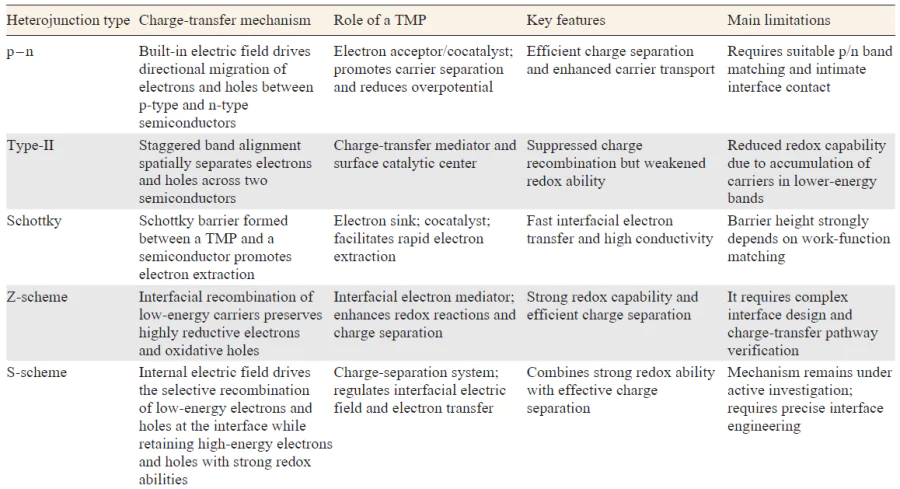
Heterojunction technology has become an effective strategy for enhancing semiconductor photocatalytic performance.[89-91] By coupling semiconductors with different electronic structures, heterojunctions allow optimizing band alignment, promote interfacial charge transfer, suppress electron-hole recombination, and broaden visible-light absorption, thereby improving quantum efficiency, carrier lifetime, and redox activity.[92] According to the band alignment and carrier-transfer pathway, heterojunctions are generally classified into p-n, Type-II, Schottky, Z-scheme, and S-scheme systems (Fig. 16). Heterojunction engineering is particularly important for TMP-based photocatalysts because TMPs possess metallic conductivity, tunable work functions, abundant active sites, and favorable hydrogen adsorption/desorption properties. In heterostructured systems, TMPs can act not only as cocatalysts for surface reactions but also as electron mediators and charge-separation centers, facilitating directional carrier migration and accelerating interfacial charge transfer. Different heterojunction architectures therefore provide distinct charge-transfer pathways and synergistic effects that enhances photocatalytic activity. Representative TMP-based heterojunction systems and their corresponding charge-transfer mechanisms are summarized in Table 1.
![[{"id":"pJvDueSwTA","type":"paragraph","data":{"text":"Schematic illustrations of charge transfer pathways in different heterojunction systems: Type-II (<i>a</i>), p – n (<i>b</i>), Schottky junction (<i>c</i>), Z-scheme (<i>d</i>), S-scheme (<i>e</i>). CB is conduction band, VB is valence band."}}]](/storage/images/resized/CL43C1PE0izVLYvWuuvalh0fy4ymSBp9KhOSxls3_xl.webp)
Among various heterojunction architectures, p – n heterojunction effectively promotes charge separation through the internal electric field generated at the interface between p-type and n-type semiconductors. The p – n junction constituted through a TMP is a very representative heterostructure.[93-95] Due to their unique metallic properties and low overpotentials, TMPs can induce e-transfer from the composites, enhancing photogenerated carrier separation and boosting the photocatalytic activity. Shi et al.[96] reported a Ni2P-modified NiO/g-C3N4 p – n heterojunction constructed via a one-step in situ phosphidation. The photocatalyst prepared using 100 mg of NaH2PO2 as the phosphidation reagent (denoted as NiO/Ni2P/CN-100) exhibited the highest photocatalytic activity, achieving a hydrogen evolution rate of 5.04 μmol h–1, which was 126 times higher than that of pristine g-C3N4 (0.04 μmol h–1) under visible-light irradiation. The remarkable enhancement originated from the synergistic effect of the p – n heterojunction and the Ni2P cocatalyst. The built-in electric field at the NiO/g-C3N4 interface promoted hole migration from the valence band of g-C3N4 to NiO, whereas photogenerated electrons were rapidly transferred from the conduction band of g-C3N4 to Ni2P, where they participated in proton reduction. This directional charge-transfer pathway effectively suppressed electron-hole recombination and accelerated interfacial charge transfer, which was further confirmed by photoluminescence (PL) and EIS measurements.
Type-II heterojunction has attracted substantial attention among a variety of heterojunction configurations because of its staggered band alignment, which enables the efficient migration of charge carriers and reduces recombination losses. This unique electronic configuration facilitates the transfer of photogenerated electrons from the CB of semiconductor II to that of semiconductor I, while holes migrate from the VB of semiconductor I to that of semiconductor II. The photocatalytic process is improved and the lifespan of charge carriers is increased because of this spatial charge separation.[97] Quang et al.[98] constructed a CoP/BiVO4/WO3 Type-II heterojunction photoanode for photoelectrochemical water splitting. In this system, the WO3 layer effectively extracted photoelectrons from BiVO4 and facilitated charge transport to the fluorine-doped tin oxide (FTO) substrate because of its high conductivity. Meanwhile, CoP NPs acted as both hole-transfer mediators and surface catalytic sites, promoting interfacial charge injection into water. As a result, the CoP/BiVO4/WO3 photoanode achieved a photocurrent density of 2.81 mA cm–2 at 1.23 V vs. reversible hydrogen electrode (RHE) and exhibited excellent operational stability over 5 h. These data demonstrate that Type-II heterojunction engineering is an effective strategy for enhancing interfacial charge separation and transfer efficiency, thereby improving the photoelectrochemical performance of TMP-based photocatalytic systems.
Schottky heterojunction is formed when a TMP contacts a semiconductor with suitable work-function differences, generating a Schottky barrier that promotes directional electron transfer and inhibits back recombination.[99][100] Owing to their metallic conductivity and favorable electronic structures, TMPs are widely used as Schottky cocatalysts in photocatalytic systems. Sun et al.[101] prepared FeP/CdS photocatalysts via an in situ phosphidation process, in which zero-dimensional (0D) FeP NPs were uniformly anchored onto CdS nanosheets. Electrochemical and spectroscopic analyses, including linear sweep voltammetry (LSV), EIS, PL, and time-resolved photoluminescence spectroscopy (TRPL), demonstrated that the intimate FeP/CdS Schottky interface effectively accelerated the separation and migration of photogenerated carriers, resulting in significantly enhancement of the photocatalytic H2 evolution activity and catalyst stability. Similarly, Han et al.[87] obtained CoP-decorated g-C3N4 nanosheets using a localized chemical deposition method. The formation of a CoP/g-C3N4 Schottky junction generated an internal electric field at the interface, which promoted efficient charge separation and directional carrier migration. Cheng et al.[102] reported a noble-metal-free Fe2P – Co2P/g-C3N4 photocatalyst with enhanced photocatalytic performance relative to pristine g-C3N4. The optimized Fe2P – Co2P/g-C3N4 composite exhibited an H2 evolution rate of 347 mmol h−1 g−1, which was 87 times higher than that of pristine g-C3N4. The remarkable enhancement in photocatalytic activity was attributed to the formation of an intimate Schottky junction between Fe2P – Co2P and g-C3N4, which provided efficient electron-transfer channels and promoted directional charge migration from g-C3N4 to the Fe2P – Co2P cocatalyst. Moreover, the synergistic interaction between Fe2P and Co2P generated a stronger interfacial driving force for charge transfer than that in the corresponding single-component Fe2P/g-C3N4 or Co2P/g-C3N4 system, resulting in substantially improved photocatalytic hydrogen evolution performance.
To overcome the reduced redox capability associated with conventional Type-II heterojunction, Z-scheme systems have been developed to simultaneously preserve highly reductive electrons and highly oxidative holes.[103] Inspired by natural photosynthesis, Z-scheme heterojunction promotes the recombination of low-energy charge carriers while retaining strongly reducing electrons and strongly oxidizing holes on the respective semiconductors, thereby maintaining high redox capability together with efficient charge separation.[104] Li et al.[105] reported a noble-metal-free Co2P/CdS Z-scheme photocatalyst with excellent photocatalytic hydrogen evolution performance. Compared with pristine CdS, Co2P, and Pt/CdS, the Co2P/CdS heterostructure exhibited superior photocatalytic activity. DFT calculations revealed the interfacial interaction between Co2P and CdS with the formation of strong Co – S bonds at the Co2P (112)/CdS (100) interface (Fig. 17a – e). Three representative interface models (A – C) with different atomic registries were constructed. In interface A, all interfacial S atoms are bonded to Co atoms, whereas in interfaces B and C, part of the interfacial Co atoms interact with Cd atoms. Among the three models, interface A exhibited the lowest Fermi level and the highest structural stability, indicating that strong Co – S bonding dominates the interfacial interaction. These robust interfacial interactions played a crucial role in promoting charge transfer and enhancing structural stability. The interfacial Co – S bonds acted as effective charge-transfer bridges, significantly accelerating carrier separation and improving overall photocatalytic H2 production efficiency (Fig. 17f, g).
![[{"id":"5QO5t0Myz_","type":"paragraph","data":{"text":"Interfacial structure and charge transfer mechanisms in TMP-based heterojunction photocatalysts. Top view of the 4 × 2 CdS (100) unit cell (<i>a</i>). 2 × 2 Co2P (112) unit cell (<i>b</i>). Interface models A (<i>c</i>), B (<i>d</i>), and C (<i>e</i>). Cd, Co, S, and P atoms are shown in dull yellow, blue, yellow, and purple correspondingly. Red dashed lines mark the CdS (100)/Co<sub>2</sub>P (112) interface. Band structure schematic of Co<sub>2</sub>P and CdS (<i>f</i>). Charge transfer mechanisms of Co<sub>2</sub>P/CdS under UV-Vis and near-infrared (NIR) light (<i>g</i>). Reproduced from Li et al.<sup>105</sup> with permission from the American Chemical Society."}}]](/storage/images/resized/Smy8MOsxfC4FUeDFJYK02rENIKOWPj4ynyFTTZhW_xl.webp)
More recently, S-scheme heterojunction has attracted increasing attention because it simultaneously gives efficient charge separation and strong redox capability.[106] Unlike Type-II heterojunction, S-scheme systems selectively recombine low-energy electrons and holes while retaining highly energetic charge carriers for photocatalytic reactions.[107-109] This charge-transfer behavior is driven by band bending and the internal electric field (IEF) established at the interface after intimate contact between oxidation and reduction photocatalysts. Specifically, electrons spontaneously migrate from the semiconductor with a higher Fermi level to that with a lower Fermi level, generating an interfacial electric field that promotes directional carrier migration and preserves strong redox potentials.[110] Zhang et al.[111] prepared an S-scheme MoP@MoO3 heterojunction via an in situ phosphidation process using MoO3 NPs as the precursor. During phosphidation, surface oxygen atoms in MoO3 were gradually replaced by phosphorus atoms to form Mo – P bonds, resulting in a core-shell MoP@MoO3 heterostructure with strong interfacial coupling. The heterojunction with the optimal MoP content exhibited markedly enhanced photocatalytic hydrogen evolution activity compared with pristine MoO3 , owing to its improved charge-transfer capability and a high density of interfacial active sites. The S-scheme charge-transfer pathway effectively promoted charge separation while preserving the strong redox ability of photogenerated charge carriers. DFT calculations and experimental data confirmed the formation of an efficient S-scheme charge-transfer pathway, highlighting the importance of interfacial engineering in hybrid phosphide-based photocatalysts (Fig. 18). Jiang et al.[112] prepared Ni2P/In2O3 composite photocatalysts via a one-step calcination-phosphidation process. The resulting heterostructure retained the lamellar morphology inherited from the Ni – MOF-74 precursor and formed a tightly coupled S-scheme interface between Ni2P and In2O3. The composite with the optimal Ni2P loading exhibited markedly enhanced photocatalytic hydrogen evolution activity compared with pristine In2O3, owing to more efficient charge separation, accelerated interfacial electron transfer, and the preservation of strong redox capability through the S-scheme charge-transfer pathway. Li et al.[113] fabricated a Ni2P@NiAl – LDH S-scheme heterojunction photocatalyst by embedding Ni2P NPs into a three-dimensional NiAl – LDH framework via a facile stirring-assisted phosphidation process. Specifically, Ni2P was first obtained by phosphidation of a NiAl – LDH precursor with NaH2PO2 at 300°C for 2 h under a N2 atmosphere. The resulting Ni2P and NiAl – LDH powders were then dispersed in ethanol, followed by stirring-assisted solvent evaporation to achieve intimate interfacial contact and form the Ni2P@NiAl – LDH heterojunction. The introduction of Ni2P not only created abundant three-dimensional reactive sites for photogenerated carriers but also effectively regulated the interfacial charge-transfer pathway through the S-scheme mechanism. Photoelectrochemical analyses further demonstrated that the incorporation of Ni2P reduced the hydrogen-evolution overpotential and accelerated photoelectron transport, thereby significantly improving photocatalytic efficiency.
![[{"id":"p6N2dE5Lq0","type":"paragraph","data":{"text":"Electronic structure and S-scheme charge transfer in the MoP@MoO<sub>3</sub> heterojunction. Model structure of MoO<sub>3</sub> (<i>a</i>) and MoP (<i>b</i>). Gray, red, and blue spheres represent Mo, O, and P atoms, respectively. Electronic band structure and density of states (DOS) of MoO<sub>3</sub> (<i>c</i>) and MoP (<i>d</i>). Electrostatic potential profiles along the z-direction for MoO<sub>3</sub> (<i>e</i>) and MoP (<i>f</i>). Schematic illustration of the electron transfer pathway in the MoP@MoO<sub>3</sub> S-scheme heterojunction (<i>g</i>). Reproduced from Zhang et al.<sup>111</sup> with permission from the Royal Society of Chemistry."}}]](/storage/images/resized/uhpXByPrTKAMPzQM5s9LLOzv08mXX3m2w5ie9LdC_xl.webp)
4.5. Hybridization with advanced materials
Composites based on metal phosphides and MOFs represent an innovative approach to creating materials with enhanced properties that combine the advantages of both components. Such composites are typically realized by embedding metal phosphide NPs into the pores or structures of MOFs. Antil et al.[114] prepared hollow ZnCo – MOF rings decorated with uniformly distributed TMP NPs, including NiCoP, FeCoP, Ni2P, and CoP, as noble-metal-free cocatalysts for visible-light-driven hydrogen evolution. Among the obtained composites, NiCoP@ZnCo – MOF exhibited the highest photocatalytic activity, delivering a hydrogen evolution rate of 8580 μmol h−1 g−1, which was approximately 16 times higher than that of pristine ZnCo – MOF and significantly superior to the corresponding physical mixture of NiCoP and ZnCo – MOF as well as Pt@ZnCo – MOF. The enhanced performance was attributed to efficient interfacial charge separation and electron transfer across the NiCoP/ZnCo – MOF heterointerface, together with the accelerated HER provided by the NiCoP cocatalyst through lowering the activation energy for proton reduction. Ouyang et al.[115] obtained novel rod-like photocatalysts (Co3O4/CoO/Co2P) using Co – MOF-74 as a precursor (Fig. 19a). The resulting materials exhibited significantly enhanced hydrogen evolution performance under visible light irradiation compared to pristine Co3O4. Upon illumination, photogenerated electrons are transferred from the Co3O4 and CoO components to the Co2P cocatalyst, at the surface of which they participate in reduction reactions to drive hydrogen production. Both DFT calculations and spectroscopic analysis indicate that this improved activity is connected to the prolonged lifespan of the photogenerated carriers and improved efficiency in charge transfer (Fig. 19b – f ). The novel structural and interfacial designs presented in this study could act as a guideline for the widespread creation of metal oxide/metal phosphide homo-metal composites specifically engineered for photocatalytic uses. Song et al.[116] synthesized an adherent MoP – Cu3P heterostructured photocatalyst through a simple one-step MOF-assisted phosphidation strategy, in which the MOF precursor served as a sacrificial template to construct intimate interfacial contact between MoP and Cu3P. Such a heterointerface effectively facilitated the separation and migration of photogenerated charge carriers, significantly increasing photocatalytic H2 evolution rate of 855 μmol h−1 g−1, approximately 3.3 times that of pristine Cu3P. The enhanced light-harvesting capability and accelerated charge transfer were further verified by UV-Vis diffuse reflectance spectroscopy (UV-Vis DRS), PL, transient photocurrent response (TPC), and EIS analyses.
![[{"id":"T9rWDce0i1","type":"paragraph","data":{"text":"Construction of ternary heterojunctions and built-in electric field in Co<sub>3</sub>O<sub>4</sub>/CoO/Co<sub>2</sub>P composites. The preparation of porous rod-shaped Co<sub>3</sub>O<sub>4</sub>/CoO/Co<sub>2</sub>P composite (<i>a</i>). Electrostatic potentials of the Co<sub>3</sub>O<sub>4</sub> (311) surface (<i>b</i>), Co<sub>2</sub>P (121) surface (<i>c</i>), and CoO (111) surface (<i>d</i>) before contact (<i>e</i>) and after contact (<i>f</i>) for the establishment of built-in electric field and ternary heterojunctions. Reproduced from Ouyang et al.<sup>115</sup> with permission from Elsevier."}}]](/storage/images/resized/Qb7fIJ5F2EDuqQdrbZALO4JAttfsyg4vr6jAMNs0_xl.webp)
TMPs mainly act as interfacial electron bridges in ternary components to provide electron transfer channels, promote photogenerated carrier separation, and improve photocatalytic H2 production performance.[117][118] Lu et al.[117] obtained a series of samples, among which g-C3N4 – 1% Ni2P – 1.5% MoS2 stood out, demonstrating an impressive H2 evolution rate of 532.41 mmol h–1 g–1, showing an increase by factors of 2.47 and 5.15 over g-C3N4 – 1.5% MoS2 and g-C3N4 – 1% Ni2P, respectively. A range of analyses, including PL, TPC, EIS, and polarization curves, showed that MPx (MPx, where M = Fe, Co, or Ni) not only functioned as a conventional cocatalyst by reducing the overpotential to enhance hydrogen production but also acted as an efficient electron transfer channel. This facilitated a more effective transfer of electrons from the active sites of g-C3N4 to MoS2, resulting in a remarkable increase in hydrogen production. He et al.[118] further reported a ternary CdS/Ni2P/g-C3N4 heterojunction, where Ni2P functions as an electron mediator to accelerate interfacial charge transfer. Under visible-light irradiation with TEOA as a sacrificial agent for hole scavenging, electrons generated in the CB of g-C3N4 are transferred via Ni2P to CdS, leading to significantly improved charge separation efficiency and enhanced hydrogen evolution activity. This study highlights the crucial role of TMPs in regulating interfacial electron transfer pathways in multicomponent photocatalytic systems. The representative hydrogen evolution performances of TMP-based/g-C3N4 photocatalysts are summarized in Table 2[119-131].
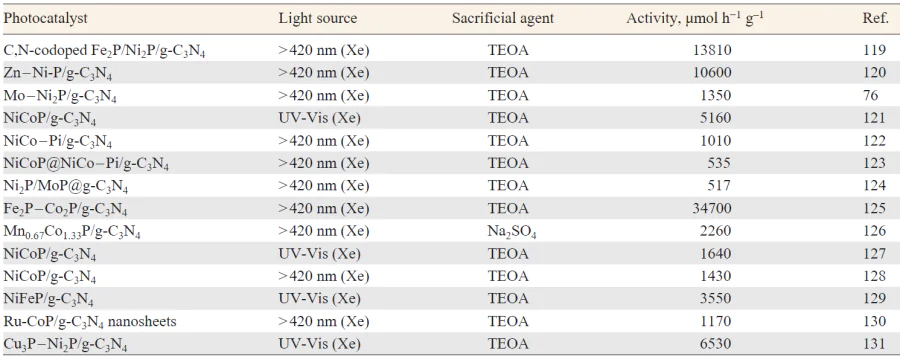
The unique electronic properties of two-dimensional TMPs have attracted considerable attention for constructing LDH-based hybrid photocatalysts. Zhao et al.[132] fabricated ZnCdS/NiCoP heterostructures by decorating ZnCdS with two-dimensional NiCoP nanosheets derived from phosphidation of NiCo-LDH precursors. Among the resulting samples, ZnCdS – 8% NiCoP exhibited the highest photocatalytic H2 evolution activity compared with samples containing lower or higher NiCoP loadings, indicating an optimal interfacial coupling between ZnCdS and NiCoP. This enhanced performance was attributed to the efficient charge separation and accelerated interfacial electron transfer facilitated by the conductive NiCoP nanosheets. By integrating experimental results with DFT calculations, a directional charge-transfer pathway across the ZnCdS/NiCoP interface was proposed. Specifically, photogenerated electrons were transferred from ZnCdS to NiCoP through the intimate heterointerface, where NiCoP served as an efficient electron acceptor and catalytic center, accelerating electron accumulation and providing active sites for proton reduction during photocatalytic H2 evolution. Similarly, Sun et al.[133] reported a Ni2P/NiCo-LDH composite photocatalyst exhibiting significantly improved visible-light-driven hydrogen evolution activity compared with individual components. The enhanced performance was closely associated with strong interfacial interactions between Ni2P and NiCo-LDH, which effectively reduced charge-transfer resistance and promoted photogenerated carrier separation. XPS analysis suggested the formation of interfacial electronic interactions involving Co and P species, which contributed to optimized charge redistribution at the heterointerface. These results demonstrate that constructing TMP/LDH heterostructures is an effective strategy to regulate interfacial charge transfer and enhance photocatalytic performance.
5. Photocatalytic applications of TMPs
5.1. Hydrogen production
TMPs have emerged as one of the most promising noble-metal-free cocatalysts for photocatalytic HER owing to their Pt-like electronic structures, abundant active sites, excellent electrical conductivity, and suitable hydrogen adsorption energies. Beyond serving as catalytic centers for proton reduction, TMPs can effectively broaden visible-light absorption, lower the overpotential for H2 evolution, accelerate interfacial electron extraction, and suppress charge recombination, thereby substantially improving both the activity and stability of semiconductor photocatalysts.[134] Recent studies demonstrate that the performance of TMP-based photocatalysts can be further optimized through cocatalyst morphology regulation, electronic structure engineering, heteroatom modulation, and interface design.[135]
One effective strategy is to optimize the morphology and composition of TMP cocatalysts to maximize active-site exposure and facilitate charge transport. Lv et al.[136] synthesized ultrathin porous NiCoP nanosheets through a pH-controlled wet-chemical route and employed them as cocatalysts for CdS. Owing to their ultrathin architecture and large specific surface area, the optimized 7.5 wt.% NiCoP/CdS composite exhibited a markedly higher hydrogen evolution rate than both pristine CdS and Pt/CdS (Fig. 20a). Photoluminescence measurements revealed significantly suppressed radiative recombination after NiCoP loading (Fig. 20b), while Mott-Schottky and KPFM analyses enabled construction of the interfacial band alignment (Fig. 20c – e). Under visible-light irradiation, photogenerated electrons rapidly migrated from CdS to the conductive NiCoP nanosheets, where proton reduction occurred efficiently (Fig. 20f ). This work demonstrates that rational morphology engineering of bimetallic phosphides effectively promotes interfacial electron transfer while simultaneously increasing the density of accessible catalytic sites.
![[{"id":"1NRCKezyLh","type":"paragraph","data":{"text":"Charge transfer behavior and enhanced photocatalytic H<sub>2</sub> evolution in TMP-based cocatalyst systems. Photocatalytic H<sub>2 </sub>evolution rates for CdS containing different amounts of a cocatalyst and 7.5 wt.% Pt/CdS under visible light irradiation (<i>a</i>). PL spectra of CdS and NiCoP/CdS (<i>b</i>). Mott-Schottky plots of CdS (<i>c</i>). Surface potential mappings of NiCoP (<i>d</i>). Energy level diagram of CdS and NiCoP (<i>e</i>). Schematic illustration of the photogenerated charge transfer between CdS with NiCoP cocatalyst under visible light irradiation (λ≥420 nm) (<i>f</i>). Reproduced from Lv et al.<sup>136</sup> with permission from Wiley."}}]](/storage/images/resized/7iEwKnFCzhP4wEtSEi9CgpT56QtRq3dySIgCGzfw_xl.webp)
Beyond conventional inorganic semiconductors, integrating TMPs with emerging porous photocatalysts offers another effective route to improve hydrogen evolution performance. Yan et al.[137] rationally integrated two-dimensional TpPa-1-COF with three representative transition metal phosphides, namely Ni12P5, Ni2P, and CoP, to construct Ni12P5/TpPa-1-COF, Ni2P/TpPa-1-COF, and CoP/TpPa-1-COF hybrid photocatalysts. The incorporation of TMPs into the TpPa-1-COF framework enabled efficient electron extraction and accelerated interfacial charge transfer, thereby markedly improving photocatalytic water-splitting performance. Notably, Ni12P5/TpPa-1-COF exhibited the highest activity, attributed to its abundant surface-active sites and reduced energy barrier for H formation, delivering a hydrogen evolution rate of 31.6 μmol h−1, approximately 19 times higher than that of pristine TpPa-1-COF (1.65 μmol h−1) and comparable to Pt/TpPa-1-COF (38.8 μmol h−1). This work represents the first successful integration of TMPs with COFs for photocatalytic water splitting and highlights the potential of combining porous crystalline frameworks with transition-metal phosphides to construct efficient noble-metal-free photocatalysts.
Electronic structure engineering has recently emerged as an effective strategy for further enhancing the intrinsic catalytic activity of TMP-derived active sites. Cheng et al.[138] precisely regulated the local coordination environment of single Fe atoms by introducing electron-rich phosphorus atoms as a unique asymmetrical FeN3P2 – CN motif into graphitic carbon nitride. Without any noble-metal cocatalyst or photosensitizer, FeN3P2 – CN achieved a hydrogen evolution rate of 2668.5 μmol g–1 h–1 under visible-light irradiation (> 420 nm), exceeding that of the conventional FeN4 counterpart by more than two orders of magnitude. Comprehensive experimental characterizations combined with DFT calculations revealed that phosphorus incorporation narrowed the bandgap, reduced the work function from 3.58 to 3.03 eV, and promoted electron transfer toward the Fe active centers, thereby enhancing visible-light harvesting and charge separation (Fig. 21a – c). Charge-density-difference analysis further confirmed stronger electronic interactions between Fe and the surrounding N/P ligands. More importantly, DFT calculations demonstrated that the asymmetric FeN3P2 coordination significantly facilitated water activation by reducing the energy barrier for the rate-determining H2O dissociation step from 0.88 to 0.57 eV. Meanwhile, the ΔGH* value approached thermoneutral conditions, indicating more favorable hydrogen adsorption/desorption kinetics (Fig. 21d – f ). These results highlight that tailoring the local electronic configuration of TMP-derived active centers provides an effective route to simultaneously optimize charge transport and reaction energetics.
![[{"id":"a_6gZV86nB","type":"paragraph","data":{"text":"Electronic structure modulation and hydrogen evolution thermodynamics of FeN<sub>3</sub>P<sub>2</sub> – CN and FeN<sub>4</sub> – CN. Charge density difference of FeN<sub>3</sub>P<sub>2</sub> – CN (<i>a</i>) and FeN<sub>4</sub> – CN (<i>b</i>) (yellow and cyan stand for charge accumulation and depletion, respectively). Work functions of FeN<sub>3</sub>P<sub>2</sub> – CN and FeN<sub>4</sub> – CN (<i>c</i>). Charge density difference of FeN<sub>3</sub>P<sub>2</sub> – CN (<i>d</i>) and FeN<sub>4</sub> – CN (<i>e</i>) with H<sub>2</sub>O molecule adsorption. Gibbs free energy diagram for H<sub>2</sub> production reaction (<i>f</i>). Reproduced from Cheng et al.<sup>138</sup> with permission from Wiley."}}]](/storage/images/resized/OyVCvgiaIr74S7xl5c4wX90y0ciL4Y4talcE0XoG_xl.webp)
Sun et al.[139] constructed a Schottky heterojunction by in situ growing ZnIn2S4 nanosheets on Co-doped FeP nanorods. XPS, XAFS analysis, and DFT calculations revealed that trace Co doping modified the chemical bonding and Fermi-level alignment at the FeP/ZnIn2S4 interface, leading to the formation of dual electron-transfer bridges through Fe – S and Zn – P bonds. The resulting Schottky junction generated a built-in electric field that effectively suppressed electron backflow while the dual interfacial transport channels accelerated electron migration from ZnIn2S4 to FeP. Consequently, the optimized Co2.5 – FeP/ZnIn2S4 photocatalyst delivered an H2 evolution rate of 9.9 ± 0.1 mmol g–1 h–1, which is approximately 12.4 times that of pristine ZnIn2S4, together with an apparent quantum yield of 11 ± 1% at 365 nm. This work demonstrates that rational interfacial electronic coupling, combined with heteroatom doping, offers an effective strategy to maximize charge-separation efficiency in TMP-based photocatalysts. These studies demonstrate that the outstanding hydrogen evolution performance of TMP-based photocatalysts arises from the synergistic optimization of active sites, electronic structures, and interfacial charge-transfer pathways. Nevertheless, balancing catalytic activity, long-term stability, and scalable catalyst fabrication remains a key challenge for the practical application of TMP-based photocatalytic hydrogen evolution.
5.2. Photocatalytic CO2 reduction
Utilizing photocatalysis for CO2 conversion into value-added chemicals such as hydrocarbons has attracted significant attention as a sustainable strategy for solar energy utilization and carbon neutrality.[140-142] As efficient and low-cost cocatalysts, TMPs exhibit great potential in enhancing CO2 photoreduction performance by promoting charge separation, accelerating surface reaction kinetics, and modulating adsorption/activation of CO2 molecules. Tang et al.[143] developed a visible-light-responsive MoP cocatalyst supported on a g-C3N4 photocatalyst for photocatalytic CO2 reduction. The resulting 15 wt.% MoP/g-C3N4 composite exhibited significantly enhanced CO2 photoreduction performance compared with pristine g-C3N4, indicating the effective role of MoP in promoting CO2 conversion activity. The improved photocatalytic performance was attributed to efficient interfacial charge separation and enhanced electron transfer induced by the MoP cocatalyst. Under simulated visible-light irradiation (λ > 420 nm), the catalyst achieved apparent quantum efficiencies of 3.5% for CO2 reduction. In situ FTIR analysis confirmed the adsorption and activation of CO2, with COO– identified as the key reaction intermediate, suggesting the formation of reduced carbon species during the reaction process. These results, together with DFT calculations, further demonstrate that MoP facilitates interfacial charge transfer and enhances reaction kinetics in the g-C3N4-based CO2 photoreduction system.
Gao et al.[144] reported the synthesis of atomically thin CuInP2S6 layers with a thickness of ~ 0.81 nm. The charge-enriched Cu – In dual sites at the monolayer edges exhibit a tandem synergistic effect, enabling highly efficient and selective ethylene formation. In contrast, the basal plane exposes sulfur atoms, which are ineffective for CO2 photoreduction due to the high energy barrier associated with proton-coupled electron transfer to *COOH (Fig. 22a – d ). Under visible-light irradiation, CO2 is primarily reduced to *CO, which migrates to neighboring Cu sites where C – C coupling occurs under thermodynamically and kinetically favorable conditions, yielding ethylene (C2H4) with a selectivity of ~74.6% and a yield of ~56.4% (Fig. 22e). The ultrathin monolayer structure further minimizes the electron transport distance from the interior to the surface, suppresses electron-hole recombination, and allows electrons to accumulate at exposed active sites, thereby enhancing CO2 reduction (Fig. 22f ). These studies demonstrate that the performance of TMP-based photocatalysts is governed by the synergistic regulation of charge transfer and CO2 activation. However, balancing catalytic activity and product selectivity remains a key challenge because of the complexity of multielectron CO2 reduction.
![[{"id":"gEAqFWScRr","type":"paragraph","data":{"text":"Reaction pathway and photocatalytic CO<sub>2</sub> reduction mechanism on CuInP<sub>2</sub>S<sub>6</sub>. CO<sub>2</sub> reduction to CO on the CuInP<sub>2</sub>S<sub>6</sub> edge (<i>a</i>). CO migration to Cu sites and further reduction to CHO (<i>b</i>). Kinetic pathway of CO transfer and C – C coupling (<i>c</i>). Gibbs free energy profile for *CO – CHO coupling to C<sub>2</sub>H<sub>4</sub> with intermediates shown in the insets (<i>d</i>). Photocatalytic CO<sub>2</sub> conversion performance including product yield, selectivity distribution, reaction rate, and product evolution comparison (<i>e</i>). BC is basal plane, ML is ultrathin monolayer structure. Schematic pathway of CO<sub>2</sub> reduction on CuInP<sub>2</sub>S<sub>6</sub> edges (<i>f</i>). Reproduced from Gao et al.<sup>144</sup> with permission from Wiley."}}]](/storage/images/resized/7L8AjaIcQgjEFsOWrkY63ngLp7aayWBDPEhkiSlo_xl.webp)
5.3. Photocatalytic nitrogen fixation
Converting atmospheric nitrogen into ammonia is essential for sustaining biological processes and chemical synthesis. However, the strong N≡N triple bond makes nitrogen activation thermodynamically and kinetically challenging, requiring efficient photocatalytic systems capable of operating under ambient conditions.[145] Shiraishi et al.[146] reported a Ni2P-loaded boron-doped graphitic carbon nitride composite (Ni2P/BCN, where BCN is boron-doped g-C3N4) for photocatalytic nitrogen fixation. The photocatalyst was evaluated in pure water under simulated solar irradiation (λ > 300 nm) at 293 K while continuously bubbling N2 through the suspension. Compared with pristine CN, both boron doping and Ni2P loading markedly enhanced NH3 generation, whereas the Ni2P/BCN composite exhibited the highest activity due to the synergistic effect of boron doping and the Ni2P cocatalyst. In a closed gas-circulation system containing 40 kPa N2, 15.4 μmol of NH3 was produced after 48 h of irradiation, accompanied by 17.2 μmol of O2 and 8.4 μmol of H2, confirming the stoichiometric coupling of nitrogen reduction and water oxidation. Boron doping shifts the valence-band position of g-C3N4, enhancing the water oxidation ability of photogenerated holes and improving charge balance. Meanwhile, Ni2P functions as an efficient electron cocatalyst by extracting conduction-band electrons from BCN and facilitating their transfer to adsorbed N2 molecules, thereby promoting N2 activation and reduction. Consequently, the Ni2P/BCN photocatalyst achieved a photochemical conversion efficiency of 0.010% (Fig. 23). This work highlights the potential of TMPs as electron cocatalysts for photocatalytic nitrogen fixation by promoting charge separation and facilitating electron transfer to adsorbed N2 molecules. However, the reported NH3 production efficiency remains relatively low compared with other photocatalytic reduction reactions, reflecting the intrinsic difficulty of N2 activation under ambient conditions. Moreover, accurately distinguishing photocatalytically generated NH3 from potential contamination remains a critical challenge, emphasizing the need for rigorous experimental protocols and reliable isotope-labeling verification. These observations suggest that further improvements in N2 adsorption, activation, and interfacial electron transfer are essential for enhancing the efficiency and reliability of TMP-based photocatalytic nitrogen fixation.
![[{"id":"LgWV3fmJr8","type":"paragraph","data":{"text":"Photocatalytic N<sub>2</sub> reduction performance and mechanism of the Ni<sub>2</sub>P/BCN catalyst. Proposed mechanism of photocatalytic N<sub>2</sub> reduction on Ni<sub>2</sub>P/BCN (<i>a</i>). Schematic of the Ni<sub>2</sub>P/BCN catalyst (<i>b</i>). NH<sub>3</sub> production over time under light irradiation (<i>c</i>). Conditions: 100 mL H<sub>2</sub>O, 200 mg catalyst, N<sub>2</sub> flow 0.3 L min<sup>–1</sup>, λ > 300 nm, 293 K. Reproduced from Shiraishi et al.<sup>146</sup> with permission from the American Chemical Society."}}]](/storage/images/resized/8HWixcUwmrn3UzBjULZDq7MtYJFCIK7wcZdBMts4_xl.webp)
5.4. Degradation of organic pollutants
The importance of developing efficient photocatalysts is paramount in addressing environmental pollution issues.[147] Shi et al.[148] constructed a 0D/2D heterojunction by integrating 0 D Cu3P quantum dots (3 – 8 nm) onto 2D BiOCl nanosheets via a self-assembly strategy. The resulting Cu3P/BiOCl composite exhibited significantly higher photocatalytic performance in comparision with pristine BiOCl for the degradation of multiple antibiotics, including tetracycline hydrochloride (TC), oxytetracycline, and ofloxacin. Under full-spectrum irradiation, approximately 86% of TC was removed within 6 min, whereas pristine BiOCl showed a much lower degradation efficiency (62%) under the same conditions (Fig. 24a). The superior photocatalytic activity was attributed to the formation of an S-scheme heterojunction, which promotes efficient spatial separation of photogenerated charge carriers and preserves strong redox potentials for surface reactions. In this structure, Cu3P quantum dots serve as cocatalytic sites that facilitate charge transfer and provide additional active sites for pollutant adsorption and degradation, thereby improving overall reaction kinetics (Fig. 24b).
![[{"id":"Q9NE88vRqe","type":"paragraph","data":{"text":"Photocatalytic pollutant degradation and reactive species generation in TMP-based heterojunction systems. Degradation of antibiotics and corresponding pseudo-first-order kinetic fitting, where k represents the apparent rate constant of the reaction (<i>i</i>). TC degradation pathway on Cu<sub>3</sub>P/BiOCl (<i>b</i>). Reproduced from Shi et al.<sup>148</sup> with permission from the Elsevier. Trapping of reactive species during bisphenol A (BPA) photodegradation (<i>c</i>). AO is ammonium oxalate (h<sup>+</sup> scavenger), BQ is benzoquinone (<sup>•</sup>O<sub>2</sub><sup>–</sup> scavenger), IPA is isopropanol (<sup>•</sup>OH scavenger). Electron paramagnetic resonance spectra of DMPO – <sup>•</sup>O<sub>2</sub><sup>–</sup> (<i>d</i>) and TEMPO (<i>e</i>) under dark and light. DMPO (5,5-dimethyl-1-pyrroline N-oxide) serves as a spin-trapping agent for <sup>•</sup>O<sub>2</sub><sup>–</sup> radicals, and TEMPO (2,2,6,6-tetramethylpiperidine 1-oxyl) acts as a probe for photogenerated h<sup>+</sup>. Schematic band structure of the NiCoP/Bi<sub>4</sub>O<sub>5</sub>Br<sub>2</sub> heterojunction before contact, after contact, and under light irradiation, referenced to the vacuum energy level (Vac) with Bi<sub>4</sub>O<sub>5</sub>Br<sub>2</sub> and NiCoP denoted as the oxidation-type photocatalyst (OP) and reduction-type photocatalyst (RP), respectively, (<i>f</i>). Surface configuration and charge density of Bi<sub>4</sub>O<sub>5</sub>Br<sub>2</sub> (<i>g</i>), Ni<sub>2</sub>P (<i>h</i>), and NiCoP (<i>i</i>) with O<sub>2</sub>. BL is the O – O bond length. Reproduced from Yang et al.<sup>149</sup> with permission from Elsevier."}}]](/storage/images/resized/IhI8D7DI9k4hZn6DU7FUjqUqU9gVhO8fpLAStx3K_xl.webp)
Yang et al.[149] developed a liquid-phase assembly strategy to load bifunctional TMP cocatalysts, including Ni2P, Co2P, and NiCoP, onto Bi4O5Br2 nanosheets. The optimized 15% NiCoP/Bi4O5Br2 heterojunction exhibited excellent photocatalytic performance for visible-light-driven aerobic degradation of phenolic pollutants in aqueous environments. Scavenger experiments confirmed that photogenerated holes (h+) and superoxide radicals (•O2–) are the primary reactive species responsible for pollutant degradation (Fig. 24c – e). Both theoretical calculations and experimental results demonstrated that the introduction of NiCoP induces an S-scheme charge transfer pathway in the heterojunction, leading to more efficient charge separation compared with pristine Bi4O5Br2 and improved accumulation of oxidative holes for pollutant mineralization (Fig. 24f ). To further understand oxygen activation behavior, adsorption energies of O2 on Bi4O5Br2, Ni2P, and NiCoP were calculated. The optimized adsorption configurations (Fig. 24g – i ) indicate that NiCoP provides the most favorable site for O2 activation, highlighting its dominant role in promoting interfacial redox reactions.
These studies demonstrate that TMPs enhance photocatalytic pollutant degradation primarily by promoting interfacial charge separation and facilitating O2 activation through strong electronic coupling with semiconductor photocatalysts. However, current investigations remain largely focused on model organic pollutants under laboratory conditions, while the degradation of complex wastewater matrices, catalyst durability, and mineralization efficiency have received comparatively less attention. In addition, the specific role of phosphorus in regulating interfacial electronic structures and reactive oxygen species generation has yet to be fully elucidated. Addressing these issues will be essential for translating TMP-based photocatalysts from laboratory studies to practical environmental applications.
5.5. Comparison of TMPs with noble-metal and other non-noble-metal cocatalysts
Noble metals such as Pt, Au, and Pd are widely regarded as benchmark cocatalysts for photocatalytic hydrogen evolution because of their near-optimal hydrogen adsorption energies, excellent catalytic kinetics, and efficient electron-extraction capability.[150][151] However, their high cost, limited abundance, and poor scalability have stimulated the search for earth-abundant alternatives. Among them, TMPs have emerged as one of the most promising candidates, offering metallic conductivity, tunable electronic structures, and numerous catalytically active sites at a substantially lower cost. The strong metal-phosphorus interaction effectively modulates the electronic structure of the metal centers, optimizing the adsorption of reaction intermediates while facilitating interfacial charge transfer. Beyond these intrinsic advantages, numerous studies have demonstrated that TMP-based cocatalysts can deliver photocatalytic hydrogen evolution performances comparable to those of Pt-loaded photocatalysts across diverse semiconductor systems, including CdS, g-C3N4, and TiO2. For example, Ni2P-, CoP-, and MoP-based cocatalysts have been reported to achieve hydrogen evolution activities approaching those of Pt while maintaining excellent stability and significantly reducing material cost.[152-154] Representative comparisons between noble-metal and non-noble-metal cocatalysts are summarized in Table 3.
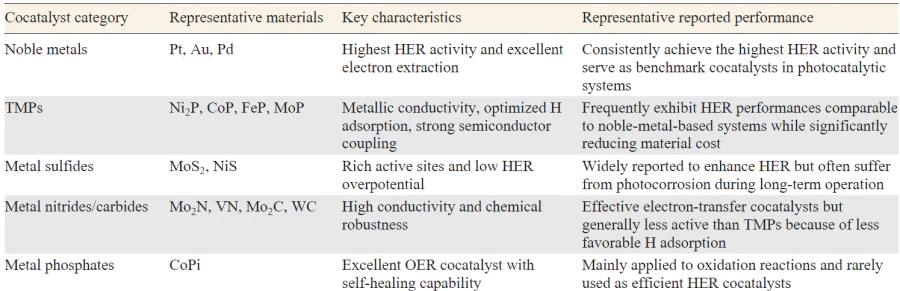
Besides TMPs, several classes of non-noble-metal cocatalysts, including transition metal sulfides, nitrides, carbides, and phosphates, have also been extensively investigated. Metal sulfides (e.g., MoS2 and NiS) have abundant active sites and low overpotentials for hydrogen evolution but are often susceptible to photocorrosion and limited long-term stability.[155][156] Transition metal nitrides and carbides exhibit high electrical conductivity and excellent chemical robustness. However, compared with TMPs and noble metals, they generally exhibit less favorable hydrogen adsorption energetics and weaker electronic coupling with semiconductor photocatalysts, which may limit interfacial charge transfer and hydrogen evolution kinetics. Metal phosphates, represented by the self-healing cobalt-phosphate oxygen-evolving catalyst (CoPi), are highly effective cocatalysts for oxygen evolution but generally exhibit limited activity toward hydrogen evolution. As summarized in Table 3, reported studies consistently demonstrate that TMPs provide a favorable balance between catalytic activity, electrical conductivity, semiconductor coupling, long-term stability, and cost-effectiveness compared with other representative non-noble cocatalysts, highlighting their considerable potential as practical noble-metal-free cocatalysts for photocatalytic hydrogen evolution.
Despite these advantages, further enhancement of the long-term operational performance of TMPs remains necessary. Current studies generally demonstrate good short-term stability, with most TMP-based photocatalysts retaining over 90% of their initial photocatalytic activity after several reaction cycles or tens of hours of continuous irradiation. However, gradual performance degradation may still occur during prolonged operation because of surface oxidation, structural reconstruction, phosphorus leaching, and interfacial degradation. Future research should therefore focus on improving their durability through interface engineering, surface protection, and compositional regulation. Meanwhile, integrating advanced theoretical calculations with operando characterization techniques will provide deeper insights into phosphorus-mediated catalytic mechanisms and guide the rational design of highly efficient and durable TMP-based photocatalysts for practical solar energy conversion.
6. Conclusion
TMPs have emerged as promising photocatalytic materials owing to their tunable electronic structures, high intrinsic catalytic activity, and structural versatility. Significant progress has been achieved in the rational design of TMPs with tailored phases, morphologies, and electronic properties, leading to enhanced light harvesting, charge separation, and catalytic activity. Meanwhile, advances in theoretical calculations and in situ/operando characterization have provided valuable insights into the structure – activity relationships governing photocatalytic performance. Consequently, TMP-based photocatalysts have demonstrated broad potential in hydrogen evolution, CO2 reduction, pollutant degradation, and selective organic transformations.
Despite these advances, several challenges remain before TMP-based photocatalysts can be translated into practical applications. Future research should focus on the following aspects:
(1) Developing green, safe, and scalable synthesis strategies. Conventional phosphidation methods often rely on toxic phosphorus sources, while safer alternatives still face challenges in phase control and crystallinity. Developing environmentally benign and precisely controllable synthesis routes is therefore essential.
(2) Expanding compositional and structural diversity. Future efforts should explore multimetallic phosphides, metastable phases, defect-engineered structures, and hierarchical heterostructures. Combining high-throughput computation with advanced synthesis can accelerate the discovery of high-performance TMPs.
(3) Enhancing long-term stability. Surface oxidation, reconstruction, and photocorrosion remain major obstacles under practical operating conditions. Advanced in situ/operando characterization together with theoretical modeling will be critical for understanding catalyst evolution and guiding stability engineering.
(4) Advancing integrated photocatalytic systems. Rational integration of TMPs with semiconductors, carbon materials, MOFs, COFs, and other functional materials can further improve light utilization, charge transfer, catalytic efficiency, and durability. Data-driven design combined with theoretical and experimental studies will facilitate the development of efficient and application-oriented TMP-based photocatalysts.
Continued advances in synthetic strategies, interface engineering, and mechanistic understanding will pave the way for the rational design and practical implementation of TMP-based photocatalysts in sustainable solar energy conversion and environmental remediation.
The authors declare that they have no known competing financial interests or personal relationships that could have appeared to influence the work reported in this paper.
This work was supported by the National Natural Science Foundation of China (52272287), and Yunnan Fundamental Research Projects (202401CF070036).
7. List of abbreviations
BAD — benzaldehyde;
BCN — boron-doped g-C3N4;
CCN — CdS@CuS – NixP;
CNS — carbon nanosheets;
CP — carbon paper;
CZS — Cd0.5Zn0.5S;
DFT — density functional theory;
EDS — energy-dispersive X-ray spectroscopy;
EIS — electrochemical impedance spectroscopy;
g-C3N4 — graphitic carbon nitride;
ΔGH* — hydrogen adsorption free energy;
HER — hydrogen evolution reaction;
HRTEM — high-resolution transmission electron microscopy;
IEF — internal electric field;
KPFM — Kelvin probe force microscopy;
LDH — layered double hydroxide;
M — metal;
MOF — metal-organic framework;
MOPF — metal-organic porous framework;
NCNTs — N-doped carbon nanotubes;
NF — nickel foam;
NP — nanoparticle;
NW — nanowire;
OER — oxygen evolution reaction;
PL — photoluminescence;
PSS-PPy — poly(styrene sulfonate)polypyrrole;
PTA — 1,3,5-triaza-7-phosphaadamantane;
rGO — reduced graphene oxide;
RP — red phosphorus;
SA — single atom;
SAED — selected-area electron diffraction;
SEM — scanning electron microscopy;
SG — three-dimensional sponge-like graphene;
TC — tetracycline hydrochloride;
TEM — transmission electron microscopy;
TEOA — triethanolamine;
TMP — transition metal phosphide;
TOP — trioctylphosphine;
TPC — transient photocurrent response;
TPP — triphenylphosphine;
TPR — temperature-programmed reduction;
XAFS — X-ray absorption fine structure;
ZIS — ZnIn2S4.
References