
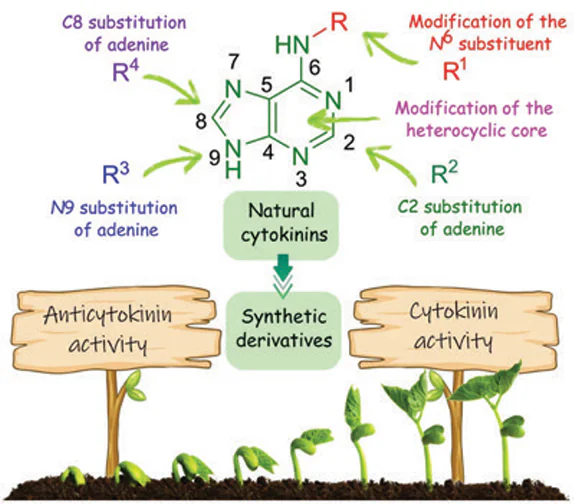
Keywords
Abstract
This review focuses on the current state of research in the synthesis of analogues of natural plant hormones cytokinins and their antagonists, anticytokinins. The review covers data published since the 1950s concerning the influence of the structure of these compounds on their phytohormonal activity in plant systems. For the first time, special attention is paid to the structural features that determine the emergence of the specificity toward the individual cytokinin receptors. Data on the structure and properties of the anticytokinins are updated for the first time in over 30 years. Based on the analysis performed, a number of recommendations are formulated and promising areas for the future research on the development of synthetic phytohormones are identified. This review will be useful both for chemists engaged in the synthesis and study of biologically active compounds and for plant physiologists and biochemists, as well as for specialists in agronomy.
The bibliography includes 176 references.
1. Introduction
Cytokinins (CKs) were discovered in 1955 as a factor stimulating the division of plant cells, which determined the name of the entire class of these phytohormones.[1][2] After more than 70 years of research, it can be stated that hardly any process in the ontogenesis of almost any land plant is free from the influence of CKs. These phytohormones regulate the size of apical and root meristems,[3-5] shoot and root branching,[6][7] chloroplast differentiation and chlorophyll degradation during leaf senescence,[8] seed germination and flowering,[9] response to biotic and abiotic stresses,[10][11] and a number of other processes.[12][13]
Study of natural CKs has always been accompanied by chemical synthesis and investigation of the synthetic analogues. Moreover, the first discovered representative of cytokinins was kinetin (Kin), N6-furfuryladenine,* isolated from herring sperm DNA.[14] It was only much later that Kin was found in plant samples, albeit in very small quantities.[15] Subsequently, this has happened more than once in the history of CK research: the synthesized compounds were later discovered in plants.
Almost simultaneously with the discovery of Kin, which is similar in structure to natural CKs, a large group of synthetic CKs based on urea derivatives was described.[16-18] These compounds, similarly to natural CKs, are capable of activating CK receptors,[19][20] but their endogenous origin in plants has never been confirmed.[21] However, studies of synthetic CKs based on the adenine or related heterocyclic compounds (benzimidazole, pyrimidine, etc.)[13] were developed more actively than those of urea derivatives, since they allowed more efficient acquisition of new data on natural CKs and their signalling system. Using synthetic CK derivatives structurally similar to natural hormones of this class, numerous relationships between structure and biological activity of CKs were established.[22] With the development of bioinformatic approaches, it became possible to identify and clarify the structural features of such complex and crystallization-resistant proteins as CK receptors.[23] In addition, the study of synthetic analogues of natural CKs gave a significant impetus to the development of work on plant tissue cultures and microclonal propagation of plants.[24][25]
In recent years, research on synthetic CKs associated with the development of new plant growth regulators has become increasingly relevant. The diversity of properties and pleiotropic action of natural CKs hinder their widespread use in agriculture.[13] Thus, the beneficial effect of CKs on the growth of the plant above-ground part is combined with an inhibitory effect on root growth and development.[26-28] Nevertheless, a number of features of CK signalling reveal the potential of synthetic CKs for the development of phytohormones with diverse beneficial effects without negative impact on plants.
This potential is primarily due to the properties of CK receptor proteins. The binding of a CK molecule to its receptor triggers a cascade of protein – protein interactions, which ends with the activation of target genes in the nucleus of the plant cell. In individual plants, CK receptors are usually represented by small families,[29-31] the members of which differ both in ligand specificity[29] and in predominant localization in organs and tissues.[3][29][30][32] In recent years, data have appeared on the existence of previously unknown branches in the intracellular transduction of the CK signal,[33][34] as well as mechanisms of its regulation involving CK receptors.[35] The listed properties of these receptors open up possibilities for local regulation of CK signal induction and transduction through the use of receptor-specific compounds that enhance signalling in those plant organs and tissues where CKs beneficially affect plant growth and development and attenuate signalling where their effect is adverse. Over the past decades, several synthetic CKs specific to individual receptors have been discovered,[23][36-38] as well as several dozen synthetic CK antagonists: anticytokinins (antiCKs), which are structurally similar to natural hormones, and some of which are also receptor-specific compounds.[37-42]
To date, the number of known synthetic CKs and antiCKs has reached several hundred. The synthesis and study of these compounds serve both fundamental scientific and practical purposes. This review summarizes and systematizes detailed information on how the structure of synthetic analogues of natural CKs influences their biological activity in cell cultures, tissues, or intact plants. The last time such reviews (e.g., Ref. [22]) were published more than 30 years ago, during the period when CK receptors had not yet been discovered. We have not only updated the current knowledge on this topic, but also, for the first time, discussed the aspects determining the selectivity of synthetic CKs and antiCKs towards individual cytokinin receptors.
* In this review, the exocyclic nitrogen atom linked to the carbon atom at the position 6 of the pyrimidine ring is conventionally designated by the symbol N6 with a number in superscript, while the atoms of the purine base have numbers located on the line next to the element symbol - nitrogen or carbon, highlighted in italics.
2. Natural cytokinins: structure, properties, and role in plants
The forms and structures of natural CKs, which serve as a starting point for the development of synthetic analogues with desired properties, are greatly diverse. Nevertheless, all natural CKs are adenine derivatives containing an isoprenyl group at the exocyclic nitrogen atom in the N6-position (isoprenoid CKs) or a methylene bridge linked to a (hetero)aromatic ring (aromatic CKs), into which a functional group may be additionally introduced. To date, at least 12 natural CKs isolated from various plant sources are known (Fig. 1).[15][43][44] These include 4 isoprenoid compounds: N6-isopentenyladenine and its hydroxylated analogues (zeatins); 8 aromatic CKs: N6-benzyladenine, its hydroxylated (topolins) and methoxylated analogues (methoxytopolins), as well as the already mentioned Kin.
![[{"id":"6UWGwJTkiu","type":"paragraph","data":{"text":"Structures of the active forms of natural cytokinins. The following abbreviations are used: iP is N<sup>6</sup>-isopentenyladenine, cZ is <i>cis</i>-zeatin, tZ is <i>trans</i>-zeatin, DHZ is dihydrozeatin; BA is N<sup>6</sup>-benzyladenine, oT is <i>ortho</i>-topoline, mT is <i>meta</i>-topoline, pT is <i>para</i>-topoline, MeoT is <i>ortho</i>-methoxytopoline, MemT is <i>meta</i>-methoxytopoline, MepT is <i>para</i>-methoxytopoline."}}]](/storage/images/resized/xW1T35YVnNhXBomlktE6lOxZiuWnWSg2kgcCStq6_xl.webp)
In Fig. 1, CKs are presented in the form of free bases. It is only in this form that they bind to cytokinin receptors, activating the transduction of the hormonal signal to target genes in the cell nucleus.[45] The activity of natural and synthetic CKs is determined by their affinity for CK receptors: the higher the affinity, the more effectively the molecule acts as a hormone. Given that CK receptors are present in plants as a family of proteins with different ligand specificity, the activity of CK bases towards different receptor paralogues is not the same.[29] It is believed that isoprenoid derivatives (except for cZ) are the most common and highly active natural CKs, while their analogues with aromatic side chains are minor and less active forms of CK bases.[21][46][47] However, cZ and aromatic CKs are recognized and degraded by CK degradation enzymes, in particular cytokinin oxidase/dehydrogenase (CKX), to a lesser extent than iP and tZ.[21][25][48] These properties of hormones are valued, for example, in plant micropropagation. Thus, BA, with its relatively low activity, due to its resistance to degradation in vivo (as well as its low cost) has become a CK widely used in plant micropropagation.[25] These aspects should be considered when choosing a starting molecule for obtaining a synthetic CK with desired properties, depending on the research aims and objectives.
In addition to natural active CKs in the form of free bases, which differ in substituents in the N6-position of adenine, inactive forms of these phytohormones, which contain various substituents in the heterocyclic core and in the side chain, are widespread in plants. They do not possess any significant affinity for CK receptors,[45] but differ in stability in planta, as well as in their ability to be transported in the plant.[21][46][47] Inactive forms of CKs are highly diverse, not only in their structure, but also, as a consequence, in the functions they perform in plants. Among the inactive forms of CKs, the following can be distinguished: ribonucleosides (ribosides), ribonucleoside 5'-mono(di- or tri)phosphates (nucleotides), O- and N-linked glucose conjugates (glucosides), and conjugates with xylose and alanine.[21][23][49-51] All these forms are either intermediate metabolites formed at different stages of CK biosynthesis, or they perform functions related to hormone transport, protection from degradation, reversible and irreversible inactivation, etc.[26][46][49] The interconversion between the nucleotide – nucleoside – base forms is one of the mechanisms regulating the hormonal activity of CKs in plants.
This review briefly examines the key processes and products of CK biosynthesis (mainly using the example of isoprenoid CKs as the most studied in this regard), presents the diversity of their natural forms, and demonstrates the influence of various substituents on their properties in plants. A more detailed discussion on the generally accepted model of CK biosynthesis pathways in plants can be found in literature.[43][46][50][52-55]
The biosynthesis of isoprenoid CKs is initiated in plastids by the transfer of an isopentenyl (isoprenyl) group from a dimethylallyl pyrophosphate (DMAPP) molecule to the N6-position of adenosine tri-, di-, or monophosphate (ATP, ADP, or AMP) to give N6-substituted nucleotides iPRTP, iPRDP, iPRMP.* This process is catalyzed by isopentenyl phosphate transferase (IPT) family of enzymes (Fig. 2, reaction 1).[28][43][53][54][56][57] There are two pathways for the formation of active CK forms as free bases. In the first pathway, synthesized CK nucleotides are transformed into the corresponding ribosides and then into free bases (see Fig. 2, reactions 3, 5). In the second pathway, 5'-monophosphates are hydrolyzed directly to free bases (see Fig. 2, reaction 7). In both cases, 5'-tri- and 5'-diphosphate forms are preliminarily converted to the 5'-monophosphate form by the action of phosphatases (see Fig. 2, reaction 2).[43][46][54]
![[{"id":"KGuuQQ7UB-","type":"paragraph","data":{"text":"Key interconversions between the nucleotide – nucleoside – base forms in cytokinin biosynthesis exemplified by isoprenoid forms. Enzymes involved in biosynthesis (conversion stage): isopentenyltransferase (<i>1</i>); phosphatase (<i>2</i>); 5'-ribonucleotide phosphohydrolase (5’-nucleotidase) (<i>3</i>); adenosine kinase (<i>4</i>); adenosine nucleosidase (<i>5</i>); purine nucleoside phosphorylase (<i>6</i>); phosphoribohydrolase (LOG) (<i>7</i>); adenine phosphoribosyltransferase (<i>8</i>); cytochrome P450 monooxygenase (<i>9</i>); zeatin reductase (<i>10</i>); tRNA isopentenyltransferase (<i>11</i>). The following abbreviations are used: PO is monophosphate, PPO is diphosphate, PPPO is triphosphate. This scheme has been compiled using published idata.<sup>50, 53, 55, 57</sup>"}}]](/storage/images/resized/kLnw2FMQYUpNZjadwRxDyjDnxPSIHlLcZHEslt0q_xl.webp)
Hydroxylation of the isoprenyl side chain of iP nucleotides catalyzed by cytochrome P450 monooxygenase (CYP735A) leads to the formation of tZ nucleotides (see Fig. 2, reaction 9).[46][54] The corresponding cis-isomer is not produced.[46][56] The formation of cZ occurs predominantly through the transfer of the isoprenyl group from DMAPP to the tRNA molecule catalyzed by tRNA-IPT (see Fig. 2, reaction 11) and is followed by hydroxylation and release of the cZ riboside 5'-monophosphate (cZRMP).[28][43][46] The formation of DHZ occurs due to the specific reduction of the double bond in the tZ side chain by NADPH-dependent zeatin reductase (see Fig. 2, reaction 10).[43]
It is important to emphasize that all known interconversions in CK biosynthesis are reversible and involve more than 10 specific enzymes (see Fig. 2).[43][46][57]
The CK bases may form N-glucosides, in which glucose is attached to nitrogen atoms at positions N3, N7, or N9 of the heterocyclic core (Fig. 3, pathways a, c, d ), and O-glucosides, in which glucose is bound to the oxygen atom of the N6-side chain of zeatin and topolin derivatives (see Fig. 3, pathway b).[25][58] N-Glucosides are biologically more stable and are among CK conjugate forms most abundant in nature. Under certain circumstances, they can constitute ~ 80% of the total CK content in a plant.[49]According to various bioassays, the N3-glucoside of BA is considerably more active than its N7- and N9-analogues and is metabolized faster, resulting in the release of BA.[51] It was found that the N7- and N9-glucosides are not hydrolyzed by glucosidase enzymes, unlike the N3-isomers. For this reason, it is assumed that glucosylation of CKs at the positions N7 and N9 leads to irreversible inactivation of the hormone, whereas N3-glucosides retain potential activity implemented through rapid hydrolysis to the free base.[52][59]
![[{"id":"f4734DmDws","type":"paragraph","data":{"text":"Scheme of glucosylation pathways of cytokinins and cytokinin nucleosides. N7-Glu, N3-Glu, N9-Glu are conjugates of natural cytokinins glucosylated at the N7, N3 or N9 position of purine, respectively; N9-Rib-Glu are conjugates of cytokinin ribonucleosides containing a glucose moiety attached via the hydroxyl group of the ribofuranose residue; cZ-O-Glu, tZ-O-Glu, DHZ-O-Glu, oT-O-Glu, mT-O-Glu are conjugates of natural cytokines glucosylated at the hydroxyl group of the N<sup>6</sup> substituent."}}]](/storage/images/resized/k6jbac6CWyBM78UAFnbK3a5tiD3xvGJg4KRxYT6j_xl.webp)
O-Glucosides are also considered to be important forms of CK storage and transport. O-Glucosylation catalyzed by O-glucosyltransferases leads to reversible inactivation of the hormone, which explains the physiological significance of the CK side chain hydroxylation. Conjugates can be hydrolytically converted into active CK bases by β-glucosidase with cleavage of the O-glucoside bond.[60] Furthermore, O-glucosylation of CKs at the side chain makes them resistant to CKX enzymes, which catalyze the degradation of free and ribosylated CKs, thereby playing an important role in regulating the level of these phytohormones in the plant.[61]
In addition, there are known structures of endogenous CK-ribosyl-linked glucosides in which glucose and ribose residues are linked to each other, forming a disaccharide nucleoside (see Fig. 3, pathway e).[25] N9-Glucopyranosylribosides of dihydrozeatin (DHZ9RG), isopentenyladenine (iP9RG), trans-zeatin (tZ9RG), and benzyladenine (BA9RG) as well as their 5'-phosphorylated forms have been found in intact plants.[62-64]
Besides the glucosides and ribosides of CKs, tZ and DHZ derivatives conjugated with a xylose residue at the hydroxyl group of the N6-substituent have been identified (Fig. 4a).[65] Derivatives of tZ and DHZ containing an alanine moiety at the N9 atom of adenine (9-alanylzeatin and 9-alanyldihydrozeatin) were found in yellow lupine and named lupinic and dihydrolupinic acids, respectively (see Fig. 4b). Lupinic acid is metabolically stable and capable of releasing tZ, indicating that alanine conjugates may serve as potential storage forms rather than deactivating forms.[51] In addition, O-methyldihydrozeatin, O-acetyldihydrozeatin, and their ribonucleosides and nucleotides were found in yellow lupine (see Fig. 4c).[51]
![[{"id":"iD-UOzpUUQ","type":"paragraph","data":{"text":"Non-glucoside conjugates of natural isoprenoid cytokinins: tZ and DHZ derivatives containing xylose residues at the N6-substituent (<i>a</i>); lupinic and dihydrolupinic acids (<i>b</i>); tZ and DHZ derivatives acylated and methylated at the N6-substituent and their nucleosides and nucleotides (<i>c</i>)."}}]](/storage/images/resized/81ar44rYnEA8I8Tz67DAR5bNjAaylJwNGAJKNjD3_xl.webp)
* From here on, the symbol R after the abbreviated name of the CK denotes its riboside; the combinations of letters TP, DP and MP denote 5'-tri-, 5'-di- and 5'-monophosphate, respectively.
3. Methods for assessing cytokinin activity of compounds
Before proceeding to direct discussion of the activity of synthetic CK derivatives, it is necessary to define what the term CK activity implies in various contexts and to characterize different methods of of assessing the activity. As noted above, the CK activity of a molecule is determined through its interaction with the CK receptor. After obtaining the crystal structure of the ligand-binding (sensor) module of the Arabidopsis CK receptor complexed with several natural and synthetic CKs,[66] it was shown by biochemical,[67] structural,[66] and bioinformatic[68][69] methods that CK receptors recognize their specific ligands through a single binding site common for all CKs. Thus, there are no fundamental differences between measuring the activity of natural and synthetic CKs.
A large number of various plant-based bioassays have been developed to assess the hormonal activity of CKs. Most of them involve, in one way or another, determination of the characteristic effect of CKs on plant cells, tissues, and organs. These include, for example, stimulation of cell division, effect on organogenesis (stimulation of shoot formation and inhibition of root growth), retardation of chlorophyll loss during leaf senescence, etc.[22][70] However, the absolute and relative values of CK activity for compounds found in such bioassays, as a rule, differ. They depend both on the type of biological response being studied and on the plant material chosen for the study. Nevertheless, the qualitative results usually coincide,[22] showing whether or not the substance acts as a CK.
Classical CK bioassays, most widely used in the second half of the 20th century, include tests for stimulation of tobacco[71] and soybean callus growth (tobacco and soybean callus bioassay),[72] induction of betacyanin/amaranthin synthesis in Amaranth seedlings (Amaranthus bioassay),[73] retardation of senescence of isolated leaves (senescence retardation assay),[74] effects on leaf and/or cotyledon growth (leaf and/or cotyledon growth assay),[75] and others. The key advantage of these bioassays is their relative simplicity and availability, as well as high sensitivity, allowing the detection of very low, physiological concentrations of CKs (usually down to 10–7 mol L–1). Nevertheless, the assays have a number of disadvantages. As already mentioned above, their results most often cannot be converted and adequately compared with each other. Some classical bioassays may produce a false-positive response to substances that are not CKs, but that, under certain conditions, have a similar molecular effect (for example, sugars[76]). Most importantly, using classical bioassays, it is impossible to detect the activity of a compound toward an individual CK receptor.
In the 21st century, in a short time after the discovery of CK receptors, a bioassay based on Arabidopsis thaliana seedlings became widespread.[77] This is a molecular-genetic method with transgenic plants in which the GUS reporter gene is under the control of the promoter of the primary CK response gene (ARR5, Arabidopsis Response Regulator 5). The activity of the test compounds is determined by the level of GUS protein accumulation in plants, which reflects the intensity of expression of the pARR5::GUS construct. This is a quantitative method for determining CK activity. The key advantage of this method is its high specificity, as it assesses the strength of activation of the cytokinin signalling pathway rather than associated effects. In terms of sensitivity, this method is not inferior to classical bioassays, allowing the assessment of CK activity at very low concentrations of compounds.
It should be noted that molecular-genetic methods have made it possible to obtain insertion mutants of Arabidopsis for CK receptors, also carrying the pARR5::GUS construct.[78] In such plants, only one of the three receptors (AHK2, AHK3, or CRE1/AHK4/WOL) is active in each mutant clone, which makes it possible to attribute the CK activity observed in the bioassay to interaction of the compound with a specific receptor. The disadvantage of this method is the use of intact plants, capable of converting the original test compounds into other CK biosynthesis products during the experiment, which can lead to false-positive results. For example, this method cannot adequately assess the activity of some CK ribonucleosides thatare rapidly converted to active CK bases in the plants.
An important achievement in methods for measuring phytohormonal activity following the discovery of CK receptors was the possibility to direct evaluation of their binding to compounds in vitro. The radioligand method is most commonly used for this purpose. It provides the most accurate assessment of the CK activity of the test compound by determining its affinity constant to a specific receptor. Both heterologous[67][79] and homologous[80][81] test systems can be used for this purpose. However, false-positive results are also possible when CKs are investigated in the form of ribonucleosides in heterologous systems.[37][80] Other disadvantages of the radioligand method include the need to use a radioactive label. As an alternative, there is a more complex and equipment-demanding colorimetric method, which does not involve radioactive compounds.[82]
When studying CKs in the form of free bases, the correlation between the results obtained using the radioligand method and those from the Arabidopsis seedling-based bioassay is very high: depending on the receptor, the correlation coefficient ranges from 0.8 to 0.9.[23] It should be noted that these methods can produce inconsistent results when testing competitive antiCK, which binds to the receptor but does not trigger CK signalling.[39][40] Furthermore, a low correlation if any, is observed when testing antiCKs with a non-competitive (presumably allosteric) mechanism of action.[38]
Only with a direct assessment of the affinity of a particular compound to a specific CK receptor using the radioligand or colorimetric method, can one speak of absolute values of CK activity (for example, dissociation constant). In other cases, only a relative CK activity is assessed, being expressed through a comparison with the activity of a control compound. For synthetic CK derivatives, the original natural CK is most commonly used as a control.
4. Structural analogues of natural cytokinins
4.1. Influence of substituents in the N 6-position of adenine on cytokinin activity
4.1.1. N6-Derivatives of aromatic natural cytokinins
The aromatic BA and Kin molecules are the first synthesized CKs.1, 2 The method for their synthesis is relatively simple,[83] and they are stable in vivo.[48] It should be noted that both compounds were found in plants decades after their description.[84-86] Therefore, BA (to a greater extent) and Kin are the most popular natural CKs, on the basis of which hundreds of derivatives with various CK and antiCK activity have been obtained over the years of research (these compounds are discussed in detail in Section 5).
One of the ways to modify the properties of the original natural CK is to change the length of the methylene chain, that is, the linker connecting the aromatic ring to the amino group in the N6 position of adenine. In the case of BA, removal of this linker gives rise to high CK activity in N6-phenyladenine, exceeding that of BA by ~10 – 40% depending on the CK receptor. However, the resulting compound does not exhibit receptor specificity.[23]Among BA analogues containing longer linkers, CK activity tends to decrease as the number of methylene units increases. Thus, N6-phenethyladenine and N6-phenylpropyladenine with a linker length of 2 and 3 carbon atoms, respectively, although retain noticeable activity in the Arabidopsis bioassay, are ~30 – 50% less active than BA. These compounds also show no receptor specificity and activate all three Arabidopsis CK receptors.[23] Elongation of the linker to 4 and 5 carbon atoms leads to a complete loss of activity of the resulting analogue.[38] A similar trend is observed for Kin derivatives: elongation of the linker reduces the activity of the compound compared to the initial molecule[87]
Modelling of the three-dimensional structure of the sensor module of CK receptors from various plant species (Arabidopsis, maize, potato, rice, etc.) has shown that the size of a molecule capable of binding to it is quite limited.[68][69][88] For this reason larger molecules often exhibit a decrease in CK activity. Long linkers appear to prevent the molecule from fully entering the pocket of the sensor module and taking the correct position capable of initiating CK signalling.[23]
It is important to note that BA derivatives containing an additional substituent (for example, a methyl group) in the linker, which creates chain branching, can be chiral. Stereoisomerism significantly affects the CK activity and receptor specificity of the compounds[23][38](see Section 4.1.4).
The replacement of heteroatoms (for example, oxygen by sulfur) in the aromatic moiety also reduces the hormonal activity of Kin derivatives by 60 – 80% compared to the original molecule.[38][89] However, Kin analogues containing a 2(or 3)-thienylethyl substituent in the N6-position exhibit pronounced receptor specificity towards the Arabidopsis CK receptors AHK2 and AHK3.[38]
A wide range of synthetic BA derivatives has been prepared by introducing additional substituents into the benzene ring. This is considered to be one of the simplest ways to modify the properties of the original CK molecule.[25] Thus, hydroxylated BA derivatives, topolins (seeFig. 1 and Refs [90][91]), were first synthesized and later found in plant material, like BA and Kin.[44][92]
The BA analogues known to date contain substituents such as halogen atoms (F, Cl, Br, I), methyl, methoxy, hydroxy, and nitro groups at the ortho-, meta-, and para-positions of the benzene ring, as well as di- and tri-substituted benzene rings with various combinations of the listed groups.[36][93-95] The activity of these compounds was mainly assessed using three classical bioassays: tobacco callus bioassay, retardation of leaf senescence, and induction of betacyanin/amaranthin synthesis in the hypocotyls of Amaranthus caudatus. It was found that the position of the substituent in the benzene ring critically influences the activity of the compound. Substituents at the meta-position (especially F, Me, OMe) predominantly increase the activity toward BA (from ~ 5 to 200% depending on the nature of the substituent and the type of bioassay), while para-substituents reduce it down to 10 – 15% of the activity of the original molecule.[36] The general trend of the dependence of activity on the substituent position can be summarized as follows: meta ≥ortho > para (Fig. 5).[36][93-95] The obtained data are consistent with the results of earlier studies,[89] in which BA derivatives with meta-substituted benzene ring exhibited twice the activity of the ortho-isomers in the radish leaf bioassay, while no activity was observed for the para-isomers.
![[{"id":"YAu4D_PVZ-","type":"paragraph","data":{"text":"Effect of the N<sup>6</sup>-substituent structure on cytokinin activity in modified N<sup>6</sup>-benzyladenine analogues: varying the length of the linker between the benzene ring and the amino group (<i>a</i>) and altering the position of substituents in the benzyl moiety (<i>b</i>). Shades of green indicate cytokinin activity in the compounds that is greater than or equal to that of BA; shades of yellow and orange indicate reduced activity; red indicates no activity."}}]](/storage/images/resized/CoCeqPjVebrBCQoJaPtDO3U5ZTihin2kqtEaersL_xl.webp)
Thus, the CK activity of BA derivatives is influenced by steric and hydrophobic effects due to the presence and position of substituents in the benzene ring (both electron-donating and electron-withdrawing ones) and by the structure and size of the linker connecting the aromatic moiety to the amino group of adenine at the N6-position (see Fig. 5).
The elongation of the linker appears to result in neither an increase in the overall hormonal activity of the compounds nor the appearance of receptor specificity. However, the nature of the linker substituents between the purine and aromatic moieties of CKs may become a determining factor in ensuring receptor specificity of BA and Kin derivatives. If the replacement of the oxygen atom by sulfur in the furan ring of Kin derivatives is capable of influencing the specificity of the compound, then varying the substituents in the benzene ring of BA derivatives leads to a change only in the non-specific CK activity.
4.1.2. N6-Derivatives of isoprenoid natural cytokinins
The currently available literature covers a limited number of modification variants of the isoprenoid substituent in the N6-position of iP, cZ, or tZ molecules. An analysis of the effect of the vinylic fluorine atom on the activity of compounds showed ambiguous results in the bioassay based on mutant tobacco Nicotiana plumbaginifolia.[96-98] Fluorination resulted in a 1.5 – 2-fold increase in CK activity for iP and cZ derivatives compared to the original molecule. However, for the tZ analogues, the activity decreased 1.5 – 2-fold (Fig. 6a). This effect may be due to the formation of a hydrogen bond between the fluorine atom and the hydroxyl group.[97]
![[{"id":"eXhEC7G_l_","type":"paragraph","data":{"text":"Structural modifications of the isoprenyl substituent at the N<sup>6</sup> position of isoprenoid cytokinins and their effect on cytokinin activity: introduction of a vinylic fluorine atom (<i>a</i>), alkyl and fluoroalkyl groups (<i>b</i>), and phenyl and benzoic acid groups (<i>c</i>)."}}]](/storage/images/resized/KscKcr8x5XjFC1f5oPneWAUM0pqVYEbCcEw4tECZ_xl.webp)
In parallel, Laloue and co-workers[96-98] investigated a series of iP and tZ derivatives modified at the methyl group of the side chain in the N6-position, which was replaced by various alkyl (ethyl, propyl, isopropyl) and fluoroalkyl (difluoromethyl, trifluoromethyl) substituents (see Fig. 6b) and bulky aromatic (phenyl and benzoyl) groups (see Fig. 6c). It was found that fluorinated iP analogues exhibited activity an order of magnitude higher than that of natural iP and approximately 3 – 5 times higher than the activity of tZ.[98] Among alkyl-substituted iP analogues, only the compound with an ethyl group exhibited a greater biological activity than natural tZ. At the same time, derivatives with bulky alkyl and aromatic substituents had very low CK activity or were completely inactive in the bioassay used, which highlights the critical importance of the size and steric characteristics of the substituent for effective binding to the receptor and manifestation of the hormonal effect.[96][97]
To date, no receptor-specific synthetic analogue of aliphatic CKs has been identified. This area of structural modification of CKs remains poorly studied.
4.1.3. Adenine derivatives with two substituents in the N6-position
In addition to CKs with a modificied substituent structure in the N6-position of adenine, N6,N6-disubstituted analogues have been synthezised in a number of studies. Adenine derivatives containing two aliphatic substituents in the N6-position, such as N6,N6-dimethyladenine, N6,N6-diethyladenine, N6,N6-dipropyladenine, N6,N6-dibutyladenine, and N6,N6-dipentyladenine (Fig. 7a), showed no activity in bioassays that involved stimulation of bud formation in the moss protonema[99] and lettuce seed germination.[100] Meanwhile, the corresponding monoalkyl-substituted analogues possessed activity in these assays (see Fig. 7b). These results were subsequently confirmed in the Amaranthus bioassay.[101] An important factor determining the CK activity of monosubstituted adenines is the presence of a proton in the N6-position, since this proton is critically important for interaction with the CK receptor.[23] In contrast, N6,N6-disubstituted analogues lacking a proton in this position, generally do not possess hormonal activity. However, in the Amaranthus bioassay, a number of disubstituted N6-benzyl-N6-alkylaminopurines showed CK activity at a level of 20 – 80% of the BA activity at concentrations from 1 to 100 μM (see Fig. 7c).[101] Meanwhile, It was shown earlier that the introduction of an additional methyl group into the N6-position of Kin and BA leads to a strong decrease in the activity compared to that of natural analogues tested in the tobacco callus bioassay.[87] The ability of N6-benzyl-N6-alkylaminopurines, effective in bioassays, to activate AHK3 and CRE1/AHK4 receptors expressed in transgenic Escherichia coli strains was also assessed.[101] It was found that these compounds do not activate the indicated receptors. It may be assumed that the activity of N6,N6-disubstituted CK analogues in the Amaranthus bioassay is not directly related to the CK signalling pathway. It should be noted that adenines with a single linear aliphatic substituent in the N6-position (see Fig. 7b) not only activate CK receptors, but in some cases exhibit pronounced specificity towards the AHK3 receptor.[101]
![[{"id":"hImoj-Q1TV","type":"paragraph","data":{"text":"Effect of alkyl groups at the N<sup>6</sup> position on the cytokinin activity for N<sup>6</sup>, N<sup>6</sup>-dialkyl-substituted (<i>a</i>) and monoalkyl-substituted (<i>b</i>) adenines and for BA derivatives with a second substituent at the N<sup>6 </sup>position (<i>c</i>)."}}]](/storage/images/resized/CqavZiz4obdm3whaNkvmJcEpxzU0Om2gf0sHRBXA_xl.webp)
The available data are limited to the description of a small series of aromatic CK derivatives (BA, Kin) containing only linear alkyl substituents of various lengths, or symmetric dialkyl-substituted adenines. We have found no data on the studies of N6,N6-disubstituted isoprenoid CKs (iP, tZ) or compounds that contain additional N6-substituents other than linear aliphatic chains (for example, cycloalkyl, aromatic, or hetaryl groups). Overall, the search among such derivatives for active and/or receptor-specific hormones is likely to be unpromising.
4.1.4. Influence of stereochemistry of the N6-substituent of adenine derivatives on cytokinin activity
Spatial isomerism is encountered among natural CKs, and it influences the intensity of the biological effect of the compound. In plants, tZ is almost 50 times more active than cZ.[102] Although the role of cZ in the regulation of metabolic processes in plant cells is relatively poorly studied,[103] cZ is known to be involved in the regulation of defence responses to changing environmental conditions and, possibly, to the action of foreign pathogens.[104][105] In addition, high cZ content is usually observed in seedlings, while it gradually decreases as the plant grows.[102] Natural pairs of enantiomers for chiral CKs are unknown. Nevertheless, to date there are experimental data on the effect of optical isomerism on CK activity of synthetic derivatives.
It is known that different bond configurations resulting from the molecular chirality determine the spatial interaction between the CK and its receptor; this affects the affinity of the compound and, consequently, the intensity of the biological effect. For example, in some biological experiments, naturally occurring (S)-(–)-dihydrozeatin (S-DHZ) possessed an order of magnitude lower CK activity than the corresponding synthetic R-(+)-isomer (R-DHZ) (Fig. 8a).[106]
![[{"id":"C6bAN-qhT-","type":"paragraph","data":{"text":"Structures of enantiomers of natural and synthetic cytokinins containing a chiral moiety: dihydrozeatin (<i>a</i>), N<sup>6</sup>-1-(1-naphthyl)ethyladenine (<i>b</i>), and a series of N<sup>6</sup>-(α-methylbenzyl)adenines (<i>c</i>)."}}]](/storage/images/resized/fb0vP4xuf93AKCVvQelJgxFdHYb9s6Fega2mH603_xl.webp)
Noticeable differences in CK activity are also observed in pairs of optically active derivatives of aromatic CKs. It was shown that (S)-(+)-N6-1-(1-naphthyl)ethyladenine (S-NEPA), a synthetic analogue of BA, is capable of stimulating soybean callus growth at a concentration of 10–6 M, while its enantiomer R-NEPA [(R)-(–)-N6-1-(1-naphthyl)ethyladenine] (see Fig. 8b) demonstrated a similar effect at an order of magnitude higher concentration.[107] Subsequently, a comparison of the interaction of NEPA enantiomers with protein kinase in vitro showed that only S-NEPA activates this enzyme, while R-NEPA does not exhibit this effect.[108] Although there is no information on interaction with CK receptors for these compounds, this fact demonstrates the direct influence of the absolute configuration of the asymmetric carbon atom on the interaction of the ligand with its target protein.
Savelieva et al.[37] established that for the methyl derivatives of BA containing a chiral α-methylbenzyl moiety (S-MBA and R-MBA) (see Fig. 8c), R-enantiomers were active towards all CK receptors in the bioassay with mutant Arabidopsis seedlings (from 20 to 120% of the activity of the original BA molecule depending on the compound and CK receptor), while S-enantiomers were capable of binding and activating only the AHK3 receptor with the activity ranging from 30 to 90% of that for BA.
This modest amount of published data provides the conclusion that the search for new synthetic CK analogues among compounds containing a chiral moiety is a promising area of research. Such compounds may not only exhibit pronounced CK activity, but, more importantly, demonstrate receptor specificity.
4.2. Influence of substituents in other positions of adenine on cytokinin activity
4.2.1. Substituents at carbon atoms
Even at the early stages of CK investigation, it was shown that the introduction of various substituents (halogen atoms, aliphatic and aromatic groups) at the C2 and C8 atoms of adenine with a free amino group in the N6-position does not result in the products exhibiting CK activity.[87][109][110] However, in the case of N6-substituted compounds, the presence of substituents in these positions can significantly affect CK activity compared to the initial molecule.
The introduction of halogen atoms, especially fluorine and chlorine, at the C2 position generally enhances the CK activity of BA derivatives relative to the non-modified molecule.[23][37][95][111-113] In this context, the 2-fluoro and 2-chloro derivatives of BA demonstrate high activity, predominantly for interaction with the AHK3 CK receptor.[23] For S- and R-isomers of BA specific to the AHK3 receptor (seeFig. 8c), the presence of an additional halogen atom at C2 increases the affinity of the compound to this receptor approximately two fold compared to C2-unsubstituted analogues.[37] However, the introduction of substituents larger than halogen atoms at the C2 position in the BA molecule usually leads to a decrease or disappearance of the CK activity of the products. Moreover, the more bulky the corresponding substituent, the lower the CK activity of the derivative.[23][95][111][114] The presence of amino, hydroxy, methylsulfonyl, sulfanyl, methylthio, benzylthio, or methyl groups in the C2-position of iP or tZ molecule also leads to a significant decrease in the CK activity compared with the original compound.22
As with substituents at C2, the effect of C8-substitution of adenine on CK activity depends on the type of substituent. C8-halogenated CK derivatives like C2-substituted analogues, demonstrate the highest activity (comparable and even superior to that of natural CK) in various bioassays.[114][115] The addition of a methyl group at this position may also increase the CK activity of the product. However, larger substituents reduce the activity.[108][110] It should be noted that C2,C8-disubstituted natural CKs are ≥2 times less active than their C2- or C8-monosubstituted analogues.[114][116] Nevertheless, even in the presence of two substituents, derivatives with a halogen atom at C2 are more active than their analogues with bulkier groups.[114]
It can be concluded that the modification of natural CKs at the carbon atoms of the heterocyclic base significantly affects the hormonal activity of the compounds. Depending on the structure and size of the additional substituent, the CK activity of the derivative either decreases or slightly increases (Fig. 9). The introduction of electron-withdrawing halogen atoms, especially fluorine, into adenine may increase in CK activity compared to that of the original molecule, probably due to the formation of additional halogen or hydrogen bonds with the CK receptor. However, the introduction of aliphatic and aromatic substituents larger than a halogen atom generally leads to a sharp decrease or disappearance of CK activity, as such substituents hinder the interaction of the molecule with the receptor hormone-binding site. For this reason, the approach involving the introducing of halogen atoms into the CK molecule can subsequently be used in combination with other modifications, especially with the introduction of a substituent into the N6-position of adenine. Such a combination improves binding of the compound to CK receptors and, consequently, may potentially enhance not only activity but also receptor specificity.
![[{"id":"_3cK9pXxDe","type":"paragraph","data":{"text":"Effect of the nature of the substituent at the carbon atoms of adenine on the cytokinin activity for C8- and C2-substituted cytokinins and for C2,C8-disubstituted cytokinins."}}]](/storage/images/resized/OEx4Kp5IOhrmf02T0yzFM8YwK9JctUhlq7uV0XOB_xl.webp)
4.2.2. Substituents at nitrogen atoms
An adenine derivative an analogue of iP containing an amino acid residue at the purine N3 position, was isolated from the tissues of the slime mould Dictyostelium discoideum. This compound was named discadenine (Fig. 10a).[117] It was shown to possess CK activity in various classical bioassays towards the AHK3 and CRE1/AHK4 receptors.[118]
![[{"id":"VyID7j157c","type":"paragraph","data":{"text":"Cytokinin structures with an isoprenyl group at the N<sup>6</sup> position and an additional substituent in the purine ring: discadenine isolated from a natural source (<i>a</i>), and the synthetic N3- and N7-methyl derivatives: N3-methyl, N<sup>6</sup>-isopentenyladenine (N3-Me-iP), N7-methyl-N<sup>6</sup>-isopentenyladenine (N7-Me-iP), N3-methyl-trans-zeatin (N3-Me-tZ), and N7-methyl-trans-zeatin (N7-Me-tZ) (<i>b</i>)."}}]](/storage/images/resized/tTH6ZtKIZDrpzsq6fLsQkIaeVw1CQAaxPNNbOjec_xl.webp)
Synthetic analogues of BA and iP in which the benzyl and isopentenyl substituents are attached to the N1 and N3 or N7 nitrogen atoms of purine, with a free amino group at the N6-position, do not exhibit CK activity in bioassays. However, derivatives of natural CKs containing substituents at the N3 or N7 and N6 positions possess CK activity, which depends on the nature of the N6-substituent[87][119] (see Fig. 10b).
The N3-methyl derivatives of BA, Kin, and iP showed a decrease in activity compared with their natural analogues, ranging from a few percent to ≥5-fold decrease compared to the parent CK.[120] N7-alkyl-substituted BA derivatives were also virtually inactive.[40][87] This decrease in activity is probably due to the fact that N3- and N7-substituted adenines lack a proton at the N9 position, which plays an important role in binding to CK receptors.[23] Nevertheless, N3- and N7-methylated tZ derivatives exhibit activity comparable to that of natural tZ (see Fig. 10b).[121] It can be assumed that the difference in the activity of tZ derivatives is associated with the presence of a hydroxyl group, capable of forming an additional hydrogen bond with the receptor.[40]
In in a number of studies[25][122][123] published in various years, it was shown that some BA derivatives containing various alkyl substituents at the N9 position (methoxymethyl, propyl, cyclohexyl, or haloalkyl groups) are less active than unsubstituted BA in classical bioassays for stimulation of tobacco and soybean callus growth. It was also shown that N9-alkyl derivatives of isoprenoid CKs iP, cZ, tZ, and DHZ possess lower activity than the corresponding natural analogues.[25][124] The weak CK activity of N9-alkyl-substituted compounds can be attributed to intracellular dealkylation, resulting in the release of active CKs lacking substituents at this position, since, as already mentioned above, the proton at the N9 atom of purine plays a key role in the binding of CK analogues to receptors.[23]
iP derivatives substituted at the N9-position with aliphatic chains containing terminal functional groups (hydroxy, chloro, bromo, azido, cyano, carboxy, and other groups) (Fig. 11) demonstrated high activity exceeding that of natural iP in bioassays for stimulation of tobacco callus growth and induction of betacyanin synthesis in amaranth.[123] However, these compounds had high activity only at concentrations of 10–4 – 10–5 M. Similar studies were performed for N9-alkyl derivatives of Kin, which also showed high values of CK activity at high concentrations.[125] It is important to emphasize that the studied compounds (both iP and Kin derivatives) did not activate Arabidopsis CRE1/AHK4 receptors in the bacterial test system based on E. coli. The iP derivatives were also unable to activate ZmHK1 and ZmHK3a receptors of maize (Zea mays).[126][125] This supports the hypothesis that the CK activity of N9-substituted CK analogues is associated with their conversion to unsubstituted forms inside the plant cell.
![[{"id":"oJPQ7nUX6T","type":"paragraph","data":{"text":"Examples of N9-substituted analogues of natural cytokines that exhibit cytokinine activity in bioassays."}}]](/storage/images/resized/Hm3rrjMfIvqjnDiX5NIipyFTxiJVk8CGME8HMPqw_xl.webp)
Derivatives of BA, T, and MeT containing tetrahydropyran-2-yl (THP) or tetrahydrofuran-2-yl (THF) moiety at the N9-position of adenine (see Fig. 11) also demonstrated CK activity comparable to that of BA in classical bioassays (leaf senescence retardation, tobacco callus growth, betacyanin synthesis in amaranth). The high activity of these compounds is apparently associated with much faster hydrolysis of the labile THP and THF moieties compared to linear alkyl substituents.[87][93] It should be noted that these N9-THP and N9-THF derivatives of natural CKs were not recognized by Arabidopsis CK receptors CRE1/AHK4 and AHK3 in the E. coli-based bioassay.[93]
Another study[127] of N9-THP derivatives of CKs showed that these compounds (especially N9-THP-MemT) do not inhibit root growth and branching in Arabidopsis and maize in the nano- to micromolar concentration range, unlike the original molecule, for which an adverse effect on root formation was observed at the same concentrations. In the nanomolar range (8 – 40 nM), N9-THP-MemT stimulated lateral root branching and leaf growth. Apparently, this compound acts as a depot form, providing gradual release of the active CK and its efficient transport in the plant vascular system, which leads to an overall beneficial effect on plant viability.
It can be concluded that any substituent groups at the nitrogen atoms of the purine heterocyclic base must hinder binding to CK receptors, and in most cases, they lead to a decrease or loss of CK activity of the compound. The CK activity detected in some cases for such substituted analogues is, most likely, associated with intracellular hydrolysis of the additional substituents and release of the original CK bases.
4.2.3. Cytokinin nucleosides
A separate trend in the study of the biological activity of modified natural CKs has been the study of their nucleoside analogues. Unlike CK derivatives containing various non-carbohydrate substituents at the N9-position, CK nucleosides are a special class of compounds similar in structure to natural metabolites. Currently, it is most relevant to study these derivatives as antiCKs (see Section 5 for details). Although it has now been established that nucleosides and nucleotides of natural CKs are not the active forms of phytohormones (see Section 2), a considerable number of studies have been devoted to investigating their CK activity. In all such studies, the in vivo CK activity of CK ribonucleoside derivatives should apparently be explained by the action of deribosylating enzymes of CK metabolism. Consequently, modification of substituents in CK nucleoside derivatives affects their affinity to these enzymes, rather than to CK receptors.
Early studies[25][128] demonstrated that a number of iP ribonucleoside (iPR) derivatives containing various isoprenyl or saturated aliphatic substituents in the N6-position of adenine demonstrate pronounced CK activity in the tobacco callus bioassay. However, the activity of the studied ribosides was significantly weaker than that of natural iP. Furthermore, using the same bioassay, the authors[25] found that the ribosides of natural CKs tZ and cZ, as well as their synthetic analogues trans- and cis-isozeatins, turned out to be 1 – 3 orders of magnitude less active than the parent free bases.
Subsequently, a large series of BA nucleoside derivatives was studied, including N6-benzyladenosine (6-benzylamino-9-β-D-ribofuranosylpurine, BAR)[129] and N6-benzyl-2'-deoxyadenosine (6-benzylamino-2'-deoxy-9-β-D-ribofuranosylpurine),[130] containing substituents at various positions of the benzene ring (Fig. 12a,b). Their activity was assessed in several plant bioassays (stimulation of tobacco callus growth, retardation of wheat leaf senescence, and induction of betacyanin synthesis in amaranth). A number of ribonucleoside derivatives and a number of 2'-deoxyribonucleosides demonstrated CK activity up to twice that of the original BAR or N6-benzyl-2'-deoxyadenosine, respectively, in various bioassays.[129][130]
![[{"id":"oYwhI4QkHw","type":"paragraph","data":{"text":"Scheme of conversion into active free bases for synthetic cytokinin nucleosides, derivatives of 9-β-D-ribofuranosylpurine (<i>a</i>), 9-β-D-2'-deoxyribofuranosylpurine (<i>b</i>), and 9-β-D-arabinofuranosylpurine (<i>c</i>)."}}]](/storage/images/resized/H0mMh5Dikp3MnNWv7C5kbwRX4NM3gQwS9ubOfnCh_xl.webp)
For some N6-benzyl-2'-deoxyadenosine derivatives, weak activation of AHK3 and CRE1/AHK4 receptors was noted.[130] However, the studies were conducted in a heterologous E. coli-based system at high concentrations of compounds (from 10 to 50 μM). The use of both bacteria and non-physiological concentrations of test compounds may explain the positive results. Subsequently, the absence of binding to receptors was demonstrated for a wide range of BA ribonucleoside derivatives containing structurally diverse N6-phenylalkyl substituents, including optically active ones.[37][38]
As in the case of N6-benzyl-substituted adenines (see Section 4.1.1.), the activity of the compounds depended directly on the position of substituents in the benzene ring and followed a decreasing trend in the series meta > ortho > para,[129] characteristic of free bases.[36][93-95] This circumstance indirectly points to the presence of false-positive results when assessing CK activity of ribonucleosides in classical bioassays.
In addition to CK riboside derivatives, the CK activity of synthetic 9-β-D-arabinofuranosylpurine derivatives (arabinonucleosides of CKs) containing various substituents (both aromatic and isoprenoid) in the N6-position was studied (see Fig. 12c). It was shown that these arabinonucleosides exhibit low or moderate CK activity (6 – 40% of BA activity) in Amaranthus and tobacco callus bioassays.[25] In addition, arabinonucleosides of BA and MeoT demonstrated effective retardation of Arabidopsis leaf senescence, a process unrelated to the activation of CK receptors.[131]
The currently available data on the receptor – ligand interaction of the indicated series (both experimental and obtained using computer modelling methods) provide very convincing evidence against the presence of phytohormonal activity in CK ribosides. The hormonal activity of CK nucleosides observed in experimental systems can be explained by rapid enzymatic hydrolysis of the ribofuranose moiety inside the cell with the release of the active base (see Fig. 12).[9][13][45]
4.3. Influence of the nature of the exocyclic heteroatom and the structure of the heterocyclic core on cytokinin activity
A number of studies address the effect of replacing the exocyclic amino group at the N6-position of adenine with alternative atoms and various groups on the hormonal activity of natural CK derivatives. It was shown[132] that replacement of the exocyclic nitrogen atom in BA and iP with sulfur, oxygen, or a methylene group (Fig. 13) leads to a significant decrease in the CK activity of the compounds in the tobacco callus bioassay. In this context, the least pronounced biological effect (almost two orders of magnitude lower than the activity of the parent molecules) was found for derivatives containing a sulfur or oxygen atom linked to the C6 position of purine. At the same time, their analogues containing a methylene group showed moderate CK activity with a value several tens of percent lower than that for BA and iP.[132] Similar compounds with a methylene group and a modified substituent at the C6 position of purine also possessed moderate CK activity in the Amaranthus bioassay.[133]
![[{"id":"fffuje6GqA","type":"paragraph","data":{"text":"Effect of the nature of the exocyclic heteroatom in the adenine molecule on the cytokinin activity of synthetic derivatives relative to that of the original natural cytokinins."}}]](/storage/images/resized/M1pprddShXuV0rQlDHhY2rwrft2leZ2uoxKoyRA3_xl.webp)
Analogues of 6-benzylthio- and 6-benzyloxypurine were subsequently studied in the bioassay based on mutant Arabidopsis seedlings with individual receptors.[23] It was found that the replacement of the exocyclic nitrogen atom in BA derivatives with oxygen or sulfur leads to loss of CK activity towards all CK receptors. Using in silico methods, it was established that the exocyclic NH group at the C6 atom of purine plays a critical role in the binding of CKs to receptors, while an oxygen or sulfur atom at this position radically changes the nature of the interaction between CK derivatives and the receptor binding site. Unlike the NH group, this atom acts a hydrogen bond acceptor, significantly changing the nature of protonation of the molecule.
It was also shown that the phytohormonal activity of compounds of the considered type is very sensitive to modification of the heterocyclic skeleton, involving changes either in the number of rings or in the number and position of heteroatoms. In the tobacco callus bioassay, it was shown that ring expansion in the natural BA molecule giving imidazo[4,5-g]- and imidazo[4,5-f ]quinazoline derivatives (Fig. 14a) resulted in the loss of CK activity.[134]
![[{"id":"s0CjbsM4es","type":"paragraph","data":{"text":"Structures of synthetic cytokinins with a modified heterocyclic core: derivatives of imidazo[4,5-g]- and imidazo[4,5-f]quinazolines with an expanded purine ring (<i>a</i>), pyrido[3,4-d]pyrimidines (<i>b</i>), imidazo[4,5-b]pyridine (1-deaza-purine analogues) (<i>c</i>), and 7-aminopyrazolo[4,3-d]pyrimidine (8-aza-9-deaza-purine analogues) (<i>d</i>)."}}]](/storage/images/resized/Luw7oEewNzy0708dJTastubQlC1ZcUdgI8HVT58G_xl.webp)
However, pyrido[2,3-d]-[135] and pyrido[3,4-d]pyrimidine[136] derivatives containing a phenyl substituent at the exocyclic nitrogen atom and an additional methyl or thiomethyl group at the C2 position of pyrimidine (see Fig. 14b) possess CK activity comparable to that of BA in the tobacco callus bioassay. In this case, the key factor determining this effect is the presence of a substituent at the exocyclic amino group corresponding to the N6-position of adenine. Replacement of the benzene ring with a bulky linear or cyclic alkyl substituent leads to pronounced antiCK activity of similar compounds (for details, see Section 5.2).[135][137]
Furthermore, for imidazo[4,5-b]pyridines, 1-deaza derivatives of iP and Kin, containing no nitrogen atom at the N1 position of purine, have been shown to exhibit CK activity (see Fig. 14c).[138] However, their 3-deaza analogues, which lack the nitrogen atom at the N3 position of purine, did not show activity of this type, while the addition of a nitrogen atom at position 8 of the molecules caused a slight increase in the biological activity of the 8-aza-3-deaza derivatives compared to the parent molecules. Another 1-deaza analogue of CKs, 6-phenylethylimidazo[4,5-b]pyridine, containing a modified aromatic substituent (see Fig. 14c), showed high CK activity, comparable to the activity of BA, in the tobacco callus bioassay.[139]7-Aminopyrazolo[4,3-d]pyrimidines (8-aza-9-deaza analogues of purine) (see Fig. 14d) also exhibited CK activity in various bioassays, albeit it was inferior to that of natural CKs.[13][139-141]
Thus, the position of nitrogen atoms in the purine heterocyclic base is an important factor for the the phytohormonal activity of the compound. The discovery of active 1-deaza derivatives shows that relatively high CK activity is preserved even despite the fact that two nitrogen atoms at positions N1 and N6 are replaced by carbon atoms. It can be concluded that the exocyclic nitrogen atom does not function as a hydrogen bond acceptor or donor, but rather orients the side chain in a direction favourable for binding to the receptor. These observations are also consistent with the results obtained for compounds in which the exocyclic amino group is replaced by an oxygen or sulfur atom.[22] Furthermore, the nitrogen atom at the N1 position of purine may not play a significant role in the binding of CK analogues to the receptor, since its replacement with a carbon atom preserves activity; this cannot be said of the nitrogen atom at position 3, the presence of which is an important condition for the presence of CK activity.
5. Anticytokinins
5.1. Main stages of anticytokinin research
In this review, the term ‘anticytokinin’ encompasses all compounds that have an antagonistic effect against CKs and reversibly inhibit certain CK-induced processes. This category includes both true CK antagonists, which compete with CKs for a common receptor target, and compounds with other mechanisms of action. Unlike the activity of synthetic CK derivatives, which is most often determined in relation to the parent CK molecule (see Section 3), the degree of antiCK activity can be determined not only by comparison with another antiCK, but also by the ability to suppress the action of some control CK.[37][38]
To date, no natural antiCKs have been identified; however, research into their synthetic analogues has a rich history and is closely related to the study of CKs themselves. The use of various antiCKs has been and remains an available and effective tool for studying both the biochemical functions and the action mechanisms of CKs. On the one hand, antiCKs expand the possibilities of establishing CK functions through inhibition of their action. This is particularly important in biological systems not subjected to the addition of exogenous phytohormones. On the other hand, studying the properties of antiCKs that are structurally similar to natural CKs makes it possible to identify the structural features of the latter that influence their phytohormonal activity. It should also be noted that antiCKs have been considered from the very beginning of their study from the point of view of possible commercial application as plant growth regulators.[142][143]
The most productive period of antiCK research characterized by the description of a large number of new compounds occurred in the second half of the 20th century, the period prior to the discovery of CK receptors. Since the most characteristic property of CKs, which determined the name of the entire class of these phytohormones, is the stimulation of cell division,[1] during the ‘pre-receptor’ period, the ability of a compound to induce or suppress the division of plant callus cells was, apparently, the most popular way to assess its CK or antiCK activity, respectively.[22][144] Nevertheless, other bioassays were also widely used to determine both CK and antiCK properties of various substances.[22][140][143][145][146] It has sometimes been noted that, depending on the bioassay, certain compounds may demonstrate high, weak, or even zero antiCK activity. Moreover, in some cases, acting of a test substance as ether antiCK or, conversely, CK depends on the type of bioassay and the plant material used.[140][145] These possible contradictions are discussed in more detail in Section 5.4.
By the end of the 20th century, information had accumulated on several dozen compounds demonstrating a stable antiCK effect in various bioassays. Some compounds with the strongest antiCK action have even been designated as ‘classical’ antiCKs.[143][144] Prior to the discovery of CK receptors, many researchers were firmly convinced that both ‘classical’ and other antiCKs structurally similar to natural phytohormones are biochemical antagonists of CKs and compete with them for the same cellular target.[22][143][144][147] The relationships between the activity and structural parameters of various compounds and the ability of highly active CKs to induce characteristic reactions in bioassays at very low concentrations, which were established back in the first years of CK research, indicated the existence of high-affinity CK receptor proteins. The researchers believed that if the activity of CKs is determined not only by their binding to receptors, but also by some other effect on receptors (for example, conformational change), then antiCKs are compounds that specifically bind to receptors but do not have any other effect, merely blocking CK binding.[142] It should be noted that in various periods of CK investigation, hypotheses have been put forward regarding the existence of several ligand-binding sites in CK receptors, necessary for the realization of different CK-induced functions. Consequently, there was no consensus on whether or not CKs and antiCKs can bind to the same receptor site.[142][148]
Without the possibility of directly testing whether antiCK acts via a mechanism of competitive inhibition or in some otherway, the main indication that a CK agonist and a putative antagonist operate by interacting with a common target was the reversibility of the antiCK effect upon the change in the concentration ratio of CK and antiCK in favour of the former.[71][149] This result also indicates the absence of any toxic effect from the inhibitor at the studied concentration.[22] The reversibility of antiCK action is a characteristic that directly defines the term ‘antiCK.’ However, this effect does not guarantee that both compounds are competitive ligands.
The advent of the ‘receptor era’ in the studies of CKs and antiCKs has made it possible to test the affinity of compounds to individual CK receptors both in vitro[67][78][79] and in transgenic plants, including CK receptor mutants.[77][78] This has significantly simplified the approach to the qualitative and quantitative assessment of CK and antiCK activity. Furthermore, in recent years, bioinformatics has opened up broad opportunities in the study and preparation of new derivatives.[23][38][150]
Nevertheless, to date, the only antiCKs that were discovered before 1999 and subsequently investigated by modern methods are the three most active pyrrolo[2,3-d]pyrimidines and pyrazolo[4,3-d]pyrimidines designated as ANCYT1, ANCYT2, and ANCYT3 (see Ref. [144]) (Fig. 15a). It was established that these compounds are not competitive receptor antagonists of CKs, i.e., they do not bind to the same site of the CK receptor as phytohormones.[144] It is important to note that all currently known CK receptors possess a single ligand-binding site.[68][69]
![[{"id":"kSy3BZVlHn","type":"paragraph","data":{"text":"Structures of anticytokinins of different classes: purine derivatives with a modified heterocyclic ring (<i>a</i>) and with N6-substituents in adenine (<i>b</i>) and adenosine (<i>c</i>), N-phenyl-N'-benzylureas (<i>d</i>), and 2-(3-hydroxypropyl)amino-4-phenyl-6-chloroquinazoline (<i>e</i>)."}}]](/storage/images/resized/IbHeobpsX0v7bcsOVtcpBmYAVsetztM0AtMU2zGk_xl.webp)
Further studies of antiCKs led to the discovery of two compounds that actually compete with CKs for binding to the receptor. These are close structural analogues of BA designated as PI-55 and LGR-991 (see Fig. 15b).[39][40] At present, they are considered the only known true CK antagonists, and they exhibit receptor specificity.
In 2012, another antiCK was discovered: a BAR derivative with the abbreviated name BOMA (see Fig. 15c).[41] This compound is also receptor-specific and was initially reported as a competitive CK antagonist. However, it was subsequently established that this is not the case, and the actual mechanism of its action remains unknown.[37] Nevertheless, in recent years, a series of new antiCKs based on BOMA have been obtained; these compounds do not possess any significant affinity for the sensor modules of CK receptors. However, many of them are characterized by receptor specificity.[37][38][42]
The number of publications on this topic and the number of known compounds of this type indicate that the greatest surge of interest in antiCKs occurred in the 1970s – 1990s, after which a considerable decline followed. Despite the prospects for antiCK research that appeared in the 21st century, many questions remain unanswered. First of all, they concern the mechanisms of action of non-competitive antiCKs. The only hypothesis regarding the functioning of such compounds that was put forward and indirectly confirmed experimentally is associated with pyrrolo[2,3-d]pyrimidine derivatives (see Section 5.2 for details).[144] However, it has not been verified in relation to other antiCKs, pyrimidine and purine derivatives. In addition, the proposed mechanism of inhibition of enzymes regulating the cell cycle did not imply the appearance of receptor specificity in antiCKs, which is known for their representatives based on BOMA. Moreover, the causes for ambivalent properties depending on the test system used, inherent in some compounds, have not been clarified.
It should also be noted that although this review discusses in detail only antiCKs that are structurally similar to natural CKs, compounds of a different structural type were found in small quantities among N-phenyl-N'-benzylurea derivatives (see Fig. 15d ).[143][151][152] In addition, an antiCK based on a 4-phenylquinazoline derivative (code S-4893) has been described (see Fig. 15e).[153] With the exception of the last-mentioned compound, the action of alternative-structure antiCKs has not been studied in relation to individual CK receptors.
It is noteworthy that the observed decline in interest in antiCKs is at variance to the sharply increased relevance of this research in recent years. Receptor-specific antiCKs discovered over the past 20 years, like receptor-specific CKs, can target the CK signalling system of plants, selectively affect particular tissues and organs, and selectively inhibit undesirable actions of CKs. Moreover, it has been shown that a single compound can act as both CK and antiCK for different receptors of the same plant.[38][40][42] For these reasons, research on antiCKs is highly promising for the development of new plant growth regulators and stimulators, especially under conditions of a ban on the commercial use of genetically modified agricultural crops. The disclosure of the molecular mechanism of action of non-competitive antiCKs is becoming a relevant fundamental problem of plant physiology.
Although a large portion of the studies reviewed in this Section was published several decades ago, it should be emphasized that they are currently of interest not only for historical reasons, but also due to the information they contain on a large number of compounds with antiCK activity, the selectivity and mechanism of action of which remain unstudied. Many antiCKs discovered in the 20th century, after being studied using modern methods, may turn out to be promising candidates for practical application in crop production. In addition, establishing the mechanism of their action can deepen the understanding of both the structure and functioning of CK receptors and the entire CK signalling process. Information about such compounds can also significantly expand the material basis for bioinformatic research.
Thus, at present, the totality of data, ranging from the results and developments of past decades to modern knowledge and tools, opens up prospects for the use of antiCKs in both applied and fundamental science.
5.2. Anticytokinins — adenine derivatives with a modified heterocyclic base
Until the beginning of the 21st century, the search for antiCKs was primarily conducted among purine (or adenine) derivatives with a modified heterocyclic base, rather than analogues of natural CKs, which are adenine derivatives. Although a consensus has now been reached in the scientific community that only CK free bases are the active forms of these phytohormones,[45] it was so difficult to reach this opinion that even studies on CK receptors were unable to immediately resolve this issue.[79][154-156] Both before the discovery of CK receptors and for some time after, it was believed that relatively bulky substituents at various positions of the adenine heterocycle do not affect the CK activity of compounds. Moreover, even at the early stages of CK research, it was established that replacing the adenine core in active compounds with another closely related heterocycle (for example, pyrazolo[4,3-d]pyrimidine) often reduces the CK -activity of the modified derivative.[13][142] Consequently, the search for antiCKs that lack CK activity but could bind to CK receptors was initially directed towards compounds structurally similar to natural CKs, but with a heterocyclic base different from adenine. The size of additional substituents was virtually neglected as a factor capable of limiting the ability of the resulting compound to bind to the CK receptor, i.e., to the same target as natural CKs.
Currently, it is possible to distinguosh several groups of compounds with antiCK activity that are similar in base structure to natural CKs, but are not adenine derivatives (Fig. 16). These compounds include derivatives of pyrazolo[4,3-d]pyrimidine (8-aza-9-deazaadenine),[71][139][147] pyrrolo[2,3-d]pyrimidine (7-deazaadenine),[145][157-160] [1,2,3]triazolo[4,5-d]pyrimidine (8-azaadenine),[140][161] and pyrido[2,3-d]pyrimidine (adenine analogues with a pyridine ring instead of a pyrazole ring).[137]Despite the diversity of non-adenine antiCKs, they share common structural features affecting antiCK activity. Substituents at positions analogous to the N9 and C2 positions of adenine play an important role in the structure of the antiCK compounds under consideration. Apparently, the presence of such substituents is a crucial condition for the appearance of antiCK properties in these heterocyclic compounds. Compounds unsubstituted at these positions are usually weak CKs.[137][142][145][158][159][162]
![[{"id":"OsbniFcqnN","type":"paragraph","data":{"text":"Anticytokinines, purine analogues with a modified heterocyclic skeleton: derivatives pyrazolo[4,3-d]pyrimidine (8-aza-9-deazaadenine) (<i>a</i>), pyrrolo[2,3-d]-pyrimidine (7-deazaadenine) (<i>b</i>), [1,2,3]triazolo[4,5-d]pyrimidine (8-azaadenine) (<i>c</i>) and pyrido[2,3-d]-pyrimidine (<i>d</i>)."}}]](/storage/images/resized/98eh8iZPas6kh0KwmgVjWaQAO9wwEt5l3jtdo1mu_xl.webp)
7-Deazapurine and 8-aza-9-deazapurine derivatives with a methyl group at the N7 and C3 nitrogen atoms, i.e., in a position corresponding to N9 of adenine, are weak antiCKs.[142][145] Replacement of the methyl group at this position with larger substituents, in particular ribose, markedly increases the antiCK activity of these compounds.[145][162] 8-Azaadenine derivatives with the strongest antiCK effect also contain a bulky substituent (methyl group or ribose moiety) at the position corresponding to the N9 atom of adenine.[140] If derivatives of 7-deazapurine, 8-aza-9-deazapurine, and pyrido[2,3-d]pyrimidine have a substituent (for example, thiomethyl or methyl group) at the carbon atom located in the pyrimidine ring between two nitrogen atoms, which corresponds to the C2 position of adenine, then these compounds also exhibit strong antiCK activity.[137][145][147][162]
However, the key structural feature of these compounds affecting their antiCK properties is the nature of the substituent at the exocyclic amino group in the position corresponding to the N6 position of adenine. Among the four classes of non-adenine antiCKs listed above, compounds containing a linear aliphatic substituent with a chain length of 4 to 7 carbon atoms exhibit the highest antiCK activity. Their analogues with longer or shorter substituents or with branched or alicyclic ones are much (up to several orders of magnitude) less active as antiCKs.[135][137][145][147][162] Moreover, the size of the substituent at the exocyclic amino group can determine whether the compound exhibits CK or antiCK properties. A minor decrease in the substituent size usually leads to a decrease in the antiCK effect, while a pronounced decrease in the size gives rise to weak CK activity.[135][137][142][145][158] Compounds in which the position corresponding to the adenine N6 position is unsubstituted possess no antiCK or CK properties.[147][158]
The listed features, associated with increased antiCK activity at a certain size of substituents in the molecule, indicate a different mechanism of action of these compounds compared to natural CKs. Indeed, after the discovery of CK receptors, it was shown that at least 8-aza-9-deazaadenines and 7-deazaadenines do not compete with CKs at the receptor level, i.e., they do not bind to the same site as natural CKs.[144]
It was also found[144] that one of the strongest non-adenine antiCKs, 3-methyl-7-pentylaminopyrazolo[4,3-d]pyrimidine (ANCYT1) (see Fig. 15), is capable of directly interacting with cyclin-dependent kinases (CDKs), thereby inhibiting their action. Biochemical studies demonstrated that this compound inhibits CDKs from both Arabidopsis and humans. The most likely sites of interaction of 8-aza-9-deazaadenine with this enzyme are the highly conserved ATP-binding sites. Thus, a theory was put forward that non-competitive antiCKs (at least 8-aza-9-deazaadenine derivatives) function by inhibition of the cell cycle due to interaction with CDKs.[144]
5.3. Anticytokinins — adenine derivatives with an N6-substituent
The antiCK activity of an adenine derivative was first reported in 1966.[163] It was shown that N6-methylaminopurine at a concentration above 100 μM suppresses the action of iP in the tobacco callus bioassay. However, this compound possesses CK activity at a concentration of 100 μM, which is generally unusual for known compounds with an antiCK effect. Since the authors did not show the reversibility of inhibition, the inhibition of callus growth is probably associated with the toxicity of the compound at high concentrations rather than with its antiCK action.
As noted above, the vast majority of studies dealing with the search for antiCKs prior to the discovery of CK receptors were focused on adenine derivatives with a modified heterocyclic base. However, after the discovery of such receptors and the re-evaluation of some previously known antiCKs, an idea was formed that all known non-adenine antiCKs inhibit the cell cycle progression by interacting with CDKs.[39][144] The subsequent search for new antiCKs that would be true CK antagonists, competing with CKs for the ligand-binding site of the receptor, was reoriented towards adenine derivatives.[39]
As a result, two competitive antiCKs were identified: 6-(2-hydroxy-3-methylbenzylamino)purine (PI-55)[39] and 6-(2,5-dihydroxybenzylamino)purine (LGR-991)[40] (see Fig. 15b). Both compounds exhibit receptor specificity; the former shows no agonist activity towards those receptors for which it is not an antagonist, while the latter acts as a weak agonist for such receptors. Shortly after their discovery, N6-(benzyloxymethyl)adenosine (BOMA) was reported as a competitive antiCK.[41] This compound belongs to the ribosylated BA derivatives and has a modified N6-substituent, a benzyloxymethyl group (see Fig. 15c). The compound was shown to exhibit receptor specificity in bioassays and in direct binding experiments with CK receptors. However, later it turned out that a heterologous test system used in the study of BOMA to analyze the ligand–receptor interaction[67][79] may lead to false-positive results in the case of CK ribosides.[80] Using a modern homologous test system[81] it was demonstrated that BOMA, even when present at a high concentration (50 μM), is virtually incapable of specifically binding to the ligand-binding site of CK receptors;[37] hence, it is a non-competitive CK inhibitor. Furthermore, since BOMA is a ribonucleoside, it does not possess CK activity of its own. However, its free base is a non-specific CK with moderate activity.[37]
A wide range of BOMA analogues differing in substituents at the N6-position of adenine have been synthesized. Quite a few compounds with antiCK properties were found among them (Fig. 17). A significant part of such antiCKs turned out to be receptor-specific in bioassays. However, like BOMA and other ribonucleosides of natural and synthetic CKs, they all virtually do not interact with the ligand-binding sites of CK receptors and are not true CK antagonists.[37][38][42]
![[{"id":"jQqc5IWfk3","type":"paragraph","data":{"text":"Structures of anticytokinins based on N<sup>6</sup>-substituted adenosines (<i>a</i>) and adenines (<i>b</i>)."}}]](/storage/images/resized/yfrUAoiJr2YNWwyNhO3KwMBCMGd4dGrqZCMO2Vic_xl.webp)
The structural features determining both the presence and the magnitude of antiCK activity of non-competitive adenine derivatives are very similar to those found in the case of non-adenine antiCKs (see Section 5.2 for details). The presence of a D-ribofuranose residue at the N9 position of adenine is crucial for the antiCK properties in BA derivatives. In the absence of a ribose moiety, most of these antiCKs are converted into CKs with varying activity.[37][38] However, unlike non-adenine antiCKs, replacement of ribose with a methyl substituent deprives BA-based compounds of antiCK properties.[38] The presence and the nature of a substituent at the C2 position also affect the magnitude of the antiCK activity of the compound.[37] Furthermore, as in the case of non-adenine antiCKs, BA derivatives with a bulky aromatic substituent at the N6-position containing 4 or 5 atoms in the linker between the adenine base and the benzene ring are generally more active than their analogues with a shorter linker.[38] It should also be noted that the antiCK properties of BA derivatives may depend on chirality, i.e., the presence of an optically active carbon atom in the side chain of the N6-substituent.[37]
In certain cases (as a rule, in the presence of a bulky substituent at the N6 atom), adenine antiCKs do not lose their antiCK properties upon deribosylation. Meanwhile, there is no currently known base that would exhibit antiCK activity while its ribonucleoside does not exhibit this activity.[38] The considered antiCK bases have low affinity for CK receptors. At a concentration of 10 μM, they are capable of inhibiting the specific binding of iP to Arabidopsis CK receptors by 20 – 70%. However, the binding levels they demonstrate do not correspond to and often do not correlate with the strength of their antiCK action in the bioassay. Consequently, in the series of BOMA-based derivatives, both ribonucleosides and bases with an antiCK effect do not act via a mechanism of competitive CK inhibition.[38]However, the receptor specificity characteristic of many of these compounds indicates the direct participation of CK receptors in the mechanism of their action. In view of this fact, together with the fact that the considered antiCKs function at relatively high concentrations (or, more precisely, at concentrations that differ considerably from the CK concentrations[40]), it has been hypothesized that they interact specifically with allosteric sites of CK receptors.[37][38] The existence of such sites appears highly probable. Thus, in 2021, data were published[164] confirming the existence of an additional binding site on the surface of the sensor module dimer of the CRE1/AHK4 receptor. This site recognizes some urea derivatives with adjuvant properties, acting as an allosteric regulator of CK receptor activity. The hypothesis of allosteric interaction with the CK receptor at a site different from the ligand-binding site was also proposed for the phenylquinazoline-based antiCK S-4893 (see Fig. 15e).[153] An additional regulatory site may be located on any module of the CK receptor, not necessarily on the hormone-binding one.
It had previously been found that the isolated C-terminal part of the CRE1/AHK4 receptor is capable of binding tritium-labelled CK in small quantities.[165] Considering that the catalytic module of the receptor contains a binding site for ATP, which is an adenine derivative, it can be assumed that some adenine derivatives are capable of competing (especially at high concentrations) with ATP for binding to the catalytic module. Competitive inhibition of ATP binding can provide effective downregulation of CK signalling based solely on the properties of a single protein, the CK receptor.[37][38] Bioinformatic methods[38] showed that at least ribosylated derivatives of BOMA can be integrated into the H-ATPase domain of the CK receptor. Nevertheless, existing hypotheses of the mechanism of action of non-competitive adenine antiCKs require thorough experimental verification.
5.4. Probable mechanism of action of non-competitive anticytokinins
Currently, there are two hypotheses regarding the mechanism of action of non-competitive antiCKs: one for non-adenine derivatives and the other for adenine ones. In the former case, it has been experimentally demonstrated that non-adenine antiCKs can inhibit CDKs, thereby blocking the normal progression of the cell cycle. The latter hypothesisis based on experimentally unverified assumption that antiCKs allosterically regulate the CK receptor by binding to its catalytic module instead of the ATP molecule.
It is worth noting that adenine and non-adenine non-competitive antiCKs not only have very similar structures, but also possess structural features that affect both the presence and the strength of their antiCK effect. This similarity is difficult to explain by anything other than a common mechanism of action in the plant cell. However, the antiCK effect of non-competitive adenine derivatives cannot be attributed to their interaction with CDKs, since receptor specificity cannot be manifested within this mechanism. Therefore, it remains to be speculated that both non-adenine and adenine non-competitive antiCKs act through interaction with CK receptors at a site different from the ligand-binding one.
A few pieces of indirect evidence support the version of a common mechanism of action for all known non-competitive antiCKs, the most significant of which is the ability of the same antiCKs to inhibit different kinases and some other proteins. One of the first indications that antiCKs can specifically bind to a protein was the discovery that the enzyme 7-glycosyltransferase is inhibited by an antiCK, 3-methyl-7-pentylaminopyrazolo[4,3-d]pyrimidine.[147][166] It is noteworthy that this interaction does not account for the antiCK properties of this compound, since 7-glycosylation inhibition increases rather than decreases the CK activity in the test system. Nevertheless, the study of 7-glycosyltransferase inhibitors led to the discovery of 6-benzylamino-2-(2-hydroxyethylamino)-9-methylpurine, a modified analogue of BA, which demonstrated more effective binding to this enzyme than natural substrates.[167] Further study of this compound, named olomoucine (Fig. 18), showed that it is a highly effective inhibitor of several CDKs, competing with their natural substrate, ATP.[168][169] Furthermore, it was subsequently found that olomoucine inhibits >35 kinases, including AMP- and ATP-activated ones.[169][170] Thus, the discovery of olomoucine refuted the the opinion prevailing at that time that selective inhibitors of ATP-competitive kinases cannot be obtained due to the high concentration of ATP in the cell.[171][172]
![[{"id":"p6dGXbLIbL","type":"paragraph","data":{"text":"Structure of olomoucine."}}]](/storage/images/resized/xfuMROB0eSGpDjJsaLoCaZEMO7tgdMmmKsRqbbho_xl.webp)
Olomoucine has not been tested for antiCK activity. However, there are other known examples where a compound with an established antiCK activity competed with AMP for binding to the protein. Some pyrrolo[2,3-d]pyrimidine derivatives can competitively inhibit a non-plant-derived enzyme, cyclic AMP phosphodiesterase.[173] Moreover, the natural CK iP and its riboside are also capable of inhibiting this enzyme, with iPR being more potent than the former.[173] Later, it was found that iP is a fairly non-specific moderate inhibitor of various protein kinases.[169]
Consequently, adenine derivatives such as CKs and antiCKs can compete with other adenine-containing molecules, including ATP and AMP, for specific binding to certain proteins. Given that non-adenine antiCKs have been shown to interact directly with CDK,[144]it can be assumed that at least some such compounds are capable of binding to other kinases, including CK receptors.
It should also be noted that the structural features of olomoucine and its derivatives, which influence the presence, strength, and specificity of the inhibitory effect, are identical to the features that influence analogous parameters of the antiCK effect for adenine and non-adenine non-competitive antiCKs. For example, testing of more than 80 adenine derivatives showed that only C2-, N6-, and N9-substituted compounds exert a strong inhibitory effect on the protein with kinase activity.[169] In this case, a polar substituent should be located at the C2 atom, a hydrophobic group should be at the N9 position, while positions 1, 3, and 7 should remain free.[174] It was also shown that antiCKs derived from pyrrolo[2,3-d]pyrimidine (7-deazaadenine) containing no substituent at the N7 position corresponding to the N9 atom of adenine possess neither antiCK properties nor the ability to inactivate AMP phosphodiesterase.[173]
Analysis of cdk2/olomoucine and cdk2/iP crystals showed that their purine groups are indeed located in the ATP-binding pocket of the kinase, while the N6-substituent remains outside and, apparently, it is responsible for binding specificity.[169] Thus, it can be assumed that it is precisely the structure of the N6-substituent that determines the receptor specificity of non-competitive adenine antiCKs. It follows that some non-adenine non-competitive antiCKs should also demonstrate receptor specificity. Experimental confirmation of such specificity in non-adenine antiCKs would confirm (or refute if no specificity is found) their action via receptors. However, to date, none of the non-adenine antiCKs have been tested for interaction with individual CK receptor proteins.
Spíchal et al.[144] claimed that non-adenine antiCKs do not, in principle, affect CK signalling. The authors reached this conclusion relying on the results of a bioassay with Arabidopsis seedlings transformed with the GUS reporter gene under the control of the promoter of the primary CK response gene.[77] None of the tested non-adenine antiCKs reduced the level of pARR5::GUS expression. However, such a result may be observed precisely in the case of receptor specificity, when the CK and antiCK activities of a compound towards different receptors cancel each other out, thus producing false-negative results regarding the effect of the test compound on CK signalling. A similar phenomenon was observed in the case of receptor-specific BOMA derivatives tested on similar transgenic seedlings with a full set of CK receptors,[38] as had previously been reported.[144] The same ‘masking’ effect of the true result can also explain the different results concerning the presence or absence of antiCK activity of the same compound when using different bioassays.[140][145] For example, in the Amaranthus bioassay, only non-specific antiCKs demonstrated an antiCK effect, while receptor-specific analogues did not exhibit this effect.[38]
Another indirect proof of the interaction of non-adenine antiCKs with CK receptors can be found in the study of Schulze-Gahmen et al.[175] The authors found that some antiCK derivatives of pyrido[2,3-d]pyrimidine exhibit strong fluorescence in water, and this property was used to investigate their potential binding to proteins. As a result, the binding of 4-n-butylamino-2-methylthiopyrido[2,3-d]pyrimidine to proteins in a membrane fraction enriched with ribosomes was observed. It is on the endoplasmic reticulum membrane, which is associated with ribosomes, that most of CK receptors are located.[176]
Thus, the ability of non-adenine antiCKs to interact with CDKs does not exclude the possibility of their binding to the catalytic module of the CK receptor. In this regard, a simple experimental test for the presence of receptor specificity of non-adenine antiCKs could provide strong evidence either for or against the hypothesis under discussion.
6. Conclusion
This review presents the current state of research in the field of molecular design of synthetic analogues of natural cytokinins and anticytokinins. The presented information makes it possible to identify promising avenues for future research in this area and to formulate the following recommendations.
1) The synthesis of new derivatives of natural CKs should be directed towards the creation of highly active receptor-specific CKs and antiCKs. The strategy of local action on cytokinin signalling using specific agonists and antagonists is promising for further practical use in agrochemistry and biotechnology. The analysis of scientific literature shows that, in this regard, compounds of certain classes, including derivatives based on natural CKs (except for BA), have not been sufficiently studied.
2) Screening by modern methods of antiCKs discovered prior to the 2000s may identify potential plant growth regulators. Many antiCKs discovered before the advent of the ‘receptor era’ should be tested using modern bioassays to identify compounds with receptor specificity, so that they can be used as potential candidates for the development of new generation of plant growth regulators or stimulators. Furthermore, such testing is necessary to establish the mechanism of their action in the plant cell.
3) Study of the mechanism of action of non-competitive antiCKs is of interest from the perspective of both fundamental and applied science. In this regard, research is needed to test the hypothesis that CK inhibitors bind allosterically to CK receptors.
4) The active application of in silico methods can significantly simplify approaches to the design of new synthetic CKs and antiCKs with desired properties. Molecular docking and virtual screening should be actively utilized at early stages of research to predict the affinity of new compounds to different receptors.
5) Close interdisciplinary collaboration between synthetic chemists, molecular biologists, plant physiologists, and bioinformaticians will become a necessary condition for the successful development of this research area. The design of compounds with desired properties is impossible without close integration of their synthesis, study of mechanisms of action at the receptor level, and verification of physiological effects on intact plants.
It can be concluded that the deliberate transition from a simple search for active CKs to the rational design of highly specific ligands, based on a deep understanding of receptor structure and signalling mechanisms, will open up new possibilities for the application of compounds of this class both for solving problems of fundamental science and for agricultural practice.
The review was prepared with financial support from the Russian Science Foundation (project No. 23-74-10026).
The authors are grateful to the Ministry of Science and Higher Education of the Russian Federation for access to electronic databases and journal archives (Theme No. 126012615953-3). The authors are grateful to Dr. Sergey N. Lomin for consultative assistance in writing this review.
7. List of abbreviations and symbols
The following abbreviations and symbols are used in the review:
ADP — adenosine diphosphate,
AHK2, AHK3 — arabidopsis histidine kinase 2, 3 (CK receptors),
AMP — adenosine monophosphate,
antiCK — anticytokinin,
ATP — adenosine triphosphate,
BA — N6-benzyladenine,
BAR — N6-benzyladenosine (6-benzylamino-9-β-D-ribofuranosylpurine),
BOMA — N6-(benzyloxymethyl)adenosine,
CDK — cyclin-dependent kinase,
CK — cytokinin,
CKX — cytokinin oxidase/dehydrogenase,
CRE1/AHK4/WOL — cytokinin response 1/arabidopsis histidine kinase 4/wooden leg (an Arabidopsis CK receptors),
cZ — cis-zeatin,
cZR — cis-zeatin riboside,
cZRMP — cis-zeatin riboside 5’-monophosphate,
CYP735A — cytochrome P450 monooxygenase,
DHZ — dihydrozeatin,
DHZR — dihydrozeatin riboside,
DHZRMP — dihydrozeatin riboside 5'-monophosphate,
DMAPP — dimethylallyl pyrophosphate,
GUS — β-glucuronidase,
iP — N6-isopentenyladenine,
iPR — N6-isopentenyladenine riboside,
iPRMP — N6-isopentenyladenine riboside 5'-monophosphate,
IPT — isopentenyl phosphate transferase,
Kin — kinetin,
LOG — phosphoribohydrolase (lonely guy),
MeoT — ortho-methoxytopolin,
MepT — para-methoxytopolin,
MemT — meta-methoxytopolin,
mT — meta-topolin,
oT — ortho-topolin,
pT — para-topolin,
R-DHZ — (R)-(+)-dihydrozeatin,
R-MBA — N6-(R)-α-methylbenzyladenine,
R-NEPA — (R)-(–)-N6-1-(1-naphthyl)ethyladenine,
S-DHZ — (S)-(–)-dihydrozeatin,
S-MBA — N6-(S)-α-methylbenzyladenine,
S-NEPA — (S)-(+)-N6-1-(1-naphthyl)ethyladenine,
tZ — trans-zeatin,
tZR — trans-zeatin riboside,
tZRMP — trans-zeatin riboside 5'-monophosphate,
THF — tetrahydrofuran-2-yl,
THP — tetrahydropyran-2-yl.
References