Keywords
Abstract
The review systematizes the achievements in the relevant field of asymmetric catalysis implemented in microreactor synthesis. The main types of stereoselective reactions involving organocatalysts, metal complexes, and enzymes in both homogeneous and heterogeneous designs are systematically compared. The results obtained in batch and continuous-flow processes are presented and general patterns determining the efficiency of various types of catalysts are identified. The data are analyzed in relation to the synthesis of pharmaceutically important chiral compounds and intermediates, including compounds that possess anticoagulant, antidepressant, antiepileptic, antiviral, and other types of biological activity. Taken together, the presented data indicate that asymmetric catalysis in microfluidic systems is both an important tool for fundamental research of stereoselective reactions and a promising technology platform for laboratory and industrial synthesis of enantiomerically pure biologically active compounds.
The bibliography includes 298 references.
1. Introduction
In recent decades, enantioselective catalysis has gained immense importance due to the growing demand for chiral compounds for biomedicine,[1][2] pharmacology,[3-7] and agrochemistry.[8][9] Historically, asymmetric catalytic reactions were first studied and implemented in laboratory as batch processes (in a flask),[10] and then on an industrial scale, in batch reactors. This approach provides accumulation of a large body of experimental data. However, batch systems possess a number of conceptual drawbacks related to temperature and concentration gradients, diffusion barriers, and the difficulty of accurate control of the reaction time. These factors are especially critical for asymmetric catalysis, where the spatial structure of the product is determined by a subtle balance between competing elementary steps that are highly dependent on even minor changes in the reaction conditions.
The combination of modern asymmetric catalysis[10] with microreactor technology offers a promising alternative to conventional batch processes due to a number of advantages. The intensification of chemical processes in microreactors (inner diameter ≤1 mm) is due, first of all, to a sharp decrease in the diffusion distances and an increase in the interfacial area for heterogeneous systems, which results in a considerable acceleration of mass exchange and suppression of concentration gradients. The molecular diffusion time decreases by several orders of magnitude compared to that in batch reactors, which can shift the process from the diffusion-limited regime to the purely kinetic regime. This is critically important for fast reactions involving competing kinetic pathways, including asymmetric organocatalysis.[11][12] The improved control of mixing and heat transfer makes it possible to stabilize the active catalytic intermediates and to minimize side reactions, which increases selectivity, in particular enantioselectivity, of the reaction.[13] The small solvent volumes used in microreactors and shorter reaction time make it possible to reduce the amount of waste and the environmental impact. The enhanced mass and heat exchange decreases the energy consumption and enhances the atom economy by increasing the yield of the target product and selectivity and decreasing the amount of by-products; this facilitates scaling-up of the processes.[14-16]
Owing to these valuable characteristics, enantioselective synthesis carried out in microreactors substantially reduces the economic expenditures and increases the efficiency of production of chiral compounds. This paves the way for expanding the scope of applicability of this approach in medicinal chemistry and other fields of science and industry. Microreactors meet environmental requirements, which enhances interest in this technology.[17-19] There are commercial devices for conducting chemical reactions in pharmaceutical[20][21] and analytical[22] chemistry and pre-production prototypes of microchips for fine organic synthesis,[23] in particular for the synthesis of biologically active compounds.[24][25] Microfluidic reactors that enable simultaneous structural identification of reaction products using UV, IR, and NMR spectroscopy are available.[22]
According to various estimates, continuous-flow processes in microreactors account for approximately 5 – 15% of small-scale chemical production, whereas for pharmaceutical substances, this proportion does not exceed 1%. Meanwhile, up to 50% of existing processes could theoretically be converted to continuous-flow operation, and pharmaceutical companies already account for about 38% of the microreactor chemistry market, which indicates a strong focus on such technologies and expected expansion of their application in the coming years.[26-28]
Mention should be made of the growing interest in the use of computational approaches for the analysis and interpretation of experimental data obtained in microfluidic processes. Machine learning and statistical modelling methods are mainly used to process multivariable data sets typical of continuous-flow systems; this makes it possible to elucidate the relationship between the reaction conditions, kinetic characteristics, and reaction stereochemistry.[29][30]
Apart from computational methods, additive manufacturing technologies, in particular 3D printing, are gaining importance for the fabrication of microreactors. The use of these methods is caused, first of all, by the possibility of reproducible variation of the geometry of reaction channels and structural components of the reactor. This creates conditions for targeted investigation of the effects of hydrodynamics, residence time of reactants, and heat exchange on the kinetics and selectivity of asymmetric catalytic processes. Thus, 3D-printed reactors can additionally be considered as a tool for physicochemical analysis of continuous-flow reactions rather than only as an independent technology platform.[31][32]
Despite the fast increase in the number of publications on asymmetric synthesis in microreactor systems, an integrative analysis of this field remains a relevant task. The known examples of application of such systems are summarized in recent reviews.[14-16][33] Systematic comparison of the results of batch and continuous-flow processes and identification of general patterns that determine the efficacy of various types of catalysts used in microreactor synthesis are gaining particular importance.
The present review focuses on the current state and future prospects of asymmetric metal complex catalysis, organocatalysis, and enzymatic catalysis for continuous-flow processes in microreactors. Primary attention is given to comparison of kinetic and stereochemical characteristics of reactions carried out in the batch and continuous-flow modes. The review considers methods for the synthesis of chiral biologically active compounds (BACs), which form the basis for a wide range of modern medications, including anticoagulants (warfarin), antiepileptic and neurotropic agents (pregabalin, levetiracetam, brivaracetam, baclofen, phenibut), antiviral drugs (oseltamivir), antidepressants and psychoactive compounds (fluoxetine, paroxetine, dapoxetine, atomoxetine, rolipram), drugs for treating neurodegenerative diseases (rivastigmine), antitumour and immunomodulatory agents (nutlin-3, esonarimod), as well as natural products, including tocopherols and alkaloids and their synthetic analogues.
According to this approach, microreactor asymmetric chemistry is considered as not only a technological tool for the industrial synthesis of BACs, but also a promising experimental platform for fundamental research into the mechanisms of stereoselective reactions.
2. Asymmetric organocatalysis
Asymmetric organocatalysis has become a fundamental area of enantioselective catalysis, along with enzymatic and metal-complex catalysis.[34-37] Unique concepts and methods have been developed in this field, and its rapid progress has been socially recognized by numerous prestigious awards, including the Nobel Prize in Chemistry of 2021.[38-40] Today, asymmetric organocatalysis is a well-established and fundamental discipline in chemistry and is actively used to produce enantiomerically pure biologically active compounds and pharmaceuticals.
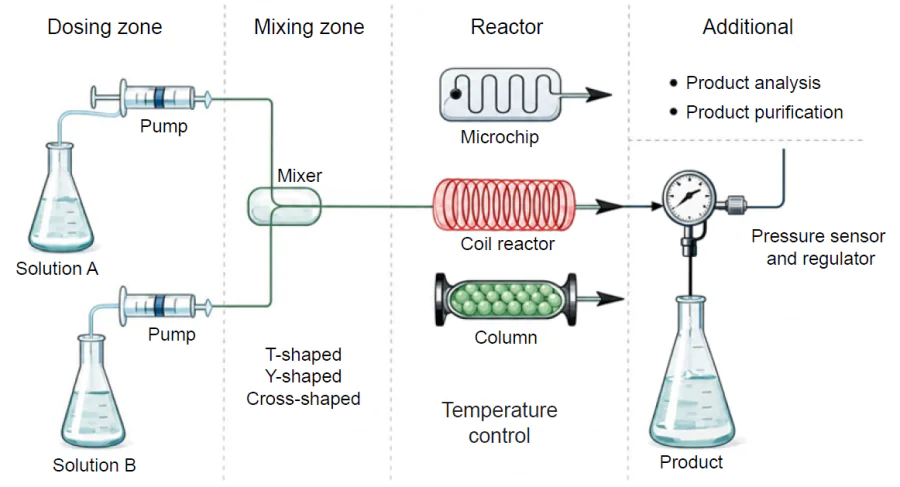
Currently, there exist quite a few microchannel systems that are used in chemical synthesis. A block diagram of these systems is shown below (Fig. 1). They are composed of a reactant dosing unit, a mixing unit using mixers of various shapes for gas and liquid flows, the proper reactor in which the main heat and mass exchange processes and chemical transformations take place, and a product isolation unit. The facility can also be provided with additional equipment for in-flow analysis or purification of the reaction product. As a rule, these systems contain a large number of control instrumentation connected to a computer and enabling remote control by an operator.
2.1. Homogeneous asymmetric organocatalysis
Homogeneous organocatalysis in a microreactor has opened up broad prospects for conducting stereoselective oxidation and С – С bond formation reactions, which find extensive use in the synthesis of biologically active compounds. The asymmetric conjugate Michael addition is a key reaction for the synthesis of various therapeutic agents, such as warfarin, baclofen, phenibut, pregabalin, and oseltamivir.
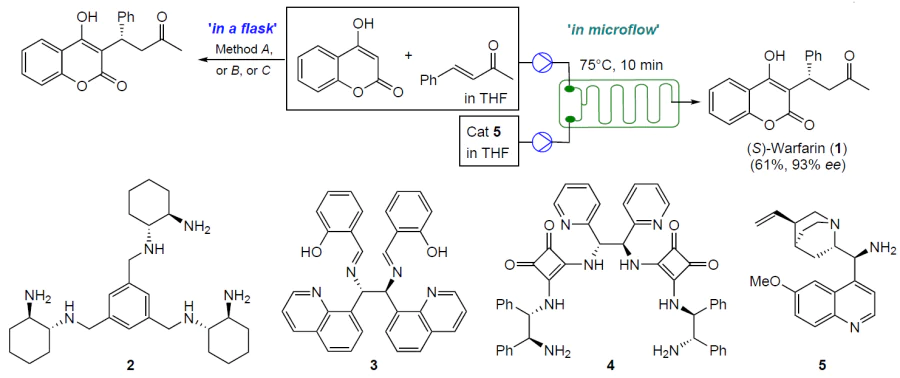
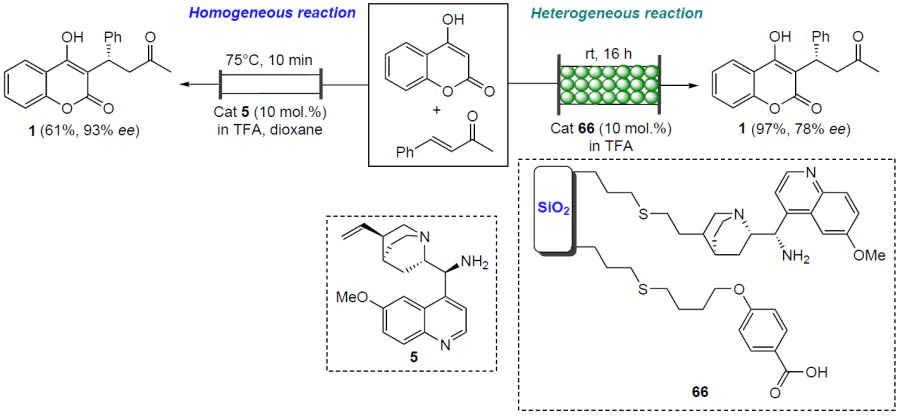
Warfarin is an oral anticoagulant widely used throughout the world. The racemic compound is accepted in clinical practice; however, (S)-warfarin (1) inhibits vitamin K epoxide reductase complex subunit 1 (VKORC1) 2 – 5 times more actively than the R-stereomer; therefore, increasing the stereoselectivity of the final step of warfarin synthesis is highly relevant.[41][42] The achievements in the asymmetric synthesis of warfarin under classical conditions were summarized by Vasechkin et al.[43] A high yield of (S)-warfarin (91%) with enantiomeric excess (ee) of 64% was achieved in the presence of polyamine 2 as a catalyst (Cat) (Scheme 1, method А).[44] The use of method В involving compound 3 prepared from (R,R)-bis(2-hydroxyphenyl)ethanediamine (HPEN) and 8-formylquinoline[45] increased the enantiomeric excess to 86%. According to Kochetkov et al.,[46] squaramide-based catalyst 4 (method С) provides a 96% yield of (S)-warfarin 1 with 96% ee. There is only one example of enantioselective synthesis of (S)-warfarin in a microchannel reactor in which the enantiomeric excess was 93%. The reaction was catalyzed by quinine derivative 5; however, the product yield was only 61% (see Scheme 1).[47] It is worth noting that the use of microreactor technology may reduce the reaction time by a factor of 144.
Pregabalin (6) is an anticonvulsant, a ligand for the voltage-gated Ca channel α2δ-subunit. Like warfarin, the S-isomer of pregabalin has a higher biological activity and approximately an order of magnitude higher affinity to the α2δ-subunit compared to the R-isomer.[48]
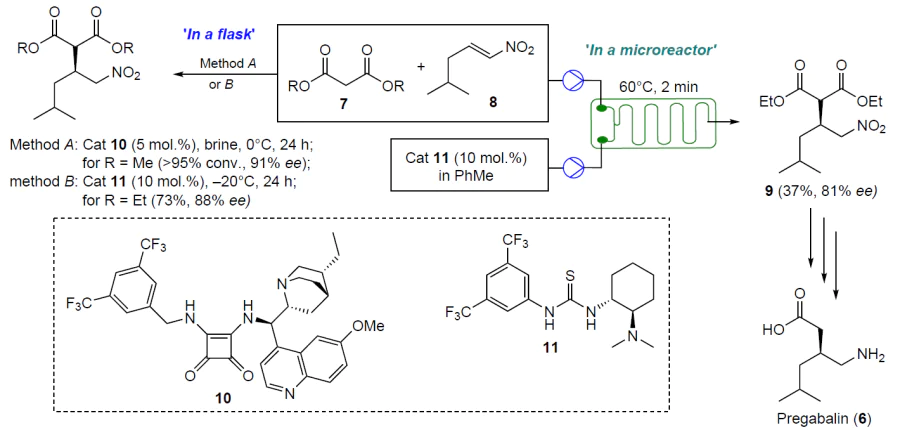
A review by Han et al.[49] describes in detail the asymmetric conjugate addition reactions for the preparation of gamma-aminobutyric acid (GABA) derivatives. In a batch process implementing a variant of pregabalin synthesis, stereoselective conjugate addition of Meldrum’s acid derivative 7 to nitroalkene 8 using chiral N-sulfinylurea gave intermediate 9 in a high yield with 92% ee.[50] The replacement of the catalyst by a squaramide derivative 10 (Scheme 2, method А*) somewhat deteriorated both the product yield and the reaction enantioselectivity.[51] In another example of the addition of diethyl malonate to nitroalkene catalyzed by chiral thiourea derivative 11, the yield of the (S)-pregabalin precursor 9 was 73% with an enantiomeric excess of 88% (see Scheme 2, method В).[52] The same reaction in a microreactor resulted in a relatively low yield of intermediate 9 and a decrease in the enantiomeric excess down to 81%; however, the reaction time decreased 720-fold.[47] The best yield of compound 9 (82%) was achieved in a batch process with the enantioselectivity being 91% ee.[53]
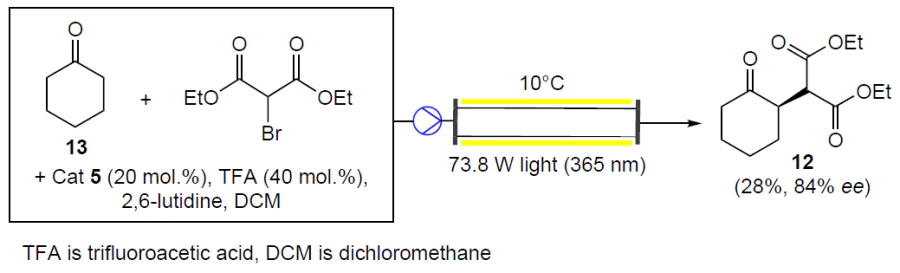
It is noteworthy that quinine-based catalyst 5 was also used in alkylation reactions. Thus, a photoorganocatalytic method of the synthesis of diethyl 2-(2-oxo-cyclohexyl)malonate (12) has been developed using alkylation of cyclohexanone (13) (Scheme 3).[54] Apart from optimization of the batch process, the feasibility and limitations were studied for this reaction implemented in a continuous flow process on a microchip, which afforded product 12 in a 28% yield with an enantioselectivity of 84% ее. The product yield considerably depended on the light-emitting diode power and process temperature.
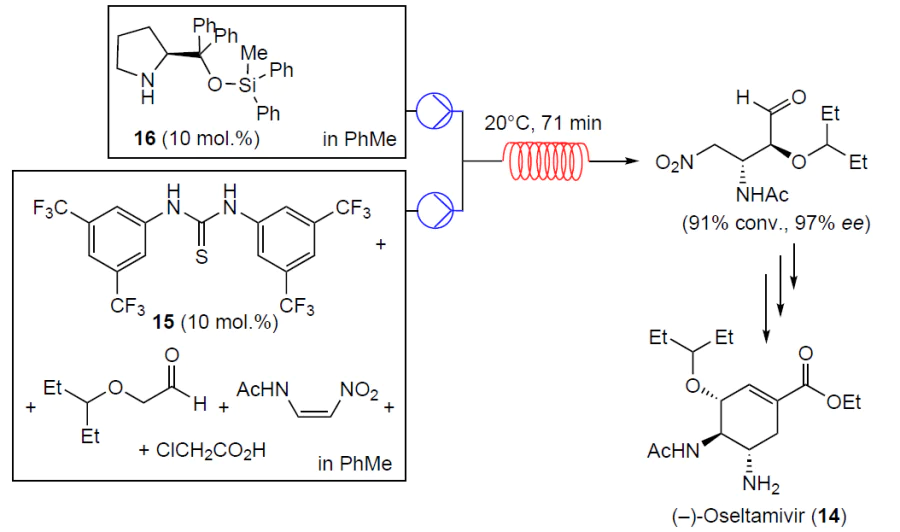
In 2017, enantioselective synthesis of the antiviral drug oseltamivir (14), influenza virus neuraminidase inhibitor, was performed in a microchannel process.[55][56] The first step of the synthesis was conjugate addition catalyzed by Schreiner’s urea (15) and proline-based chiral catalyst 16 (Scheme 4). The enantioselectivity of the process was 97%, which is comparable with the results obtained in the batch mode.
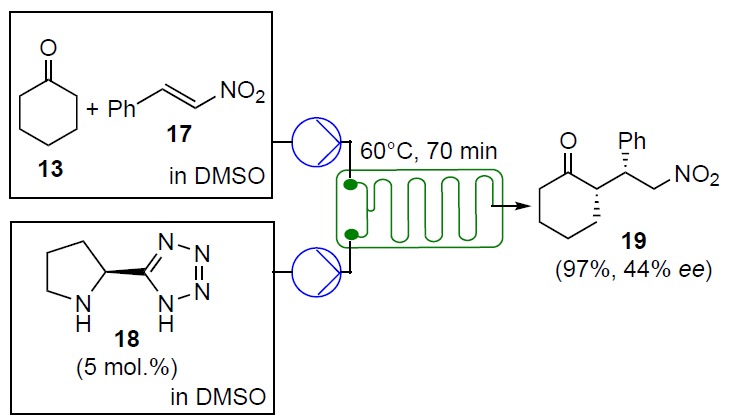
Most often, proline, quinine, squaramide, urea, and thiourea derivatives are used in the conjugate Michael addition reaction.[49][57-59] Study of the reaction of cyclohexanone (13) with β-nitrostyrene (17) showed that in the classical method, some catalysts based on quinine and thiourea and certain catalysts based on proline were ineffective, and only tetrazole 18 provided a 95% yield of compound 19 with sufficiently high diastereoselectivity: the diastereomeric ratio (dr) was 9 : 1 (Scheme 5).[58] Optimization of the reaction conditions and conduction of the process on a microchip somewhat increased the product yield, improved the diastereo- and enantioselectivity, and reduced the process duration threefold.
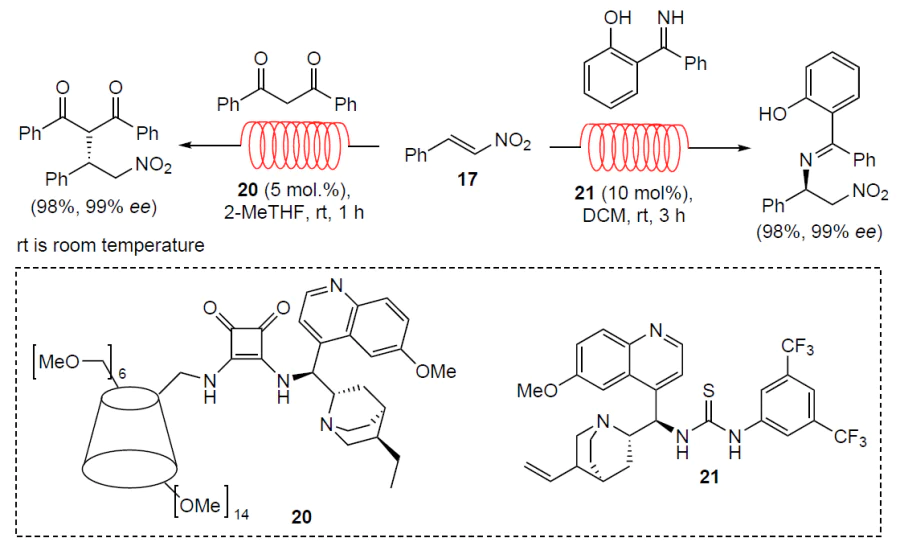
In an unusual example of a microchannel process, hybrid compounds with quinine and β-cyclodextrin moieties (e.g., conjugate 20) connected via squaramide or thiourea linker were used as catalysts. These catalysts provided the formation of Michael conjugate addition products in yields and ee exceeding 90% (Scheme 6).[60] Structurally similar catalyst 21 based on quinine and thiourea was effectively used in the aza-Michael reaction.[61] By varying the solvent and the catalyst concentration, the highest product yield (98%) and enantioselectivity (99% ее) were achieved.
Aldol condensation is a powerful tool for C – C bond formation and fabrication of complex organic structures. Diverse catalysts for asymmetric aldol condensation have been described in a number of reviews.[62-67] Most often, L-proline and its derivatives such as compounds 16, 18, and 22 and other amino acids are used as chiral catalysts to prepare aldols in microreactors under homogeneous conditions. Using these catalysts, an enantiomeric excess of 65 – 94% can be achieved for product 23 (Scheme 7).[68-71]
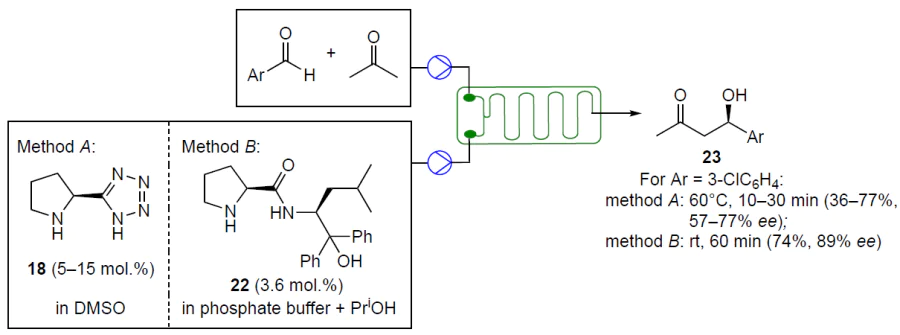
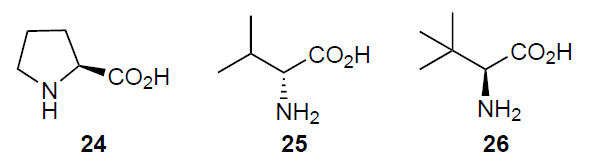
Comparison of the product yields and enantioselectivities for the reactions of cyclohexanone (13) with various benzaldehydes provides the conclusion that the continuous-flow process in a microreactor gives better results.[65][66][68][71][72] Amino acids 24 – 26 were used as catalysts.
The enantioselectivity of the reaction catalyzed by L-proline (24) at 25°С was 90% for the predominantly formed (S,R)-enantiomer of 2-[hydroxy(p-nitrophenyl)methyl]cyclohexanone (27) corresponding to the major anti-diastereomer (Table 1). It was found that the product yield has increased, while the time of the reaction involving p-nitrobenzaldehyde (28) has decreased by almost an order of magnitude.
![Formation of (S,R)-stereoisomer of 2-[hydroxy(<i>p</i>-nitrophenyl)methyl]cyclohexanone (<b>27</b>) in a microflow with amino acids as catalysts (10 mol.%).<sup>70</sup>](https://rcr.colab.ws/storage/images/resized/c2nd5pl8L39Qb2AU9ONaM4tCbtMhBMf1CsYL7LON_xl.webp)
This pronounced acceleration of the reaction made it possible to conduct a series of experiments at lower temperatures, which naturally resulted in increase in the enantioselectivity to 98% at –10°С, while maintaining high values of diastereoselectivity (syn : anti ratio) (see Table 1, entries 2 – 4). As the temperature gradually decreased, the yield of the dehydration by-product decreased from 5% to trace amounts.
The use of amino acid with the opposite configuration, D-valine (D-Val, 25), as the organocatalyst resulted in a high enantioselectivity (96% ее) for the other (R,S)-enantiomer of the same major anti-diastereomer 27 (anti : syn = 16.5 : 1) (Fig. 2). The authors believe that the higher enantioselectivity and shorter reaction time achieved in a continuous-flow process in a microreactor compared with laboratory batch reactions are due to decreasing probability of the reversible aldol reaction, resulting in racemization of the major product. The use of tert-leucine (L-tert-Leu, 26), which is even more sterically hindered than valine, resulted in further increase in the stereoselectivity and in the reaction rate. Indeed, in the presence of L-tert-Leu (26), the reaction was completed in 30 min at 25°С and achieved a high diastereoselectivity (dr = 26 : 1) with 97% ее for the major (S,R)-anti-diastereoisomer of the target product 27. The reactor, which represented a stainless-steel capillary with an internal diameter of 0.8 mm and a length of 1 m, produced 2 g of the product per hour.
![Chromatograms of aldol <b>27</b> formed in the asymmetric reaction of cyclohexanone (<b>13</b>) with p-nitrobenzaldehyde (<b>28</b>) catalyzed by amino acids in a microreactor [250 × 4.6 mm Chirobitic TAG column; 0.2% solution of diethanolamine (DEA); 0.70 mL min<sup>–1</sup> flow rate; UV detector at 210 nm].<sup>70</sup> Copyright Elsevier 2024.](https://rcr.colab.ws/storage/images/resized/4peGwamAHaPw9ow1IkPsUssotpOeUR9aQ4RDZqdp_xl.webp)
In the reaction of benzaldehydes with acetone catalyzed by chiral (pyrrolidin-2-yl)tetrazole (18), higher yields of aldol products (71 – 78%) and higher enantioselectivity (68 – 75% ee) were achieved in the presence of electron-withdrawing substituents in the para-position of the benzene ring.[68]
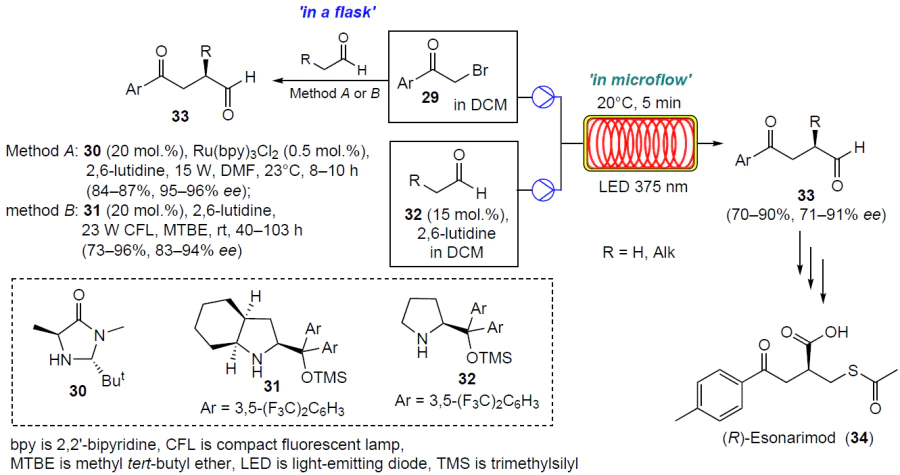
The asymmetric photoorganocatalysis was effectively employed for the α-alkylation of aldehydes with α-bromoacetophenones 29 catalyzed by chiral heterocycles 30 – 32 to obtain 1,4-dicarbonyl compounds 33 (Scheme 8).[73] Conducting the reaction on a microchip made it possible to avoid the use of expensive photosensitizers and reduce the reaction time by several orders of magnitude.[74][75] It was established that under optimal conditions, the reaction proceeds with high product yield and good enantioselectivity for a broad range of substrates (see Scheme 8). In addition, the developed enantioselective α-alkylation reaction was employed to prepare the key intermediate in the synthesis of the antirheumatic drug (R)-esonarimod (34).
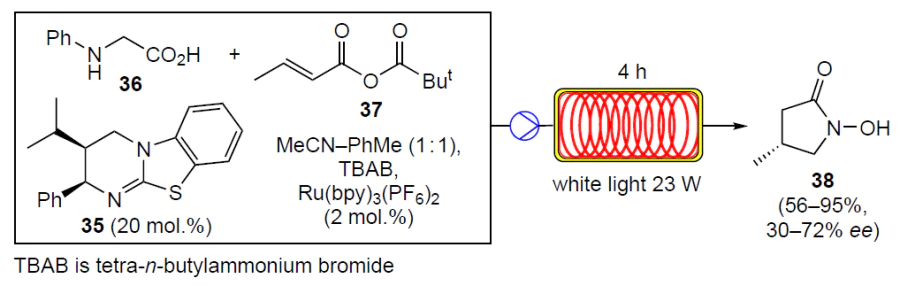
In recent years, the interest in stereoselective radical C – C bond formation reactions has continued to increase. Rio-Rodriguez et al.[76] used compound 35 as a catalyst for enantioselective radical polar [3+2]-cycloaddition of α-amino radicals generated from amino acids [e.g., N-phenylglycine (36)] to α,β-unsaturated anhydride 37 to give γ-lactam 38. This transformation, analogous to the Giese reaction, led to a series of γ-lactams in up to 79% yields and with stereoselectivity of up to 74% ее. The authors[76] demonstrated that conducting this reaction in a microchannel photoreactor results, in most cases, in higher product yields while reducing the reaction time fourfold, with the enantioselectivity of the reaction decreasing only slightly (Scheme 9). Generally, the microchannel system provides a 30-fold increase in the reaction productivity** compared to the batch reaction.
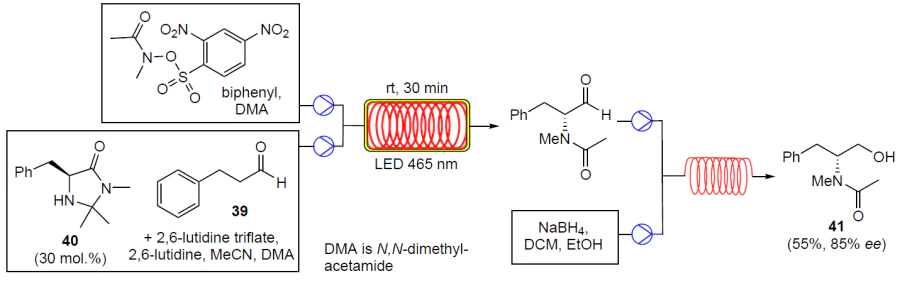
In another radical reaction, that is, the enantioselective photocatalytic addition of α-amino radicals to aldehyde 39 catalyzed by an inexpensive and commercially available imidazolidinone, MacMillan catalyst (40), product 41 was isolated after reduction in 55% yield and with 85% ee (Scheme 10).[77] When the reaction was carried out on a microchip, the productivity was 60 times higher, while the reaction time decreased 32-fold without any loss of stereoselectivity.
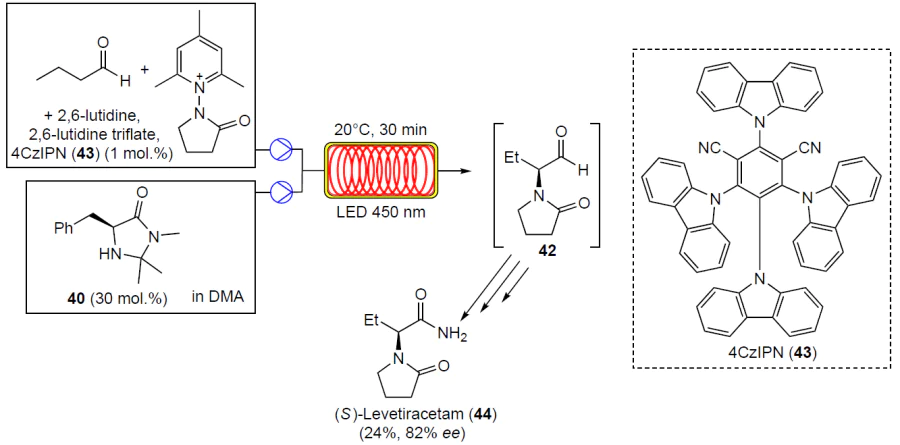
An unusual approach to the preparation of α-substituted aldehyde 42 by generation of the С – N bond was proposed in 2025.[78] The authors investigated the photocatalytic generation of N-lactam radicals for the enantioselective α-functionalization of aldehydes in the presence of MacMillan catalyst 40 and 1,2,3,5-tetrakis(carbazol-9-yl)-4,6-dicyanobenzene (4CzIPN, 43) as a photocatalyst (Scheme 11). The developed method was successfully applied to continuous-flow synthesis of the antiepileptic drug (S)-levetiracetam (44).[79][80]
The mor recent data on photochemical enantioselective catalysis in a microreactor are summarized in a review by Spils and Felpin[81] published in 2025.
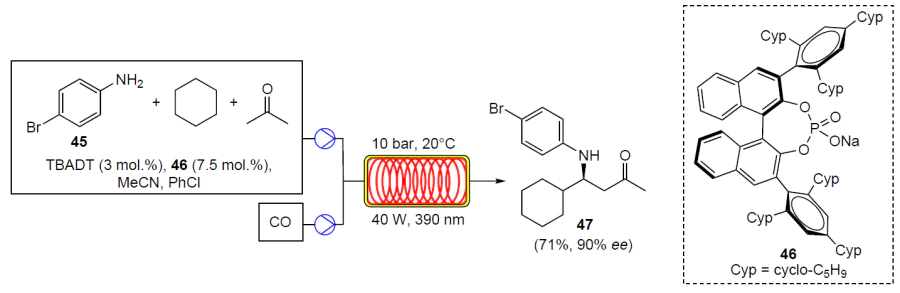
Chiral phosphoric acids (CPA), first prepared in 2004, proved to be effective as Brønsted acid catalysts. These are among the most frequently used organocatalysts, with their scope of application being constantly expanding. Over the last two decades, quite a few highly selective asymmetric transformations have been performed using these catalysts, in particular Friedel – Crafts,[82][83] Mannich,[84][85] Diels – Alder,[86] and Strecker[87] reactions. In 2024, another unusual and impressive application of these catalysts was proposed, namely, a strategy for the direct, one-step incorporation of alkanes, CO, and other simple, commercially available reagents into target chiral compounds upon exposure to light.[88] This concept was demonstrated in relation to two transformations that gave synthetically important β- and α-amino ketones. The first one included a catalytic cascade of carbonylation and asymmetric Mannich reaction involving p-bromoaniline (45), acetone, and cyclohexane in the presence of tetrabutylammonium decatungstate (TBADT) as a photocatalyst and CPA sodium salt 46. The second transformation comprised carbonylation/asymmetric radical addition reactions implemented on a microchip (Scheme 12). The synthesis of β-amino ketone 47 was scaled up to gram amounts using a combination of batch and continuous-flow processes, which made it possible to achieve a product yield of 71% with an enantioselectivity of 90% ее.
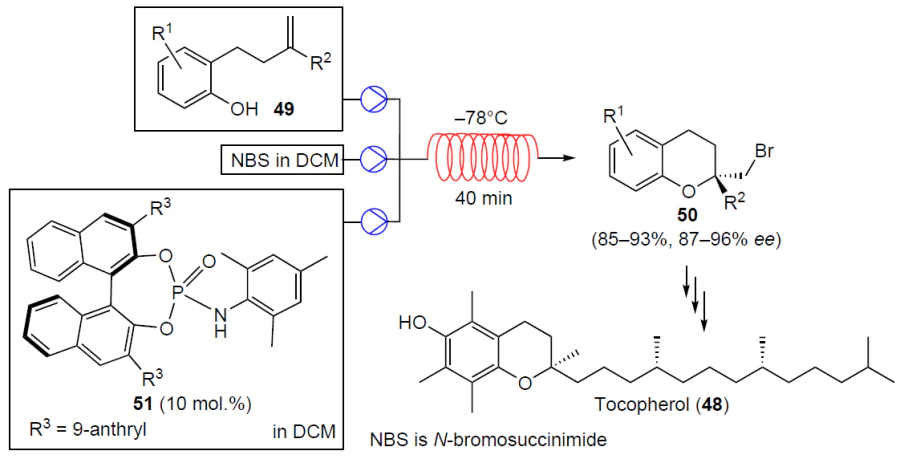
Cheng et al.[89] developed an enantioselective method for the synthesis of (+)-α-tocopherol (48) based on substituted phenols 49. The key step in the formation of the chromane ring in compound 50 was catalyzed by a CPA derivative, phosphoramidate 51 (Scheme 13). In relation to numerous substrates 49, it was shown that conduction of the reaction as a continuous-flow process in a micro-reactor decreases the reaction time from 12 h to 40 min, with the product yield and stereoselectivity being maintained at similarly high levels.
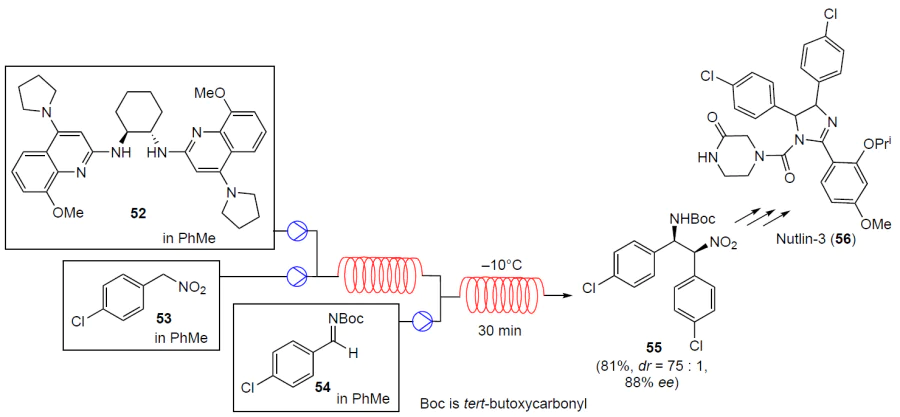
The use of homogeneous catalyst 52 enabled the successful stereoselective aza-Henry reaction involving p-chlorophenylnitromethane (53) and N-protected p-chlorophenylaldimine (54) in a continuous-flow mode in a microreactor (Scheme 14).[90] The product 55 thus formed is an intermediate in the synthesis of (–)-nutlin-3 (56), an inhibitor of DNA methyltransferase and mdm2-mediated degradation of the p53 tumour suppressor and the RB retinoblastoma protein.[91][92] Moreover, the inhibitory activity of the (R,S)-isomer of 56 was 150 times as high as the activity of the (S,R)-enantiomer, which attests to the high significance of the enantioselective synthesis of this compound.[93]
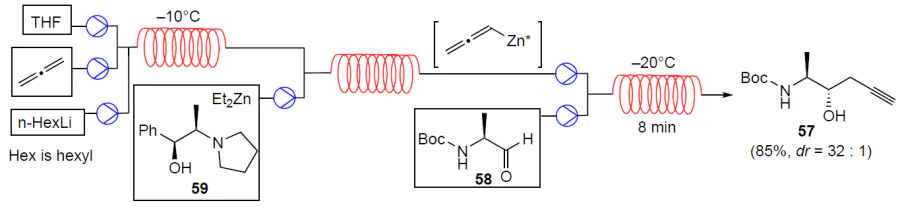
Using a series of microchips arranged in sequence, an asymmetric propargylation was successfully carried out.[94] The continuous-flow process that included allene dissolution, lithiation, and transmetallation (Li → Zn) and asymmetric propargylation in a microreactor afforded α-propargyl-β-amino alcohol 57 in a high yield and with high regio- and diastereoselectivity (Scheme 15). When the synthesis is carried out on a microchip, it is possible to react aminoaldehyde 58 with unstable intermediate, allenyllithium. In this process, commercially available and recyclable (1S,2R)-N-pyrrolidinylnorephedrine (59) served as a ligand beneficial for highly diastereoselective propargylation (dr = 32 : 1).
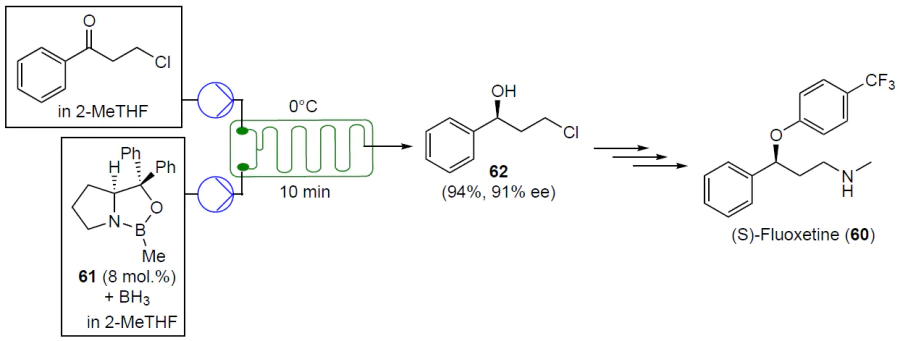
The asymmetric reduction of ketones is an important step in the synthesis of many chiral pharmaceuticals such as dapoxetine, fluoxetine (60), rivastigmine, aprepitant, and others. The efficiency of the homogeneous stereoselective reduction of ketones with diborane using the Corey – Bakshi – Shibata (CBS, 61) catalyst in a continuous-flow process in a microreactor was demonstrated by Angelis et al.[95] (Scheme 16). The reaction time was 10 min, and a yield of 3-chloro-1-phenylpropan-1-ol (62) was more than 90%, with the reaction being highly stereoselective.
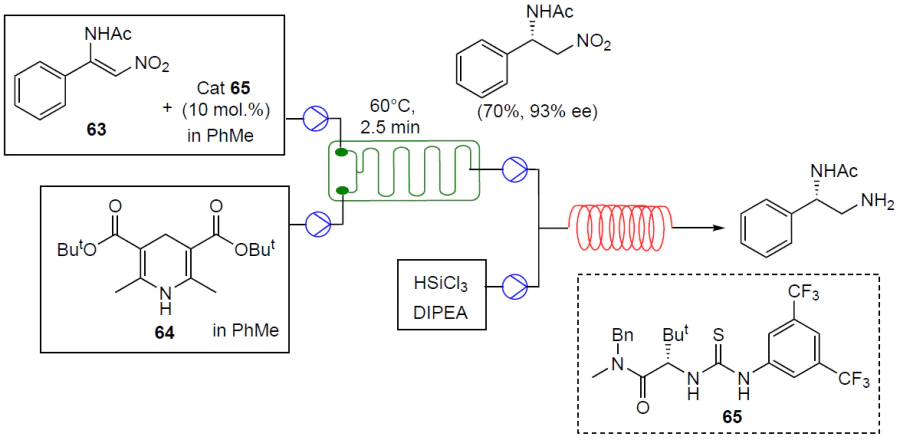
A two-step synthesis of chiral 1,2-diamines, convenient synthons for the preparation of complex BACs, was carried out in a microreactor under continuous-flow conditions.[96] In the first step, N-protected nitroenamine 63 was reduced with dihydropyridine 64 in the presence of chiral thiourea 65 as a catalyst; the reaction stereoselectivity was above 90% (Scheme 17). In the second step, the nitro group was reduced with the HSiCl3 – diisopropylamine (DIPEA) system to give a product in 30% yield. Comparison of the efficiency of the conventional approach and the microreactor synthesis revealed that ~70% of the starting reactant was converted to the product in less than 5 min, as opposed to other methods, in which such conversion is not achieved even within 30 min.
Thus, homogeneous organocatalysis implemented as a continuous-flow process using a microreactor is particularly effective for kinetically sensitive enantioselective reactions involving the formation of C – C and C – N bonds, such as the Michael addition, the aldol reaction, and α-alkylation. In relation to the synthesis of warfarin, pregabalin, oseltamivir, levetiracetam, and a number of pharmaceutically significant intermediates, switching to the continuous-flow process in a microreactor may reduce the reaction time by 1 – 2 orders of magnitude, while the enantioselectivity would remain the same, moderately decrease, or, in some cases, even increase due to a decrease in the proportion of side reactions.
* Here, the conversion is given; in other cases, the product yield is indicated unless otherwise stated.
** Particularly, space-time yield (STY); for details, see Section 5.
2.2. Heterogeneous asymmetric organocatalysis
Despite the widespread popularity of continuous-flow processes carried out in microreactors in the last decades, the active use of homogeneous asymmetric organocatalysts in these processes is complicated by the need to separate the product from the catalyst and possibly to recycle the catalyst.[97] This drawback of homogeneous catalysis makes heterogeneous chiral organocatalysts increasingly attractive.[98] Heterogenization ensures the stability and stable activity of the catalyst over time and also allows easy separation of the catalyst from the reaction mixture and reuse. This promotes decrease in the reaction time and provides high turnover numbers (TONs) of the catalyst.[97] The indicated advantages account for more extensive scope of applicability of heterogeneous organocatalysis compared to homogeneous catalysis, in particular for the С – С and С – X bond formation and for reduction, oxidation, cycloaddition, and cyclopropanation reactions. Meanwhile, in some processes, immobilization of the catalyst on a solid support adversely affects its performance, resulting in a decrease in the product yield and enantioselectivity of the reaction.[99]
Depending on the type of reaction and the process design, a heterogeneous catalyst can be used in the following forms (Fig. 3):[100]
— as a reactor bed material with a packed (fixed) layer (the catalyst is immobilized on polymeric or inorganic species, e.g., silica gel or polystyrene) (option I);
— as a monolithic column (copolymerization of various monomers, including that contained in the catalyst inside the reactor) (option II);
— as a wall-coated reactor (covalent attachment of the catalyst to the inner walls of the reactor) (option III).
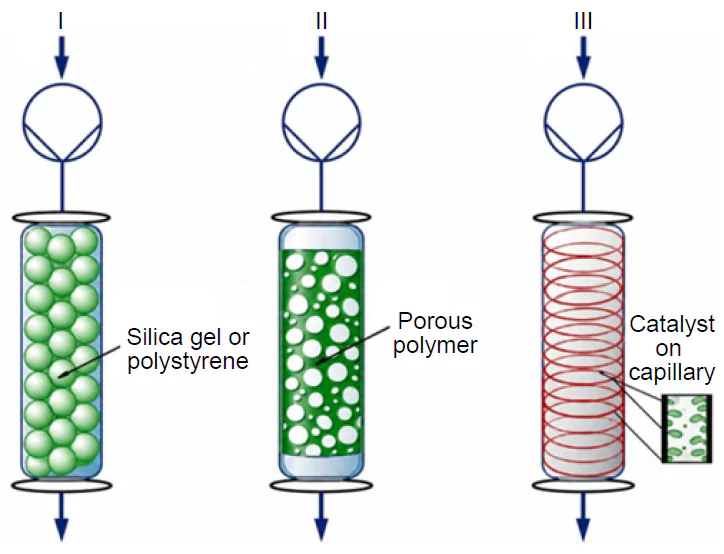
Organocatalysis in packed-bed flow reactors is becoming an increasingly popular approach. Most often, reactors are steel or glass columns with diameters ranging from 1 to 6 mm and lengths ranging from 10 to 150 mm[13] with a supported catalyst present inside.[101] The columns are directly connected to standard fluoroplastic (PTFE) or fluorinated ethylene–propylene (FEP) tubes of 1/16'' (1.6 mm) or 1/8'' (3.2 mm) diameter. The materials used most often as supports for chiral catalysts, in particular metal complexes,[102] include silica gel (e.g., SBA-15,[103] mesoporous silica with pore diameters of 2 – 50 nm[101]) or commercial resins (e.g., Amberlyst-15, a sulfonic acid resin representing a styrene–divinylbenzene copolymer with a particle size of 0.6 – 0.85 mm and pore size of 24 – 30 nm).[104] For packed-bed microreactors, the optimal particle size of the catalyst ranges from 30 to 150 μm. The choice of a particle size always involves a difficult trade-off between diffusion rate and increased pressure in the system.[105]
Packed-bed microreactors are most popular because a heterogeneous catalyst can be easily prepared by functionalizing a polymer matrix or silica gel with chiral compounds. The main drawback of these reactors is nonuniform packing, resulting in a broad distribution of the residence times of substrates in the reactor and uncontrollable hydrodynamics of the process. When an organic polymer is used as a support, the problem may be exacerbated by resin swelling, especially in the case of gel-like polymers, which have weak cross-links.[97]
In a monolithic reactor, the heterogeneous catalyst occupies the whole volume of the reactor as a structured material that is usually formed inside the reactor and has a regular or irregular network of microchannels. The material has two types of pores: large flow-through pores that allow the solution to pass through the reactor and smaller pores (meso- or micropores) that provide a large surface area (typically >100 m2) and fast diffusion of reactants to the catalytic sites. Monolithic reactors designed for catalytic applications have a considerable advantage over conventional packed beds: owing to their lower hydraulic resistance, they can achieve higher productivity at a specified pressure drop.[97]
Reactors with functionalized inner walls, also known as wall-coated reactors, represent a largely unexplored method of covalent binding of a catalyst to the inner walls. Unlike the above types of microreactors for heterogeneous catalysis discussed above, this design considerably improves the hydrodynamics of the process, since the central cavity of the reactor remains free for the unimpeded flow of reactants. However, it should be borne in mind that the contact between the reactants and catalyst particles may be limited in this reactor.[97]
2.2.1. Reactions of С – С and C – X bond formation
Reactions resulting in the formation of C – C bonds such as the conjugate Michael addition or the aldol reaction are usually carried out in packed-bed microreactors or in monolithic microreactors. In particular, the synthesis of (S)-warfarin (1) in a packed-bed reactor using catalyst 66 based on silica gel modified with quinine derivative 5 can achieve a yield of 97% and enantioselectivity of 78% ee.[106] These results are in sharp contrast with the data obtained for the homogeneous process involving the same catalyst (Scheme 18).
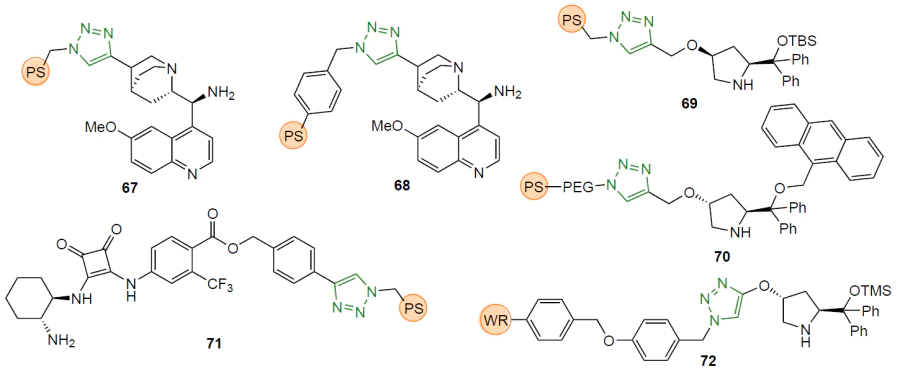
The most popular chiral heterogeneous organocatalysts are based on organic resins [polystyrene (PS)[107-113] or Wang resin (WR),[114] which are connected to the asymmetric catalytic site (quinine[107][108] or proline[109][110][112-114] derivative) through a 1,2,3-triazole linker. For example, catalysts 67 – 72 make it possible to achieve high stereoselectivity of conjugate Michael addition reactions involving a broad range of substrates (Fig. 4).
Heterogeneous catalysts 69 and 72 were successfully used in the microreactor synthesis of important selective serotonin reuptake inhibitors: (+)-femoxetine (73)[114] and (+) and (–)-paroxetines (74)[110] (Scheme 19). The latter was obtained from intermediate 75 in several steps.
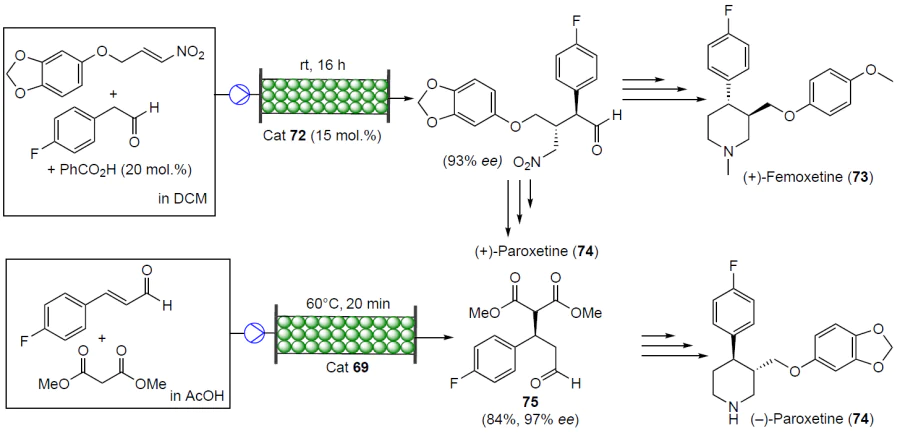
The asymmetric synthesis of (S)-rolipram (76), a selective phosphodiesterase-4 inhibitor, based on the conjugate addition of nitromethane to cinnamaldehyde derivative 77 was carried out using hydroxyproline derivative 69 as a catalyst (Scheme 20)[115][116] Nitro compound 78 was the key intermediate of this transformation, which was formed in a high yield and with a good stereoselectivity.

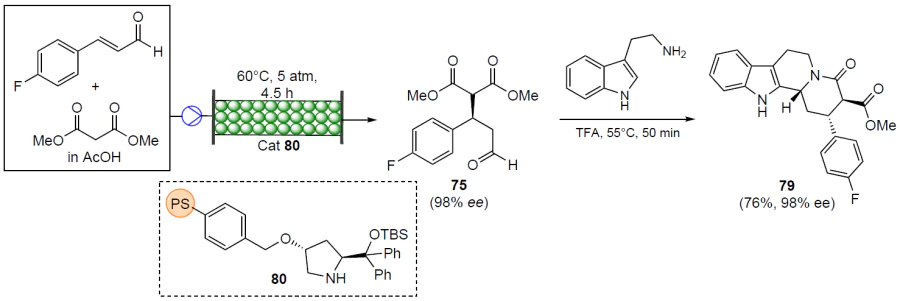
Intermediate 75 of the (–)-paroxetine (74) synthesis was used as a substrate for the formation of the indoloquinolizidine skeleton present in many biologically active alkaloids such as yohimbine, reserpine, hirsutine, etc.[117-119] A continuous-flow process performed in a microreactor comprised the cascade diastereoselective Pictet – Spengler reaction followed by lactamization yielding the target product 79 in 76% yield with 98% ee (Scheme 21).[104]
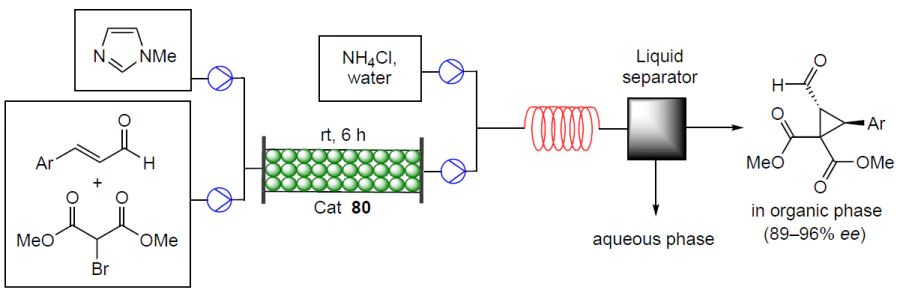
Catalyst 80 was also applied for the stereoselective synthesis of substituted cyclopropanes in a microreactor (Scheme 22).[120]
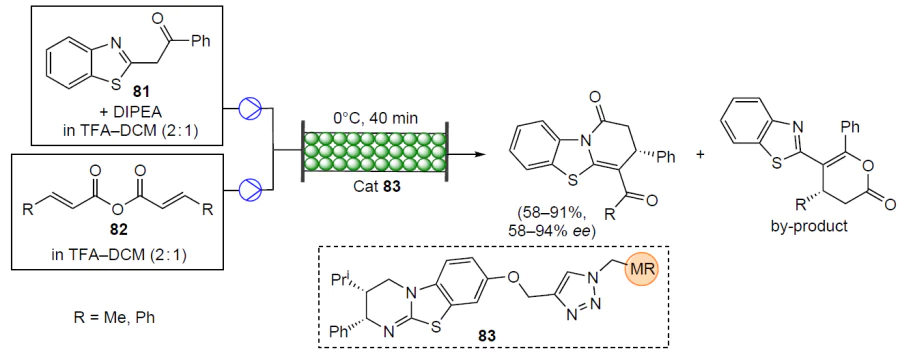
The approach consisting in binding a chiral catalyst to a polymeric support is used not only for proline and quinine derivatives. For example, isothiourea-based derivative of the HyperBTM catalyst [(2R,3S)-(–)-3,4-dihydro-3-isopropyl-2-phenyl-2H-pyrimido[2,1-b]benzothiazole] was prepared and used for the synthesis of annulated heteroaromatic structures.[121] The strategy was based on the cascade consisting of conjugate Michael addition of benzo[d]thiazol-2-ylacetophenones 81 to α,β-unsaturated anhydrides 82 and cyclization (Scheme 23). The reaction in a fluidized-bed microreactor that was packed with chiral catalyst 83 immobilized on Merrifield resin (MR) had a high enantioselectivity for most substrates, with the catalyst retaining its activity for 42 h.
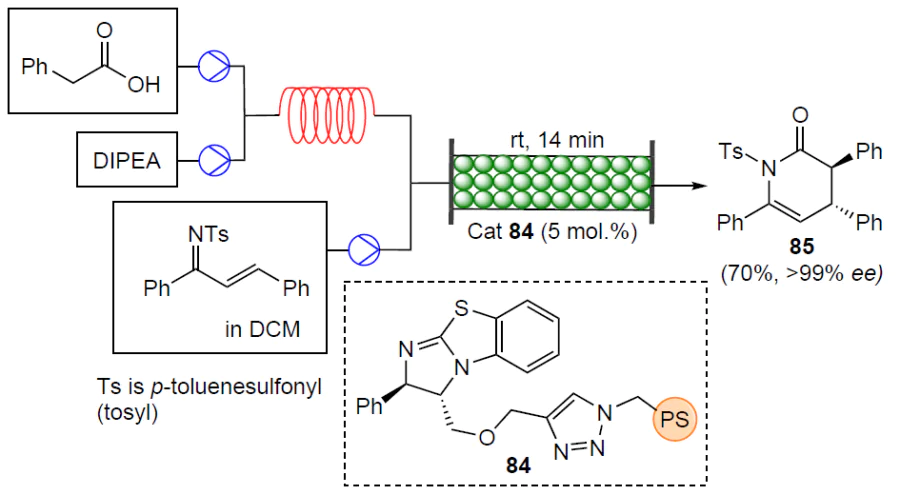
A similar example was reported by Izquierdo and Pericàs.[122] An enantiomerically pure analogue of benzotetramisole (BTM, 84) immobilized on polystyrene was successfully used to synthesize dihydropyridinones 85 via domino conjugate addition/cyclization reaction (Scheme 24). The implementation of a continuous-flow process made it possible to reduce the reaction time by an order of magnitude and to obtain 4.4 g of enantiomerically pure product in 11 h.
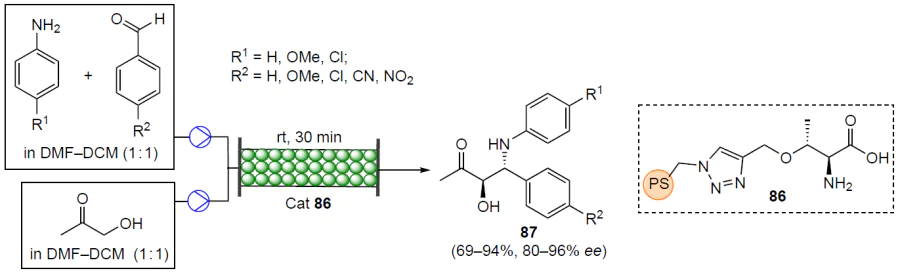
Catalyst 86 based on L-threonine bound to the polystyrene matrix via a 1,2,3-triazole linker showed excellent results in three-component Mannich reaction giving chiral β-amino-α-hydroxycarbonyl compounds 87 (Scheme 25).[123] The use of the catalyst in a continuous-flow process on a microchip made it possible to increase the diastereo- and enantioselectivity of the reaction compared to a batch process.
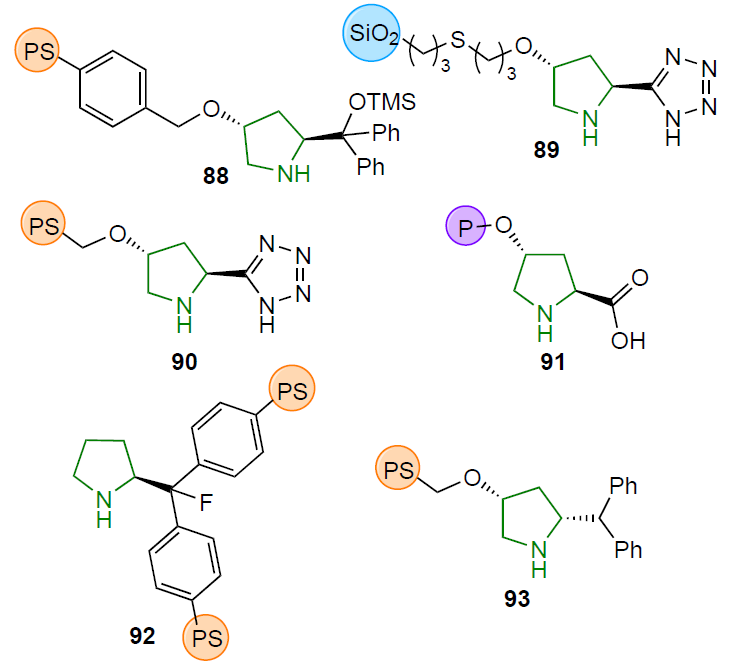
Other chiral catalysts 88 – 93 structurally similar to compound 80 immobilized on a polymer substrate or silica gel also proved to be effective for aldol condensation,[106][124][125] Mannich reaction,[124][126-128] and conjugate addition;[129-132] the enantioselectivity of the reactions often exceeded 95% (Fig. 5).
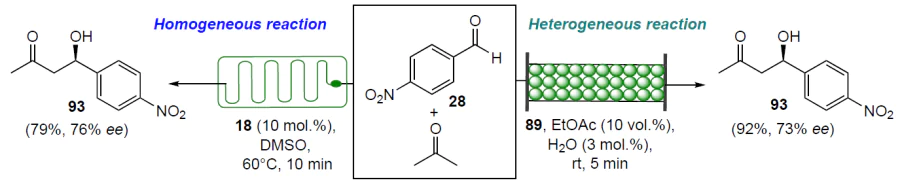
Comparison of the conditions of the aldol reaction exemplified by the reaction between p-nitrobenzaldehyde (28) and acetone demonstrated advantages of the heterogeneous process on microchips over the homogeneous process. The former provides a higher yield of aldol 93 and decreases the reaction time twofold (Scheme 26).[68][125]
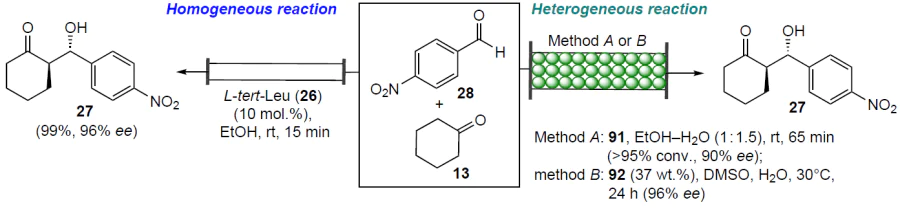
It is noteworthy that highly stereoselective aldol reaction also proceeds in monolithic reactors. For example, Greco et al.[133] reported the reaction of cyclohexanone (13) with p-nitrobenzaldehyde (28) catalyzed by the styryl proline derivatives 91.[133] The stereoselectivity of the reaction was somewhat lower than that of a similar homogeneous reaction[70] catalyzed by L-tert-Leu (26), but substantially higher than that of the reaction conducted under batch conditions.[134][135] Porous organogel 92 was obtained by copolymerization of tert-butyl methacrylate, ethylene glycol dimethacrylate, and L-Pro derivative and was used to fill a monolithic microreactor (Scheme 27). This immobilized catalyst ensured high stereoselectivity in the formation of aldol 27.[136]
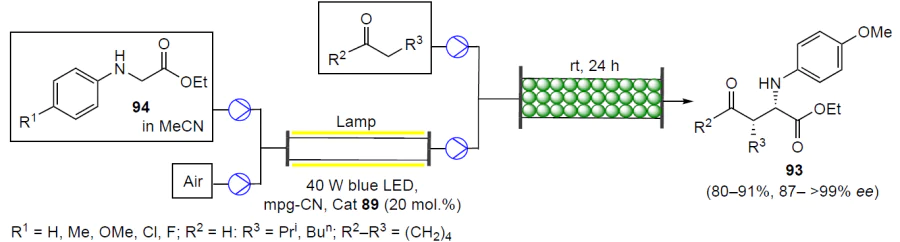
In 2024, Poletti et al.[128] proposed a new environmentally friendly and efficient approach to the synthesis of enantiomerically pure non-protein α-amino acid derivatives 93, which involved the Mannich reaction in a continuous-flow process on a microchip (Scheme 28). The first step is the photochemical generation of an imine from ethyl N-arylglycinate 94 taking place in a reactor packed with mesoporous graphitic carbon nitride (mpg-CN). This is followed by the Mannich reaction involving α-enolizable ketones or aldehydes activated with Si@Ley-supported organocatalyst 89 and the imine formed in the first step.
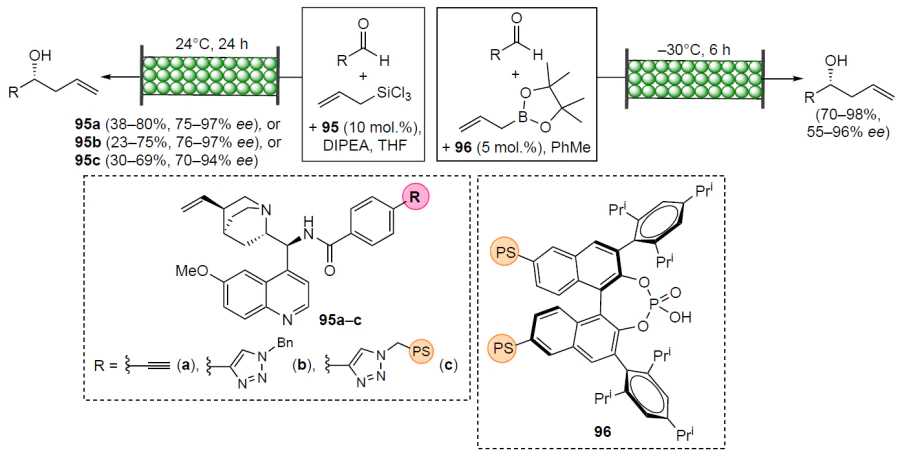
Chiral heterogeneous catalysts based on quinine (95a – c) and 3,3-bis(2,4,6-triisopropylphenyl)-1,1-binaphthyl-2,2-diyl hydrogen phosphate (TRIP, 96) immobilized on polystyrene provide high yields and high stereoselectivity in the allylation of aliphatic and aromatic aldehydes (Scheme 29).[137-139] In addition, these catalysts remain active for more than 10 operating cycles in the batch mode and for dozens of hours of continuous-flow synthesis in a microreactor without any decrease in the product yield or stereoselectivity.
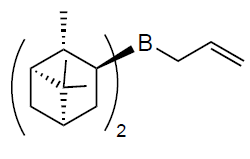
Chiral diols formed after oxidation of the allylation product serve as substrates for the synthesis of a number of pharmaceuticals such as selective serotonin reuptake inhibitors and the lipid-lowering agent ezetimibe.[117] It is worth noting that in-flow asymmetric allylation can be carried out with high yield and enantioselectivity using homogeneous catalysis with organoboron borneol derivative (−)-Ipc2B(All), where Ipc is isopinocamphyl, All is allyl.[140] A review by Tang et al.[141] presents numerous methods for enantioselective allylation with boron-containing compounds in classic design. Reactions of this type carried out under conventional conditions require stirring of reactants for > 12 h at low temperature (< –30°C) to achieve equally high yields and enantioselectivity.
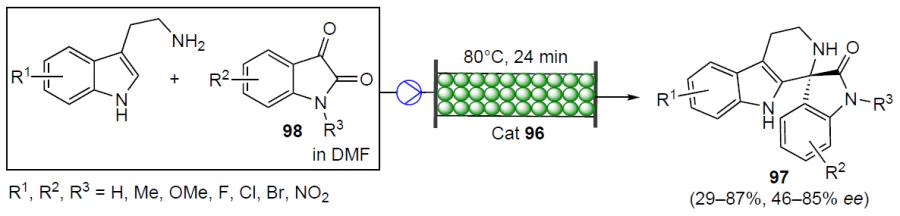
Apart from allylation, CPA derivative 96 can be used to prepare complex heterocyclic structures.[142] An example is the enantioselective synthesis of spiroindolinones 97, which possess a considerable therapeutic potential and exhibit antimalarial,[143] antitumour,[144] and anticonvulsant activities.[145] The synthesis is based on enantioselective Pictet – Spengler cyclization (Scheme 30). The synthesis of key compounds in a fluidized-bed microreactor packed with immobilized catalyst 96 made it possible to reduce the reaction time by more than an order of magnitude compared to the batch process. However, the necessity of performing the synthesis at relatively high temperatures had an adverse effect on the stereoselectivity of the reaction. It is also noteworthy that not only isatin derivatives 98, but also α-keto esters can be used as electrophilic agents in reactions with tryptamines, which gives enantiomerically pure quaternary tryptolines.
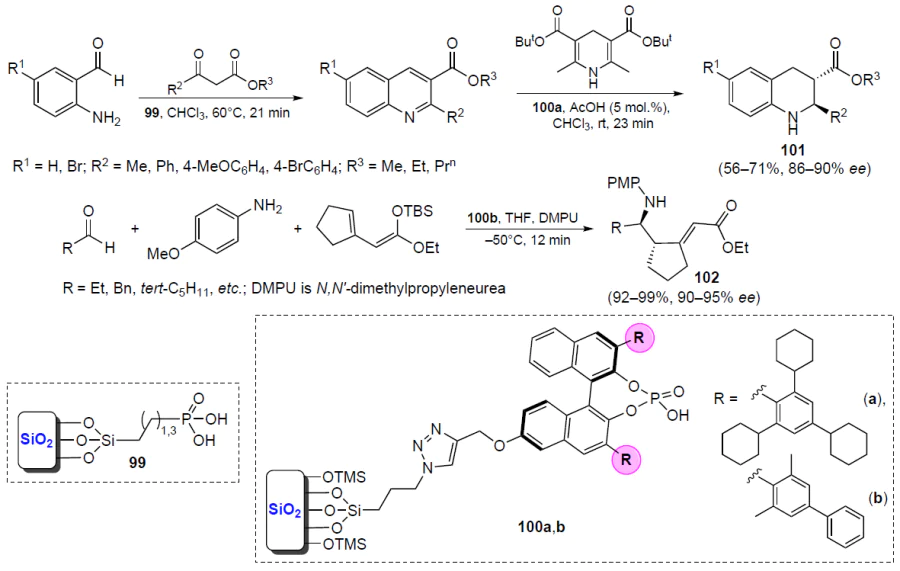
In 2024, Laue et al.[146] reported a general strategy for direct immobilization of chiral phosphoric acids on a broad range of solid supports including silica, polystyrene, and alumina.[146] Then immobilized catalysts 99 and 100a,b were used to carry out a series of synthetically valuable stereoselective reactions as batch and continuous-flow modes. Thus the Fridländer condensation/hydrogen transfer reaction sequence and the Mannich reaction conducted under cryogenic conditions in a microreactor afforded imino esters 101 and 102, respectively (Scheme 31). In most cases, high product yields and high stereoselectivities were observed, and the catalyst could be reused and showed high stability: after 10 cycles of batch process, there was no decrease in the selectivity or catalytic activity. In the continuous-flow process, the heterogeneous system operated for 19 h, and high enantioselectivity was maintained throughout the whole process.
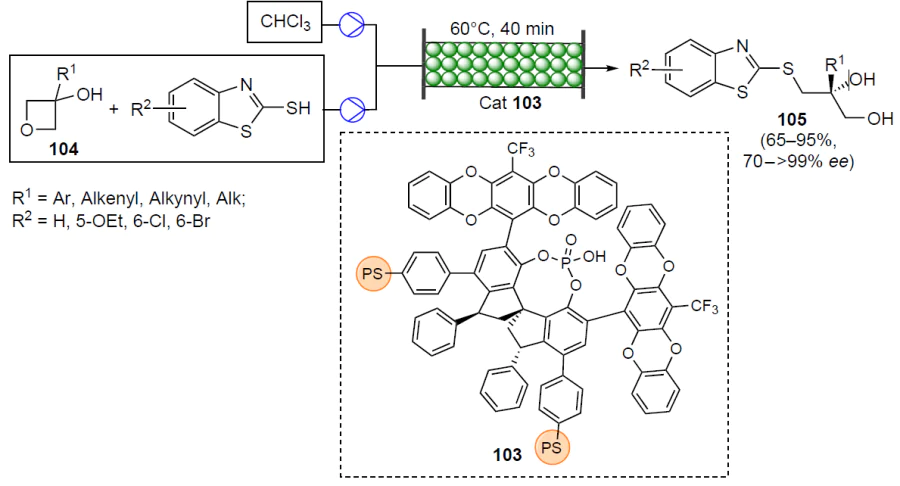
The scope of applicability of CPA was extended to the synthesis of C2-symmetric derivatives of 1,1'-spirobiindane-7,7'-diol (SPINOL) containing polymerizable styrene groups.[147] The radical copolymerization of these monomers with styrene made it possible to synthesize a family of immobilized chiral phosphoric acids based on SPINOL (for example, compound 103). In a continuous-flow process in a microreactor using this heterocatalyst, the catalytic desymmetrization of 3,3-disubstituted oxetanes 104 took place to give diols 105 in > 90% yield with up to 99% ее; the catalyst exhibited a very high activity without a decrease in the conversion or enantioselectivity after 16-hour operation cycles (Scheme 32).
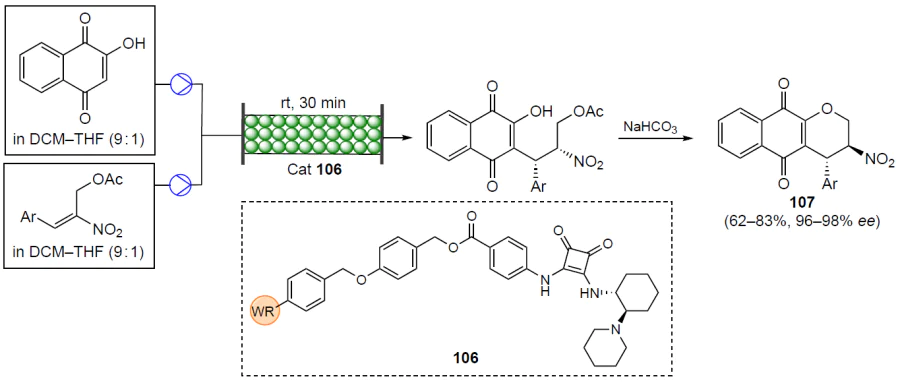
Squaramide-based catalyst 106 supported on the Wang resin was used for the microreactor synthesis of chiral dihydropyranonaphthoquinones 107,[148] heterocyclic molecules exhibiting a wide range of biological activity (Scheme 33).[149][150]
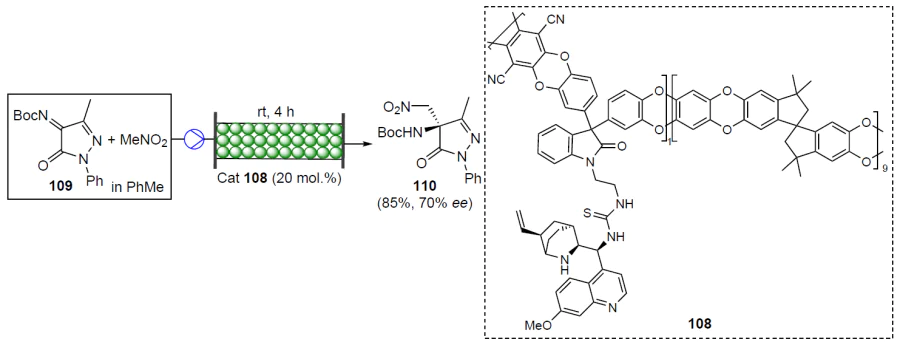
Heterogeneous organocatalyst 108 was synthesized[151-153] on the basis of an intrinsically microporous polymer combining the microporosity of solids with the solubility and processibility of glass-like polymers. The polymer base of the catalyst was obtained by condensation of 3,3-diaryloxyindole monomer, 5,5',6,6'-tetrahydroxy-3,3,3',3'-tetramethylspirobisindane, and 2,3,5,6-tetrafluoroterephthalonitrile. Heterocatalyst 108 was used for the enantioselective aza-Henry reaction involving pyrazolinone ketimines 109 and nitromethane. The reaction was carried out in the continuous-flow mode on a microchip to obtain nitro derivative 110 (Scheme 34).
Catalyst 21 based on quinine and thiourea supported on silica gel was employed in the asymmetric Strecker reaction involving spiro[cyclohexane-1,3'-indole] (111) (Scheme 35).[154] Conducting the process on a microchip gave (S)-α-aminonitrile 112 with 90% ee vs. 40% ee for the batch process.

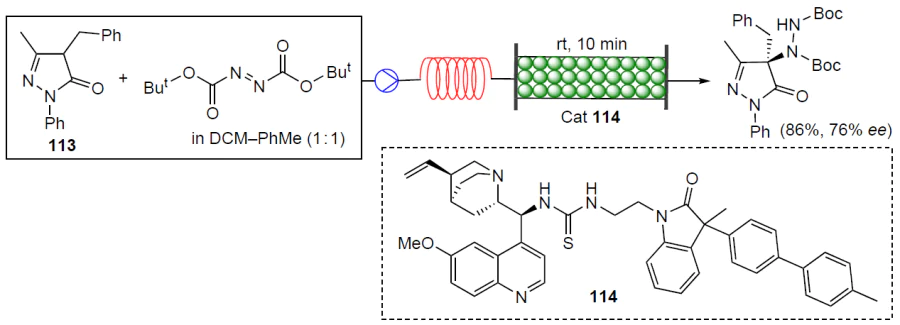
Sánchez-Molpeceres et al.[155] described an effective example of enantioselective formation of the C – N bond implemented as an organocatalytic amination of 4-substituted pyrazolone 113 with azodicarboxylates catalyzed by thiourea derivative 114 containing quinine and 3-methyl-3-(p-diphenyl)indoxyl moieties (Scheme 36). The practical value of this approach was illustrated by using the immobilized catalyst in a continuous flow within a microreactor system, where the catalyst activity was maintained for 3 h without additional reactivation, with the reaction time being decreased by an order of magnitude compared to a batch laboratory process.
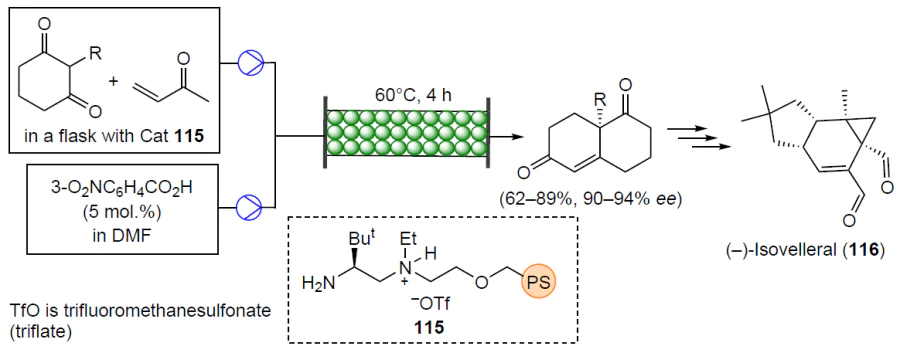
1,2-Diamine catalyst 115 immobilized on polystyrene was applied in the enantioselective Robinson annulation in the continuous-flow mode on a microchip (Scheme 37).[156] The high activity of this heterocatalyst was preserved for 10 operation cycles; in a similar process in a microreactor, this catalyst provided the synthesis of (−)-isovelleral (116) possessing antimicrobial and fungicidal properties.
2.2.2. Oxidation and reduction reactions
One of the few examples of enantioselective reduction in a microflow is reduction of the C = N bond in imines 117 with trichloromethylsilane (Scheme 38).[157][158] It was shown that immobilization of MacMillan catalysts (118a,b) on a polystyrene matrix provides better stereoselectivity than immobilization on silica gel.
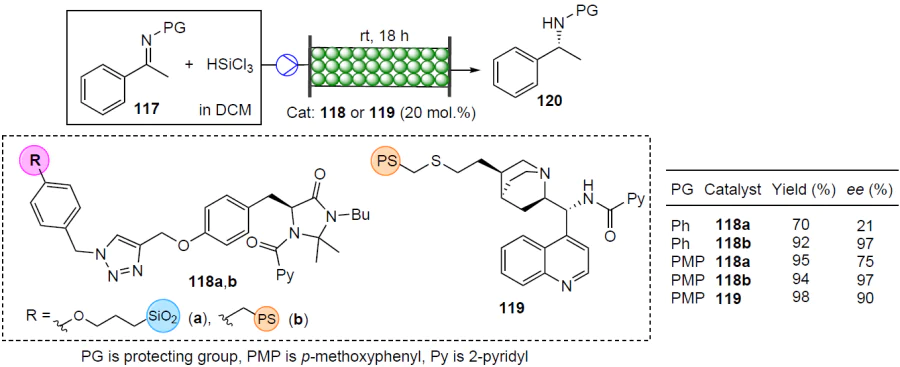
Heterogeneous catalysts 118a,b and 119 showed comparable stereoselectivity in the synthesis of chiral N-aryl-1-arylethane-1-amines 120. In a batch process, the enantioselectivity of imine reduction ranged from 66 to 99% ee.[159]
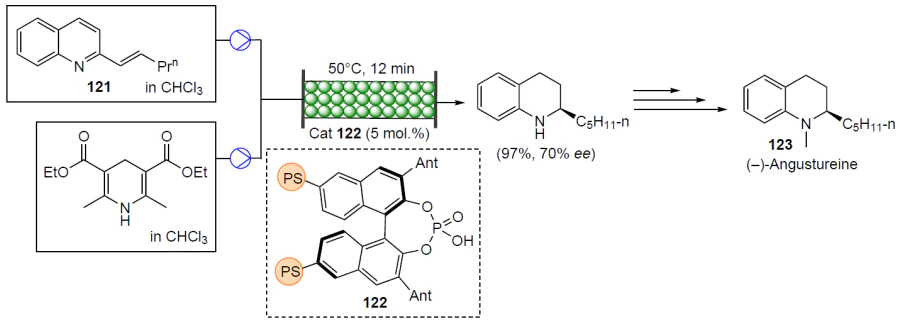
Chiral phosphoric acid derivatives are effective not only in the C – C bond formation reactions, but also in enantioselective hydrogenation. For example, it was demonstrated that the asymmetric hydrogenation of 2-substituted quinoline 121 catalyzed by CPA 122 carried out in microreactors opens up the possibility of preparing biologically active Hancock alkaloids such as (–)-angustureine 123 (Scheme 39), (–)-cuspareine, and (–)-galipinine.[160-162]
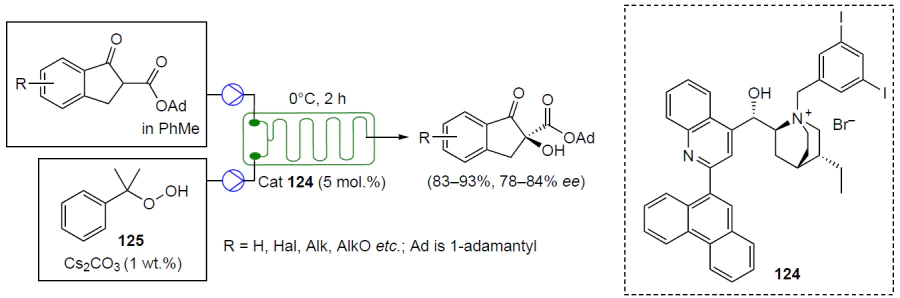
Tang et al.[163] reported heterogeneous two-phase (in the liquid/liquid system) α-hydroxylation of β-dicarbonyl compounds catalyzed by cinchonine derivative 124 (Scheme 40). It was shown that the C – H oxidation with cumyl hydroperoxide 125 results in high yields and high stereoselectivity in both batch and continuous-flow modes; however, the reaction time is reduced by a factor of 12 in a microreactor.
2.2.3. Cycloaddition reactions
Heterogeneous chiral catalysts are effectively used for the enantioselective synthesis of β-lactams.[164][165] The main steps in the asymmetric synthesis of β-lactams using solid reactants and a catalyst include the generation of ketene from the corresponding acyl chloride, the catalytic reaction step, and the purification procedure (scavenging of the polymer resin). The ketene is usually generated by adding a base, 2-tert-butylimino-1,3-dimethyl-2-diethylaminoperhydro-1,3,2-diazaphosphorine (BEMP), with quinine immobilized on the Wang resin acting as the chiral catalyst. The resin is scavenged using another resin functionalized with benzylamine. This procedure can be used to prepare disubstituted β-lactams in moderate yields and with high enantioselectivity (ee > 90%).
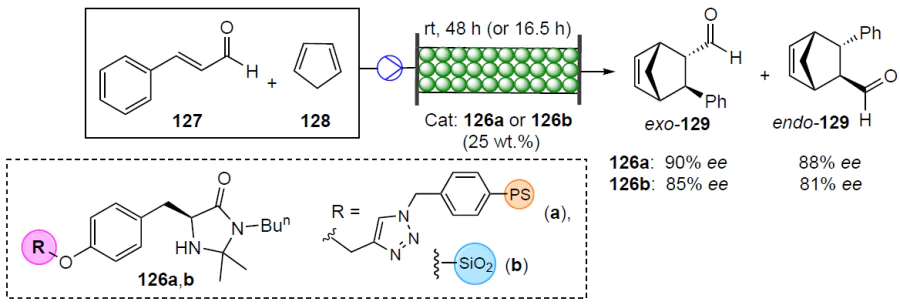
Using modified MacMillan catalyst 126 immobilized on a monolithic support, Chiroli et al.[166][167] carried out the Diels–Alder reaction in a continuous-flow process in a microreactor (Scheme 41). The reaction of cinnamaldehyde (127) with cyclopentadiene (128) afforded a mixture of equal amounts of endo- and exo-products 129 with a relatively high enantioselectivity for each diastereomer. It is noteworthy that a polystyrene-based support bound to the catalyst via a triazole linker provided better enantioselectivity of the reaction compared to a silica gel-based support.
Thus, the above-indicated advantages of heterogeneous organocatalysis in microreactor systems, that is, the catalyst stability, the possibility of catalyst regeneration, decrease in the reaction time, and high TON values, allow effective use of this approach in a wider range of reactions compared to homogeneous organocatalysis.
3. Asymmetric metal complex catalysis
Enantioselective catalysis using chiral coordination compounds is an advanced strategy for the preparation of enantiomerically pure products.[35] [168-170] Over the past few decades, the range of asymmetric transformations involving metal complexes has markedly expanded, and they have become well-established tools for the production of enantiomerically enriched pharmaceuticals.[171][172]
3.1. Homogeneous metal complex catalysis
3.1.1. Reactions of С – С bond formation
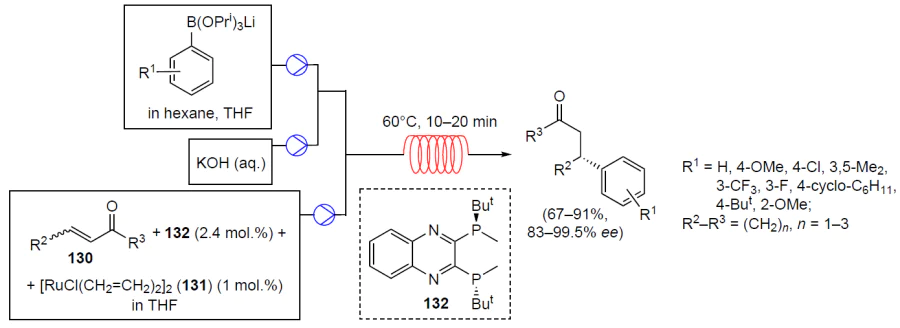
The studies on the formation of C – C bonds via homogeneous enantioselective metal complex catalysis using microreactors are largely concerned with the Michael addition and the Henry reaction. Thus the asymmetric arylation of α,β-unsaturated ketones 130 catalyzed by ruthenium complex 131 in the presence of chiral ligand 132 furnished target aryl ketones within a few minutes, with the reaction enantioselectivity being above 95% ее in most cases (Scheme 42).[173]
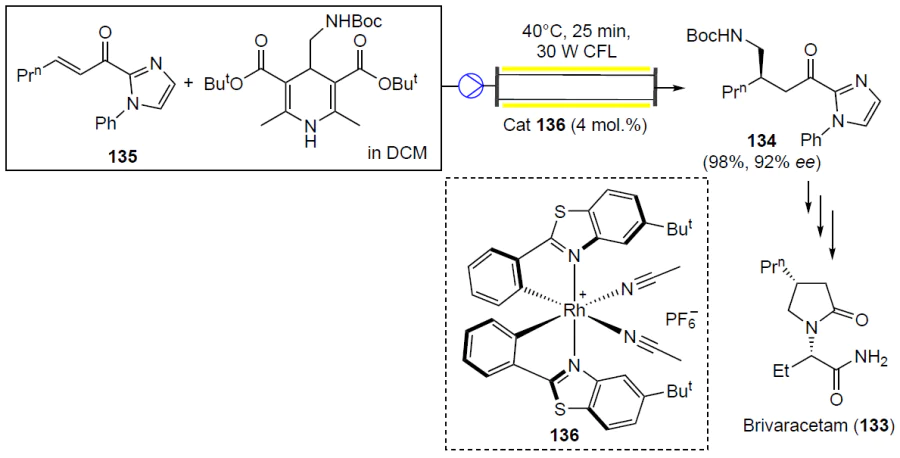
The enantioselective synthesis of the antiepileptic drug brivaracetam (133) was performed using a continuous-flow microreactor (Scheme 43).[174-176] Key intermediate 134 was obtained from α,β-unsaturated acylimidazole 135 and the corresponding Hantzsch ester in the presence of rhodium photocatalyst 136 in a nearly quantitative yield and with high enantioselectivity.
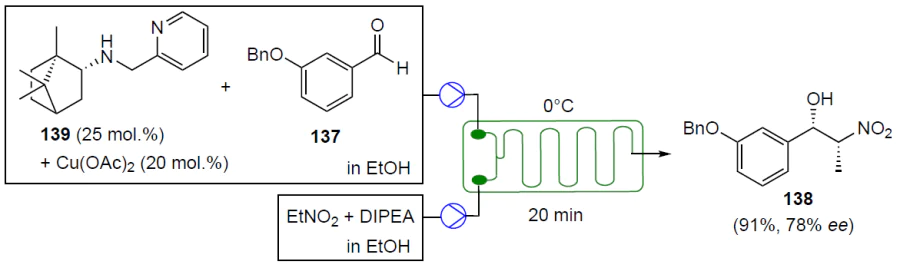
The Henry reaction is an effective method for C – C bond formation widely used in the synthesis of biologically active compounds and pharmaceuticals. Currently, quite a few methods of asymmetric metal complex catalysis involving a wide range of metal salts (La, Cu, Zn, Co, Mg) are known for a variety of substrates.[177][178] However, there are relatively few examples of the metal complex-catalyzed Henry reaction carried out under continuous-flow conditions on microchips. Rossi et al.[179] described a stereoselective synthesis of biologically active 1,2-amino alcohols such as norephedrine, metaraminol, and methoxamine in a 3D-printed microreactor (Scheme 44). The CuII-catalyzed Henry reaction involving 3-benzyloxybenzaldehyde 137 proved to be fairly sensitive to temperature and the reactant feed rate. Under optimal conditions, a 91% yield of nitroaldol 138 was achieved with a stereoselectivity of 78% ee, owing to the use of chiral ligand 139. The reaction characteristics also slightly varied depending on the material and the microreactor size: the best product yields and enantioselectivity were obtained in a reactor made of polylactide. In the batch process, the highest yields and enantioselectivities were achieved in the presence of a salen ligand based on a cis-2,5-diaminobicyclo[2.2.2]octane cage or using homogeneous organocatalysis by calix [4]arenes with α-methylbenzylamine-functionalized crown ethers. This was critically important for the synthesis of enantiopure β-adrenergic blockers such as (S)-toliprolol and (S)-moprolol.[180][181]
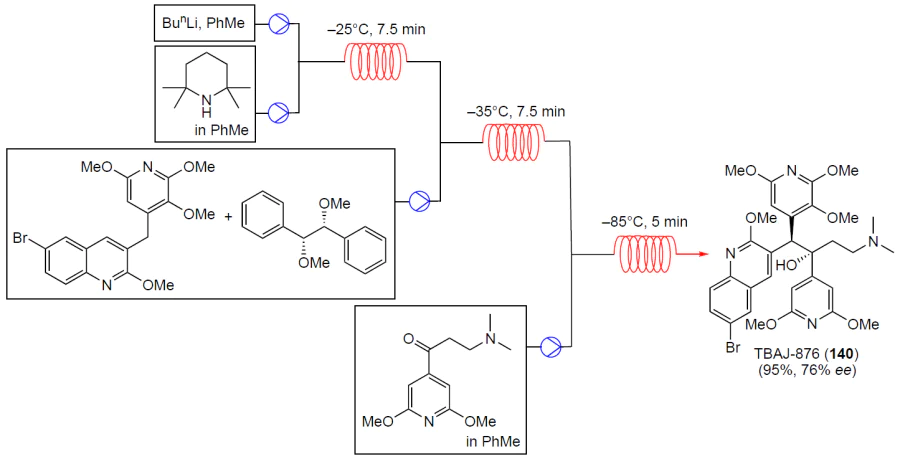
The synergistic bimetallic Li – Li catalysis was exemplified by the synthesis of the antituberculosis drug TBAJ-876 (140), a mycobacterial adenosine triphosphate synthase inhibitor (Scheme 45).[182-184] Thorough selection of reaction conditions and exact sequence of introduction of reactants onto a microchip made it possible to obtain a product in a nearly quantitative yield. Furthermore, Gao et al.[182] were able to scale up the continuous-flow synthesis for multigram amounts of the substrates.
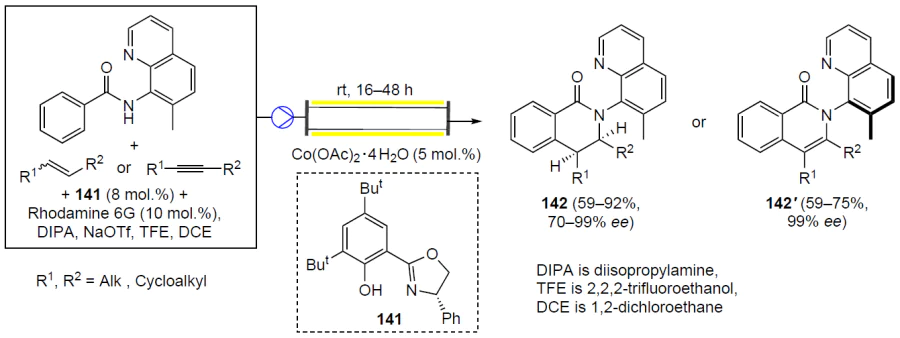
Cobalt-based catalysts are extensively used for the synthesis of optically active compounds with both central and axial chirality. In 2024, Xu et al.[185] proposed a new strategy that combined the organic photoredox catalysis, flow chemistry, and enantioselective C – H activation catalyzed by cobalt(II) acetate tetahydrate with chiral ligand 141. This method made it possible to perform regio- and stereoselective synthesis of chiral heteroaromatic structures 142 or 142' with enantioselectivity of up to 99% ее (Scheme 46).
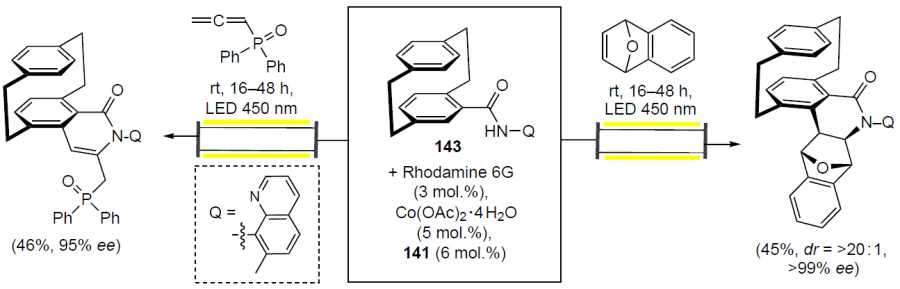
A year later, the same research group[186] demonstrated that their approach involving photoredox catalysis and enantioselective activation of the C – H bond was applicable for efficient synthesis of chiral [2.2]paracyclophane (PCP) derivatives (Scheme 47). This method was used to synthesize various disubstituted multichiral compounds in good yields and with high diastereo- and enantioselectivities (>20 : 1 dr, > 99% ee). The unreacted enantiomer of [2.2]paracyclophane 143 was isolated in a yield of up to 50% with high optical purity (>99% ee) and was subsequently converted into valuable ligands. This reaction was scaled up to gram amounts using continuous-flow photochemical synthesis on a microchip, while maintaining the efficiency.
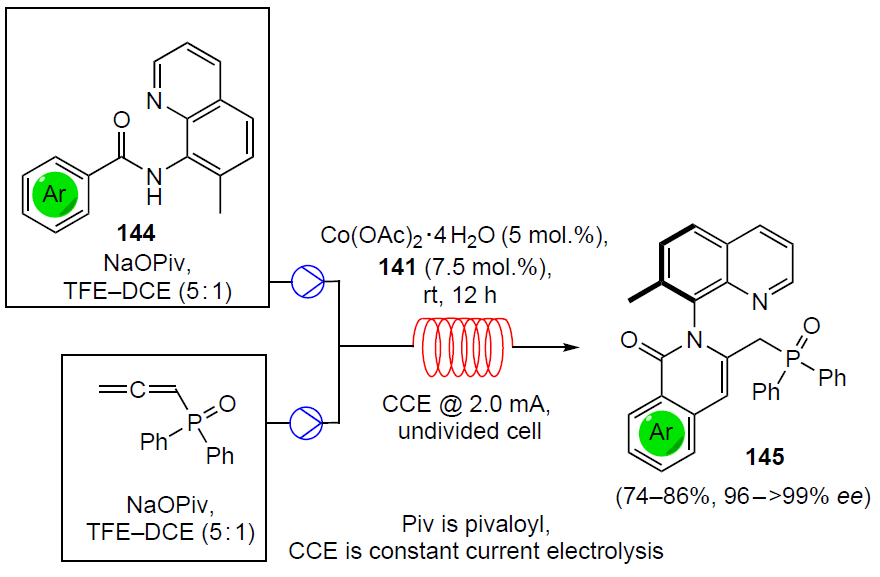
Unusual results were obtained in a study of atropo-selective C – H annulation of electronically diverse benzamides 144 electrocatalyzed by cobalt(II) acetate tetrahydrate with ligand 141.[187] This approach led to isoquinolines 145 with C – N axial chirality in high yields and with enantioselectivity of up to 99% ee (Scheme 48). The enantioselective electrocatalysis was also carried out in a continuous-flow electrochemical microreactor in the absence of a supporting electrolyte; in this case, the yield and enantioselectivity remained virtually unchanged. Apart from allenes that contain a phosphine oxide moiety, this reaction was also performed for substrates with D-menthol and cholesterol moieties, which provided a stereoselective synthesis of derivatives of these biologically valuable compounds with >98% ee.
3.1.2. Reduction and oxidation reactions
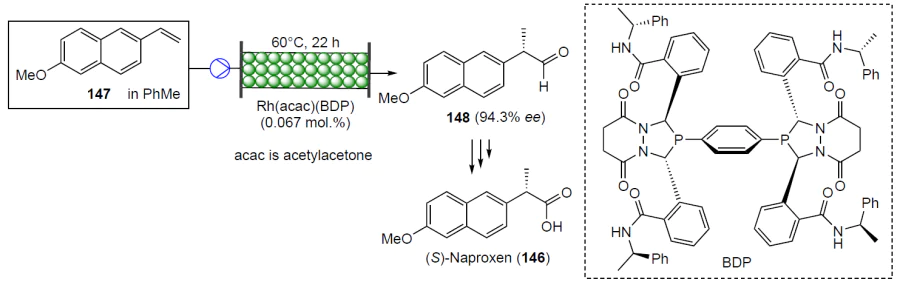
Stereoselective hydrogenation reactions[188][189] were among the first examples of homogeneous metal complex catalysis in a continuous-flow process on microchips. Later, Abrams et al.[190] developed a method for the synthesis of (S)-naproxen (146) based on the enantioselective hydroformylation of 2-vinyl-6-methoxynaphthalene (147), which is catalyzed by a rhodium complex with chiral bis(diazaphospholane) (BDP) (Scheme 49). Aldehyde 148 formed with high enantioselectivity (94% ee) was subsequently oxidized with NaClO2 to give (S)-naproxen (146) in an overall yield of 83%.
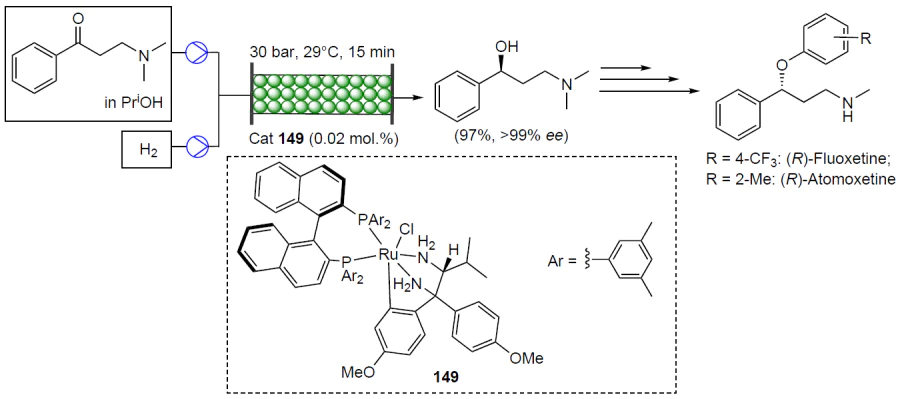
A number of chiral catalysts based on RuII complexes (e.g., compound 149) were used for the enantioselective reduction of β-amino ketone (Scheme 50).[191] The use of the sterically crowded catalyst 149 made it possible to carry out this reaction under mild conditions with a nearly quantitative yield and enantioselectivity > 99% ee. This reaction is important for the synthesis of well-known antidepressants such as fluoxetine and atomoxetine (see Scheme 50). Equivalent product yields and enantioselectivity can be achieved under conventional conditions using the [Ir(COD)Cl]2 complex catalyst (COD is cycloocta-1,5-diene) and ferrocene-based chiral tridentate phosphine ligand; however, the microreactor technologies may decrease the process time by a factor of 64.[192]
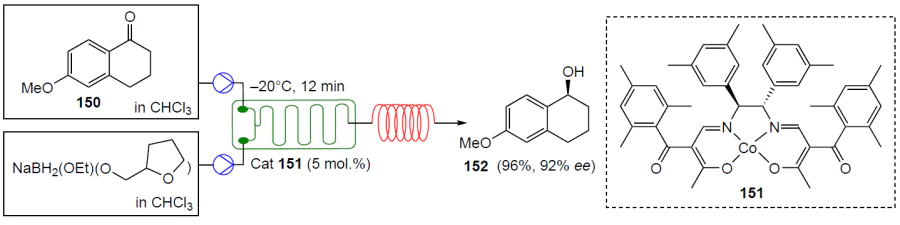
Hayashi et al.[193] proposed a method for the continuous-flow reduction of tetralone 150 with a sodium borohydride derivative catalyzed by chiral CoII salen complex 151 on a microchip (Scheme 51).[193] The selectivity of the process and the yield of product 152 were comparable with the results obtained in the batch mode.
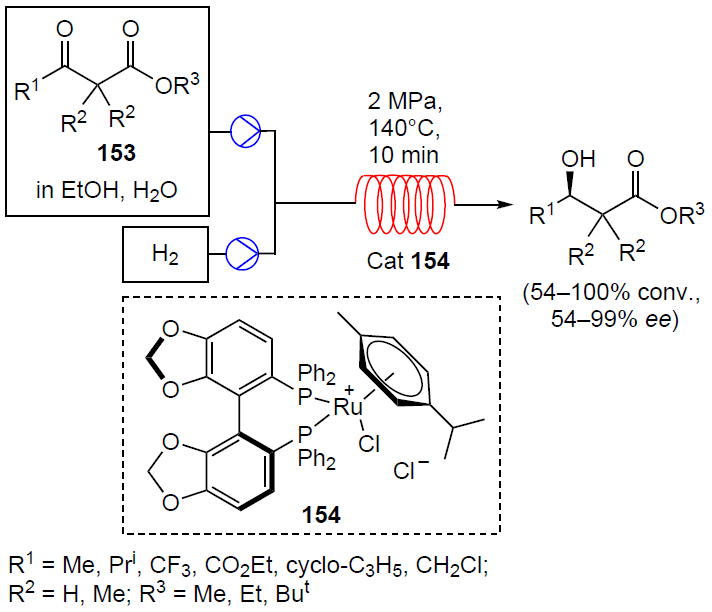
Another example of the asymmetric reduction of ketones catalyzed by metal complexes was reported in 2025 by He et al.,[194] who investigated the enantioselective reduction of 1,3-dicarbonyl compounds 153 with RuII complexes carried out on a microchip (Scheme 52). Compound 154 proved to be the most effective catalyst, providing high product yields and enantioselectivities for a broad range of substrates.
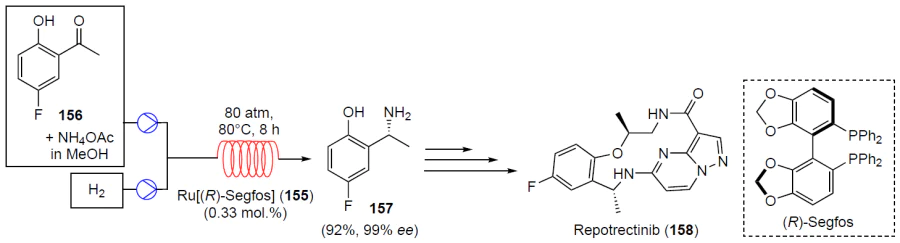
Ruthenium(II) complex 155 with the (R)-Segfos ligand showed excellent catalytic properties in reductive amination.[195] The scaling-up of the process to gram amounts of substrate 156 proved to be much more successful when the reaction was performed in a continuous-flow mode on a microchip, as indicated by increase in the product yield by 37% and in ee by 5% compared to those for the batch mode. The (R)-2-(1-aminoethyl)-4-fluorophenol (157) thus obtained served as the substrate for the synthesis of repotrectinib (158), a clinically approved next-generation tyrosine kinase inhibitor (Scheme 53).[196-198]
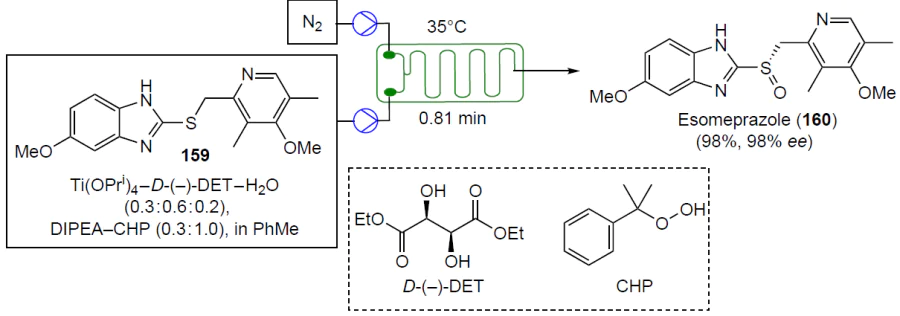
In 2024, Gao et al.[199] reported a detailed study of the stereoselective oxidation of the sulfide moiety in ufiprazole 159 to form esomeprazole 160. The reaction was catalyzed by titanium isopropoxide and (–)-diethyl tartrate (DET) (Scheme 54). Testing of four microreactor synthesis facilities showed that the best results in terms of reaction time, yield, and stereoselectivity are achieved when nitrogen is added to the reaction mixture to increase the turbulence and, hence, to enhance stirring of the reactants. In this case, 98% yield of product 160 and 98% ee were achieved in only 48 s. The classic synthesis of esomeprazole 160 requires a 150 times longer reaction and gives the same product in only 78% yield.[200]
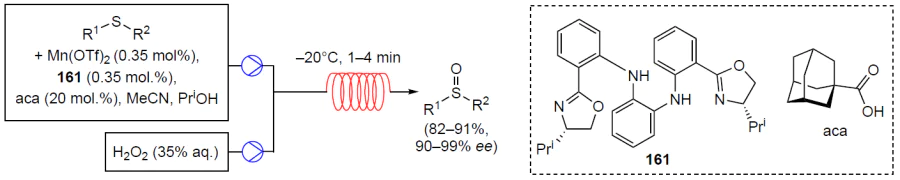
Dai et al.[201] reported asymmetric sulfooxidation catalyzed by manganese(II) complex in the presence of ligand 161. When a microreactor was used, the same chiral sulfoxides were obtained in a yield of >80% with an enantioselectivity of 99% ee fifteen times faster than in a standard laboratory batch process (Scheme 55). A similar chiral catalyst based on oxazolidine and FeII salt was effectively used for the epoxidation of α,β-unsaturated ketones. For a reaction time of 10 min, product yields of up to 88% and enantioselectivity of up to 90% ee were achieved.[202] The most recent achievements in sulfooxidation are comprehensively covered in a review.[203]
Although the range of reactions carried out in the presence of heterogeneous metal complex catalysts in microreactors is still limited, the benefits of this approach are already evident. They include not only the considerable decrease in the time needed to achieve high yields of products, but also environmentally friendly and safe reaction conditions. This approach serves more and more often as a necessary stage in the transition to more cost-effective heterogeneous processes involving immobilized metal complex catalysts.
3.2. Heterogeneous metal complex catalysis
3.2.1. Reactions of С – С and C – X bond formation
The asymmetric conjugate Michael addition can be accomplished both using homogeneous metal complex catalysis and heterogeneous continuous-flow process in a microreactor. Buendia et al.[204] prepared a series of products of conjugate addition of dimethyl malonate 7a (R = Me) to nitroalkene 8 with an enantioselectivity exceeding 90% ee, owing to the use of chiral catalyst 162, a nickel diamine complex incorporated in polystyrene (Scheme 56).[204] Previously, the same reaction was performed using a structurally similar catalyst immobilized on silica gel.[205] Note that the developed method of stereoselective conjugate addition allows for the synthesis of (S)-pregabalin (6) in a yield and ee of approximately 90%, which is much more efficient than the use of homogeneous organocatalysis (see Scheme 2).
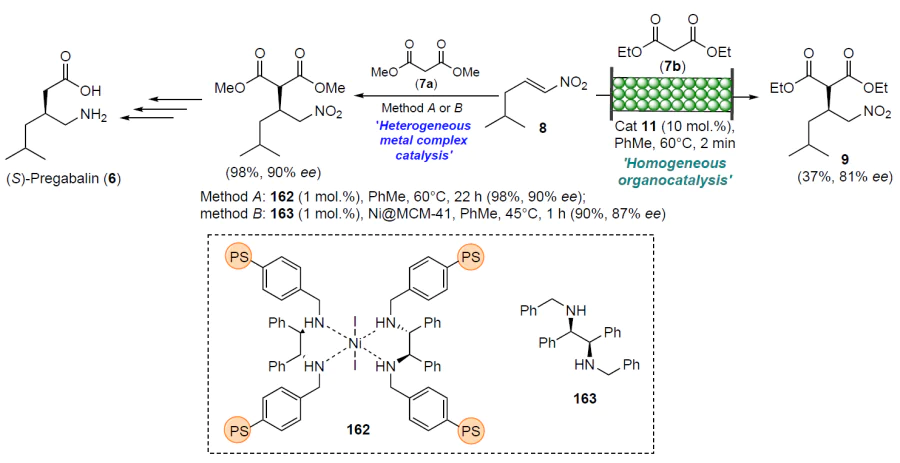
In 2023, Ishitani et al.[206] reported the synthesis of a heterogeneous nickel catalyst by the reaction of nickel iodide complex with two molecules of diamine ligand 163 and mesoporous MCM-41 silica (see Scheme 56).[206] This catalyst is applicable for continuous-flow synthesis on a microchip for 90 h without any loss of enantioselectivity, as demonstrated in a conjugate Michael addition reaction.
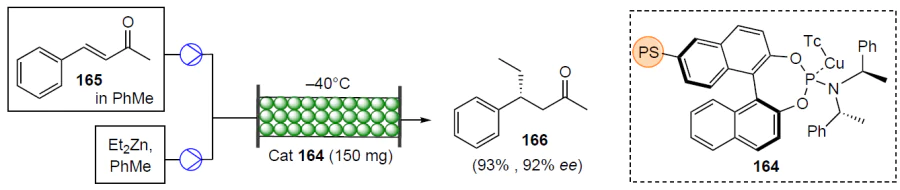
Wang et al.[207] synthesized an effective copper catalyst based on chiral phosphoramidite 164 (Тс is thiophene-2-carboxylate) immobilized on polystyrene for the asymmetric conjugate addition of both ketones and imines involving organozinc reagents (Scheme 57). In the case of substrate 165, a heterogeneous catalytic system was used in a continuous-flow process in a packed column. This allowed the sensitive organozinc reagents to participate in the reaction for a long period of time without a decrease in activity. Product 166 was obtained in a nearly quantitative yield and with a high enantiomeric excess.
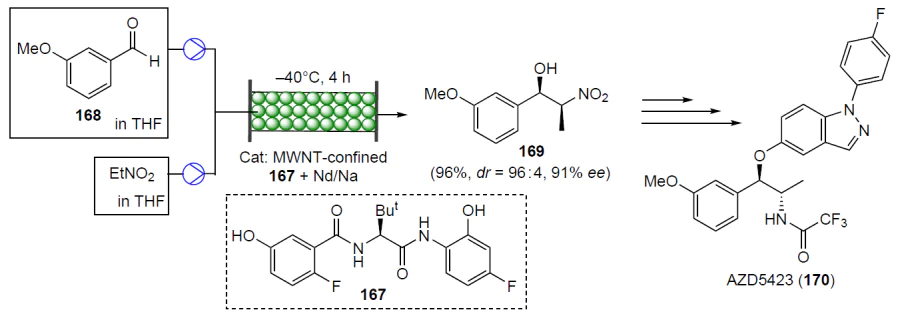
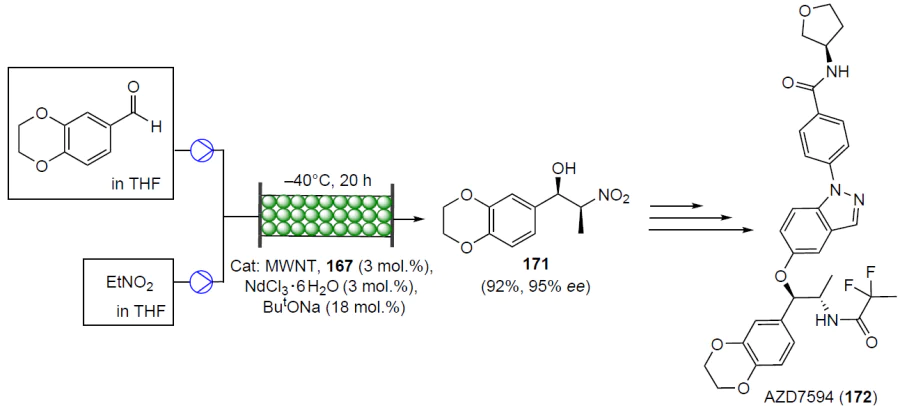
An effective example of the Henry reaction in a microreactor for the synthesis of enantioenriched anti-1,2-amino alcohols was reported by Hashimoto et al.[208] A recoverable chiral heterobimetallic catalyst confined in an entangling network of multiwalled carbon nanotubes (MWNTs) was prepared using chiral diamide 167 and an Nd/Na alloy. This catalyst performed nitroaldol reaction between m-methoxybenzaldehyde (168) and nitroethane to give compound 169 in a high yield with approximately 90% ее (Scheme 58). Subsequently, compound 169 was used for the synthesis of AZD5423 (170), a promising inhaled non-steroidal selective glucocorticoid receptor modulator, currently undergoing Phase II clinical trials.[209]
The efficacy of the heterobimetallic Nd/Na catalyst in the Henry reaction was also demonstrated in an independent study.[210] Under optimized conditions, the product yield and reaction enantioselectivity were 96%, and the resulting nitroaldol 171 was subsequently used to prepare the enantiomerically pure AZD7594 agent (172) with a similar action, which is also in Phase II clinical trials (Scheme 59).[211]
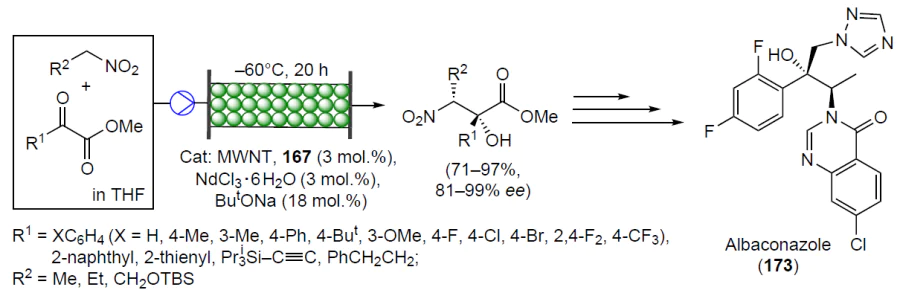
The same heterobimetallic catalyst was also employed in the Henry reaction involving α-keto esters and nitroalkanes (Scheme 60).[212]The addition products serve as intermediates in the synthesis of new antifungal agents, such as albaconazole (173).[213][214]
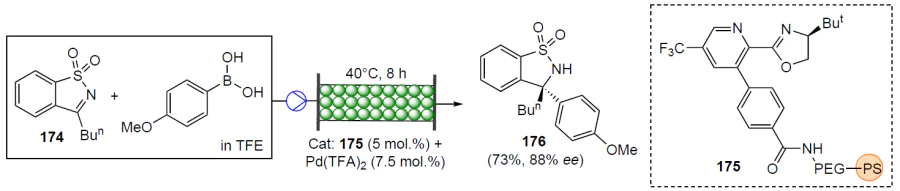
An unusual example of heterogeneous asymmetric metal complex catalysis was reported by Kocúrik et al.[215] The arylation of cyclic N-sulfonyl ketimines 174 catalyzed by a palladium complex containing chiral ligand 175 resulted in the synthesis of a set of chiral benzosultams 176, components of many natural products and pharmaceutical and agricultural agents[216][217](Scheme 61). The catalyst immobilized on the TentaGel-S-NH2 resin based on polyethylene glycol and polystyrene retained high catalytic activity throughout 10 operation cycles. It is noteworthy that slightly higher yields and enantioselectivities were achieved when this reaction was conducted under homogeneous catalysis.
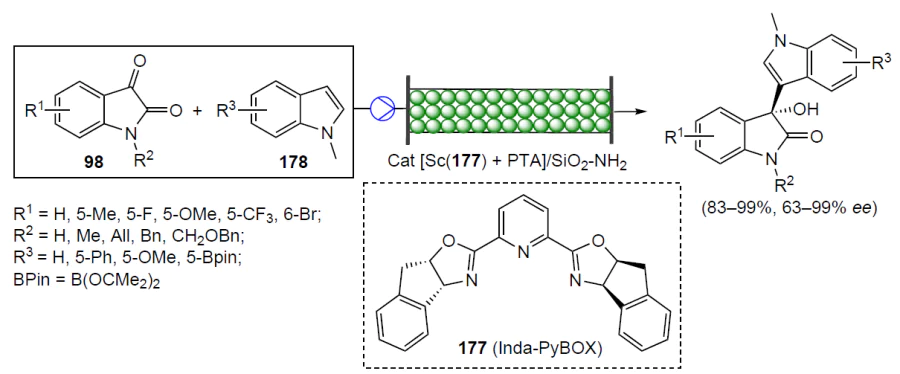
Using non-covalent immobilization, Saito and Kobayashi[218] synthesized in 2021 chiral multicomponent heterogeneous catalysts based on scandium complexes with ligand 177 (Inda-PyBOX). In combination with phosphotungstic acid (PTA) immobilized on amino-functionalized silica gel, this complex demonstrated excellent selectivity and high activity in the enantioselective Friedel – Crafts reactions involving isatins 98 and indoles 178 under continuous-flow conditions in a microreactor (Scheme 62). The catalysts were prepared using non-covalent interactions between the chiral scandium complexes and PTA. They remained active for 19 h, and no leaching of metal particles was observed.
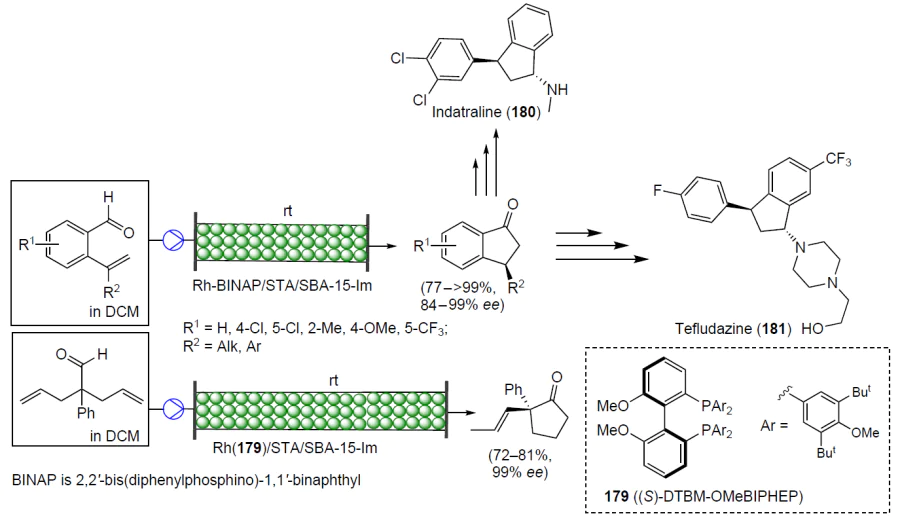
The same authors[219] developed similar rhodium-based catalysts for continuous-flow enantioselective hydroacylation on a microchip. Heterogeneous catalysts were prepared by simple mixing of support materials and rhodium complexes. Chiral Rh catalysts were immobilized on mesoporous silica functionalized with imidazole groups (SBA-15-Im) and with silicotungstic acid H4[SiW12O40] (STA). The acid consisted of a polyoxy cluster with a Keggin structure, which facilitated electrostatic interactions with the rhodium ion and acid – base interactions (Scheme 63). Catalysts with ligand 179 [(S)-DTBM-OMeBIPHEP] exhibited an excellent activity and an enantioselectivity of up to 99% ee in the synthesis of optically pure ketones. Under optimized reaction conditions, TON > 300 was achieved for deactivation time of 6 h without leaching of Rh particles. The catalyst was found to be effective for a broad range of substrates and to be versatile with respect to the structure of chiral ligand. The chiral ketones formed in the hydroacylation reaction served as substrates for the synthesis of a number of important pharmaceuticals such as indatraline (180) and tefludazine (181).[220][221]
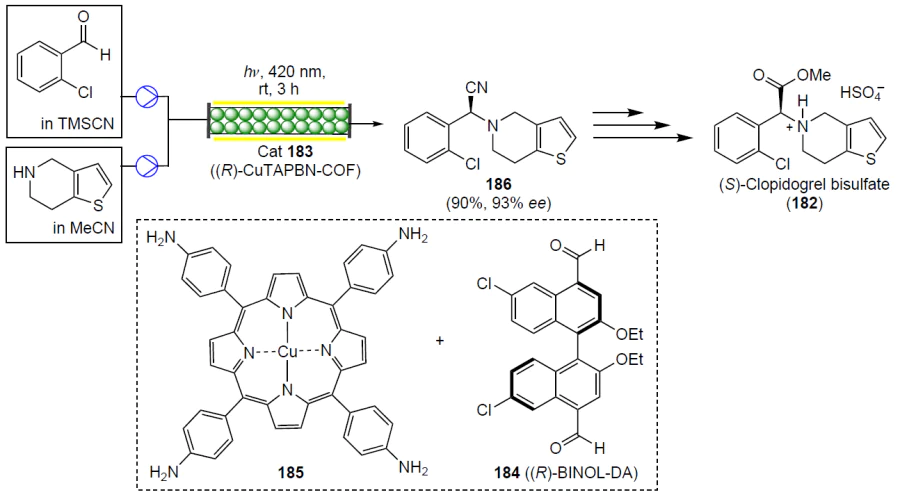
An enantioselective synthesis of the key intermediate for the synthesis of (S)-clopidogrel (182), a well-known antithrombotic drug, has been developed using the Strecker reaction.[222][223] To carry out the photochemical reaction, the authors prepared the covalent framework heterocatalyst (R)-CuTAPBN-COF (183) using ligand 184 [(R)-6,6'-dichloro-2,2’-diethoxy-1,1'-binaphthyl-4,4'-dicarbaldehyde, (R)-BINOL-DA] and Cu tetraaminophenylporphyrin 185, which ensured excellent enantioselectivity of the reaction (Scheme 64). This approach was easily scaled up to gram quantities in a fixed-bed, continuous-flow microreactor, which provided the synthesis of the clopidogrel precursor 186 in a 90% yield and with 93% ee.
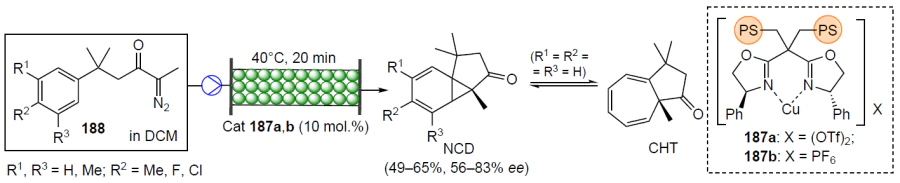
Crowley et al.[224][225] developed an enantioselective intramolecular Buchner reaction involving α-diazoketones and α-diazo-β-oxosulfones using heterogeneous copper – bis(oxazoline) catalysts 187a,b immobilized on polystyrene. The reaction was carried out in batch and continuous flow modes in a microreactor (Scheme 65). The authors demonstrated that this catalyst can be reused up to seven times without activity loss. For some α-diazo ketones 188, the enantioselectivity achieved in a continuous-flow process using the immobilized catalyst was comparable with that achieved in a conventional process with homogeneous catalysis. The synthesized azulenones exist in dynamic equilibrium between the norcaradiene (NCD) and cycloheptatriene (CHT) forms via reversible electrocyclic ring opening/closure.[225]
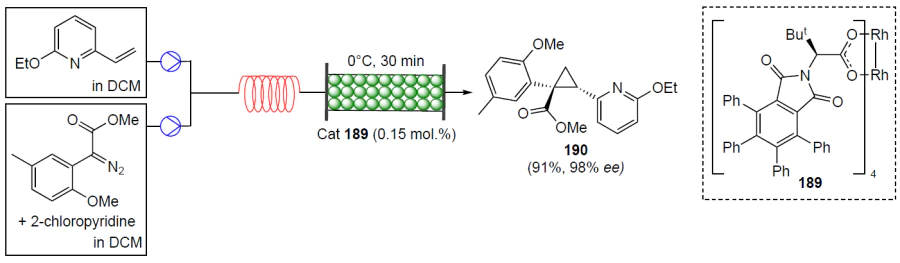
A similar enantioselective cyclopropanation reaction catalyzed by the chiral rhodium complex 189 was reported by Lathrop et al.[226] The synthesis on a microchip scaled-up to multigram quantities yielded enantiopure cyclopropane derivative 190 in a 91% yield (Scheme 66).
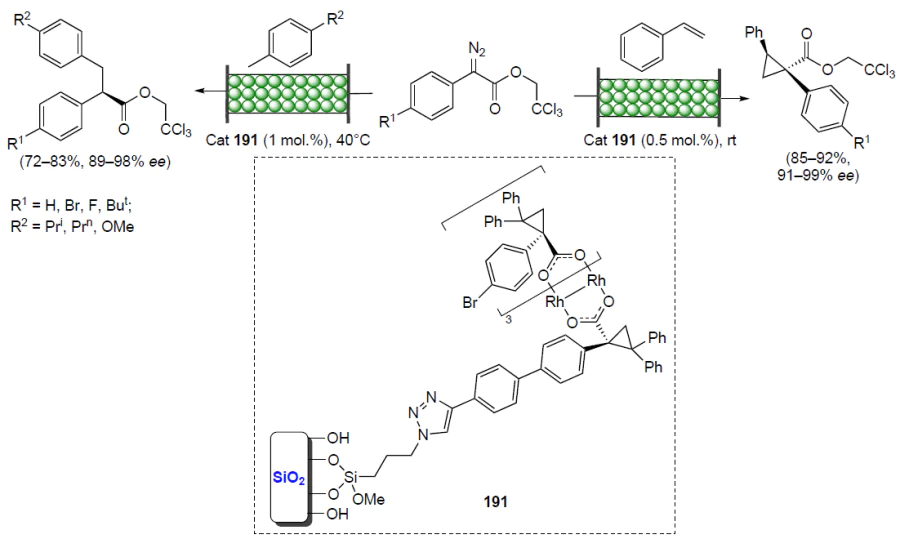
Yoo et al.[227] investigated a broad range of complex enantioselective reactions of insertion into the C – H bond and cyclopropanation catalyzed by silica-immobilized rhodium complex 191 (Scheme 67). The yield, regioselectivity, and enantioselectivity of the products achieved in a continuous-flow microreactor were as high as those in a conventional batch reactor, with the catalytic properties of compound 191 being retained after multiple use.
3.2.2. Reduction and oxidation reactions
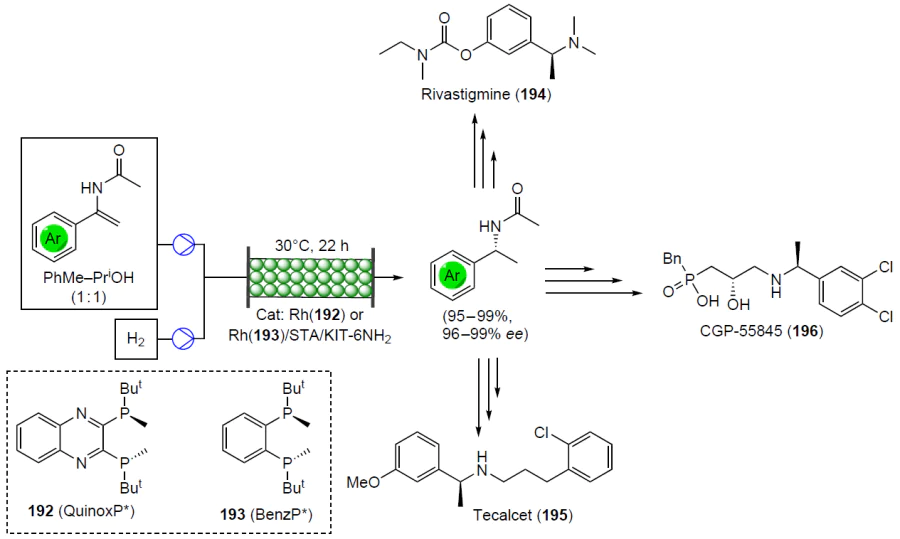
Multicomponent catalysts have also found use in flow hydrogenation processes. Chiral Rh catalysts with ligands 192 and 193 were immobilized on mesoporous silica (KIT-6) modified with aminopropylsilane and silicotungstic acid H4[SiW12O40] (Scheme 68).[228] They demonstrated excellent activity and selectivity in the continuous-flow asymmetric hydrogenation of a wide range of enamides in a microreactor, yielding optically active amides without metal leaching. The authors showed that these catalysts can be easily tailored to a particular process by modifying the chiral ligands, which demonstrates their high versatility. The products of this reduction are important intermediates of the synthesis of numerous drugs such as rivastigmine (194), tecalcet (195),[229] cinacalcet,[229][230] and the compound designated by CGP-55845 (196).[231][232]
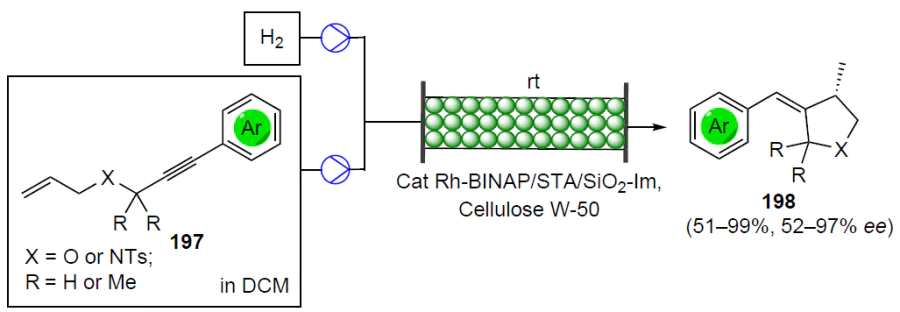
Saito et al.[233] described the enantioselective cyclization of 1,6-enynes in a continuous-flow process in a microreactor using chiral heterogeneous rhodium catalysts based on SiO2 composites functionalized with STA and imidazoline (Scheme 69).[233] Study of the continuous-flow process indicated that targeted modification of the structure of heteropoly acids and amines can substantially improve the performance of the catalyst. Under optimal reaction conditions, a number of substrates 197 were converted to cyclic products 198 in high yield and with high enantioselectivity without leaching of the Rh catalyst.
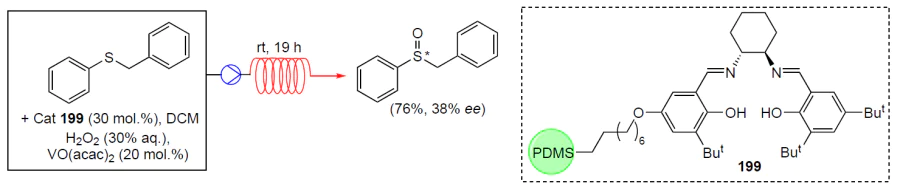
Polysiloxane-immobilized chiral vanadium(IV) salen complexes were successfully used for asymmetric sulfoxidation in a microcapillary.[234] Typical salen ligands such as chelate 199 were incorporated into polysiloxane (PDMS) via hydrosilylation in the presence of the Karstedt catalyst (Scheme 70). In the oxidation of benzyl phenyl sulfide, 76% yield of the corresponding sulfoxide was achieved. However, the reaction enantioselectivity turned out to be low, ranging from 14 to 38% ee, depending on the length of the linker connecting the ligand to the polymer.
The growth of the number of continuous-flow microreactor processes involving heterogeneous metal complex catalysts is driven by requirements for cost-effectiveness and safety, as well as for the reproducibility of key reaction characteristics compared to homogeneous processes. Although in some cases, the enantioselectivity of homogeneous processes still exceeds that for heterogeneous catalysis, this difference is being gradually eliminated with the use of new support materials that are more suitable for immobilization. Therefore, the prospects for implementation of this particular approach for the production of BACs appear quite realistic.
4. Enantioselective biocatalysis
Biocatalysts represent an alternative to conventional catalysts and offer a number of benefits, including ready availability due to renewable resources, biodegradability, and high stereo-, regio-, and chemoselectivity.[235-239] In addition, enzymes are often water-soluble, which eliminates the need for organic solvents. Owing to these benefits, enzymatic catalysis has become a powerful tool in organic synthesis and is also often used in industry to produce enantiopure pharmaceuticals.[240-243] The integration of microreactor devices into biocatalysis has led, over the past decade, to a sharp increase in the number of studies dealing with the use of enzymes on microchips operating in the continuous-flow mode. They offer a number of benefits such as compact size, fast heat transfer, and minimum consumption of reactants.[244]
Depending on the form of the biocatalyst, two main groups of microreactors for enzymatic reactions can be distinguished: systems that use free enzymes and systems that contain enzymes immobilized in flow channels. The immobilization of enzymes for subsequent use in biocatalysis in microchannels can be reversible or irreversible. The former comprises adsorption, cross-linking through the formation of coordination bonds with metals or weak covalent bonds via disulfide bridges, and encapsulation into a gel. More stable binding rules out leaching of the enzyme and involves strong covalent binding to the support or incorporation of an enzyme into a polymer through cross-linking. The latter group, irreversible immobilization, is most promising for the use in microreactors. These devices provide not only high stereoselectivity and good conversion for a wide range of processes, but also high stability under reaction conditions and during storage. This opens up the way to environmentally friendly and cost-effective continuous-flow production of optically pure physiologically active compounds.[244-246]
4.1. Homogeneous biocatalysis
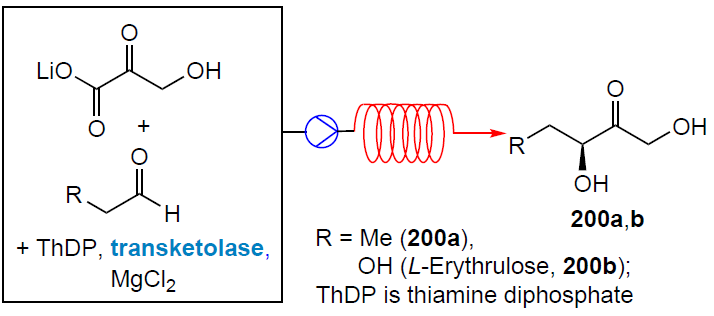
Chiral keto alcohols can be efficiently synthesized using transketolase as a catalyst (Scheme 71).[247] It was established that the synthesis of α-hydroxy acid 200a, both in the batch mode and in the continuous-flow mode on a microchip, proceeds twice as fast as the production of L-erythrulose (200b). In addition, the yield and ee for products 200 were virtually independent of the type of synthesis (conventional laboratory or microreactor synthesis).
Hydroxynitrile lyases, which are widely encountered in nature and are expressed by Escherichia coli and Pichia pastoris strains, exhibited high catalytic activity in the stereoselective synthesis of cyanohydrins from aldehydes.[248][249] The enantioselectivity was higher for aromatic aldehydes (>95% ee) than for aliphatic aldehydes (>85% ee).
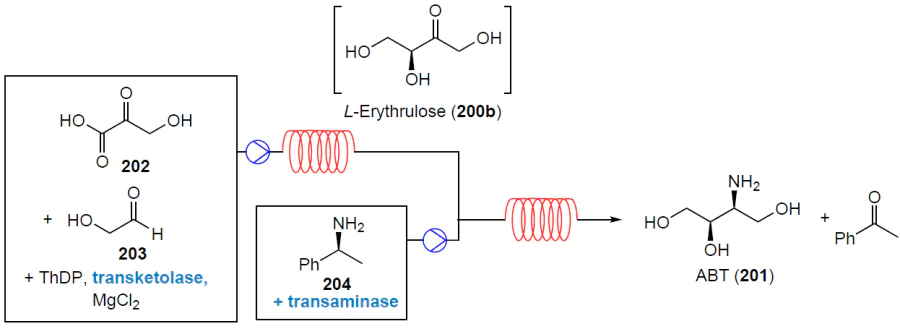
(2S,3R)-2-Aminobutane-1,3,4-triol (ABT, 201) is a key intermediate in the asymmetric synthesis of nelfinavir, a HIV protease inhibitor.[250] Gruber et al.[251] implemented a two-step enzymatic synthesis of ABT involving the successive use of microreactors (Scheme 72). The first step, that is, the synthesis of L-erythrulose (200b) from hydroxypyruvate 202 and glycolaldehyde 203, was optimized compared to the results of O’Sullivan et al.,[247] with the reaction time being reduced from 2 h to 8 min. The optimization involved increasing the concentrations of transketolase and transaminase and selecting a rational concentration of the ThDP cofactor, which exhibits inhibitory activity against transaminase. In the second, transaminase-catalyzed, step a 100% yield of key product 201 was achieved for complete conversion of (S)-α-methylbenzylamine (204), which served as a substrate.
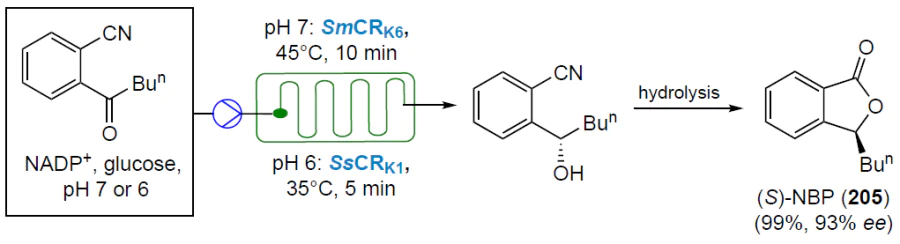
A new biocatalytic approach has been developed[252-254] for the synthesis of (S)- and (R)-3-n-butylphthalides (NBP, 205), which are potential effective agents for treatment of the acute ischemic stroke and other neurological disorders (Scheme 73). Directed evolution of the carbonyl reductases SmCRV4 and SsCR resulted in the formation of SmCRK6 and SsCRK1 variants, respectively, which have markedly higher enzyme activity. The reduction of 2-pentanoylbenzonitrile by these enzymes in the presence of the oxidized nicotinamide adenine dinucleotide phosphate (NADP+) and glucose resulted in high substrate conversion and excellent enantioselectivity.
4.2. Heterogeneous biocatalysis
[]
4.2.1. Reactions of С – С and C – N bond formation
Hydroxynitrile lyases are effective not only in homogeneous, but also in heterogeneous reactions. The most common type of reactor used for heterogeneous catalysis by hydroxynitrile lyases are microreactors, so-called monolithic reactors. The catalyst is immobilized either on the surface of a monolithic structure or, what is more advisable, in the pores, if the structure has bi- or trimodal porosity and the reactants move through tortuous pores. The continuous, monolithic structure ensures flow stability and virtually rules out compression of the bed.[255][256] In a bioreactor of this type, hydroxynitrile lyase isolated from the plant Hevea brasiliensis (HbHNL) was covalently immobilized on hydrophilic mesoporous silicates. This bioreactor provided (S)-mandelonitrile 206 synthesis from benzaldehyde in a nearly quantitative yield over a few minutes (Scheme 74).[257] In the batch process, 94% conversion of benzaldehyde was achieved only after 30 h, resulting in a low yield of the product (42%).
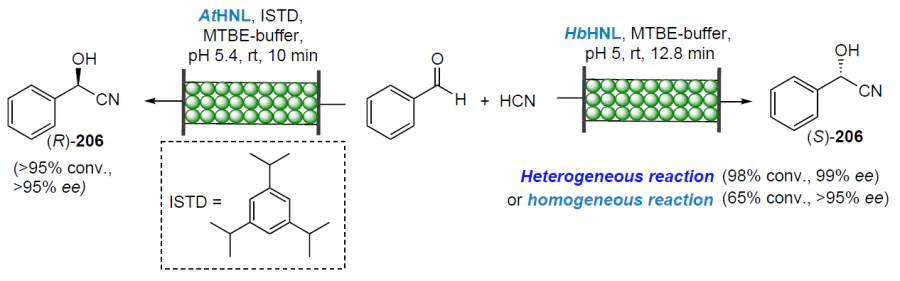
Later, Stradomska et al.[258] developed a monolithic silica microreactor with a tortuous hierarchical pore structure in which hydroxynitrile lyase isolated from Arabidopsis thaliana (AtHNL) was immobilized.[258] The continuous-flow system with a microreactor residence time ranging from 3 to 30 min made it possible to achieve high benzaldehyde conversion (90 – 95%), while maintaining a high enantiomeric excess of the product (90 – 98% ee) (see Scheme 74). Other examples of the use of monolithic microreactors for biocatalysis and characteristic features of these reactors are described in detail in a review by Lambarska et al.[241] published in 2024.
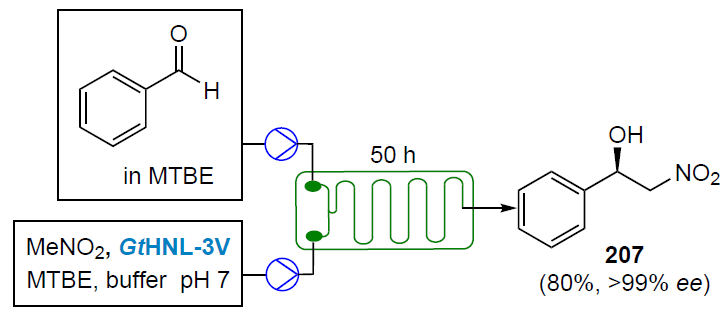
The Henry reaction involving benzaldehyde and nitromethane is catalyzed by the enzyme GtHNL-3V immobilized on celite R-633. Under these conditions using a microchip, (R)-2-nitro-1-phenylethanol (207) was selectively obtained in a good yield (Scheme 75).[259]
A two-step method was developed for stereoselective synthesis of (2S,3R)-2-aminobutane-1,3,4-triol (201) in an enzyme microreactor with a packed tube.[260] The authors designed a microreactor system based on reversible immobilization of transketolase and transaminase on special microbeads and operating on the fluidized-bed reactor principle. It was shown that immobilized transketolase retains activity for up to 16 days, whereas immobilized transaminase lost approximately 93% of its activity after 5 days.
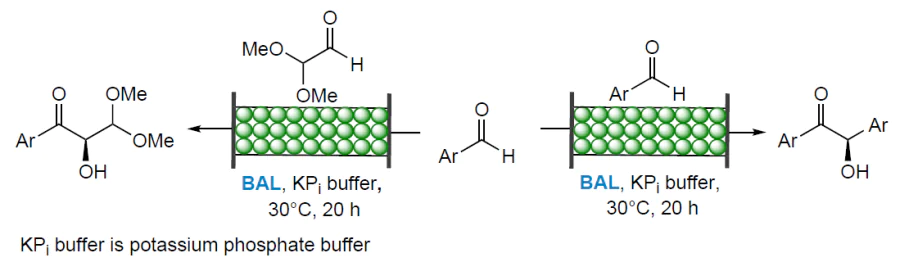
Heterogeneous enzymatic catalysis makes it possible to form C – C bonds via benzoin condensation involving benzaldehydes. Benzaldehyde lyase (BAL), isolated from the bacterium Rhodococcus erythropolis and immobilized on Profinity epoxide resin, exhibited moderate catalytic activity toward a number of aromatic aldehydes. However, in a similar reaction involving unsubstituted benzaldehyde, a 98% enantiomeric excess of benzoin was achieved (Scheme 76).[261]
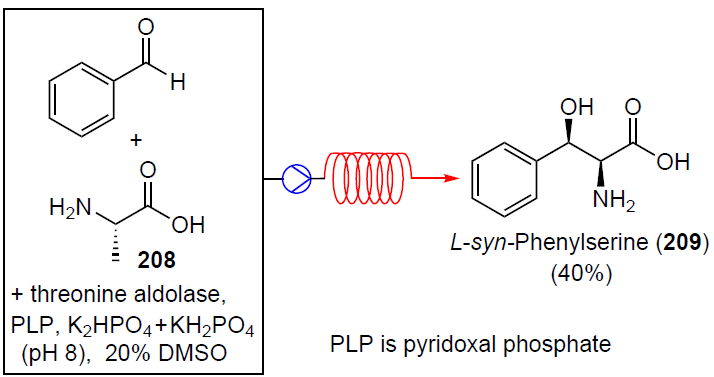
Tibhe et al.[262] found that heterogeneous enzymatic catalysis is effective for C – N bond formation reaction in the synthesis of chiral α-amino acids. Thus the reaction of benzaldehyde and L-alanine (208) catalyzed by immobilized threonine aldolase resulted in the stereoselective formation of L-syn-phenylserine (209) with > 99% ee (Scheme 77). However, the maximum yield of product 209 was only 40%, which was due to the reversibility of the reaction. Similar results for this reaction have also been reported by other authors.[263]
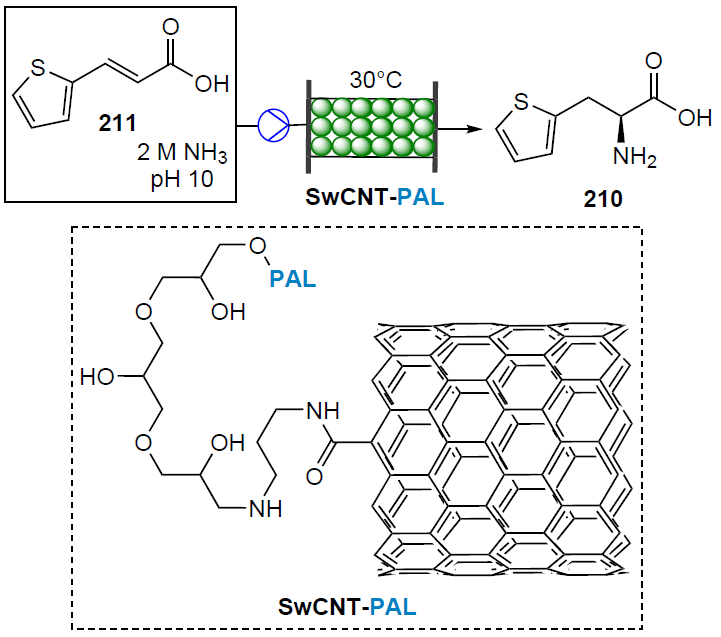
The biocatalytic properties of phenylalanine-ammonia lyase (PAL) immobilized on carboxylated single-walled carbon nanotubes (SwCNTs) were investigated by Bartha-Vári et al.[264] The covalent immobilization was performed using a glycerol diglycidyl ether-based linker. The SWCNT-PAL biocatalyst proved to be effective for the synthesis of (S)-2-amino-3-(thiophen-2-yl)propanoic acid (210) by enantioselective addition of ammonia to (E)-3-(2-thienyl)acrylic acid (211) (Scheme 78). The catalyst retained > 80% of the catalytic activity after twelve reaction cycles, which attests to the high stability of the catalyst.
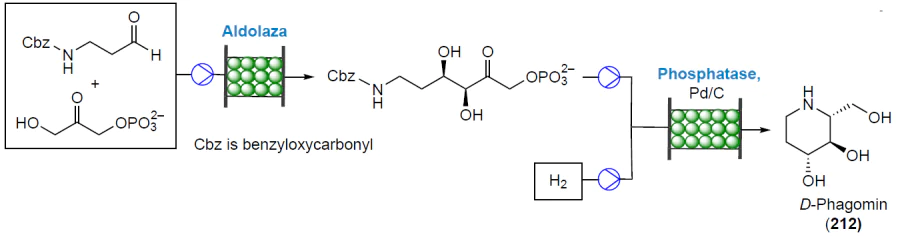
An elegant application of biocatalysis in a continuous-flow process was demonstrated by Hartley et al.,[265] who designed a cascade microreactor system for the synthesis of the antidiabetic drug D-fagomine[266] (212). The authors immobilized proteins with conjugated cofactors on trifluoroketone-activated agarose beads and packed them into packed-bed glass columns. The key step in the process was the asymmetric aldol reaction catalyzed by aldolase isolated from the bacterium Staphylococcus carnosus (Scheme 79).
4.2.2. Reduction and oxidation reactions
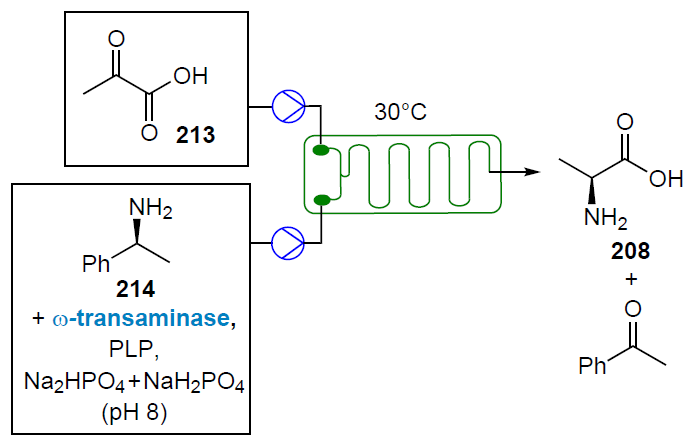
Reductive amination reactions are among the most common transformations catalyzed by immobilized enzymes. It has been reported that cycloolefin polymer microchips that have meandering channels with a hydrophilic inner surface can be used to immobilize wild-type ω-transaminase or E. coli cells overexpressing this enzyme.[267] This microreactor was used for the asymmetric synthesis of L-alanine (208) from pyruvate 213 and (S)- α-methylbenzylamine (MBA, 214). A 50% conversion of the starting reactants was achieved in 15 min for the enzyme capable of being immobilized on the non-modified inner surface of the microchannel (Scheme 80).
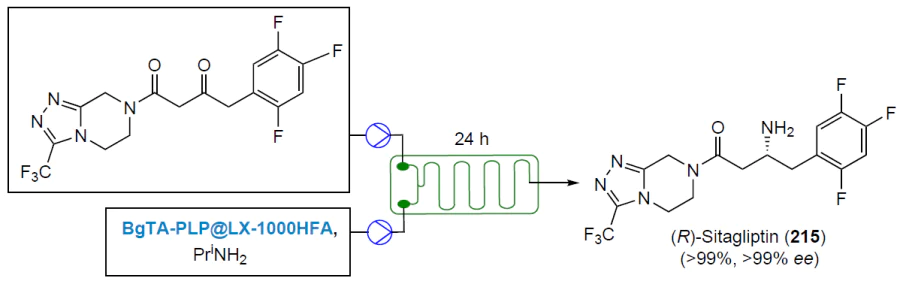
The enzymatic reductive amination on a microchip was used in the continuous-flow synthesis of the antidiabetic drug sitagliptin (215) (Scheme 81).[268][269] The BgTA transaminase and pyridoxal phosphate were immobilized on the LX-1000HFA epoxy resin. The resulting catalyst retained 84% of the activity after recovery and afforded only the R-enantiomer of compound 215.
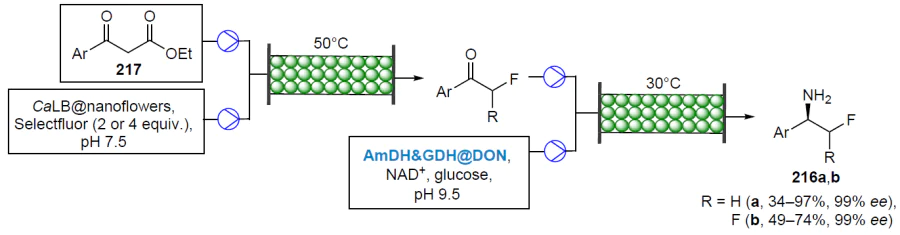
Huang et al.[270] described enzymatic cascade synthesis of α-mono- and difluoromethylamines 216a,b from β-ketoacid esters 217 using two successive catalytic microreactors (Scheme 82).[270] In the first reactor, organoenzymatic decarboxylative fluorination took place in the presence of lipase B isolated from the fungus Candida antarctica (CaLB). In the second reactor, stereoselective bi-enzymatic reductive amination occurred under the action of a mixture of amine dehydrogenase (AmDH) and glucose dehydrogenase (GDH) immobilized on dendritic organosilicon nanoparticles (DONs). Depending on the amount of fluorinating agent (Selectfluor), either monofluorinated or difluorinated derivatives were obtained.
Wang et al.[271] developed a system for continuous-flow amination in a microreactor using ω-transaminase covalently immobilized on ethylenediamine (EDA)-modified epoxide resin. Using this system, the authors synthesized (S)-1-Boc-3-aminopiperidine (218), the key intermediate for a number of new calcium/calmodulin-dependent protein kinase inhibitors (Scheme 83). The immobilized ATA-W12-EES ω-transaminase exhibited a high stability: 90% of the activity was retained after 15 operation cycles. Conduction of this reaction in a microreactor resulted in 95% substrate conversion in 10 min, whereas this conversion in the batch process required 6 h.
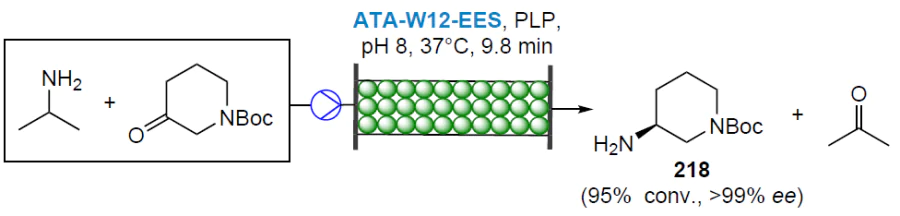
A number of studies implemented two-step stereoselective reduction of 5-nitrononane-2,8-dione (219) to (2R,8R)-5-nitrononane-2,8-diol (220) catalyzed by alcohol dehydrogenase isolated from the bacterium Lactobacillus brevis (LbADH) and glucose 1-dehydrogenase (Scheme 84).[272-274] This was the first reported instance of catalysis by enzymatic hydrogel particles produced intracellularly using an in vivo system based on E. coli.[274] These enzymes can also be immobilized on Co2+-functionalized magnetic beads, which fill a packed-bed microreactor.[273]

Chen et al.[245] reported a hydrogel monolithic microreactor fabricated by microfluidic assembly in situ. The hydrogel biocatalyst was prepared by successive addition of 3-methyl-1,2,4-triazole and magnesium(II) ions at 25°C to a solution of crude secondary alcohol dehydrogenase isolated from the thermophilic bacterium Thermoanaerobacter brockii (TbSADH). Owing to the high content of Mg2+ chelating agent and the possibility of hydrogen bonding to triazole, the resulting hydrogel was able to effectively bind the NADPH cofactor. The reduction of acetophenone in a microreactor resulted in an almost complete conversion of the substrate to give (R)-1-phenylethanol (221) with > 99% ee (Scheme 85).*
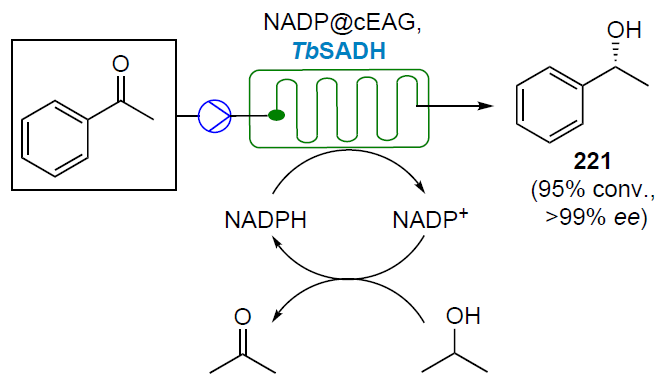
An enzyme system consisting of ketoreductase (KRED) and alcohol dehydrogenase isolated from Lactobacillus kefir (LkADH) was developed for the enantioselective reduction of ketones. The enzymes were immobilized on polyvinyl alcohol particles using an entrapment method. The heterocatalyst exhibited not only high catalytic activity, but also excellent mechanical stability. The synthesis of chiral hydroxy ester 222 in a continuous-flow process was performed with >99% ee within 10 min, which is 36 times faster than the batch process (Scheme 86).[275]
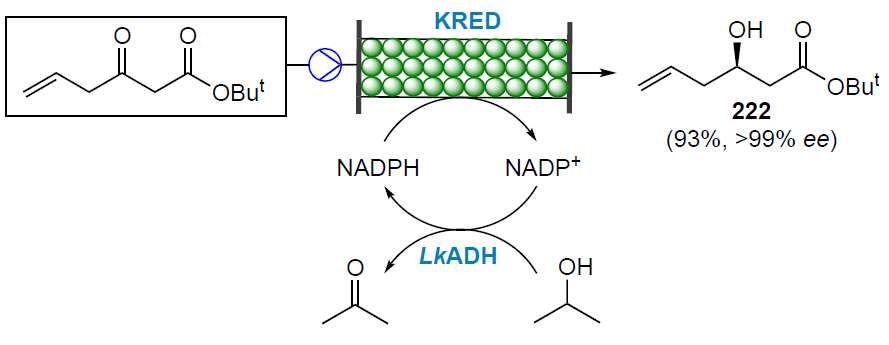
Basso et al.[276] studied the effect of immobilization methods on the activity of the KR002 ketoreductase. This enzyme immobilized on a Chromalite MIDA/Ni support exhibited a twofold increase in the enzyme activity compared to other methods such as covalent immobilization, immunoelectrophoresis, or adsorption. Apart from the high enzymatic activity achieved by affinity immobilization of histidine-tagged ketoreductase, other benefits of this approach have also been demonstrated, in particular:
— completion of the process in 2 h in the batch mode or in a few minutes in the continuous mode,
— the use of five times lower amount of the enzyme, and
— the possibility of co-immobilization of KR002 and GDH enzymes for fast cofactor regeneration in situ.
The apKRED-9 ketoreductase isolated from the bacterium Acetobacter pasteurianus 386B was successfully immobilized on two platforms: glutaraldehyde-activated beads made of the LX1000HA amino polymer and cofactor-enriched poly(ethylenediamine) (CEP). Both biocatalysts demonstrated long-term stability in the reduction of tetrahydrothiophen-3-one (223) to (R)-tetrahydrothiophen-3-ol (224) both in the continuous-flow process in a microreactor and in the batch process. In both cases, high conversion (> 98%) and ee above 99% were achieved (Scheme 87). However, the use of the CEP platform proved to be more rational, as it is more stable during long-term storage and has a broader scope of applications for other enzymes, such as transaminase, amino acid dehydrogenase, ene reductase, imine reductase, and monoamine oxidase.
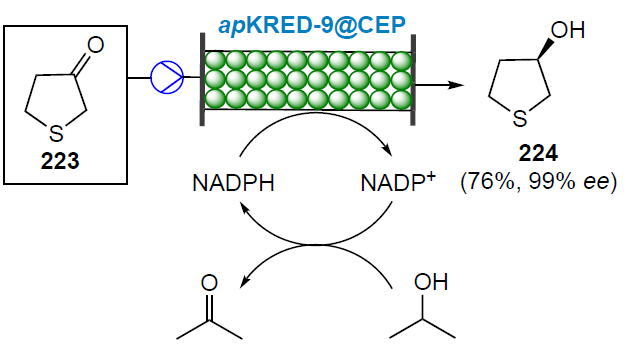
In 2024, an elegant two-step synthesis of chiral amines 214 and alcohols 225 from ethylbenzenes 226 has been developed (Scheme 88).[277] The first step involved oxidation of the substrate with an artificial peroxygenase (CoN4SA-POase) with CoN4 active sites and 70% tert-butyl hydroperoxide (227). The enantioselective reduction of intermediate substituted acetophenones was catalyzed by S-selective ketoreductase from Lactobacillus fermentum (Lf SDR1) and R-selective LkADH, which were co-immobilized with glucose dehydrogenase (GDH) on DONs in a continuous flow. For the reductive amination, amine dehydrogenase from Jeotgalicoccus aerolatus (JaAmDH) was co-immobilized with glutamate dehydrogenase (GDH), which gave the heterogeneous catalyst JaAmDH&GDH@DON. This cascade microreactor made it possible to achieve a high enantioselectivity.
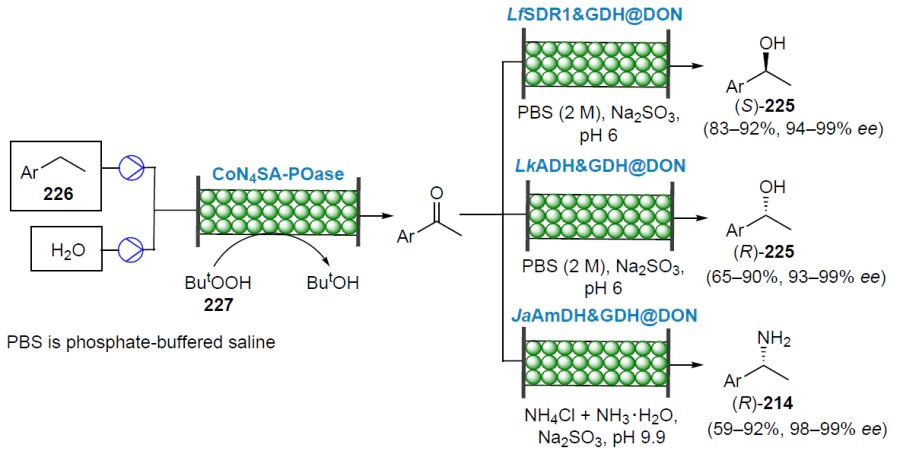
Santiago-Arcos et al.[278] proposed a two-step method for the synthesis of 4-(R)-hydroxypentanoic acid (228) by fabricating a cascade biocatalytic system for continuous-flow operation (Scheme 89). The first heterogeneous biocatalyst to be used for oxidation of substrate 229 to 4-oxopentanoic acid (230) was prepared by incubation of the potassium salt K[AuCl4] with porous agarose microbeads functionalized with diethylaminoethyl groups (AG-DEAE). The resulting catalyst was treated with a 1 mM solution of β-mercaptoethanol (BME) to prevent the intraparticle growth of Au nanoparticles, which causes inactivation of the catalyst. After 24 h at a temperature of 40°C, a mixture of lactone 231 and 4-oxopentanoic acid was formed in the first reactor, indicating that opening of the lactone ring is the rate-limiting step in the synthesis of compound 230. To accelerate the reaction, the researchers decided to use the immobilized biocatalyst Novozyme 435 containing lipase B from Cryptococcus antarcticus; this biocatalyst provided complete conversion of the starting substrate within 24 h even at room temperature.

To carry out the second step of the enantioselective ketone reduction, the histidine-labelled ketoreductase isolated from Lactobacillus kefir (LkKRED) was co-immobilized with NADPH on agarose microbeads that had been functionalized with cobalt chelates and epoxy groups (E). The Co2+-containing chelates promoted local immobilization of histidine-labelled LkKRED, while epoxy groups facilitated irreversible attachment, which stabilized the enzyme. Further increase in the stability was achieved by coating the immobilized biocatalyst with polyallylamine hydrochloride (PAH) to block the remaining epoxy groups and form a positively charged polymer layer. This coating also provided the electrostatic binding of NADPH. A similar reduction of ketones catalyzed by ketoreductase immobilized on agarose microbeads was also carried out previously by Benítez-Mateos.[279]
Yuan et al.[280] developed a method for the synthesis of enantiomerically pure γ- and δ-lactones 230 by enantioselective reduction of keto acids followed by cyclization (Scheme 90). A heterogeneous bifunctional biocatalyst was prepared by co-immobilization of two modified enzymes, carbonyl reductase SmCRM5 and glucose dehydrogenase BmGDH, on ESR-3 resin. This immobilization strategy provided faster recirculation of the NADPH and NADP+ cofactors, which increased the substrate conversion to 100% and shortened the reaction time. However, in some cases, this system markedly decreased the stereoselectivity of the reaction compared to that for native enzymes as catalysts. It is noteworthy that conduction of the reaction in a continuous-flow mode resulted in a higher product yield with lower enantioselectivity and increased the STY parameter threefold compared to the batch process.
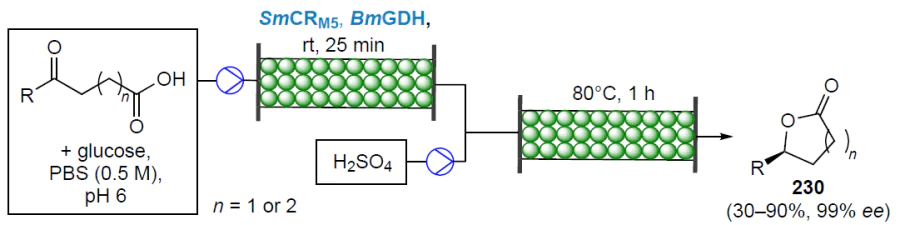
The conversion of 2-methylpropane-1,3-diol 231 into hydroxy acid 232 carried out as the first step of the synthesis of (S)-captopril (233), angiotensin-converting enzyme inhibitor, is one of the few examples of enantioselective enzymatic oxidation (Scheme 91).[281] The bacterium Acetobacter aceti MIM 2000/28 cells were immobilized on alginate granules and packed into a glass microcolumn. The immobilized biocatalyst made it possible to obtain intermediate 232 with nearly complete conversion of the diol and an enantiomeric excess of 96 – 97%.

A cofactor-independent enzyme system for С – Н bond hydroxylation was developed for enantioselective amination of arylalkanes at this bond. The authors used a bi-enzymatic reactor for the amination of intermediate alcohols; the reactor was subsequently optimized through co-immobilization of enzymes (Scheme 92).[282] The spatially separated co-immobilization of two enzymes, nonspecific peroxygenase (AaeUPO) isolated from Agrocybe aegerita and glucose oxidase (GO), on an amphiphilic core–shell substrate (DONs) improved the mass transfer of organic substrates and protected AaeUPO from inhibition by glucose and by formed H2O2. Meanwhile, co-immobilization of the CpsADH and JaAmDH enzymes on dendritic silica nanoparticles (DSNs) functionalized with quaternary ammonium cation increased local concentrations of the substrate and cofactor, improved mass transfer, and enhanced the cofactor regeneration. The integration of these two modules into a continuous-flow cascade microreactor system was favourable for intensification of the process (see Scheme 92).
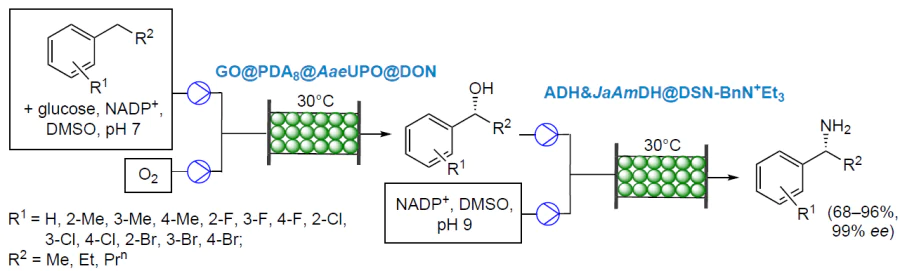
Although enzymatic catalysis covers a narrower range of reactions than metal complex catalysis or organocatalysis, for quite a few hydrolytic processes, reduction and oxidation reactions, immobilized biocatalysts in microreactors exhibit both high stereoselectivity and conversion and also good stability, which opens up the way for the environmentally friendly and cost-effective continuous-flow production of optically pure, physiologically active compounds.
In recent years, the range of enzymatic reactions has been expanding, owing to the catalytic promiscuity effect,[283] that is, the ability of enzymes to catalyze non-traditional reactions, including one-pot multicomponent transformations in which several chemical bonds can be formed and several functional groups can be introduced within one step. Therefore, it is beyond doubt that the prospects for using immobilized enzymes in microreactor-based processes would also become real for other, previously purely chemical, transformations. Optimization of the product yields and stereoselectivity of enzyme-catalyzed asymmetric reactions offers an excellent alternative to catalysts based on metal complexes or organocatalysts.
* The abbreviation cEAG refers to a structured hydrogel matrix formed from crude extracts.
5. Comparison of the results of reactions in the batch mode and in continuous-flow microreactors
While studying reactions conducted in microreactors, researchers should always compare the results (reaction time, product yields, and stereoselectivity of the transformation) with the corresponding parameters of batch processes carried out in a flask. For a correct comparison, it is necessary that the conditions of a particular reaction in the two designs be as similar as possible. Most of the above examples compare the results of organic reactions carried out in the batch mode in laboratory or in the continuous mode on microchips; however, the reaction conditions are often substantially different, which precludes a real assessment. Nevertheless, the comparative data for a number of name reactions that we summarized in Table 2 make it possible to identify the characteristic differences between the microreactor approach and batch reactors for the preparation of valuable synthetic products. Known literature data are presented for a number of the most important processes involving metal complex or enzymatic catalysis or organocatalysis under homogeneous or heterogeneous conditions. In addition, apart from the evaluation of conversion efficiency customary for organic chemists, which includes the reaction time and selectivity and product yields and enantiomeric purity, the Table presents other parameters used for flow systems. First of all, this is the space-time yield (STY), which shows the amount of the product formed per unit volume of the reactor per unit time:[284]

Another important parameter given in Table 2 is the material index calculated as the ratio of the total mass of the raw materials and auxiliary materials to the mass of the finished product. This index evaluates the degree to which the production process approaches a waste-free process for which the material index amounts to one. This value is important from the perspective of green chemistry.
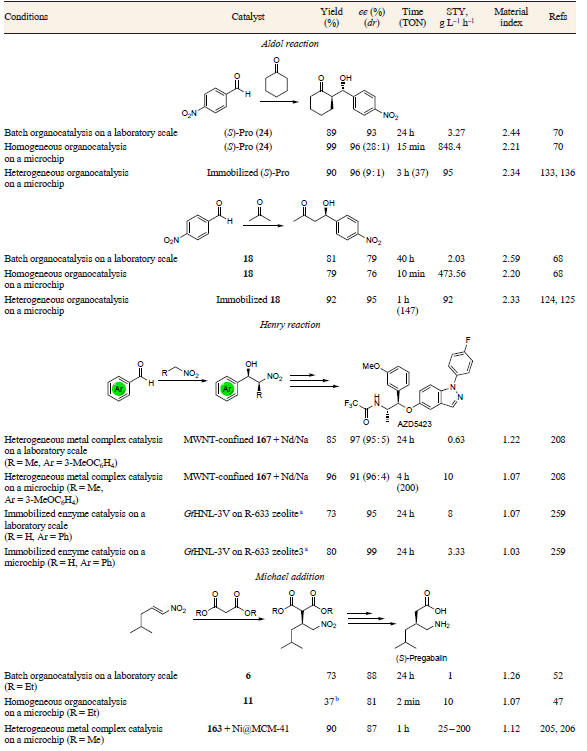
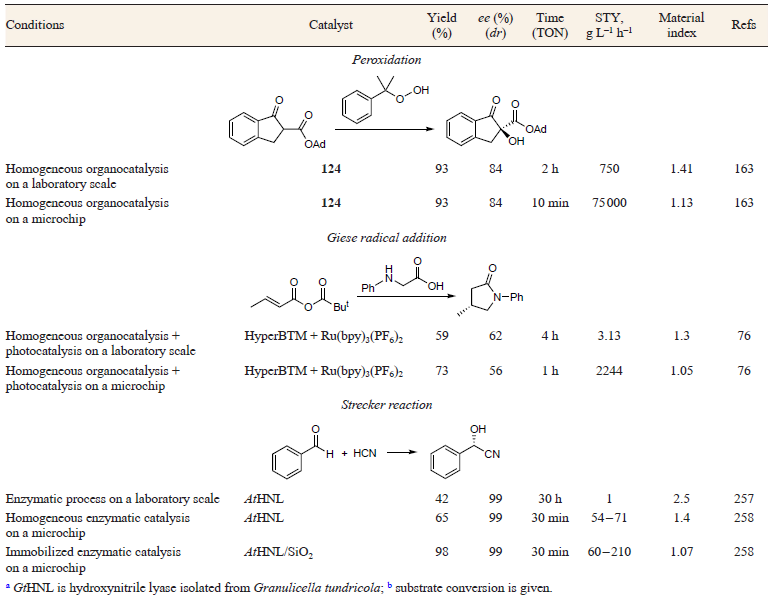
The intensification of reactions, including catalytic reactions, in a microreactor has a clear quantitative justification.[285] Thus, microreactors have a surface area to volume ratio of up to ~30 000 m2 m–3. Meanwhile, for small laboratory vessels and batch tank reactors, this parameter is ~4 – 100 m2 m–3, which ensures fundamentally more efficient heat and mass exchange. This results in a decrease in the thickness of the diffusion boundary layer at the walls and catalyst surface and, hence, in more efficient involvement of the catalytic sites in the reaction. In addition, micro- and millisecond mixing times (~10–4 – 10–6 s) are achieved in microfluidic devices vs. a few seconds or tens of seconds for reaction between the reactants in batch systems.
It should be noted that for liquid/liquid or gas/liquid heterogeneous processes, changes in the dispersity and deformation of nanolitre microdroplets take place in a microflow; the dynamics of these processes is determined by the balance of the coalescence, stretching, and breakup processes under the action of shear stress. This phenomenon is caused by local gradients of the dynamic interfacial tension arising during the chemical reaction, which gives rise to interfacial convection (so-called Marangoni effect).[286][287] The intensification of mass transfer and mixing in the heterogeneous system is also due to the specific hydrodynamics of a two-phase flow in microchannels. First of all, this is caused by the appearance of internal Taylor convection flows (circulation zones within droplets and liquid slug).[288-290] When curved channels or coils are used, this mechanism is supplemented by secondary Dean vortices, which substantially accelerate the renewal of the interface.[291][292]
The comparison of the aldol reaction performances presented in Table 2 demonstrates a particularly pronounced effect of the microchannel approach: the use of amino acids (L-Pro, L-tert-Leu, D-Val) as catalysts reduces the reaction time from a few hours to 15 – 30 min, providing high enantio- (up to 97% ee) and diastereoselectivity (dr reaches 26 : 1). An additional advantage of microchips is the possibility of conducting the reactions at reduced temperatures in order to increase the stereoselectivity, which is virtually impossible in a flask because of the pronounced decrease in the reaction rate.
The conduction of the conjugate Michael addition in a continuous-flow mode in a microreactor for the synthesis of warfarin, pregabalin, and oseltamivir reduces the reaction time 100 – 700-fold, with the enantioselectivity being maintained at 80 – 97% ее. In some cases, an increase in the reaction rate is accompanied by an increase in the enantiomeric excess by 3 – 10% compared to the batch process.
However, the microreactor technology does not always improve the stereochemical performance. For example, for radical reactions, ee decreases by 5 – 15% as the reaction is transferred to a microchip, which may be due to insufficient contact time between the reactants and the catalyst or enhanced sensitivity of the catalytic system to the concentration gradient of the components along the length of the reactor. Even in these cases, the space-time yield (STY) ultimately increases by 1 – 2 orders of magnitude compared with the batch process.
The results presented inTable 2 demonstrate advantages of processes conducted in microreactors in most of the cases. This is manifested, first of all, as a decrease in the reaction time by 1 – 3 orders of magnitude: from a few hours or days on a laboratory scale to minutes and seconds in microreactors. Most often, the yield of the product increases. Interestingly, in a number of cases, the selectivity, including stereoselectivity, of the reactions also increases. This fact can be attributed to a decrease in the influence of side reactions and possible racemization on the stereoselectivity index with a considerable reduction in the reaction time. However, the effect of racemization is barely manifested in enzymatic reactions in which the stereoselectivity is nearly always close to 100%. Nevertheless, quite a few considered reactions evidently show benefits for heterogeneous process conditions: this follows from the decrease in the reaction time and in the required material costs. As regards the scaling-up of the process, a key feature of microflow systems is the maintenance of kinetic and stereochemical parameters with increasing productivity via shortening of the reaction time or parallel operation of several microreactors. Therefore, two main approaches are currently used for scaling-up of microreactor processes:
(1) numbering-up of microreactors operating in parallel,
(2) increase in the channel size (length or diameter).
Gao et al.,[199] who studied the asymmetric sulfoxidation for the synthesis of esomeprazole (160), achieved a productivity of 5.6 g h–1 with 98% yield, 98% ee, and 99% regioselectivity of the product by increasing the number of reactors to two (V = 2.7 mL × 2) (Scheme 93; MFC stands for mass flow controller, BPR is back pressure regulator).
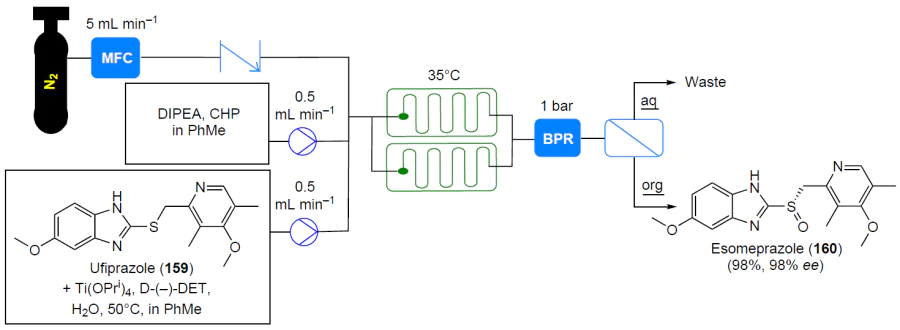
Another possibility for increasing the productivity was reported by Amara et al.,[293] who addressed the asymmetric hydrogenation of N-[1-(5-fluoropyrazin-2-yl)ethenyl]acetamide (234) catalyzed by the Rh-(S,S)-EthylDuphos complex (235). This is a molecular catalyst immobilized on a solid support (alumina) through a heteropoly acid linker. By a 20-fold increase in the length of the reaction column, which resulted in an increase in the microreactor volume from 8 to 150 mL, the authors achieved production of approximately 1 kg of compound 236 per day, while maintaining a quantitative yield and 99% ee (Scheme 94).
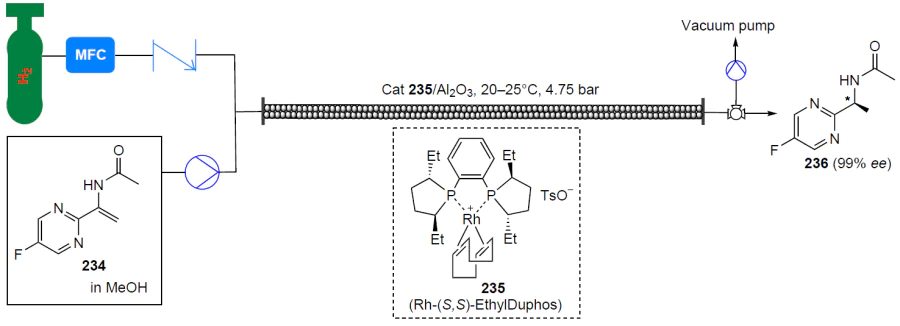
Thus, unlike batch processes, where an increase in volume is often accompanied by deterioration of heat and mass transfer and, as a result, causes a decrease in reaction selectivity, microreactor technologies may provide the formation of chiral biologically active compounds and their intermediates on an industrial scale without changing the optimal conditions.
6. Conclusion
In recent decades, continuous microfluidic technologies have become a powerful tool for improving the quality of asymmetric reactions, providing a fundamentally new level of control over the reaction medium by combining advances in catalysis, organic synthesis, and chemical engineering, and creating the base for switching to highly efficient continuous-flow chemical production of BACs. This review analyzes organic, metal complex, and enzyme chiral catalytic systems in the homogeneous and heterogeneous designs and compares characteristics of these systems with the results achieved in batch processes and in laboratory syntheses. Analysis of the published data presented in the review indicates that advantages of continuous microflow processes are manifested for various types of asymmetric catalysis.
The key engineering advantages of the microreactor technology are related to the following issues:
— shortening of diffusion paths, which leads to an increase in the mass transfer rate;
— increase in the interfacial area per unit volume, which enhances the contact between the reactants;
— precise hydrodynamic regulation, which ensures reproducible reaction times and temperature profiles in the microreactor;
— precise control of process parameters and decrease in the volume of the reaction medium, which enhances the chemoselectivity of the reaction and the safety of synthesis on a laboratory scale and small-scale industrial production.[294][295]
Microreactors make it possible to study and optimize all known types of asymmetric catalysis: homogeneous, heterogeneous, and enzymatic. In most instances, they decrease the reaction time and the catalyst amount and increase the yield of the target product, while maintaining high stereoselectivity of the reactions. This gives reason to hope for further expansion of microfluidic technologies to other types of chemical and enzymatic processes.
Despite the considerable progress, the current stage of development of continuous-flow asymmetric synthesis has a number of unresolved fundamental and engineering challenges. It is necessary to further develop kinetic models that take into account features of laminar flow and diffusion transport. Many studies lack quantitative estimation of the effect of hydrodynamic regime, residence time distribution, and local heat and mass transfer on the reaction kinetics and selectivity. There are no data on the relationship between the physicochemical parameters of the processes occurring in a microreactor and the nature of the chiral catalyst active sites and transition states, which, in some cases, may lead to an increase in enantio- and diastereoselectivity. Further implementation of heterogeneous processes in industry requires new approaches for effective immobilization of the catalyst and prevention of catalyst leaching under continuous flow of the reaction mixture. Deactivation processes of immobilized chiral catalysts, inner mass transfer in porous supports, and ways for establishing versatile criteria for the choice of the optimal reactor type have not been adequately addressed. The crucial factors for the efficiency of continuous-flow asymmetric synthesis include not only the activity of the chiral catalyst, but also the complex interplay of molecular and engineering process parameters, including flow hydrodynamics, distribution of the reactant residence time, heat and mass transfer efficiency, and the reactor design and geometry. Solving these problems is a necessary condition for the further industrial implementation of microfluidic technologies for the production of chiral BACs.
This review demonstrates the rapid evolution of the reactor base from simple capillary microreactors to integrated multistage platforms in which the stages of synthesis, separation, analysis, and purification of chiral biologically active products, as well as the catalyst recycling procedure, are combined into a single process flow diagram. The subsequent development of the production of chiral BACs may be determined by the integration of microfluidic reactors with modern catalytic systems, in-line analysis (using chiral HPLC, various types of spectroscopy, and mass spectrometry), computational fluid dynamics, kinetic modelling, and machine learning algorithms.[296-298] The latest techniques for fabrication of microreactors with submicron resolution[31] give reasons to hope for the future creation of smart chemical production facilities that would enable safe, highly selective, resource-efficient, and cost-effective synthesis of chiral pharmaceutical substances.
This review was written with the financial support of the Ministry of Science and Higher Education of the Russian Federation within the framework of the State Assignment of the A.N.Nesmeyanov Institute of Organoelement Compounds, Russian Academy of Sciences (theme No. 075-03-2026-024) and the Russian Science Foundation (Project No. 24-13-00310).
7. List of abbreviations and symbols
The following abbreviations and symbols are used in the review:
ABT — 2-aminobutane-1,3,4-triol,
AaeUPO — nonspecific peroxygenase isolated from Agrocybe aegerita,
AG-DEAE — agarose microgranules functionalized with diethylaminoethyl groups,
Ad — 1-adamantyl,
AI — artificial intelligence,
AmDH — amine dehydrogenase,
All — allyl,
apKRED — ketoreductase isolated from Acetobacter pasteurianus,
Ant — 9-anthryl,
AtHNL — hydroxynitrile lyase isolated from Arabidopsis thaliana,
BAC — biologically active compound,
BAL — benzaldehyde lyase,
BDP — bis(diazaphospholane),
BEMP — 2-tert-butylimino-1,3-dimethyl-2-diethylaminoperhydro-1,3,2-diazaphosphorine,
BINAP — 2,2'-bis(diphenylphosphino)-1,1'-binaphthyl,
BINOL-DA — 6,6'-dichloro-2,2'-diethoxy-1,1'-binaphthyl-4,4'-dicarbaldehyde,
BME — β-mercaptoethanol,
Boc — tert-butoxycarbonyl,
bpy — 2,2'-bipyridine,
BPR — back pressure regulator,
BTM — benzotetramisole,
Cat — catalyst,
CaLB — lipase B isolated from Candida antarctica,
CBS — Corey – Bakshi – Shibata catalyst,
Cbz — benzyloxycarbonyl,
CEP — cofactor-enriched poly(ethylenediamine),
COD — cycloocta-1,5-diene,
CFL — compact fluorescent lamp,
CPA — chiral phosphoric acids,
4CzIPN — 1,2,3,5-tetrakis(carbazol-9-yl)-4,6-dicyanobenzene,
Cyp — cyclopentyl,
DMA — dimethylacetamide,
DCE — 1,2-dichloroethane,
DCM — dichloromethane,
DEА — diethanolamine,
DET — diethyl tartrate,
DIPA — diisopropylamine,
DIPEA — diisopropylethylamine,
DMPU — N,N'-dimethylpropyleneurea,
DON — dendritic organosilicon nanoparticles,
dr — diastereomeric ratio,
DSN — dendritic silica nanoparticles,
EDA — ethylenediamine,
ee — enantiomeric excess,
GABA — γ-aminobutyric acid,
GDH — glucose dehydrogenase,
GO — glucose oxidase,
GtHNL — hydroxynitrile lyase isolated from Granulicella tundricola,
HbHNL — hydroxynitrile lyase isolated from Hevea brasiliensis,
HNL — hydroxynitrile lyase,
HPEN — bis(2-hydroxyphenyl)ethanediamine,
HyperBTM — (2R,3S)-(–)-3,4-dihydro-3-isopropyl-2-phenyl-2H-pyrimido[2,1-b]benzothiazole,
Ipc — isopinocamphyl,
JaAmDH — amine dehydrogenase isolated from Jeotgalicoccus aerolatus,
KPi — potassium phosphate buffer,
KRED — ketoreductase,
LbADH — alcohol dehydrogenase isolated from Lactobacillus brevis,
LkADH — alcohol dehydrogenase isolated from Lactobacillus kefir,
LkKRED — reductase isolated from Lactobacillus kefir,
LED — light-emitting diode,
MBA — α-methylbenzylamine,
MFC — mass flow controller,
mpg — mesoporous graphitic (support),
MR — Merrifield resin,
MTBE — methyl tert-butyl ether,
MWNT — multi-walled carbon nanotubes,
NADPH (NADP+)–nicotinamide adenine dinucleotide phosphate (reduced and oxidized forms, respectively),
NBP — n-butylphthalide,
NBS — N-bromosuccinimide,
PAH — polyallylamine hydrochloride,
PAL — phenylalanine-ammonia lyase,
PBS — phosphate buffered saline,
PCP — [2.2]paracyclophane,
PEG — polyoxyethylene glycol,
PG — protecting group,
Piv — pivaloyl,
PLP — pyridoxal phosphate,
PMP — p-methoxyphenyl,
PS — polystyrene,
PTA — phosphotungstic acid,
Py — pyridyl,
rt — room temperature,
SPINOL — 1,1'-spirobiindane-7,7'-diol,
STA — silicotungstic acid,
SWCNT — single-walled carbon nanotube,
STY — space time yield,
TBAB — tetra-n-butylammonium bromide,
TBADT — tetra-n-butylammonium decatungstate,
TBS — tert-butyldimethylsilyl,
TbSADH — secondary alcohol dehydrogenase isolated from Thermoanaerobacter brockii,
Тc — thiophene-2-carboxylate,
ThDP — thiamine diphosphate,
TfО — triflate,
TFA — trifluoroacetic acid,
TFE — 2,2,2-trifluoroethanol,
TMS — trimethylsilyl,
TON — turnover number,
TRIP — 3,3-bis(2,4,6-triisopropylphenyl)-1,1-binaphthyl-2,2-diyl hydrogen phosphate,
Ts — p-toluenesulfonyl (tosyl),
VKORC1 — vitamin K epoxide reductase complex subunit 1,
WR — Wang resin.
References