
Keywords
Abstract
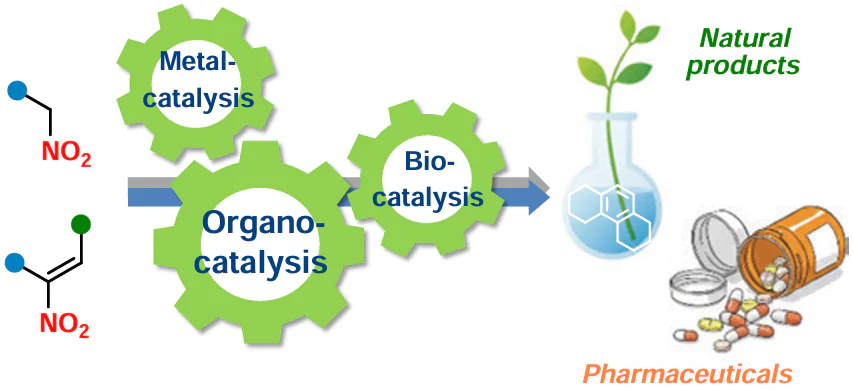
Over the past decade, the chemistry of nitro compounds has been extensively developed. A particular focus of research has been placed on stereoselective transformations leading to key precursors of natural products and pharmaceutical ingredients. Most important among them are asymmetric reactions of nitroalkanes with electrophiles (e.g., Michael addition, Henry and nitro-Mannich reactions), nucleophilic additions and cycloadditions to nitroalkenes, cascade multistep processes, and novel strategies for the stereoselective introduction of the nitro group. Precise stereocontrol in these reactions is achieved through the application of new efficient organocatalysts, including solid-supported ones, as well as enzymatic and biocatalytic approaches that directly involve nitro compounds. Herein, we have systematized recently published data on the application of nitro compounds for the target-oriented stereoselective synthesis of natural and artificial bioactive molecules. The review covers the period from 2016 to 2026.
The bibliography includes 283 references.
1. Introduction
Nitro compounds are convenient and readily available feedstocks and intermediates in the synthesis of complex organic molecules, including natural products or active pharmaceutical ingredients (APIs).[1-3] Among them, aliphatic nitro compounds (nitroalkanes and nitroalkenes) exhibit versatile reactivity in carbon-carbon and carbon-heteroatom bond forming reactions, which makes them useful reagents for organic synthesis. Furthermore, the nitro group possesses an amazing transformability to a number of other functional groups, first of all amino group, thus providing an expedient access to various bioactive amine scaffolds of high demand by pharmaceutical industry and R&D. Another important feature of the nitro compounds is their excellent compatibility with efficient stereo- and enantioselective catalytic strategies, such as organocatalysis,[4] organometal catalysis[5] and biocatalysis.[6] This compatibility significantly enhances application area and practical importance of the developed methodologies.
A decade ago, we summarized remarkable achievements in the chemistry of natural compounds and medicinal chemistry associated with the fruitful use of nitro compounds at the key steps of stereoselective target-oriented syntheses.[7] Since publication of this comprehensive contribution, which has attracted considerable readership attention, some particular aspects of these perspective research areas have been additionally highlighted by other researchers in more recent review articles with a focus on asymmetric cascade reactions of γ-nitro carbonyl compounds,[8] stereoselective nitro-Mannich reactions,[9] asymmetric conjugate additions to nitroalkenes,[10][11] domino reactions of nitronates,[12] and efficient stereoselective approaches to neuraminidase inhibitor Tamiflu[13] and prostaglandins.[14] However, we have not found a comprehensive update of recent achievements in pharmacology-oriented stereoselective transformations of nitro compounds in chemical literature.
Herein, we systematized recently published data on the application of nitro compounds for target-oriented stereoselective synthesis of natural products and pharmaceutical ingredients covering the period from 2016 to 2026 along with a few earlier reports not mentioned in the previous review. The data are arranged according to the types of nitro compounds used as substrates and include reactions of nitroalkanes, nitroalkenes, nitroalkane derivatives and other types of nitro compounds. Within each section, the content is divided by the reaction type (Michael, Henry, aza-Henry, Mannich, cascade reactions, etc.) and further subdivided in accordance with the reagent structure and/or methodologies used (non-catalytic methodologies, organometal catalysis, organocatalysis, biocatalysis). Considering that alternative schemes for the synthesis of some analogs of natural products and/or active pharmaceutical ingredients are located at different sections of the review, in Section 6 we have provided a list of bioactive molecules in alphabetical order. Section 6 also contains information on their natural sources, types of biological activity and synthetic methods used with links to sections and schemes of the review where more detailed information on a particular compound or reaction of interest to the reader can be found.
2. Reactions of nitroalkanes
While nitroalkanes display versatile reactivity, their principal synthetic utility lies in reactions with electrophiles at the α-carbon. A wide range of electrophiles, including Michael acceptors, aldehydes, ketones, and imines, can participate in these transformations. As the reactions are base-catalyzed, proceeding via nucleophilic nitronate anions, chiral amines are ideal organocatalysts for achieving high enantioselectivity. The resulting β-functionalized nitroalkanes are valuable synthetic intermediates, particularly in pharmaceutical synthesis, as the nitro group can be efficiently reduced to form amine derivatives.
2.1. Addition of nitroalkanes to electron-deficient olefins
The stereoselective addition of nitroalkanes to electron-poor olefins has received great attention, as the reaction products may be converted to γ-nitroesters, which provide direct entry to a plethora of natural and medicinally relevant compounds, specifically 2-pyrrolidinones, 2-piperidones, pyrrolizidines, and γ-amino acids.[15][16] γ-Aminobutyric acid (GABA), the simplest member of the row, is a primary regulator of the mammalian central nervous system.[17][18] Several synthetic analogs of GABA, such as Pregabalin, Baclofen and Phenibut, exhibit analgesic, tranquilizing, anticonvulsant and anxiolytic activities.[19-21]
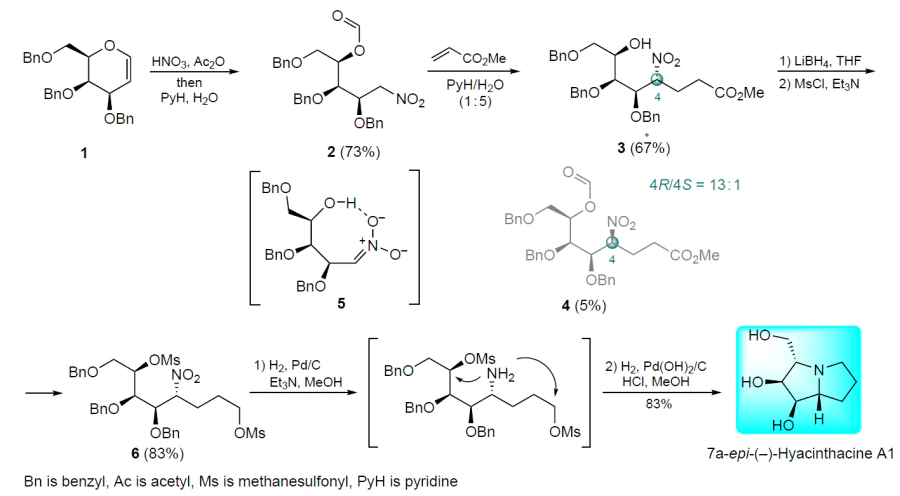
Nitro compounds derived from chiral pool, in particular carbohydrates, remain attractive synthetic intermediates for total synthesis of enantiopure natural products. An important advantage of these nitro compounds is high diastereocontrol of their reactions provided by the chiral carbohydrate framework. An illustrative recent example is the total synthesis of 7a-epi-(–)-Hyacinthacine A1 developed by Ye and co-workers[22] employing a diastereoselective Michael reaction of the protected nitro-polyol 2 with methyl acrylate (Scheme 1). Compound 2 was prepared by nitration/fragmentation of Bn-protected glycal 1. The Michael addition of 2 to methyl acrylate proceeded smoothly in water in the presence of pyridine base. Under mild reaction conditions and with a certain H2O/pyridine ratio (5 : 1), high diastereoselectivity of the process was achieved (4R/4S = 13 : 1). Notably, the formyl group was cleaved in the major isomer 3 (67% yield), while the minor isomer 4 (5% yield) remained formylated. The origin of high diastereoselectivity is attributed to the formation of an intramolecular hydrogen bond in the deformylated nitronate intermediate 5 that results in a more efficient shielding of the Si-face of the C=N-bond. Subsequent hydride reduction of the ester and mesylation of the free hydroxyl groups gave 6, which was converted to the desired 7a-epi-(−)-Hyacinthacine A1 through reductive cyclization/deprotection.
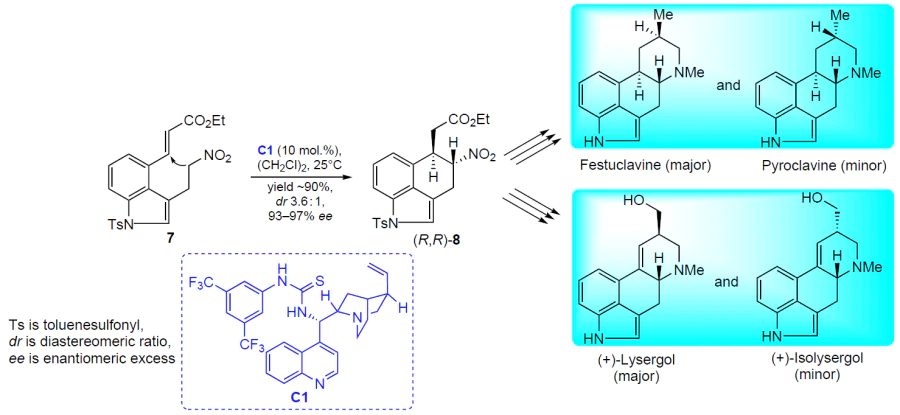
Bisai and co-workers[23] reported an elegant approach to enantioselective construction of vicinal stereocenters in N-protected indole derivatives 7 via cinchona-thiourea catalyzed intramolecular asymmetric Michael addition of the nitronate moiety to neighboring α,β-unsaturated ester functionality. This ring-forming reaction is characterized by high enantioselectivity (up to 97% ee), though the diastereomeric ratio of tricyclic products 8 was less than 4 : 1 (Scheme 2). The major diastereomer (R,R)-8 obtained in the presence of cinchonidine-derived organocatalyst C1 was used by the authors as a synthon for the development of a unified approach to the ergot alkaloids. Reduction of the nitro functionality followed by specially designed transformations of the amino and ester groups and 6-endo-trig cyclisation allowed constructing the desired tetracyclic alkaloid skeleton. As a result, the first total syntheses of diastereomeric alkaloid pairs Festuclavine/Pyroclavine and Lysergol/Isolysergol were accomplished, in which compounds Festuclavine and Lysergol were the major components.
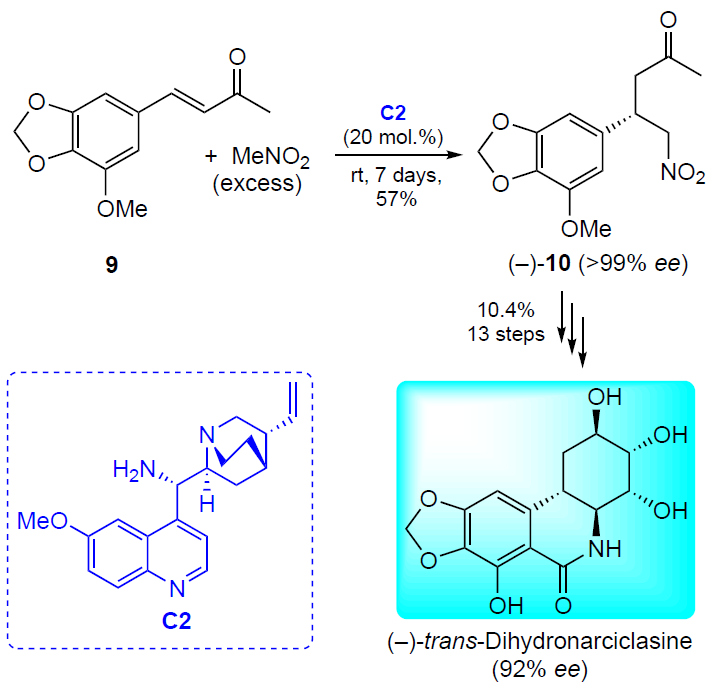
A feasible and enantioselective total synthesis of (−)-trans-Dihydronarciclasine, which belongs to the family of natural phenanthridone alkaloids, a subclass of the Amaryllidaceae alkaloid family,[24] was accomplished by Kádas and co-workers.[25] The key step of this new synthesis was an asymmetric organocatalytic Michael addition of nitromethane to butenone 9 derived from vanillin to give an optically active nitropentanone (–)-10 in good yield (Scheme 3). Excellent enantiomeric purity of the adduct (–)-10 (> 99% ee) was delivered by (8S,9S)-9-amino(9-deoxy)epiquinine (C2) organocatalyst. The chiral precursor (–)-10 was converted into the target alkaloid in ~10% overall yield with 92% ee over 13 synthetic steps. As a result, the first and facile access to the ent-form of naturally occurring (+)-trans-Dihydronarciclasine, a highly potent cytostatic alkaloid, has been provided.
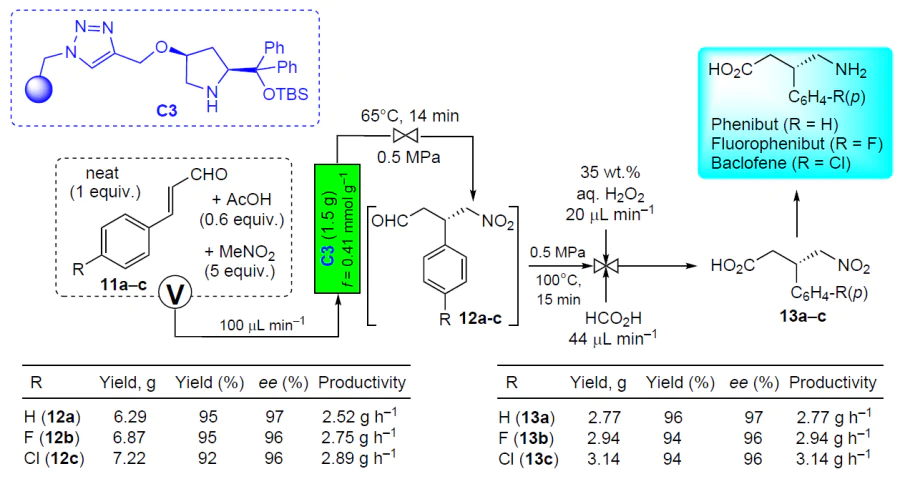
The asymmetric Michael-type addition of nitromethane to α,β-unsaturated aldehydes offer practical access to γ-nitroaldehydes as critical chiral precursors, which can be transformed into the pharmaceutically important GABA analogs via subsequent oxidation and reduction steps. Especially attractive for the multistep syntheses of active pharmaceutical ingredients and related compounds are continuous flow processes, which reduce solvent usage and improve environmental performance, cost, and health issues. Kappe and co-workers[26] developed a simple and sustainable entry to optically active γ-nitrobutyric acids 13a – c as key intermediates of the GABA analogs Phenibut, Fluorophenibut, and Baclofen by merging the targeted organocatalytic asymmetric conjugate addition with the subsequent oxidation of aldehydes 12a – c in a telescoped flow process (Scheme 4). For the organocatalytic asymmetric conjugate addition of nitromethane to cinnamaldehydes 11a – c, a polystyrene-supported cis-4-hydroxydiphenylprolinol tert-butyldimethylsilyl (TBS) ether (C3) was selected as an efficient organocatalyst in combination with AcOH as an acidic additive. High yields (up to 95%) and excellent ee’s (up to 97%) were achieved for each reaction, and corresponding chiral γ-nitroaldehydes 12a – c were obtained on a multigram scale without the need for chromatographic purification, after excess nitromethane and residual AcOH were removed by simple evaporation. Then, γ-nitroaldehydes 12a – c were oxidized with performic acid generated in situ from formic acid and 35% aq. H2O2 under flow conditions. The preparative-scale procedure proved to be applicable to all three aldehyde substrates. Multigram quantities of the desired γ-nitrobutyric acids 13a – c were obtained in excellent yields after simple evaporation. Importantly, the E-factors for the two-step telescoped sequences were only 2.44, 2.25 and 2.13, respectively, underlying a green nature of the continuous-flow method.
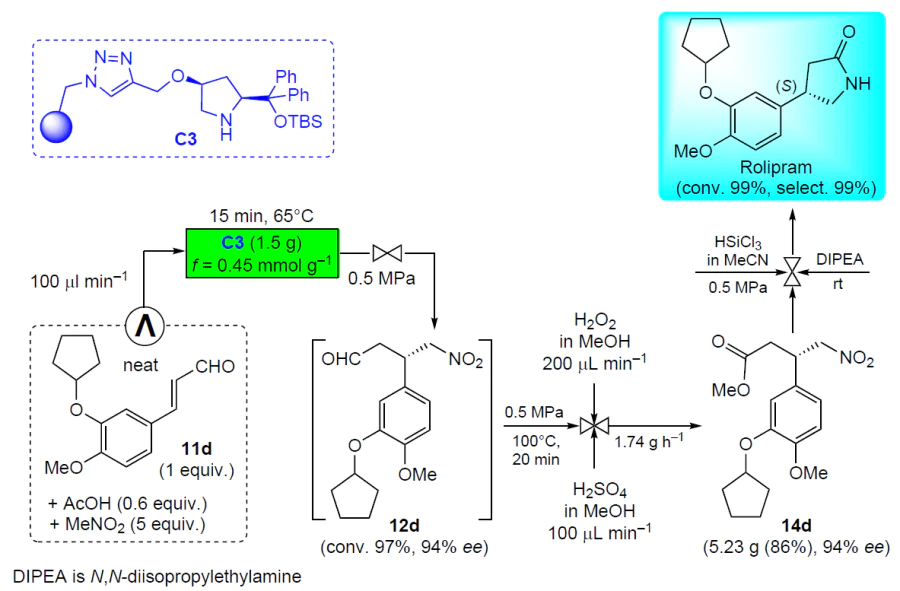
In a follow-up study, the same research group[27] reported the enantioselective flow synthesis of Rolipram, highly selective inhibitor of a cAMP-specific type IV phosphodiesterase (PDE4).[28] The first step of the total synthesis was a telescoped asymmetric conjugate addition of nitromethane to properly functionalized enal 11d in the continuous flow of the nitromethane access (5 : 1) through a glass column filled with the cross-linked polystyrene-supported organocatalyst C3 (Scheme 5). The resulting chiral Michael adduct 12d of enantiomeric purity 94% ee was immediately subjected to oxidative esterification of the aldehyde group under the action of persulfuric acid generated in situ from H2SO4 and hydrogen peroxide in the MeOH flow passing through a coil heated to 100°C. No racemization of the γ-nitro ester 14d was observed over the oxidative esterification and only a relatively small amount of waste was produced at this step as demonstrated by an E-factor of 9.3. Finally, the trichlorosilane-mediated reduction of the nitro group in γ-nitro ester 14d followed by concomitant lactamization of the in situ generated γ-amino ester afforded target Rolipram with high conversion and selectivity.
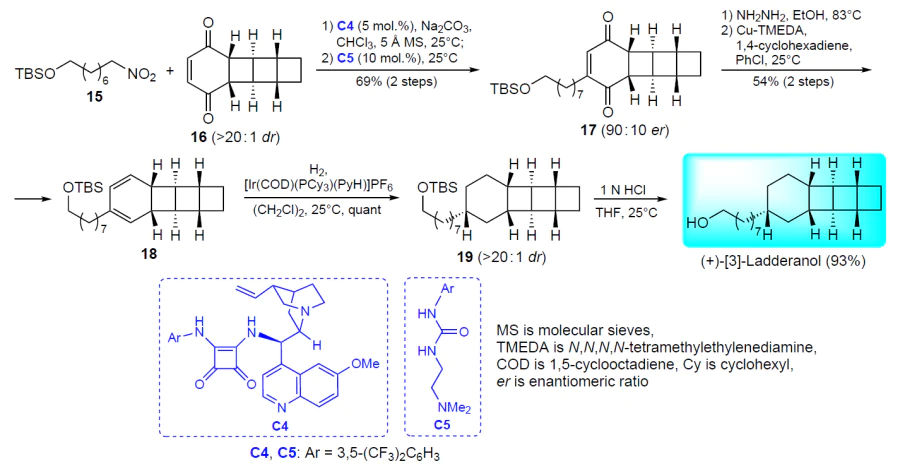
Manna and Mukherjee[29] developed an original organocatalytic enantioselective desymmetrizing formal C(sp2) – H alkylation reaction of linear nitroalkanes with electron-poor alkenes in which the nitro group acts as a leaving moiety and successfully applied it[30] to the concise total synthesis of [3]-Ladderanol, a component of architecturally unique natural ladderane phospholipids.[31] The pre-prepared meso-cyclohexenedione 16 with the required configuration readily reacted with TBS-protected 8-nitrooctan-1-ol (15) to afford cross-coupling product 17 in 69% yield with 90 : 10 er over the two-step formal C(sp2) – H alkylation process using a sequential combination of chiral quinine-derived squaramide C4 and achiral tertiary amine–urea organocatalyst C5 (Scheme 6). Although a large excess (5 equiv.) of nitroalkanes 15 had to be used in this reaction to achieve a reasonable reaction rate, most of the unreacted nitroalkanes (3.6 – 3.9 equiv.) could be recovered and reused. The product 17, having the entire carbon-skeleton of natural [3]-Ladderanol with the correct stereochemistry at the fused ring junctions, was then subjected to the two-step deoxygenation protocol developed by Burns and co-workers.[32] The resulting 1,3-cyclohexadiene derivative 18 was isolated in 54% overall yield over two steps. Hydrogenation under homogeneous conditions using Crabtree’s catalyst [Ir(COD)(PCy3)(PyH)]PF6 quantitatively converted 18 to the desired diastereomer 19 without affecting the ladderane motif. Deprotection of the TBS group with aqueous HCl concluded the total synthesis of (+)-[3]-Ladderanol. The late-stage introduction of chirality offers flexibility to this synthetic approach, which allows for the synthesis of both the enantiomers of [3]-Ladderanol as well as an analog with a good level of enantioselectivity.
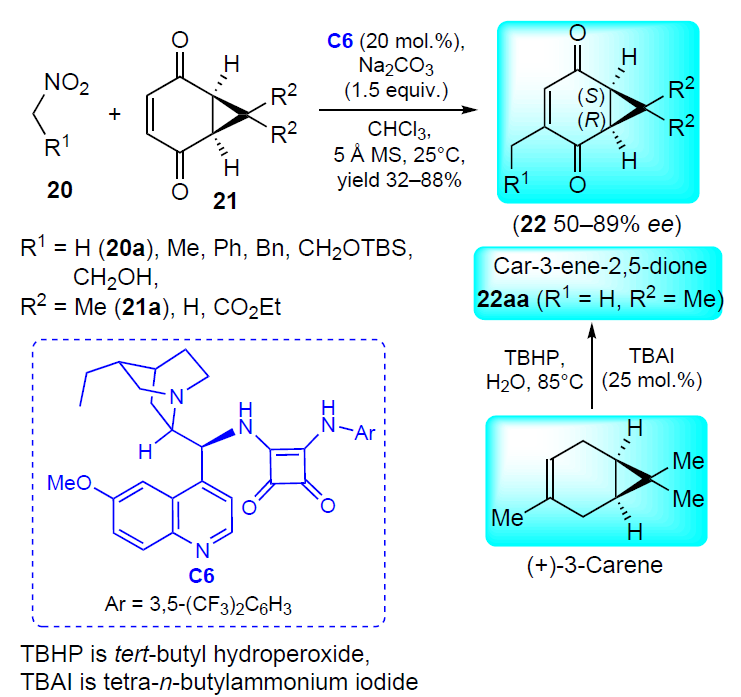
Similar C(sp2) – H alkylation methodology was applied by Ray and Mukherjee[33] for catalytic nitroalkane 20-induced enantioselective desymmetrization of meso-cyclopropane-fused cyclohexene-1,4-diones 21, a framework found in several bioactive compounds. The peculiarity of this approach is retaining the bicyclo[4.1.0]heptane moiety over the desymmetrization process which has never been realized before. The authors discovered that various nitroalkanes 20 added to activated cyclopropane-fused cyclohexene-1,4-diones 21 in the presence of dihydroquinine-derived squaramide C6 affording alkylated bicyclo[4.1.0]heptane derivatives 22 in moderate to high yield with moderate to reasonable enantioselectivity (Scheme 7). 7,7-Dimethylbicyclo[4.1.0]heptane 21a was also smoothly methylated with nitromethane 20a under proposed conditions. The resulting compound 22aa, identical to the natural product car-3-ene-2,5-dione, was obtained in 61% yield with 89% ee. The absolute stereochemistry of 22aa was confirmed to be (1S,6R) by comparing its specific rotation with similar compound prepared from optically pure (+)-3-carene.
Despite numerous reports on the asymmetric addition of nitroalkanes to α,β-unsaturated aldehydes or ketones, summarized in this and previous reviews,[7] information on the intermolecular addition of nitroalkanes to α,β-unsaturated ethers remain scarce due to the reduced electrophilicity of the alkene moiety conjugated with the ether group. In contrast, the use of nitroalkanes as nucleophiles in the reactions with more active α,β-unsaturated carboxylic acid derivatives, such as N-acylpyrazoles,[34] imides,[35] N-acylpyrroles[36] or thioamides[37] is well documented. Some intramolecular enantioselective addition of certain tethered nitroalkanes to α,β-unsaturated esters has also been reported using bifunctional cinchona-derived catalysts.[23][38]
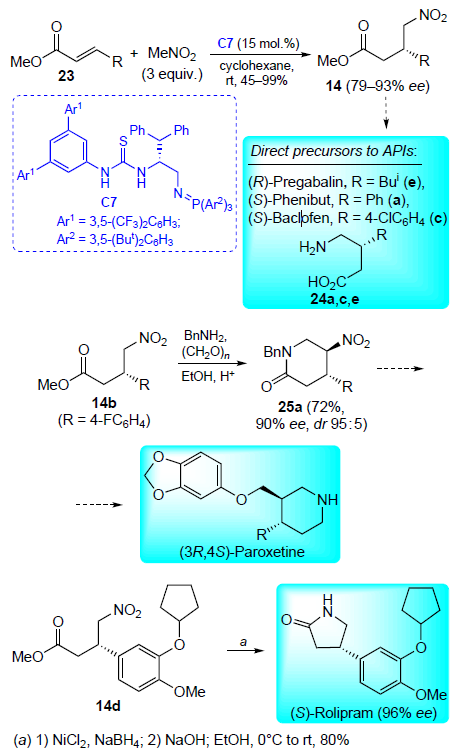
In 2023, Dixon and co-workers[39] described enantioselective intermolecular conjugate addition of nitromethane to otherwise inactive α,β-unsaturated esters 23, catalyzed by a specially designed bifunctional iminophosphorane superbase C7 (Scheme 8). The reaction proceeded most efficiently in the cyclohexane/nitromethane biphasic system and could be conducted under air with no detrimental effects to yield or enantioselectivity of products 14, as a testament to the robustness of the catalytic system. The methodology tolerates a larger range of substituents compared to previously reported strategies and can be applied to up to 10 mmol scale, with the catalyst recovery. With the synthesis of 14e, 14a and 14c, the enantioselective formal synthesis of (R)-Pregabalin, (S)-Phenibut and (S)-Baclofen was achieved. Additionally, γ-nitro ester 14b was converted to δ-lactame 25a in 72% yield, 95 : 5 er (major enantiomer) and 95 : 5 dr in a single step, en route to (3R,4S)-Paroxetine.[40][41] Finally, the enantioselective synthesis of (S)-Rolipram was achieved in 80% yield with 96% ee by a one-pot reductive lactamization of the γ-nitroester 14d with NiCl2/NaBH4 under basic conditions.
Over the past decade, biocatalysis has emerged as a powerful tool in organic synthesis, particularly in the field of nitro compound chemistry.[42] Along with hydrolases widely used on an industrial scale for the benign synthesis of commodity and bulk chemicals, further enzyme classes, capable of catalyzing enantioselectively C – C-bond formation reactions, have gained increasing interest. Poelarends and co-workers[43] focused on the development of a biocatalytic procedure for the asymmetric synthesis of γ-nitroaldehydes, precursors to pharmacologically important GABA analogs (see also subsection 3.1.1. of this review). This research group discovered[43] that the F50A mutant of the 4-oxalocrotonate tautomerase (4-OT) can efficiently promote asymmetric Michael addition of nitromethane to α,β-unsaturated aldehydes 11, yielding various γ-nitroaldehydes 12 with high enantiopurity (up to 99% ee) and in high isolated yield (61 – 96%). The catalytic mechanism appears to involve the formation of enzyme-bound iminium ion intermediates Int1 in a manner reminiscent of organocatalysis (Scheme 9). Furthermore, inclusion of a suitable aldehyde dehydrogenase (ALDH) and cofactor recycling nicotinamide adenine dinucleotide hydrogen (NADH) oxidase in the reaction mixture enabled the efficient one-pot synthesis of γ-nitrocarboxylic acids 13 via a biocatalytic cascade reaction (for alternative enzymatic syntheses of compounds 13 see Section 3.1.1).
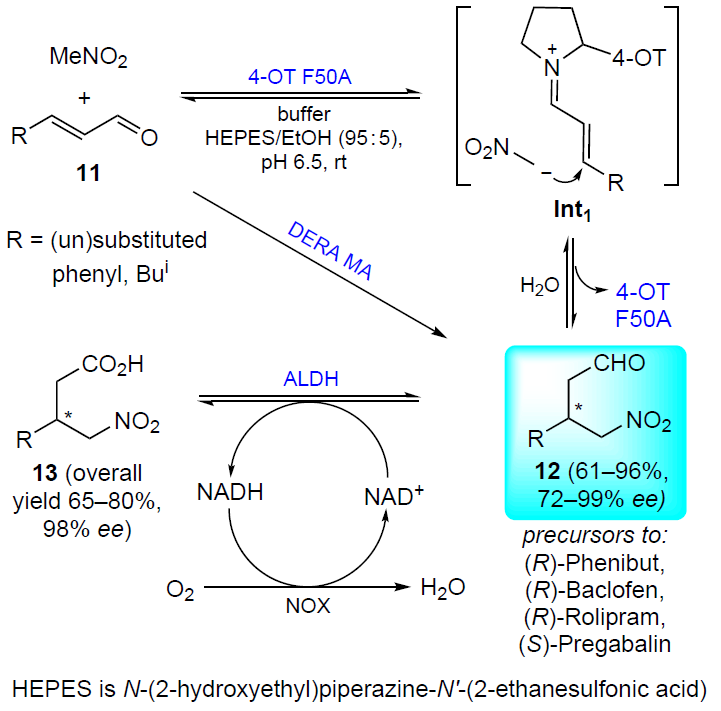
Later, Poelarends and co-workers[44] reported efficient asymmetric synthesis of γ-nitroaldehydes 12 from nitromethane and α,β-enals 11 catalyzed by redesigned DERA enzyme (the archetypical class I aldolase 2-deoxy-D-ribose-5-phosphate aldolase) from Escherichia coli named DERA-MA (see Scheme 9). The enzymatic products 12 were obtained with good conversions (> 95%) as the desired R-enantiomers with good to excellent enantiopurity (er 86 : 14 – 99 : 1). The authors demonstrated synthetic usefulness of DERA-MA by performing semipreparative-scale synthesis of γ-nitroaldehyde precursors to the pharmaceutically active γ-aminobutyric acids Phenibut, Baclofen, and Fluorophenibut.
2.2. Nitroaldol (Henry) reaction
During the past decade, the reaction of nitroalkanes with carbonyl compounds known as nitroaldol or Henry reaction, has compelled significant attention as a powerful tool for stereoselective preparation of β-nitro alcohols which find numerous applications in the synthesis of natural compound analogs and pharmaceutical ingredients. Two new stereogenic centers are typically formed in the Henry reaction. Therefore, careful control of their relative and absolute configuration by choosing appropriate catalyst structure and reaction conditions is the key for attaining high diastereo- and enantioselectivity of these transformations.
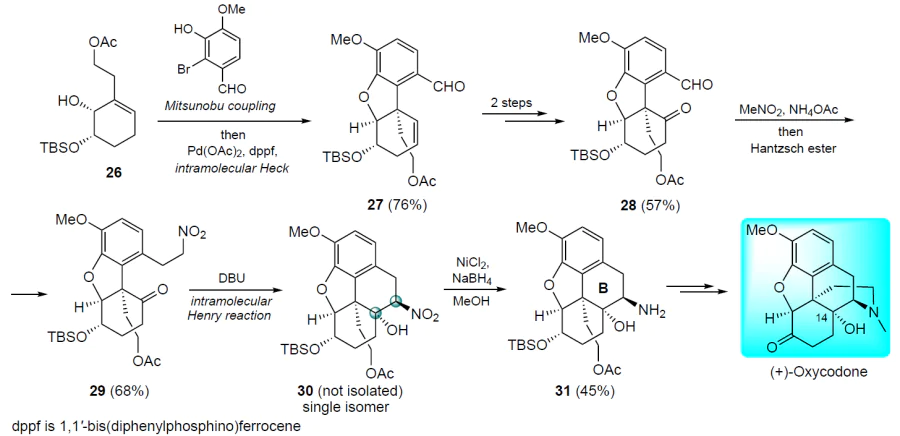
A diastereoselective intramolecular Henry reaction was used by Hudlicky and co-workers[45] to assemble the B ring of the (+)-enantiomer of analgetic Oxycodone (Scheme 10). In their strategy, ketoaldehyde 28 was accessed in 4 steps from an enantiomerically pure cis-dihydrodiol 26 that is available from phenethyl acetate by enzymatic dihydroxylation. The Henry reaction of ketoaldehyde 28 obtained from corresponding aldehyde 27 with nitromethane gave nitroalkene, which was selectively reduced to nitroalkane 29 with Hantzsch ester. Subsequently, treatment of the product with 1,8-diazabicyclo[5.4.0]undec-7-ene (DBU) afforded nitroalcohol 30 as a single stereoisomer. This product was chemically labile and showed a tendency towards retro-Henry reaction. Thus, it was immediately subjected to a reduction with NaBH4/NiCl2 without purification to give aminoalcohol 31 in 45% yield over two steps. Thus, using this four-step sequence, the B-ring of the target ent-oxycodone was successfully constructed and the C – 14 hydroxyl was installed.
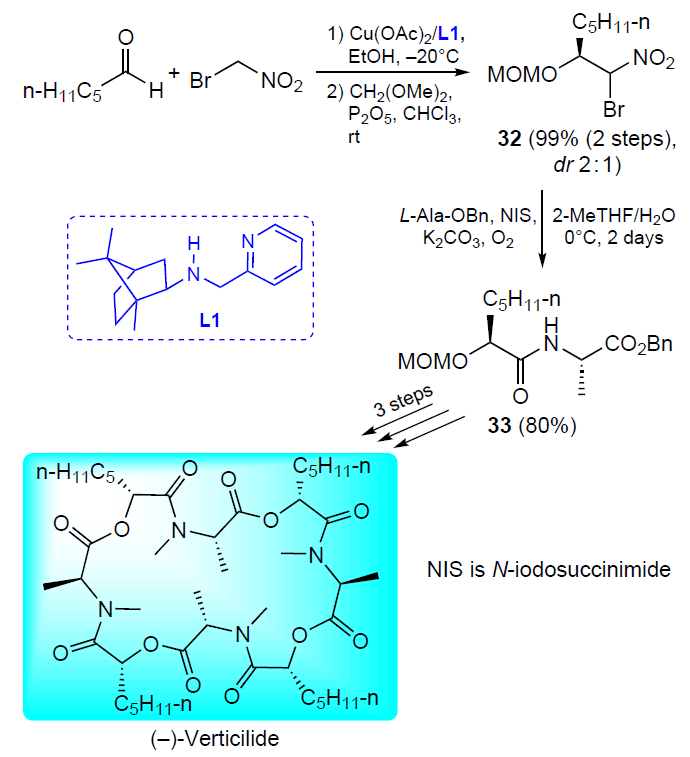
Batiste and Johnston[46] developed a six-step synthesis of the natural product (–)-Verticilide, a 24-membered macrocyclic oligodepsipeptide isolated by Omura and co-workers[47] in 2006 from culture broth of Verticillium sp. FKI-1033. This natural product inhibits ryanodine binding to ryanodine receptor (RyR) and shows insecticidal activity.[47] The proposed synthetic approach is based on asymmetric Henry reaction of n-hexanal with bromonitromethane in the presence of Cu(II)/L1 catalytic system followed by selective methoxymethylene (MOM) protection of the hydroxyl group to afford compound 32 as a mixture of two diastereomers in a 2 : 1 ratio. Subsequent enantioselective synthesis of α-oxy amide 33 and Mitsunobu-based depsipeptide formation provided rapid access to macrocyclic (–)-Verticilide (Scheme 11). The Henry reaction is equally effective for (R)- or (S)-α-hydroxy heptanoic acid residue preparation, and it has been used later for preparations of ent-Verticilide at a larger scale.[48] Furthermore, the 24-membered macrocyclic oligodepsipeptides are currently under study as promising cell-permeable antiarrhythmic compounds.[49][50]
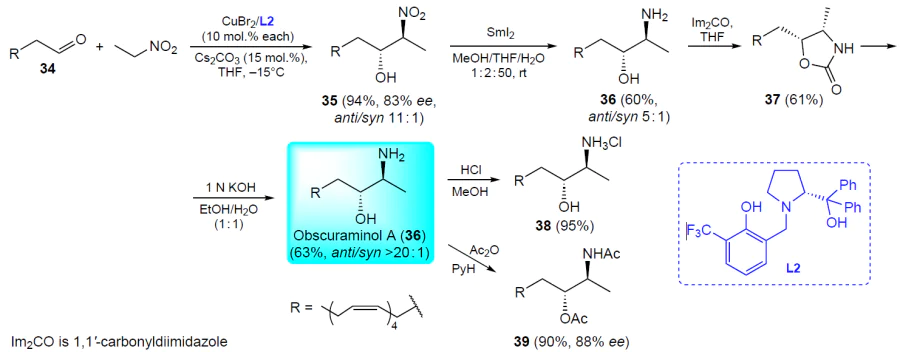
Sphingosines are common biomembrane constituents of sphingolipids which are involved in many biological functions.[51][52] Obscuraminol A (36), a member of this family, was isolated by Garrido et al.[53] from the chloroform extracts of the marine ascidian Pseudodistoma obscurum. In 2016, Hansen and co-workers[54] presented the first chemical synthesis of Obscuraminol A (36) using an organocatalyzed anti-diastereoselective and enantioselective Henry reaction (Scheme 12). In the presence of Cu(II) and phenol-proline derived ligand L2, polyunsaturated aldehyde 34 reacted with nitroethane under mild conditions (THF, –15°C, 120 h) to afford (2S,3R)-nitroaldol adduct 35 in 94% yield with good diastereoselectivity (anti/syn 11 : 1) and 83% ee. Applying SmI2-mediated reduction protocol resulted in the isolation of the desired amino-alcohol 36 as a 5 : 1 mixture of anti and syn diastereomers in 60% total yield. This mixture appeared inseparable at this stage. In order to achieve the separation, it was treated with 1,10-carbonyldiimidazole to afford a syn/anti mixture of isomeric cyclic oxazolidinones, the major of which, cis-isomer 37, was isolated by chromatography in 61% yield. Subsequent alkaline hydrolysis of oxazolidinone 37 provided access to the target amino alcohol 36 (dr >20 : 1). The absolute (2S,3R) configuration was assigned to product 36 based on the similarity of the specific optical rotation data for derivatives 38 and 39 with reported data.
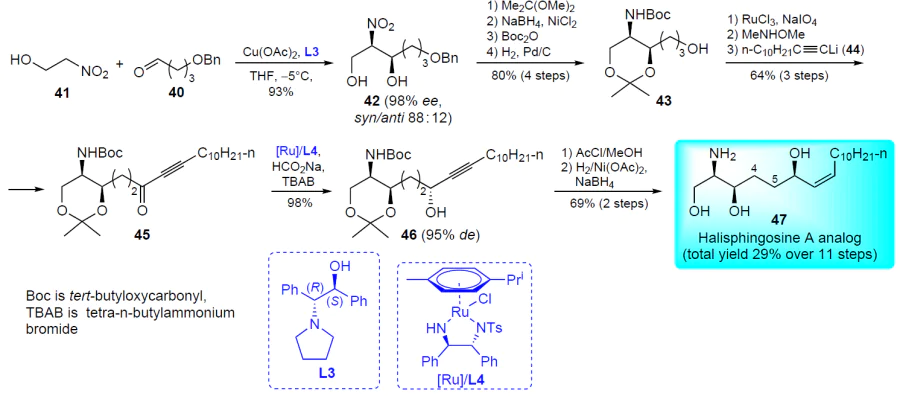
In 2020, Schobert and co-workers[55] reported synthetic efforts to obtain Halisphingosine A, a metabolite of the marine sponge Haliclona tubifera. The synthetic scheme started with catalytic syn-selective Henry reaction of readily available aldehyde 40 with 2-nitroethanol (41) in the presence of Cu(OAc)2 and ligand L3, previously reported by Chen and co-workers.[56] The nitrodiol 42 was formed in this reaction as a mixture of diastereomers with a syn/anti ratio of 88 : 12 and 98% ee (syn) in 93% overall yield (Scheme 13). After protection of the hydroxyl groups with acetonide moiety, the diastereomers were separated via column chromatography to furnish the pure syn diastereomer. Subsequent reduction of the nitro group with NiCl2/NaBH4, Boc-protection of the crude amine and hydrogenation of the benzyl protecting group afforded N-Boc amino alcohol 43. The unprotected hydroxyl group in compound 43 was oxidized to carboxylic group with RuCl3/NaIO4. The latter was converted into Weinreb amide moiety, which was transformed into ynone 45 under the action of in situ generated 1-dodecynyllithium (44). The third stereogenic center was introduced into compound 45 by asymmetric transfer hydrogenation of the ketone group using sodium formate and Noyori’s catalyst [Ru]/L4 to afford propargyl alcohol 46 with 95% de. Finally, the alkyne 46 was deprotected with AcCl/MeOH and the resulted aminotriol was dihydrogenated to give stereoselectively compound (2R,3R,6R,7Z)-47 as the sole product in 29% overall yield over 11 steps. However, the chemical shifts of C – 4 and C – 5 atoms in 13C NMR spectra of synthetic product 47 deviated conspicuously (Δδ = 1.9 ppm/3.9 ppm) from those reported for the natural Halisphingosine A.[57]
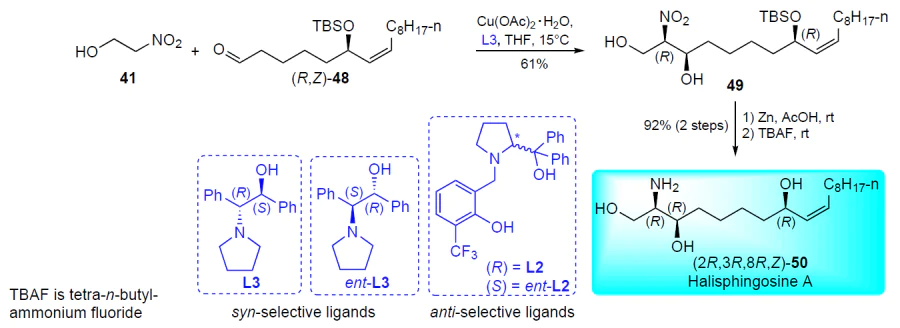
To address inconsistencies in the NMR interpretation of this natural product, Beemelmanns and co-workers[58] described another synthetic route to Halisphingosine A via a late-stage enantioselective Henry reaction of previously synthesized aldehyde (R,Z)-48 with 2-nitroethanol (41) in the presence of Cu(OAc)2 and enantiomeric syn- and anti-selective ligands L3 and L2 (Scheme 14). In this way, the authors synthesized and fully characterized different stereoisomers of the proposed Halisphingosine A. However, only Δ9-C(8) – OH (2R,3R,8R,Z)-50 exhibited the positive absolute optical rotation value as reported for the natural product. Comparative NMR studies also revealed similarity between the synthetic product 50 and the natural compound. Therefore, the authors concluded that (2R,3R,8R,Z)-2-aminooctadec-9-ene-1,3,8-triol 50 most likely has the structure of the natural product Halisphingosine A.
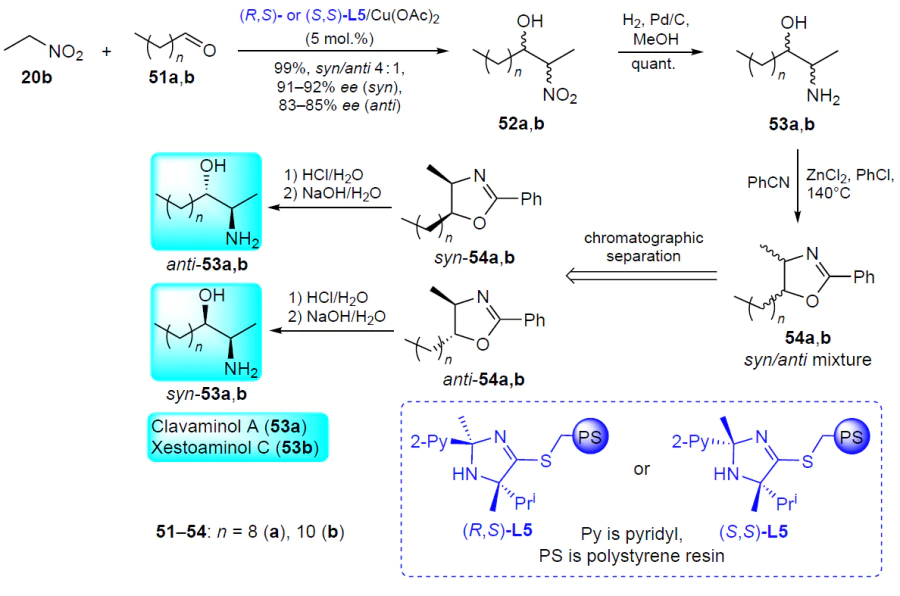
Nováková et al.[59] reported a simple preparation of natural sphingoid bases Clavaminol A and Xestoaminol C possessing cytotoxic activity and all their unnatural stereoisomers via an asymmetric Henry reaction of nitroethane (20b) with alkanals 51a or 51b. A mixture of syn- and anti-isomers of nitroaldols 52 in a 4 : 1 ratio was formed in these reactions in nearly quantitative yield. Luckily, enantioselectivities for both enantiomers were good in the reactions catalyzed by Cu(II) complexes with pseudo-enantiomeric imidazoline-type ligands (R,S)-L5 and (S,S)-L5 tagged to a polystyrene resin (Scheme 15). Moreover, the ee values achieved in the individual catalytic cycles were mutually comparable and did not decrease even after tenfold recycling the catalytic systems. Nevertheless, the separation of individual diastereomers of nitroaldols 52a and 52b was impossible probably due to the presence of a highly flexible long-chain alkyl group in their structures. Therefore, the mixtures of nitroaldols 52a and 52b were transformed via catalytic hydrogenation to amino alcohols 53a and 53b in quantitative yield. The latter compounds were converted to diastereomeric mixtures of 2-phenyloxazoline derivatives 54a and 54b under the action of benzonitrile in the presence of anhydrous ZnCl2 as a Lewis acid catalyst. The syn/anti isomers of the heterocycles 54a and 54b appeared readily separable by simple chromatography on silica gel without racemization. Subsequent hydrolysis of individual oxazolines syn-54 and anti-54 with 6 M HCl in EtOH at 90°C afforded pure diastereomers of amino alcohols 53a (Clavaminol A) and 53b (Xestoaminol C) in 80 – 97% yield.
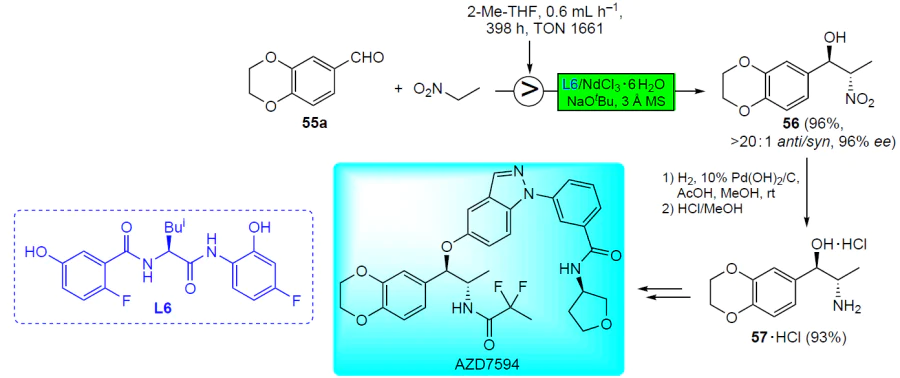
Shibasaki and co-workers[60] succeeded in achieving an excellent anti-selectivity in asymmetric catalytic nitroaldol reaction of aromatic aldehyde 55a with nitroethane in a continuous flow mode to produce nitroalcohol 56, a key precursor to the compound AZD7594, a therapeutic candidate for treatment of asthma and chronic obstructive pulmonary disease (Scheme 16). The solid-phase catalyst was readily prepared by mixing a leucine-derived diamide ligand L6 having fluorophenol units with inexpensive inorganic salt NdCl3 · 6 H2O and NaOBut, without covalent bond linkages. The flow system was operated with 2-Me-THF as the eluent for ca. 400 h to provide a crude adduct 56 in a highly anti-diastereoselective manner (anti/syn > 20 : 1) in 96% yield with 96% ee. No work-up was required over the continuous flow procedure and the turnover number (TON) reached 1600. Facile reduction of the nitro group in compound 56 afforded a key intermediate 57 of AZD7594.
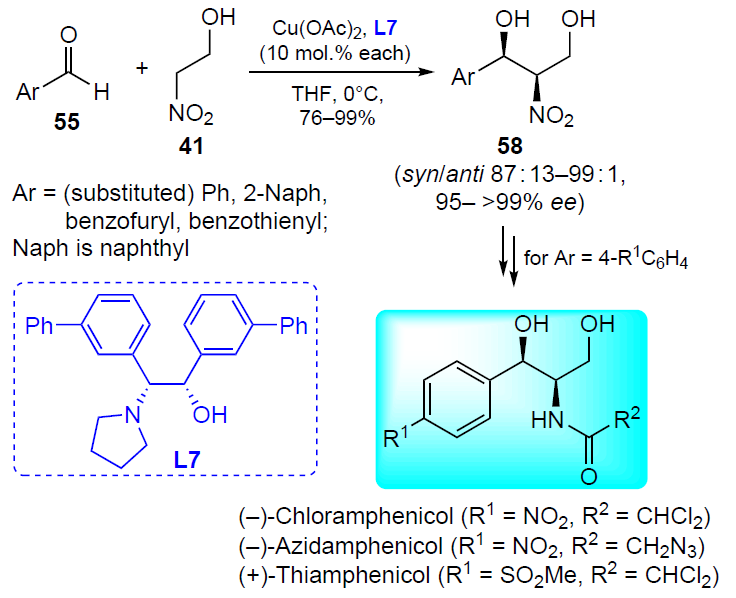
Chen and co-workers[61] found that similar reactions of aromatic or heteroaromatic aldehydes 55 with nitroethanole 41 proceed syn-selectively in the presence of Cu(OAc)2 and chiral syn-β-amino alcohol ligand L7 affording the desired adducts 58 in 76 – 99% yield with up to 99 : 1 syn/anti ratio and > 99% ee (Scheme 17). The reaction products 58 with appropriate configuration of stereocenters and required substituents in the aromatic ring were readily transformed to amphenicols, a class of synthetic antibiotics, which exhibit a broad spectrum of activity against both Gram-negative and Gram-positive microorganisms, such as Streptococcus spp., Staphylococcus spp., Pasteurella spp., etc.[62]
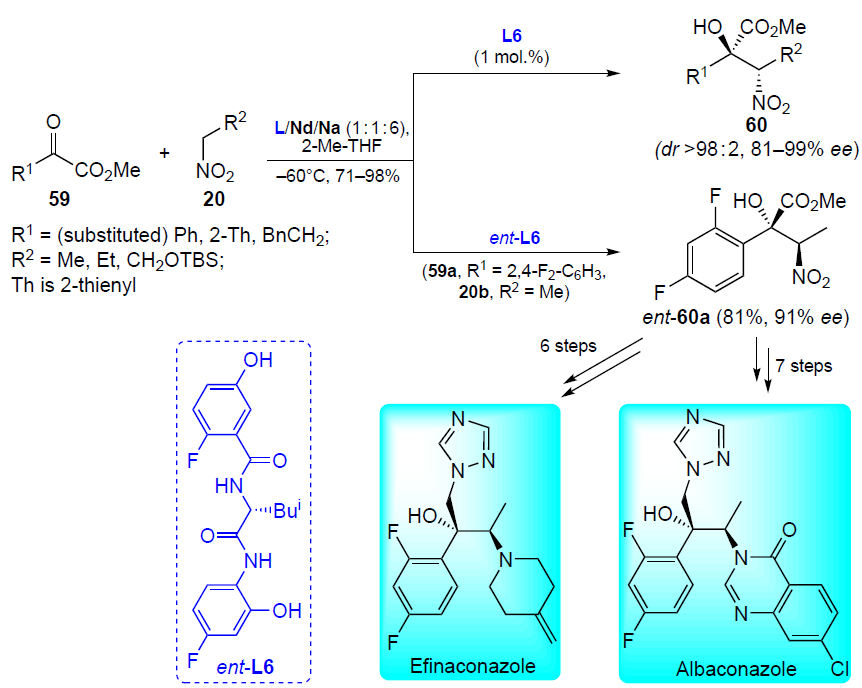
Asymmetric catalytic Henry reactions of nitroalkane pronucleophiles with aldehydes are well studied, but far more challenging are diastereoselective catalytic Henry reactions of higher nitroalkanes with ketones to generate chiral β-nitro alcohol scaffolds with two adjacent stereogenic centers including a quaternary one.[63] To address this challenge, the Shibasaki group[64] applied the self-assembled solid-phase heterobimetallic Nd/Na catalytic system containing diamide ligand L6 to the anti-selective asymmetric nitroaldol reaction of α-keto esters 59 with nitroalkanes 20 at a continuous-flow platform (Scheme 18). In the presence of the heterogeneous catalyst, the desired nitroaldol products 60 were obtained in up to 98% yield with excellent diastereoselectivity (anti/syn > 98 : 2) and enantioselectivity (up to 99% ee). Aromatic α-keto esters bearing electron-donating alkyl and methoxy groups and electron-withdrawing halogen and CF3 groups tolerated the reaction conditions to give the desired nitroaldol adducts with high stereoselectivities. Interestingly, the use of 2-Me-THF instead of THF as a flow solvent enhanced the reaction rate and generally afforded better stereoselectivity, enabling diastereo- and enantioselective completion of the reaction with as little as 1 mol.% of catalyst loading. The utility of the catalytic system was demonstrated by stereoselective synthesis of the marketed antifungal agents Efinaconazole and Albaconazole,[65] which share a key structural motif of 2,4-difluoroarylated vic-amino tert-alcohol. The multistep synthesis of the antifungal agents included nitroaldol reaction of the α-keto ester 59a bearing the 2,4-difluorophenyl unit with nitroethane (20b) in the presence of antipodal ligand ent-L6 followed by a sequence of stepwise reduction of the nitro and the methoxycarbonyl functional groups and subsequent installation of the required heterocyclic motifs.
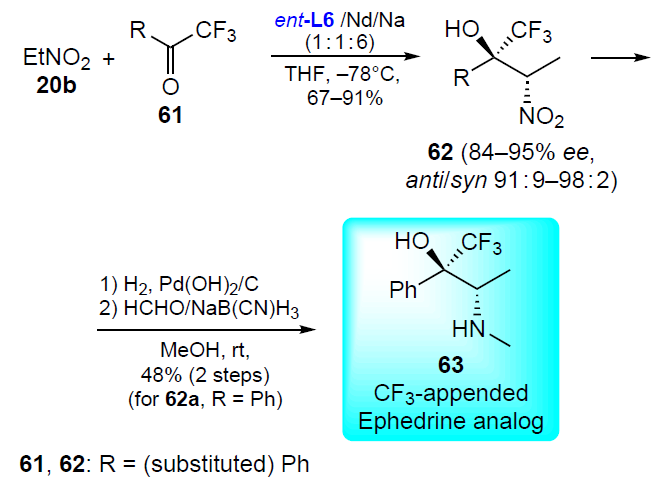
Furthermore, similar catalytic system comprising Nd/Na heterobimetallic catalyst ligated with a chiral diamide ent-L6 exhibited prominent efficiency in the anti-selective catalytic asymmetric nitroaldol reaction of nitroethane (20b) with trifluoromethyl ketones 61 in a batch mode.[66] Under optimal conditions (THF, –78°C) anti-nitroaldoles 62 bearing quaternary stereogenic center were formed predominantly in high yields with excellent diastereo- and enantioselectivities (Scheme 19). Subsequent catalytic hydrogenation of the α,α,α-trifluoroacetophenone-derived anti-nitroaldole 62a to corresponding vic-amino alcohol followed by reductive methylation of the latter with formaldehyde allowed facile asymmetric synthesis of CF3-appended Ephedrine analog 63 highlighting the potential utility of the reaction in medicinal chemistry.
Drabina et al.[67] developed a new synthetic approach to the anticoagulant drug (S)-Rivaroxaban based on asymmetric catalytic Henry reaction between aldehyde 64a and nitromethane in the presence of the copper(II) acetate complex with (2R,5S)-5-isopropyl-5-methyl-2-(pyridine-2-yl)imidazolidine-4-one (L8). Nitroaldol 65a, containing stereogenic center of (S)-Rivaroxaban, was generated in this reaction in moderate yield (72%) with 87% ee (Scheme 20, method A). Subsequent catalytic hydrogenation, acetylation and the oxazolidinone ring formation reaction furnished solid (S)-Rivaroxaban of high purity.
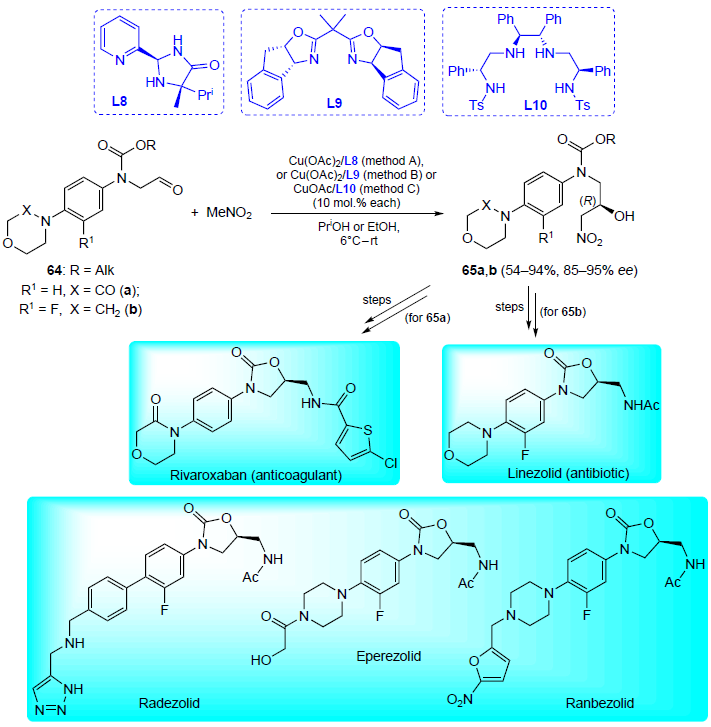
In a follow-up study,[68] to widen the reaction scope and improve the process efficiency, the authors studied in more detail asymmetric Henry reactions of nitromethane with aldehydes 64a,b, which are the key step of stereoselective synthesis not only Rivaroxaban, but also antibiotic Linezolid and some other oxazolidone skeleton drugs. They identified most efficient catalytic system comprising copper acetate and chiral bis-oxazoline ligand L9. Under optimal reaction conditions, intermediate β-nitro alcohols 65a and 65b were formed in 54 – 94% yield with enantiomeric excesses up to 95% ee (see Scheme 20, method B). A sequence of catalytic hydrogenation and oxazolidone ring formation reactions completed the synthesis of the target drugs. In 2025, Zhang and Xiao[69] exploited a Cu-bis(sulfonamide) – diamine complex CuOAc/L10 in an asymmetric Henry reaction to construct versatile chiral nitroalcohols 65 with high enantioselectivity from carbamate-acetaldehydes 64 or their analogs and nitromethane (see Scheme 20, method C). The proposed approach allowed for the asymmetric total syntheses of a series of oxazolidone skeleton drugs, including Linezolid, Rivaroxaban, Radezolid, Eperezolid and Ranbezolid in a concise and efficient way.
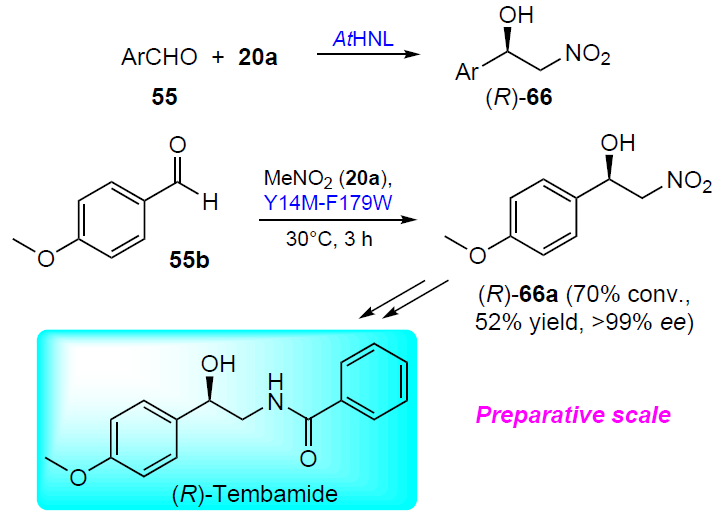
Biocatalytic approach for enantioselective synthesis of pharmaceutically relevant β-nitroalcohols via the asymmetric Henry reaction has gained significant advances over the past decade.[70] Due to their environment friendliness and high selectivity, biocatalysts (enzymes) are a good choice in the medicine-oriented sustainable catalytic transformations. To attain efficient and stereoselective biocatalysts for the Henry reaction, the Padhi’s group[71] engineered the Arabidopsis thaliana hydroxynitrile lyase (AtHNL). As a result, perspective variants of AtHNL were prepared that exhibit up to 12-fold improved catalytic efficiency than the wild-type AtHNL. The engineered variants have also displayed excellent enantioselectivity (up to > 99%) and higher conversion in the synthesis of (R)-enantiomers of different β-nitroalcohols via asymmetric Henry reaction. Moreover, using cell lysates of Y14M/F179W, the authors accomplished a preparative-scale synthesis of (R)-1-(4-methoxyphenyl)-2-nitroethanol ((R)-66a), the key precursor to (R)-Tembamide, from nitromethane (20a) and p-methoxybenzaldehyde (55b) in 52% yield with > 99% ee (Scheme 21).
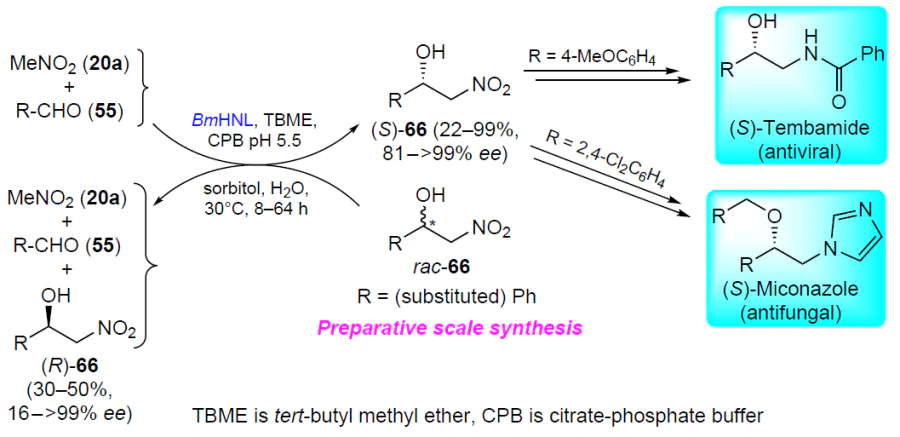
The same researchers[72] found that a single unmodified enzyme, Baliospermum montanum hydroxynitrile lyase (BmHNL), enabled bidirectional catalysis of Henry and retro-Henry reactions under similar conditions. The direct biocatalytic Henry reaction of nitromethane with benzaldehyde derivatives bearing electron-donating or electron-withdrawing substituents at the ortho-, meta-, and para-positions of the phenyl ring, afforded chiral β-nitroalcohols (S)-66 in 22 – 99% yield with 81 – >99% ee (Scheme 22). On the other hand, racemic β-nitroalcohols rac-66 were readily converted to the corresponding R-enantiomers (R)-66 with up to 99% ee in the presence of the same BmHNL via a kinetic resolution. This is the first report where a (S)-selective hydroxynitrile lyase (HNL) exhibited remarkable enantioselectivity in obtaining both (R)- and (S)-β-nitroalcohols. Another important feature of the developed protocol is its broad substrate scope (total 46 examples), despite promiscuous catalytic activity of the biocatalyst used. Furthermore, the method enabled preparative scale synthesis of (S)-1-(4-methoxyphenyl)-2-nitroethanol, a precursor to (S)-Tembamide, a natural product with antiviral activity (41% yield, 96% ee, 1594 total turnover number (TTN)), and (S)-1-(2,4-dichlorophenyl)-2-nitroethanol, a chiral precursor of (S)-Miconazole with antifungal activity (90% yield, 91% ee, 1763 TTN).
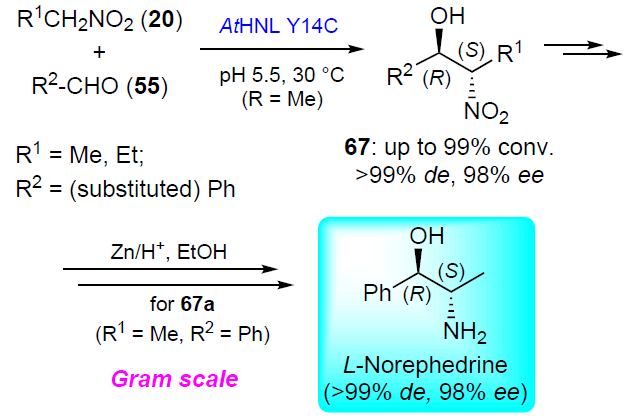
Another important result obtained by the Padhi’s group[73] is the development of highly anti-diastereoselective biocatalytic asymmetric Henry reaction of α-substituted nitroalkanes RCH2NO2 (R = Me, Et) with aromatic aldehydes. The authors identified the Arabidopsis thaliana hydroxynitrile lyase AtHNL variants Y14C and Y14A with single amino acid substitution as promising biocatalysts for this reaction. Under slightly acidic conditions, various benzaldehydes 55 reacted with nitroethane (20b) or 1-nitropropane (20c) affording diverse (1R,2S)-β-nitroalcohols 67 with high enantio- and stereoselectivity (up to >99% ee, >99% de), >99% conversion and ~3470 TTN (Scheme 23). A gram-scale biocatalysis was also achieved by the facile reaction of available benzaldehyde (55c, R2 = Ph) with nitroethane (20b, R1 = Me) followed by a one-step chemical reduction of the Henry product 67a to L-Norephedrine, a sympathomimetic agent, with 98% ee and >99% de.
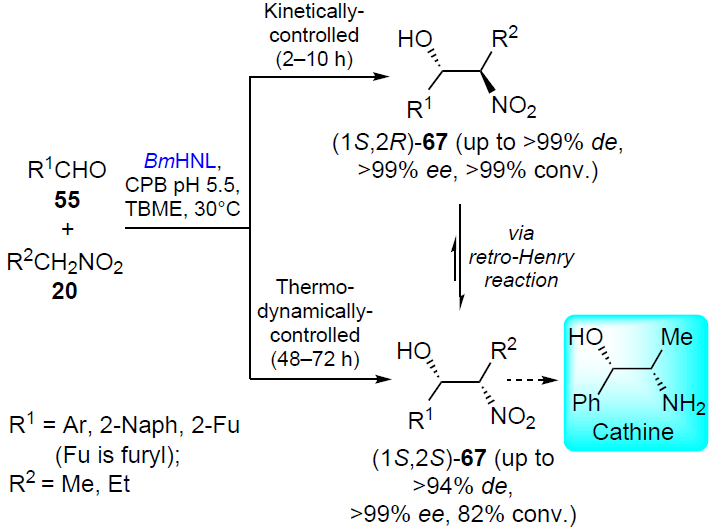
In 2025, Padhi and co-workers[74] reported a single native enzyme (BmHNL)-catalyzed asymmetric Henry reaction between nitroalkanes 20 (R2 ≠ H) and aldehydes 55 which exhibits complementary diastereoselectivity. The anti-diastereomers (1S,2R)-67 were formed as the major products within 2 – 10 h (Scheme 24). However, incubating the reaction longer (48 – 72 h) has resulted in a gradual decrease in the diastereomeric excess (de), accompanied by the continuous emergence of an unusual cis diastereoisomers (1S,2S)-67. Based on the 1H NMR experiments, the authors concluded that there is a stereoselective cleavage of (1S,2R)-67 to benzaldehyde and nitroalkanes (retro-Henry reaction), promoted by BmHNL, followed by thermodynamically favorable syn-Henry reaction. This process is responsible for steadily increasing amount of (1S,2S)-67 (R1 = Ph, R2 = Me) in the reaction mixture. Furthermore, the same biocatalyst enabled both the gram-scale synthesis of (1S,2R)-67 and the preparative-scale synthesis of (1S,2S)-67 (R1 = Ph, R2 = Me), which is a precursor to the appetite suppressor D-Norpseudoephedrine (Cathine),[75] via the dynamic kinetic resolution.
The continuous flow biocatalytic syntheses are even more attractive than the corresponding batch reactions because of their safety and reduced reaction volumes.[76] Hanefeld and co-workers[77] immobilized the triple variant of Granulicella tundricola hydroxynitrile lyase GtHNL-A40H/V42T/Q110H (GtHNL-3V) on Celite R-633 and applied the composite in the Henry reaction of nitromethane with benzaldehyde in batch and continuous flow systems. A total yield of 82% of the corresponding (R)-nitroaldol and excellent enantioselectivity (> 99%) were achieved in the batch system over 24 h. Remarkably, the biocatalyst could be successfully reused in the same reaction up to five times. However, subsequent recycling experiments and reactions under continuous flow conditions resulted in a significant decrease in the process efficacy. The authors attributed this decrease to changing the reaction mixture polarity induced by nitromethane which affects the stability of the immobilized biocatalyst.
2.3. Aza-Henry (nitro-Mannich) reaction
The aza-Henry (nitro-Mannich) reaction, in which a nitroalkane and an imine react diastereo- and/or enantioselectively to form a β-nitroamine, is a versatile tool for target-oriented synthesis. Many anticancer drugs, antivirals, antimicrobials, enzyme inhibitors, containing C – N bonds, have been synthesized using this reaction.[9] Several transition metal complexes and organocatalysts were shown to be compatible with this methodology to ensure good to very high level of asymmetric induction. Moreover, the reaction can be readily integrated into useful cascade processes. The structural diversity of the products, ranging from simple heterocycles or azabicycles to complex alkaloids, iminosugars, amino acids or diamino acids and phosphonates, shows the versatility of the nitro-Mannich reaction. Given the high prevalence of nitrogen-containing groups, which present in more than 84% of pharmaceuticals, it is not surprising that the nitro-Mannich reaction has found many applications in the synthesis of natural products and synthetic biologically active substances, including APIs.
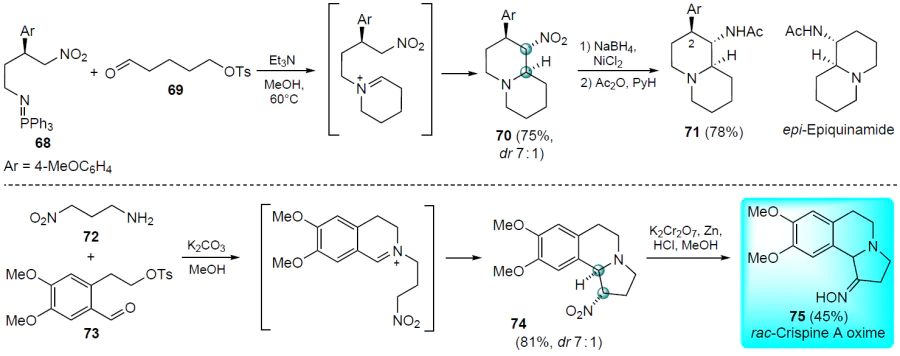
Disadee and Ruchirawat[78] developed an efficient one-pot cascade strategy to useful azabicyclic scaffolds involving a diastereoselective intramolecular nitro-Mannich reaction (Scheme 25). In their method, aldehydes bearing a distal tosylate group were involved in a condensation with linear nitroamines or their surrogates. Initially formed imines were cyclized via an intramolecular aza-Henry reaction followed by an intramolecular substitution of the tosylate group. Accordingly, indolizidine, as well as homologous [6,6]- and [6,7]-ring systems could be assembled with high diastereoselectivity. Using this method, compound 71 representing a C – 2 arylated derivative of alkaloid epi-Epiquinamide was synthesized by a base-promoted condensation of enantiopure nitro compound 68 with aldehyde 69 followed by reduction/acylation of the nitro group in 70. Another alkaloid derivative, nitro-substituted Crispine A (74), was synthesized in 81% yield and dr 7 : 1 through condensation of nitroamine 72 and aromatic aldehyde 73. Partial reduction of the nitro group in 74 with in situ generated Cr(II) species gave Crispine A oxime 75.
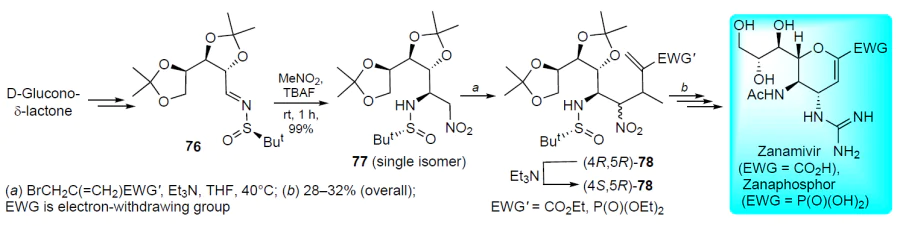
Lin and Fang[79] proposed the total synthesis of anti-influenza agents Zanamivir and Zanaphosphor via chiral auxiliary-directed asymmetric aza-Henry reaction. The diastereoselective aza-Henry reaction of 76 derived from inexpensive D-glucono-δ-lactone with nitromethane proceeded smoothly in the presence of TBAF to afford β-nitroamide 77 in the (5R)-configuration exclusively with 99% yield (Scheme 26). The (R)-tert-butylsulfinamide appeared to be an excellent chiral auxiliary to induce remarkable stereoselectivity in the aza-Henry reaction. Allylic alkylation of sulfinamide 77 with ethyl 2-(bromomethyl)acrylate or phosphonate in the presence of a base (Et3N) afforded corresponding functionalized precursors (4S,5R)-78 diastereoselectively. Subsequent elimination of the (R)-tert-butylsulfinamide auxiliary, deprotection and dihydropyrane formation steps afforded target anti-influenza agents. Of the two agents, Zanaphosphor has been shown to exhibit higher anti-influenza activity than Zanamivir[80] providing stronger electrostatic interactions with three arginine residues (R118, R292, and R371) in the active site of influenza neuraminidase.
Later, Yus et al.[81] successfully applied the chiral auxiliary approach for the total synthesis of (+)-C(9a)-epi-Epiquinamide — an epimer of quinolizidine alkaloid (+)-Epiquinamide, which was isolated from the skin of Ecuadoran frog Epipedobates tricolor.[82] A key step of the synthesis was the diastereoselective aza-Henry-type coupling of ethyl γ-nitrobutanoate 79 with chiral N-tert-butanesulfinyl imine 80 (Scheme 27). After optimizing the reaction conditions, the authors managed to obtain β-nitro sulfamide 81 in 86% yield in a highly diastereoselective manner considering the addition to the imine functional group. As for the nitro-substituted stereogenic center, its rapid isomerization under basic conditions led to a 1 : 1 mixture of epimers. Removal of the tert-butanesulfinyl group was achieved by treatment of 81 with 2 M solution of HCl in Et2O. Further treatment of the resulting ammonium salt with sodium ethoxide gave nitroquinolizidinone 82 as a 6 : 1 mixture of diastereomers in 75% overall yield. In this double cyclization, the free amine intermediate Int2 participated as the N-nucleophile in an intramolecular N-alkylation and the lactam formation steps.

Catalytic, particularly organocatalytic, versions of the aza-Henry reaction have become more popular over the past decade. However, adaptation of these methods to a process chemistry has been slower and only a few scalable applications of organocatalysts are reported in the literature.[83-85] The reasons are generally high organocatalyst loadings (5 – 10%), lower reaction rates and the necessity of chromatographic separation of organocatalyst from the organic reaction product.
Johnston and co-workers[86] translated a stereoselective aza-Henry reaction between arylnitromethane 84 and Boc-protected aryl aldimine 83 promoted by a homogeneous bis(amidine)-type organocatalyst C8 into an automated intermittent-flow process while maintaining high selectivity and product yield (Scheme 28). The main limitation of the conventional batch reaction is very long residence times to achieve full conversion. Importantly, in the developed intermittent-flow continuous stirred tank process full conversion of the imine 83 to the adduct 85 was attained within a 40 min total turnover time and the product was readily crystallized from the reaction mass. After 16-cycle experiment, a 25 g-sample of the product 85 was isolated in 81% yield with 88% ee and 98.6% purity. The process is safer and more productive than conventional batch reaction. It allows for easy recycling of catalyst C8 and nitroalkane 84 excess, significantly reducing waste.
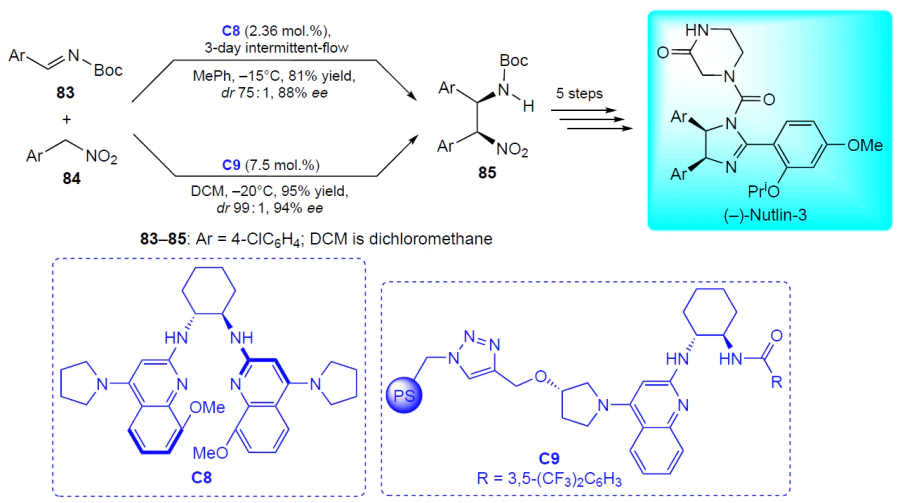
In 2025, Ragno and co-workers[87] presented a strategy for the immobilization of Johnston-type mono-amidine catalyst onto polystyrene resin. The polystyrene-supported 3-pyrrolidinol-linked organocatalyst C9 showed similar performance to the homogeneous counterpart in the synthesis of the Nutlin-3 precursor 85: yield up to 95%, ee up to 94%, and dr up to >99 : 1 (see Scheme 28). Moreover, the catalyst C9 is recyclable through simple filtration, exhibiting a satisfactory stereoinduction of 93% ee after 5 cycles with only a moderate decrease in conversion efficiency (ca. 5% after each cycle). Accumulated TON was 69.7. The results obtained by Johnston[86] and Ragno[87] groups are highly important because (–)-Nutlin-3 produced by Hoffman-La Roche is an efficient p53/MDM2 inhibitor and anti-cancer agent.[88]
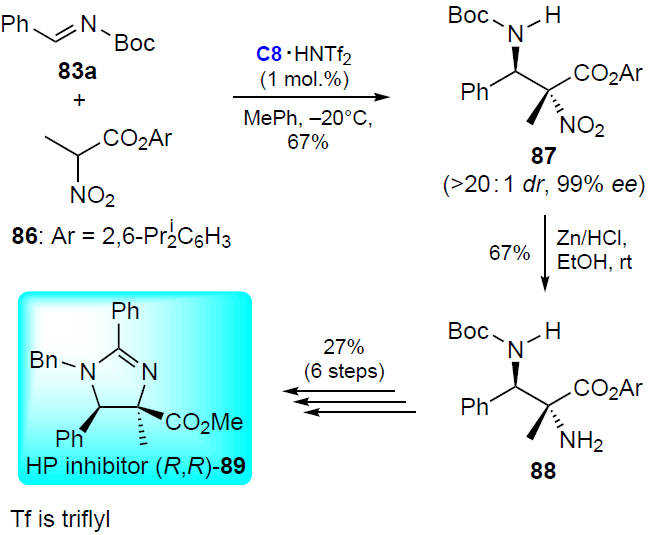
An important target for the treatment of certain cancers[89] and inflammatory diseases[90] is proteasome. Some highly functionalized imidazolines, especially (R,R)-trans stereoisomers, capable of specific binding the human proteasome (HP) in a noncompetitive fashion are considered as promising drug candidates.[91] Sprague and Johnston[92] proposed a stereoselective entry into this class of molecules based on organocatalytic enantioselective and anti-selective aza-Henry reaction. In the presence of chiral bis(amidine) C8/bis-triflyl imide (1 : 1) catalytic system, N-Boc benzaldimine 83a reacted with α-substituted α-nitro ester 86 in toluene at low temperature affording adduct 87 in 67% isolated yield as a single diastereomer of high enantiomeric purity (Scheme 29). The reaction was performed on a gram scale, and the required catalyst loading was only 1 mol.%. Nitro urethane 87 was converted to amino urethane 88 under the action of zinc metal in aqueous HCl – EtOH. Subsequent N-protection, N-deprotection and ring-closing reactions completed the total synthesis of HP inhibitor (R,R)-89 in 27% yield over 6 steps.
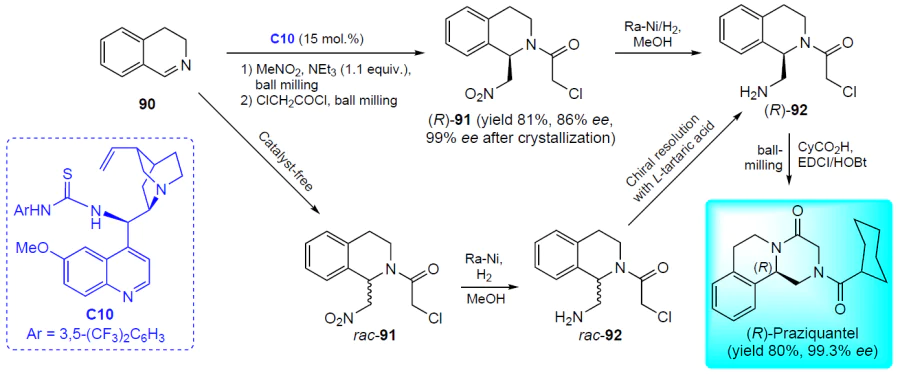
Yu and co-workers[93] developed two synthetic approaches to enantiomerically enriched levo-Praziquantel ((R)-Praziquantel), an efficient drug for the treatment of schistosomiasis which is also effective against a broad range of cestodes and trematodes in humans and animals.[94][95] The pathways started with solvent-free mechanochemical aza-Henry reaction of 3,4-dihydroisoquinoline (90) with nitromethane performed either in the presence of quinine-thiourea organocatalyst C10 or under catalyst-free conditions (Scheme 30). Subsequent one-pot treatment of the crude reaction products with chloroacetyl chloride afforded chiral (86% ee) or racemic 1-nitromethyl-2-chloracetyl tetrahydroisoquinoline (91), respectively, in good yields. Moreover, the recovery and reuse of the grinding auxiliary made the process more sustainable. The chiral or racemic nitro compounds (R)-91 or rac-91 were then subjected to catalytic hydrogenation to corresponding amines 92 over Raney® nickel. Alternatively, the chiral precursor (R)-92 could be prepared by chiral resolution of the racemate rac-92 with L-tartaric acid. Finally, an acylation/ring-closing sequence from (R)-92 and cyclohexanecarboxylic acid proceeded smoothly in the presence of EDCI/HOBt (EDCI is 1-ethyl-3-(3-dimethylaminopropyl)carbodiimide hydrochloride, HOBt is 1-hydroxy benzotriazole) under one-pot ball-milling conditions affording levo-Praziquantel in 80% yield with > 99% ee. Notably, chromatography purification of the crude product could be avoided by using the mechanochemical protocol.
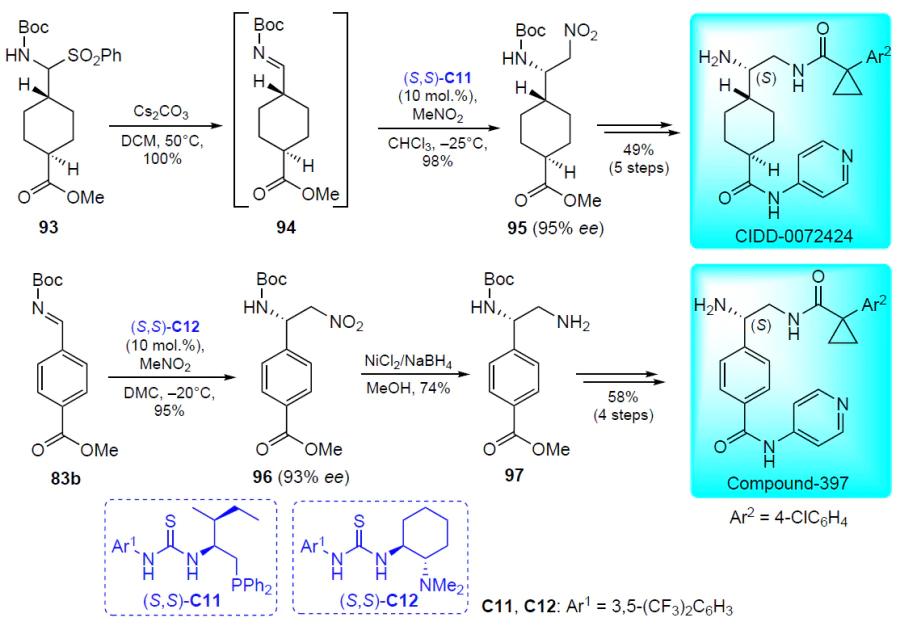
In 2024, McHardy and co-workers[96] applied highly enantioselective aza-Henry reaction for the asymmetric synthesis of compound CIDD-0072424, a central nervous system penetrant, selective small molecule inhibitor of protein kinase C epsilon (PKCε) which is considered as perspective medicine for treatment of alcohol-induced disorder and nonopioid pain management. Imine 94, easily accessible from α-amidosulfone 93, was treated without isolation with nitromethane in the presence of bifunctional phosphine-thiourea catalyst (S,S)-C11 to provide 98% isolated yield of β-nitrourethane 95, with 95% ee (Scheme 31). The synthesis of the target molecule CIDD-0072424 was accomplished by a 5-step sequence comprising a NiCl2-mediated reduction of the nitro group in compound 95 with borohydride and subsequent amidation and deprotection reactions to install the required peripheral structural fragments. The resulting (S)-enantiomer of CIDD-0072424 appeared 10 times more potent than the corresponding (R)-enantiomer. Preliminary in vitro ADME data showed high plasma protein binding and excellent microsomal stability. Similar reaction methodology was successfully applied for the synthesis of PKCε inhibitor compound-397, an analog of CIDD-0072424, bearing para-phenylene in place of the cyclohexane core. In this case, usage of tertiary amine-thiourea catalyst (S,S)-C12 developed by Takemoto provided better results: intermediate (S)-96 was obtained from imine 83b and nitromethane in a 95% isolated yield with 93% ee and transformed into the (S)-enantiomer of compound-397 in five similar gram-scalable synthetic steps with 42% overall yield. This highly potent PKCε inhibitor shows robust in vivo activity and favorable pharmacokinetic profile.
2.4. Cascade and domino reactions of nitroalkanes
Cascade and domino reactions of nitro compounds with bielectrophiles lead to cyclic and policyclic compounds useful for pharmacology.[97][98] Furthermore, nitro-containing cyclic skeletons with multiple stereocenters are frequently found in numerous natural products, biologically active molecules, and lead compounds.[99-101] A stereoselective construction of structurally complex scaffolds via asymmetric cascade and domino reactions of nitro alkanes allows assembling bioactive molecules from simple and readily available starting materials in a green and atom-efficient way.
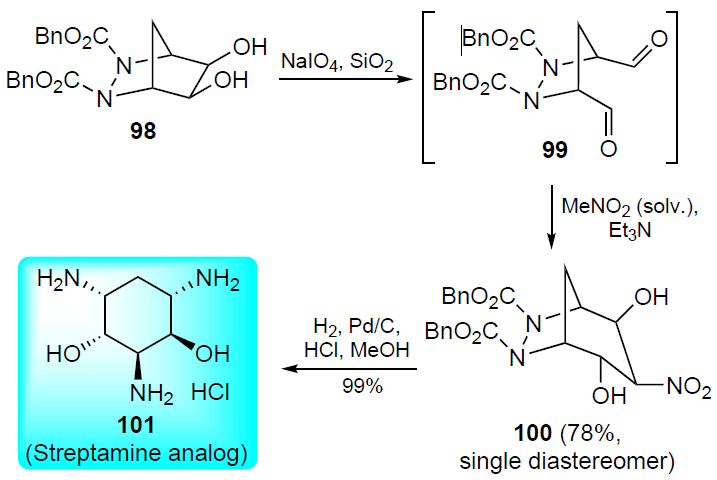
An intramolecular double Henry reaction represents an attractive route to construct polysubstituted carbo- and heterocycles. Intriguingly, the required dicarbonyl compounds can be generated by oxidative fragmentation of cyclic alkenes and diols providing a strategy for ring homologation.[102] Recently, Micouin and co-workers[103] exploited this strategy to access structural analog of Streptamine 101 (Scheme 32). They demonstrated that 1,5-dialdehyde 99 generated from 1,2-diol 98 smoothly reacts with nitromethane in the presence of Et3N to give cyclic nitrodiol 100 in 78% yield. The product was formed as a single diastereomer, although six possible diastereomers can theoretically be generated in this process. The observed stereochemistry of 100 is believed to originate from thermodynamic control. Notably, the use of Et3N as a base was crucial for cyclization, while NaOH and sodium alkoxides gave poor yields of 100. Hydrogenation of 100 over Pd/C afforded the desired 2,4,6-triaminocyclohexane-1,3-diol hydrochloride 101.
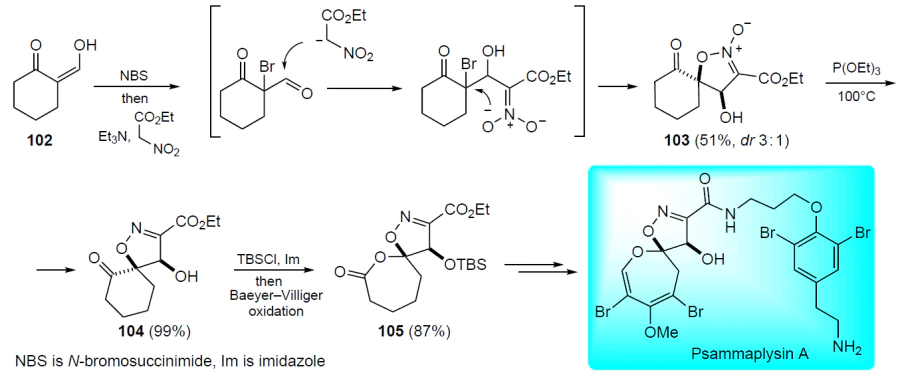
Magauer and co-workers[104] exploited the Henry reaction/cyclization cascade of ethyl nitroacetate with brominated formylcyclohexanone 102 in the total synthesis of the spiroisoxazoline subunit of marine alkaloid Psammaplysin A (Scheme 33). Notably, the initially formed nitronate anion cyclized via an intramolecular SN2 reaction to give isoxazoline N-oxide 103. At low temperature, the product was formed as a separable 3 : 1 mixture of isomers, while increase of the temperature worsened diastereoselectivity. Deoxygenation of the N-oxide moiety with P(OEt)3 to give 104 followed by TBS-protection and Baeyer – Villiger oxidation afforded isoxazoline-lactone 105, which contains the key spirocyclic framework of the Psammaplysin A.
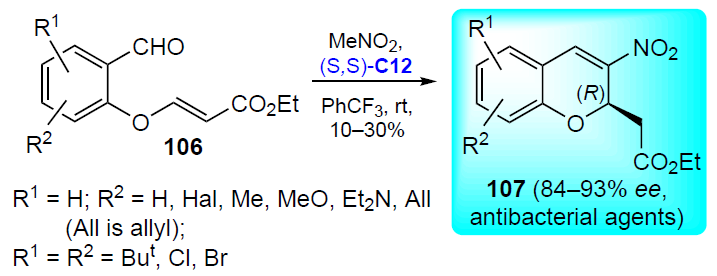
Ren and co-workers[105] disclosed a one-pot Henry/Michael/dehydration organocatalytic domino sequence of O-alkenylated salicylaldehyde derivatives 106 with nitromethane as a dual nucleophile. In the presence of the cyclohexanediamine-based Takemoto thiourea catalyst (S,S)-C12, this strategy allowed straightforward assembly of chiral (R)-2-alkyl 3-nitro-2H-chromenes 107 in poor yield but with good to high enantioselectivity (up to 93% ee) (Scheme 34). Preliminary in vitro antibacterial evaluation revealed that most of the obtained (R)-3-nitro-2H-chromene derivatives (R)-107 exhibited higher antibacterial activities against four Gram-positive bacteria (S. aureus, B. subtilis, Bacillus cereus and Staphylococcus epidermidis) than the corresponding racemic compounds. Furthermore, compounds (R)-107 with two electron-withdrawing substituents had superior antibacterial activities than the corresponding mono-substituted products (R)-107.
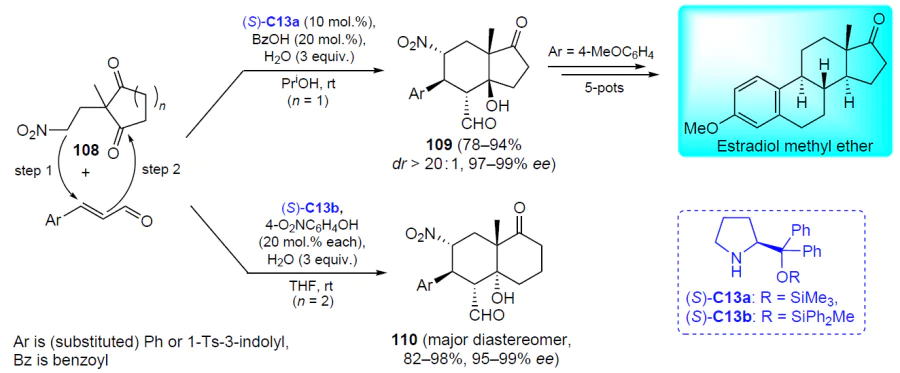
Hayashi and co-workers[106-108] developed effective syntheses of key bicyclic precursors of useful natural products based on cascade reactions of 1,3-diketones 108, bearing the nitroethyl group at position C2, with α,β-enals. The proposed methodology comprises a sequence of asymmetric Michael reaction (step 1) `and intramolecular ring forming aldol cyclization (step 2) (Scheme 35). In the presence of chiral organocatalysts (S)-C13a or (S)-C13b, bicyclic adducts 109[106][107] or 110,[108] bearing five contiguous stereogenic centers, were formed as a single diastereomer in high yield with up to 99% ee. Water additive (3 equiv.) significantly accelerated the cascade reactions facilitating hydrolysis of iminium ions, generated from the enal and the catalyst. Furthermore, in accordance with the step-economy concept,[109] the authors significantly simplified the conversion of compound 109 into Estradiol methyl ester, by reducing the number of synthetic steps from 12 to 5 and increasing the overall yield of the target compound from 6.8% to 15%.
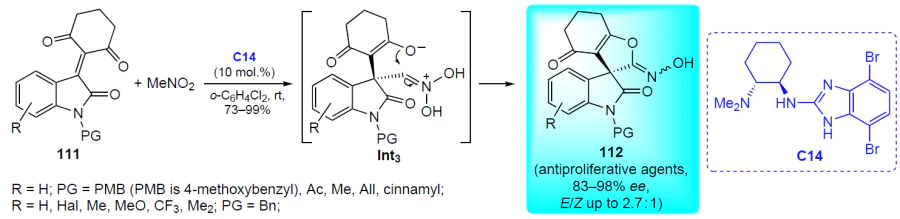
Spirooxindole scaffolds represent an important class of heterocyclic frameworks and are widespread in natural products and pharmaceuticals with pronounced biological activities.[110] Recently, Deng and co-workers[111] reported a cascade Michael addition/interrupted Nef reaction sequence using readily available oxindole-derived alkenes 111 and nitromethane as starting materials. In the presence of chiral 1,2-diaminocyclohexane-derived bifunctional organocatalyst C14 bearing 2-aminobenzimidazole structural fragment, this reaction led to spiro-polycyclic oxindole derivatives 112 containing an oxime group in moderate to high isolated yields (up to 99%) with an excellent level of enantioselectivities (up to 98% ee) (Scheme 36). The reaction likely proceeds via the formation of protonated aci-nitro compound Int3 followed by intramolecular spiro-cyclization which interrupted the Nef reaction. The 2-gram scaled experiment under optimized conditions demonstrated the synthetic utility of the developed method. Furthermore, the potential application of the synthesized spirooxindoles in drug development has been evidenced by significant anti-proliferative activity of compound 112a (R = 5-Br, PG = Bn) toward two human cancer cell lines (half-maximal inhibitory concentrations (IC50) are 14.08 μM for line HCT116 and 15.46 μM for line HT29).
2.5. Other reactions of nitroalkanes oriented to pharmacology
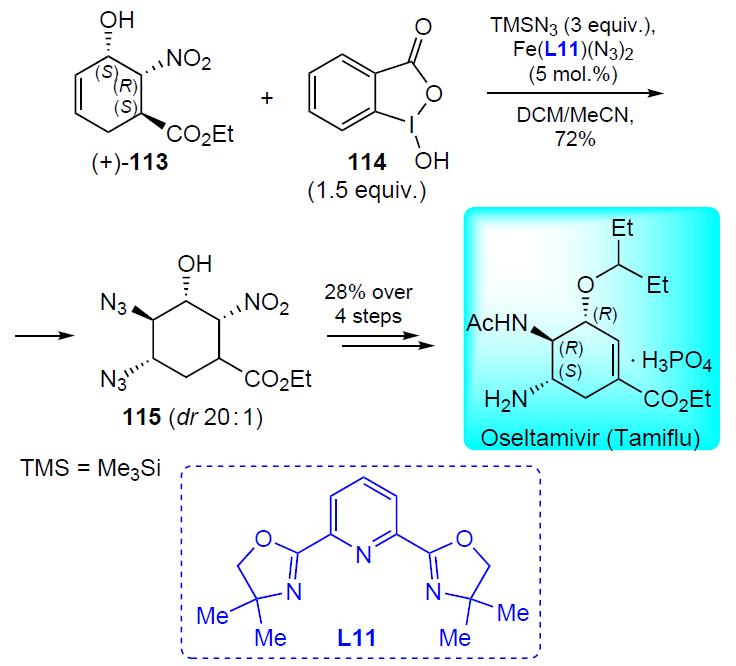
Xu and co-workers[112] reported a gram-scale synthesis of Oseltamivir phosphate, the prodrug of a potent viral neuraminidase inhibitor Tamiflu, in which the key trans-diamino moiety was efficiently installed via stereoselective diazidation of properly functionalized nitrocyclohexene derivative 113 with required absolute configuration of stereocenters under the action of TMSN3/114 reagent system (Scheme 37). High diastereoselectivity of the diazidation reaction was modulated by the organometal catalyst generated in situ from Fe(N3)2 and the C2-symmetric achiral PyBOX ligand L11. Subsequent HNO2 elimination, azide reduction and protection – deprotection steps furnished total synthesis of the target API. Importantly, the proposed approach is applicable for a large-scale Tamiflu synthesis (for other recently developed synthetic approaches to Oseltamivir see Refs [113-115] in Section 3.3 below).
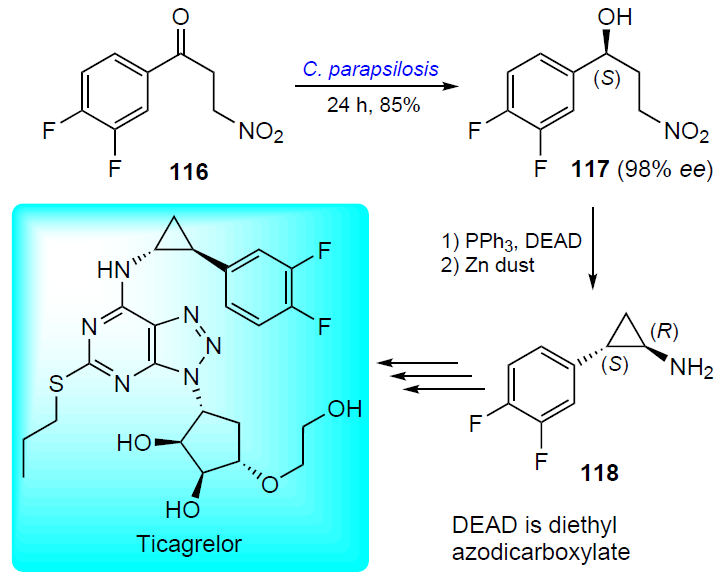
Biocatalytic stereoselective reactions of functionalized nitroalkanes also appeared useful for asymmetric synthesis of APIs. One example is Ticagrelor, a novel P2Y12 receptor antagonist blocking adenosine diphosphate-mediated platelet aggregation, that contains (1R,2S)-2-(3,4-difluorophenyl)-cyclopropan-1-amine (118) structural fragment. The latter can be attained via enantioselective reduction of the ketone group in available β-nitro ketone 116 followed by stereoselective cyclopropane ring closure in the nitro alcohol 117 and transformation of the nitro group into the amino group (Scheme 38). Chemical reduction of the ketone group in nitro ketone 116 requires expensive chiral catalyst, and the enantioselectivity is not high.[116] Bandichhor and co-workers[117] screened sixteen different microorganism strains for their potential activity in the asymmetric reduction of 1-(3,4-difluorophenyl)-3-nitropropan-1-one (116) and identified Candida parapsilosis species as the best biocatalysts for this enzymatic reaction which allow obtaining compound 117 with high yield and enantioselectivity of 98% ee.
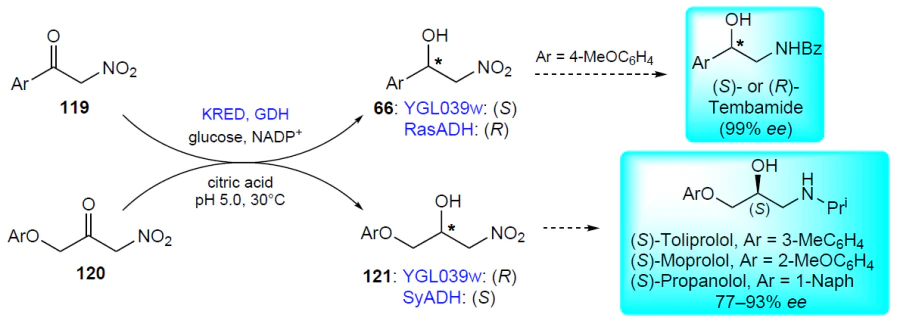
In 2018, Tentori et al.[118] discovered that commercial ketoreductases (KREDs), stable NAD(P)H-dependent enzymes, can act as efficient reductants of prochiral α-nitro ketones to corresponding chiral alcohols. A year later, Chen and co-workers[119] reported stereoselective bioreduction of 1-aryl-2-nitro-1-ethanones 119 and 1-aryloxy-3-nitro-2-propanones 120 catalyzed by KREDs with publicly known sequences YGL039w or RasADH/SyADH to furnish both enantiomers of the corresponding β-nitro alcohols 66 and 121 with good-to-excellent conversions (up to > 99%) and enantioselectivities up to 99% ee in most cases (Scheme 39). The authors also succeeded in the preparative scale synthesis of several important β-nitro alcohols, including the synthetic intermediates for both enantiomers of Tembamide, natural compound isolated from various members of the Rutaceae family, as well as (S)-enantiomers of bioactive molecules Moprolol, Toliprolol and Propanolol.
3. Reactions of α-nitroolefins
Conjugated nitroolefins occupy a privileged position in synthetic organic chemistry. Multiple reactivity modes of nitroalkenes along with their availability via the Henry reaction render them invaluable intermediates for target-oriented synthesis of nitrogen-containing molecules.[120][121] Primarily renowned as strong Michael acceptors, nitroolefins readily react with diverse nucleophiles to deliver β- or γ-functionalized nitroalkanes.[10] These adducts serve as direct precursors to a wide array of bioactive molecules, often through reduction of the versatile nitro group.[8] Beyond the Michael addition, nitroolefins exhibit rich cycloaddition chemistry serving as 2π-components in normal electron-demand Diels-Alder reactions,[120][122] as dipolarophiles in [3 + 2]-cycloadditions,[120][122] and, uniquely, as heterodienes in inverse electron-demand hetero-Diels-Alder reactions leading to six-membered cyclic nitronates.[123-125] These processes provide rapid access to complex carbo- and heterocyclic frameworks bearing multiple stereogenic centers. This multifaceted reactivity has been actively exploited in pharmacology-oriented syntheses over the past decade, particularly in total synthesis of complex natural products such as alkaloids and marine metabolites Madangamine E,[126] Keramaphidin B,[127] Allesamidine,[128] Stephadiamine,[129] and Tetrodotoxin[130] among others.
3.1. Conjugate addition reactions
In this sub-section, useful applications of nitroolefins in medicinal chemistry and chemistry of natural products based on stereoselective Michael reactions with enolates, dicarbonyl compounds, amines, alcohols, thiols and some other nucleophiles promoted by metal-free organocatalysts or enzyme-derived biocatalysts are considered. Such catalytic asymmetric processes often enable highly enantioselective formation of valuable functionalized nitroalkanes, useful precursors for constructing pharmaceuticals and natural product analogs with precise stereocontrol.
3.1.1. Addition of aldehydes or ketones to α-nitroolefins
The α-C – H active carbonyl compounds are widely employed as nucleophilic substrates in reactions with nitroolefins. The most useful transformations of this type are organocatalytic processes leading to enantiomerically enriched γ-nitroketones and γ-nitroaldehydes, which are important intermediates in the synthesis of various pharmaceuticals. Many asymmetric addition reactions of aldehydes or ketones with α-nitroolefins efficiently proceed in the presence of chiral secondary or primary amines, which contain an adjacent auxiliary Lewis basic, Brønsted acidic or sterically hindered group, as organocatalysts. Among them, readily available proline-based silylated α,α-diarylprolinoles developed by Jorgensen[131] and Hayashi[132] have found useful applications in pharmacology-oriented reactions of carbonyl compounds with α-nitroolefins over the past decade.
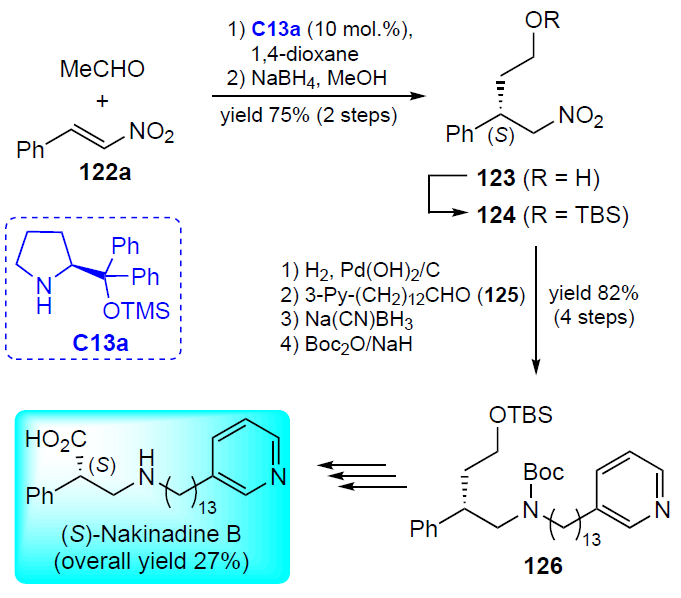
In 2016, Garg and Pandey[133] accomplished total synthesis of (S)-Nakinadine B, a marine natural product isolated from Okinawan marine sponge Amphimedon sp. (SS-1059) which posseses significant cytotoxicity against tumor cell lines including L1210 murine leukemia and KB human epidermoid carcinoma cells.[134][135] A key stereocontrolling step of this synthesis was the asymmetric addition of acetaldehyde to nitrostyrene 122a in the presence of diphenylprolinol silyl ether (C13a) that has ensured enantioselective formation of the required S configuration (Scheme 40). Chemoselective reduction of the aldehyde group in rather labile Michael adduct followed by silylation of the hydroxyl group in the resulting γ-nitro alcohol 123 afforded O-protected γ-nitroalcohol 124 in 72% yield over three steps. The latter was further subjected to a sequence of transformations including the nitro group reduction to the amino group, the Shiff base formation with aldehyde 125, the imine hydrogenation and N-protection reactions to give precursor 126 in 82% yield over four steps. Subsequent deprotection, oxidation and oxidative fragmentation reactions furnished the target (S)-Nakinadine B in 27% overall yield calculated on nitrostyrene 122a. The authors expect the proposed synthetic strategy would allow variation of substituents at the 2-aryl and N-alkyl sites to open a way to enantioselective synthesis of other nakinadine alkaloid analogs.
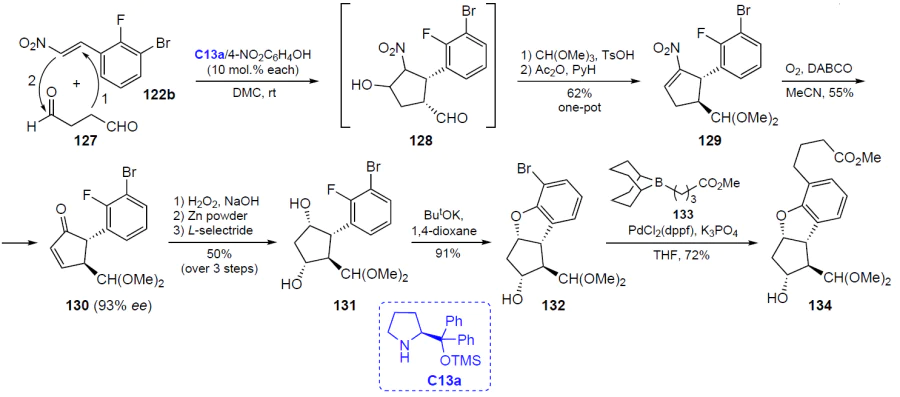
Hayashi and co-workers[136] used chiral silylated diarylprolinole organocatalysts in the key steps of a convergent and enantioselective total synthesis of the most active isomer of Beraprost, which is a more stable and less cytotoxic analog of Prostaglandin PGI2, a physiologically active natural product inhibiting platelet aggregation and vasodilation activities.[137] The authors installed a unique tricyclic core in Beraprost by utilizing the asymmetric Michael – Henry cascade reaction (formal [3 + 2] cycloaddition) of succinaldehyde 127 with nitroalkene 122b in the presence of catalyst C13a as a key step (Scheme 41). The highly substituted cyclopentane 128 was protected with dimethylacetal in situ followed by complete epimerization of α-position with respect to the formyl group and dehydration under acetylation conditions to afford nitroalkene 129 as a single isomer. Notably, these three-step reactions sequence can be carried out in a one-pot fashion on a multigram scale. An oxygen-promoted Nef reaction with 1,4-diazabicyclo[2.2.2]octane (DABCO) afforded enone 130 with 93% ee. Subsequent base-mediated epoxidation, reductive epoxide opening and L-selectride mediated carbonyl reduction reactions gave diol 131 in 50% yield over three steps. Treatment of 131 with ButOK and subsequent installation of the alkyl side chain on the aromatic ring in compound 132 by the Suzuki – Miyaura coupling with alkylborane 133 completed the formation of the tricyclic structural motif 134 of Beraprost in only seven pots.
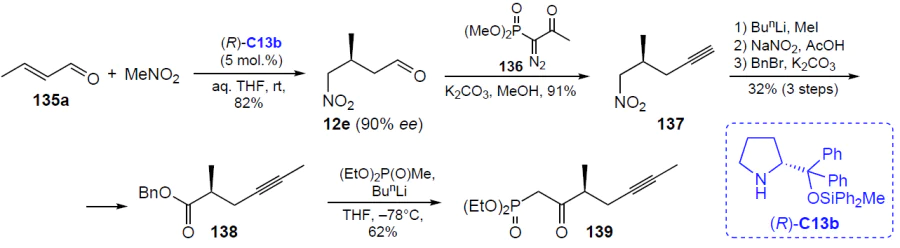
The Horner – Wadsworth – Emmons reagent 139 required for construction of the ω-side chain of Beraprost was synthesized by the same authors via the enantioselective organocatalyzed Michael addition of nitromethane to crotonaldehyde (135a) (Scheme 42). This reaction was carried out in the presence of similar organocatalyst (R)-C13b containing more sterically hindered phenyl groups at the Si atom to afford the desired product 12e in 82% yield with 90% ee. Treatment of γ-nitroaldehyde 12e with the Ohira – Bestmann reagent 136 furnished terminal alkyne 137. Subsequent three-step transformation including a selective methylation at the terminal position of the alkyne group, followed by the Nef reaction and esterification provided benzyl ester 138 which was converted to the desired reagent 139 by a Claisen-type reaction with diethylmethane phosphonate.
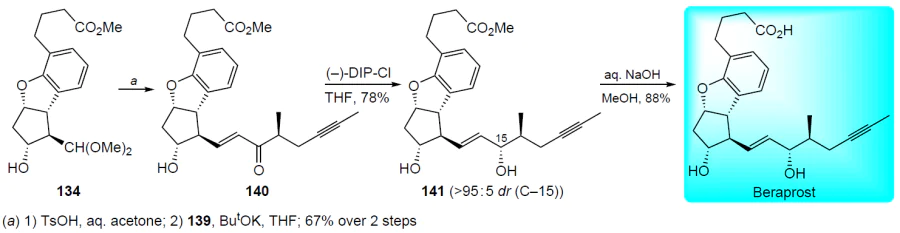
Final steps of the total synthesis of Beraprost included acid hydrolysis of dimethylacetal 134, E-selective Horner –Wadsworth – Emmons reaction of the resulting aldehyde with the reagent 139, a diastereoselective 1,2-reduction of the enone 140 with (–)-B-chlorodiisopinocampheylborane (DIP-Cl) and a basic hydrolysis of the methoxycarbonyl group in the allylic alcohol 141 (Scheme 43).
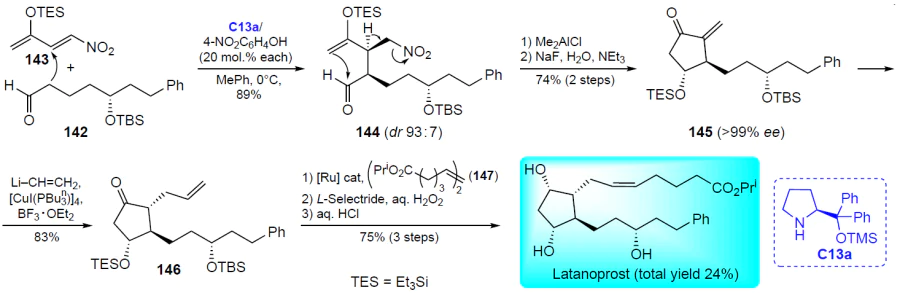
In 2023, the same research group[138] reported organocatalytic asymmetric synthesis of Latanoprost, an antiglaucoma agent developed by Pharmacia as an analog of the prostaglandin PGF2α.[139][140] The construction of the cyclopentanone core of this analog was initiated by diastereoselective conjugate addition of functionalized chiral aldehyde 142 to 4-nitro-2-siloxybuta-1,3-diene (143) enabled by silylated α,α-diphenyl prolinol (C13a)/p-nitrophenol catalytic system affording Michael adduct 144 in 89% yield with dr 93 : 7 (Scheme 44). Ring-forming intramolecular Mukaiyama aldol reaction of 144 with Me2AlCl afforded an unstable aldol product, which was converted without purification into methylene – cyclopentanone 145 of high enantiomeric purity via elimination of HNO2 under the action of NaF and Et3N. Subsequent Michael addition of vinyl lithium to the enone 145 efficiently proceeded with the formation of 2-allyl cyclopentanone 146 on a gram scale using [CuI(PBu3)]4/BF3 · OEt2 reagent system. Final three steps included the Ru-catalyzed olefin metathesis with alkene 147, stereoselective reduction of the keto group with L-selectride and deprotection of both siloxy groups with aqueous HCl, which were conducted in a one-pot manner to afford Latanoprost in 24% overall yield.
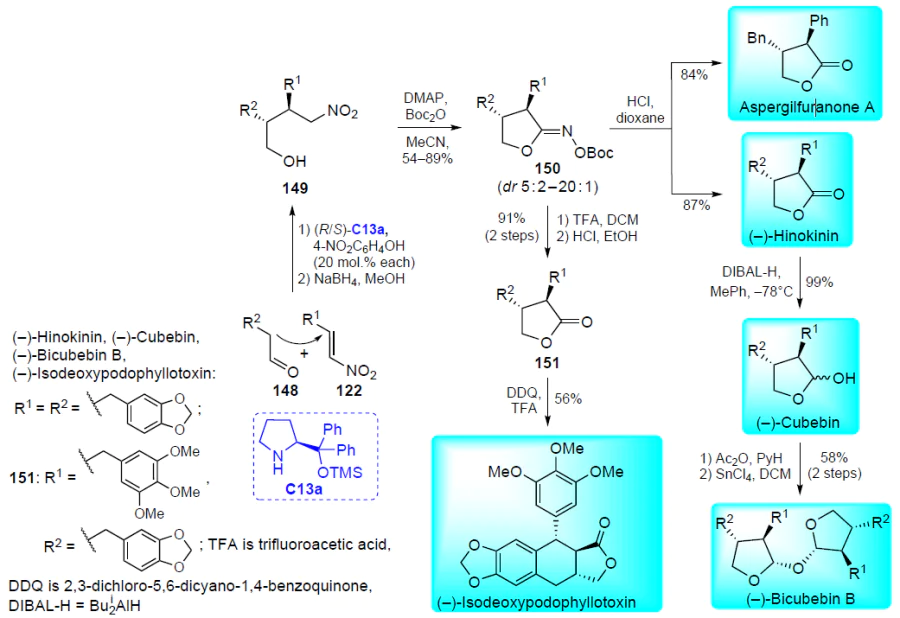
Yuan and co-workers[141] selectively prepared trans-α,β-substituted butyrolactone O-(Boc) oxime carbonates 150 from δ-nitro alcohol precursors 149 under mild conditions, using cost-effective reagents, viz., 4-dimethylaminopyridine (DMAP) and Boc2O (Scheme 45). Notably, δ-nitro alcohols 149 are conveniently accessible via asymmetric Michael addition of aldehydes 148 to nitroalkenes 122 in the presence of prolinol C13a/p-nitrophenol catalytic system mentioned before. Through organocatalysis, a variety of substituents can be readily incorporated into nitro alcohols 149. Complete removal of the oxime moiety from 150 resulted in the formation of the butyrolactone ring system. This methodology was utilized in the concise preparation of α,β-substituted γ-butyrolactones, important structural motifs of several lignan natural products including (±)-Aspergilfuranone A, (–)-Hinokinin, (–)-Cubebin, (–)-Bicubebin B, and (–)-Isodeoxypodophyllotoxin.
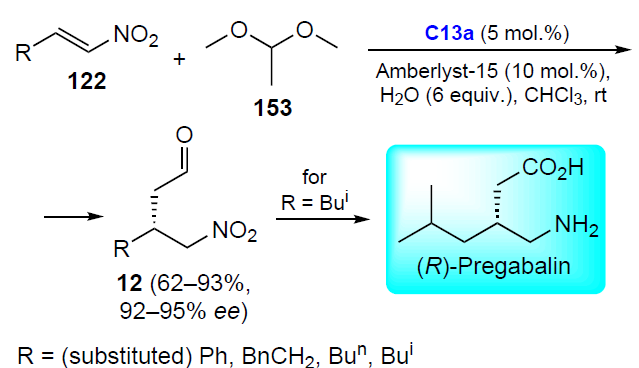
Controlling reactivity of acetaldehyde (152a), one of the most active aliphatic aldehydes, is challenging as it readily undergoes self-condensation side reactions leading to oligomerization. Therefore, organonocatalytic reactions of 152a usually require relatively high catalyst loading (10 – 20 mol.%) and the use of a large reactant excess. To address this problem, Carlone and co-workers[142] suggested the use of acetaldehyde dimethyl acetal 153 as a relatively stable masked acetaldehyde precursor in these reactions. It was found that in the presence of prolinol C13a/Amberlyst-15 catalytic system and a small amount of water, compound 153 gradually releases in situ free acetaldehyde, which enantioselectively undergoes nucleophilic addition to nitroalkenes 122 to afford the corresponding Michael adducts 12 in high yields and with high enantiomeric purity (Scheme 46). The developed protocol was applicable to a 1 g scale reactions and allowed preparation of key intermediates to important APIs, such as Pregabalin.
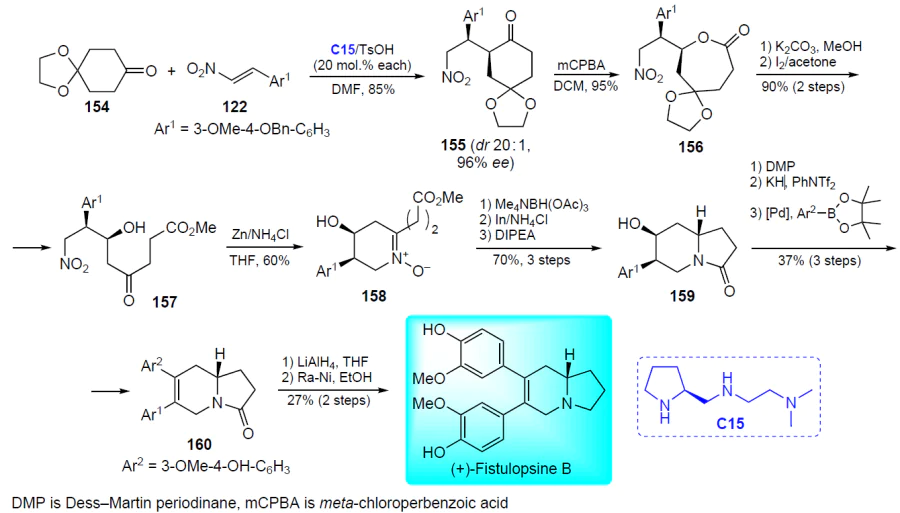
In 2018, Moorthy and Pansare achieved[143] the first synthesis of diarylindolizidine alkaloid (+)-Fistulopsine B, a natural compound isolated from the bark and the leaves of Ficus fistulosa.[144] The (+)-Fistulopsine B exhibits in vitro antiproliferative activity against breast (MCF7) and colon (HCT 116) carcinoma cell lines GI50 (concentration of drug causing 50% inhibition of cell growth) ranging between 2 and 7 mM). The developed synthetic procedure is based on the organocatalytic Michael addition of cyclohexane-1,4-dione monoethylene ketal (154) to nitrostyrenes (122) in the presence of the proline-derived triamine C15 bearing secondary and tertiary amino groups as an organocatalyst to afford the nitroketone 155 in good yield (85%) and with high stereoselectivity (dr 20 : 1, 96% er) (Scheme 47). The Baeyer – Villiger oxidation of 155 provided the lactone 156 in excellent yield (95%). Ring-opening methanolysis of 156 and subsequent hydrolysis of the ketal moiety generated the highly functionalized octanoate 157 (90% over two steps) that contains all the required carbon atoms for the indolizidine framework. The next step involved the construction of the functionalized piperidine ring. Accordingly, partial reduction of the nitro group in 157 with Zn/NH4Cl system, presumably to the corresponding hydroxylamine, resulted in concomitant cyclization with the ketone moiety to provide the nitrone 158. Further stereoselective reduction of the C=N and N – O bonds in 158 with Me4NBH(OAc)3 and In/NH4Cl, respectively, followed by treating the forming mixture with DIPEA afforded lactamization product 159. To install the second aryl substituent into the six-membered ring, the hydroxy lactam 159 was oxidized with Dess – Martin periodinane to the corresponding ketolactam (80%) which was subjected to the enol triflate formation and Suzuki – Miyaura cross coupling reactions to furnish the diaryl indolizidinone 160. Subsequent reduction of the amide group and debenzylation provided the target (+)-Fistulopsine B.
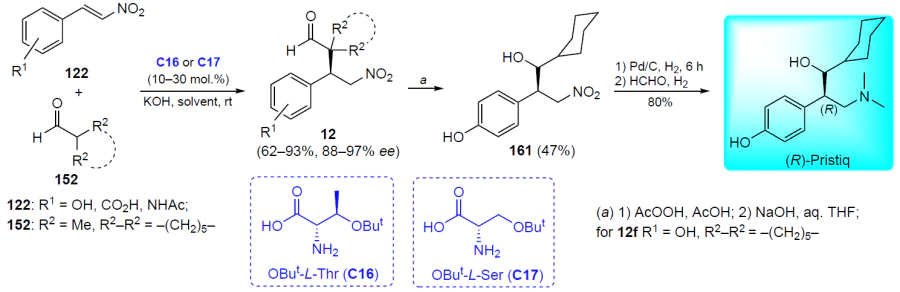
Chiral primary amines also act as useful organocatalysts in pharmacology-oriented conjugate addition reactions of carbonyl compounds with niroalkenes. Nugent et al.[145] proposed an organocatalytic methodology enabling facile enantioselective addition of branched aldehydes 152 to β-nitrostyrenes 122 bearing unprotected carboxyl, amido or hydroxy groups at the m- or p-position of aromatic ring and applied it to the asymmetric synthesis of (R)-Pristiq (Scheme 48). The potassium salts of threonine or serine tert-butyl esters C16 and C17 were identified as efficient catalysts of these reactions. In the presence of C17/KOH system (10 mol.%) under optimized conditions, the key intermediate 12f (R1 = OH, R2 – R2 = –(CH2)5–) was obtained in 86% yield with 95% ee. Aldehyde 12f was converted to the nitro alcohol 161 via the Baeyer – Villiger oxidation with commercially available 36 – 40% peracetic acid followed by basic hydrolysis of the corresponding formate ester. The reduction of the nitro group in compound 161 with Pd/C and H2 and subsequent treatment of the crude reaction mixture with aqueous formaldehyde under hydrogen afforded (R)-Pristiq in 80% yield after chromatographic purification. This API is a demethylated analog of Venlafaxine, which is a widely prescribed anti-depressant drug (its hydrochloride salt is marketed as Effexor). The Pristiq has an improved half-life and inhibitor potency (norepinephrine and dopamine uptake).[146]
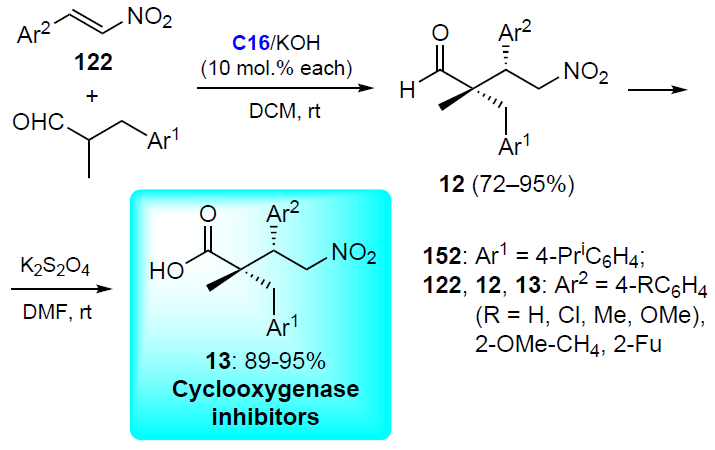
Bungau and co-workers[147] applied the OBut-L-Thr (C16)/potassium hydroxide catalytic system for the asymmetric Michael addition of acyclic α-branched aldehyde 152 to nitrostyrene derivatives 122 (Scheme 49). The γ-nitroaldehydes 12 were isolated in high yields as inseparable mixtures of diastereomers. Luckily, oxidation of the reaction products 12 with potassium peroxymonosulfate afforded γ-nitroacids 13, which were easily separable, and the major diastereomers of these compounds were further used for pharmacological assays. The in vitro testing revealed antioxidant activity and ability of some acids 13 to inhibit cyclooxygenase (COX 1/2) and lipoxygenase (5-LOX) enzymes, which indicated their analgesic and anti-inflammatory potential. Unfortunately, the authors provided no data on enantiomeric enrichment of the bioactive products.
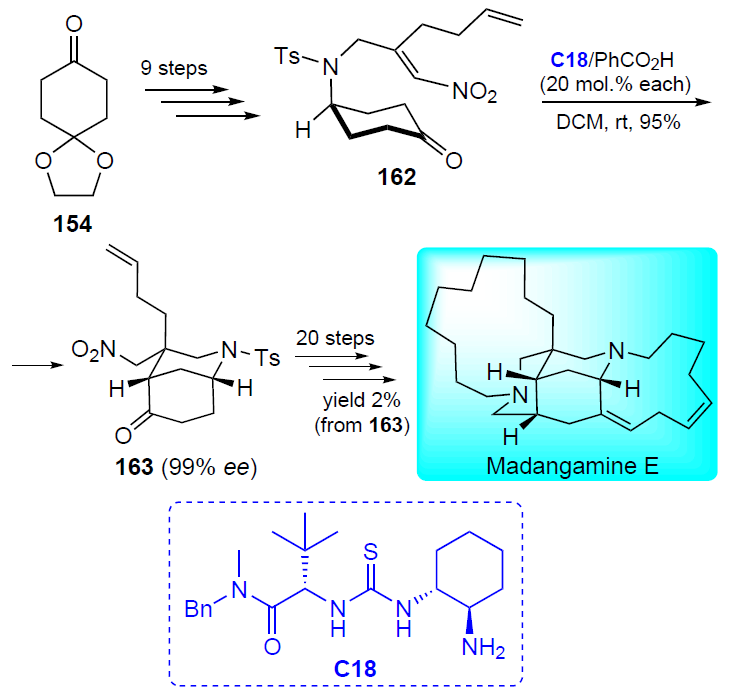
Dixon and co-workers[126] proposed a new organocatalytic desymmetrization reaction to achieve the enantioselective total synthesis of Madangamine E, a member of the madangamine natural product family, isolated from marine sea sponges of the Xestospongia genus.[148] Total synthesis of Madangamine E from the starting ketone 154 was completed in 30 steps, enabled by highly enantioselective desymmetrizing intramolecular Michael addition reaction of intermediate 162. This key carbon – carbon bond forming reaction performed in the presence of the primary amine-thiourea organocatalyst C18 in combination with PhCO2H as an acidic additive, effciently constructed a chiral bicyclic core 163 bearing three stereogenic centers, including a quaternary carbon, in near-perfect enantio- and diastereo-selectivities. The procedure demonstrated excellent scalability (> 5 g scale) (Scheme 50). Subsequent multi-step transformations of the key intermediate 163 afforded pentacyclic fused ring system of Madangamine E in 2% total yield.
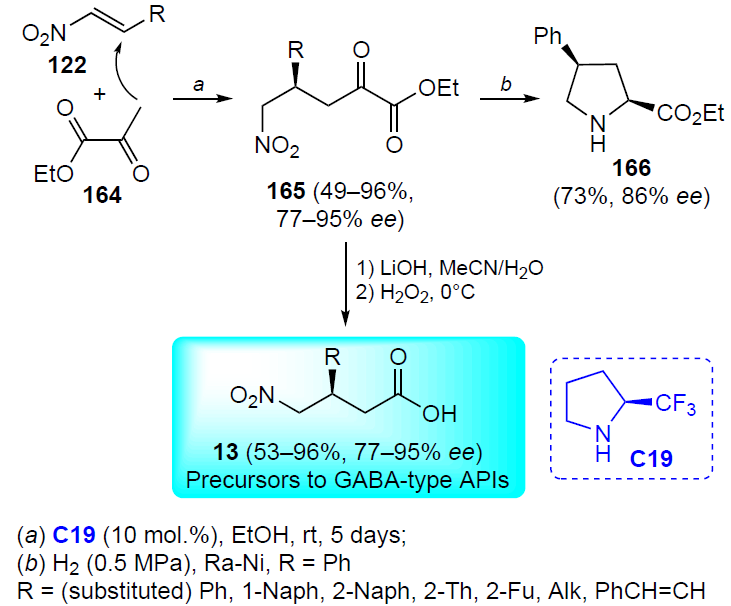
Mlynarski and co-workers[149] hypothesized that enamine intermediates generated from pyruvate esters and chiral secondary amines could be enantioselectively intercepted by nitroalkenes as efficient Michael acceptors. Indeed, in the presence of 2-(trifluoromethyl)-pyrrolidine C19 as organocatalyst, various aromatic and aliphatic nitroolefins 122 were shown to react with ethyl pyruvate (164) to give products 165 with 49 – 96% yield (in most cases > 90%) and 77 – 95% ee (Scheme 51). Hydrolysis of the ester group in compounds 165 proceeded under mild conditions leaving the stereogenic center intact. By combining hydrolysis with oxidative decarboxylation in a simple one-pot procedure, Michael adducts 165 were efficiently converted into γ-nitroacids 13, which are the direct precursors to the APIs Phenibut, Baclofen and Pregabalin. δ-Nitro-α-ketoester 165 (R = Ph) can also be easily converted to 4-substituted proline derivative 166 via a cascade reductive amination in the presence of the Ra – Ni catalyst. Enantiomeric excess of product 166 was the same as in the starting substrate 165.
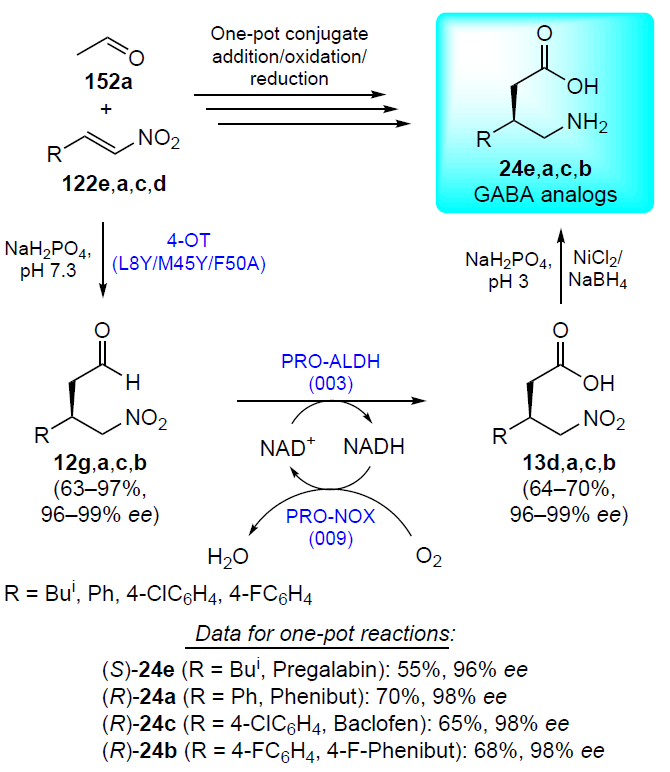
A promising green approach to asymmetric construction of pharmaceuticals from available nitroalkenes and carbonyl compounds is based on the use of natural enzymes or their artificial analogs. Usage of enzymes allows minimizing the number of reaction steps and improving the ‘pot-economy’ of the process. Poelarends and co-workers[150][151] reported a one-pot two-step biocatalytic cascade route for the synthesis of the pharmaceutically relevant enantiomers of γ-nitrobutyric acids 13, starting from simple precursors, viz., nitroalkenes 122 and acetaldehyde 152a, a challenging substrate for asymmetric organocatalytic transformations (Scheme 52). A tailor-made highly enantioselective artificial ‘Michaelase’ (4-OT L8Y/M45Y/F50A), an aldehyde dehydrogenase (PRO-ALDH) with a broad non-natural substrate scope, and a cofactor recycling system were employed as biocatalysts in this transformation. Moreover, the authors also developed a three-step chemoenzymatic cascade procedure including the one-pot chemical reduction of enzymatically prepared compounds 12 into pharmaceutically important GABA analogs Pregabalin, Phenibut, Baclofen and 4-Fluorophenibut, achieving high enantiopurity (up to 99 : 1 er) and high overall yields (up to 70%). Replacing 4-OT L8Y/M45Y/F50A by enantiocomplementary 4-OT variant A33D led to the opposite enantiomers of 12 with the same yields and enantioselectivity.
Fansher and Palmer[152] discovered that wild-type trans-o-hydroxybenzylidenepyruvate hydratase-aldolase (NahE) isolated from Pseudomonas putida acts as an efficient biocatalyst of the Michael addition of sodium pyruvate 167 to β-nitrostyrenes 122. This reaction occurs at the active site of the enzyme via the formation of the enamine intermediate with the pyruvate 167 and proceeds with low catalyst loading at room temperature to form 5-nitro-2-oxo-4-phenylpentanoic acids (168) in high yields with moderate to excellent enantioselectivity (Scheme 53). The preferential Re-face attack of the enamine nucleophile to the acceptor nitroalkene determined the reaction course. The resulting (R)-enantiomers of α-oxoacids 168 readily undergo oxidative decarboxylation with hydrogen peroxide to afford chiral 4-nitro-3-phenylbutanoic acids 13, valuable intermediates for the stereoselective synthesis of known APIs (for alternative biocatalytic synthesis of compounds 13 see Section 2.1, Scheme 9).
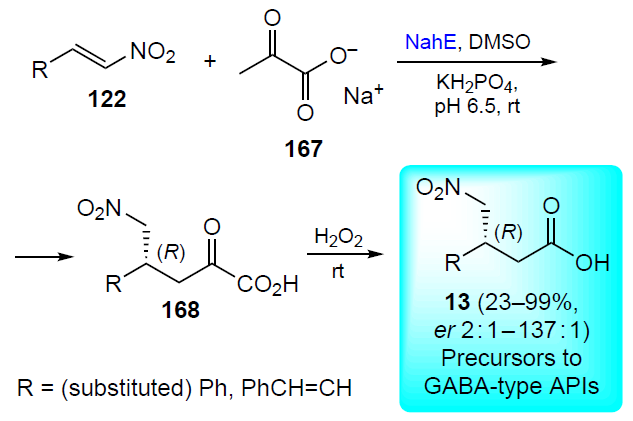
To our knowledge, only one useful application of chiral organometal catalyst for asymmetric synthesis of natural products via asymmetric conjugate addition of ketones to α-nitroolefins has been reported over the past decade. As a part of ongoing research program on kainoid chemistry,[153] Kan and co-workers[154] described a detailed, practical and scalable procedure for total syntheses of acromelic acids A and B. These natural kainoids isolated from Clitocybe acromelalga[155] exhibit potent neuro-excitatory activity via activation of ionotropic glutamate receptors in the brain.[156] The key step for their synthesis was asymmetric conjugate addition of α-ketoesters 169a or 169b to corresponding nitroalkenes 122f or 122g in the presence of chiral Ni complex Ni(OAc)2/L12 (Scheme 54). The respective adducts 170a or 170b are formed under the proposed conditions in nearly quantitative yield with excellent diastereoselectivity (dr > 20 : 1) and enantioselectivity 91 – 95% ee. Importantly, this procedure allows producing valuable intermediates 170a and 170b on a 10 g scale. A sequence of catalytic hydrogenation of the nitro group in compounds 170, intramolecular reductive amination of the carbonyl group followed by transformations of functional groups and base-promoted epimerization of the C – 2 stereocenter in the pyrrolidine ring gave corresponding pyrolidine derivatives 171a and 171b. Total synthesis of the target natural products was completed by acidic hydrolysis of the ester groups in these precursors.
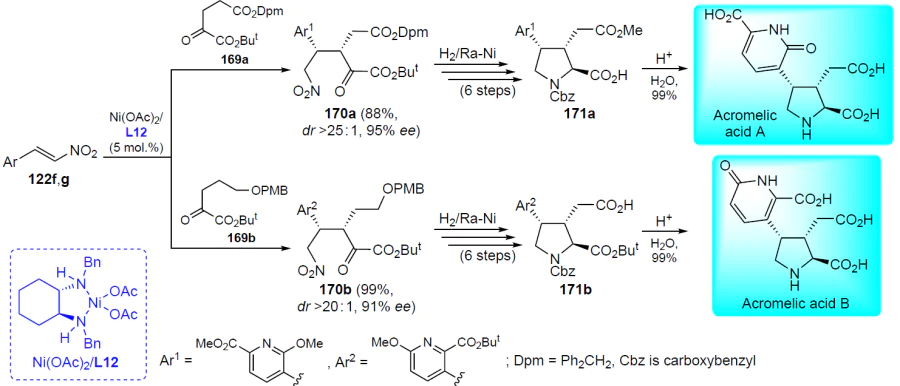
3.1.2. Addition of 1,3-dicarbonyl compounds to α-nitroolefins
β-Dicarbonyl compounds are well-established nucleophiles in the stereoselective Michael reaction leading to densely functionalized organic compounds useful for drug design. Among them, conjugate addition of malonic and acetoacetic acid derivatives to α-nitroalkenes provides a simple and efficient route to γ-nitrocarboxylic acids, valuable precursors to pharmacology relevant analogs of GABA and naturally occurring γ- and δ-lactones. Moreover, in the presence of metal-based catalysts bearing specific C2 – symmetric chiral ligands or metal-free bifunctional organocatalysts, these important molecules may be assembled stereo- and enantioselectively from available racemic or prochiral starting compounds under simple experimental conditions.
Šebesta and co-workers[157] investigated the applicability of squaramide (Rawal type) organocatalysts for asymmetric syntheses of γ-aminobutyric acid-based chiral drugs via asymmetric Michael reactions. The authors discovered that dimethyl malonate reacts with trans-4-chloro-β-nitrostyrene (122с) in the presence of bifunctional tertiary amine — squaramide catalyst C20 (5 mol.%) in DCM to afford adduct 172a in 84% yield with enantiomeric purity 86% ee (Scheme 55). Polystyrene-supported squaramide C21 having similar structure exhibited promising activity (83% yield of 172a) and even better enantioselectivity (96% ee) under the proposed conditions. However, a significant deactivation of the recovered heterogeneous catalyst was observed even in the second and especially in the third run (yields of 172a in the recovery experiments dropped to 61% and 11%, respectively). Compound 172a was transformed into antidepressant (R)-Baclofen hydrochloride via the known sequence of hydrogenation, decarboxylation and acidic hydrolysis reactions in 56% overall yield.
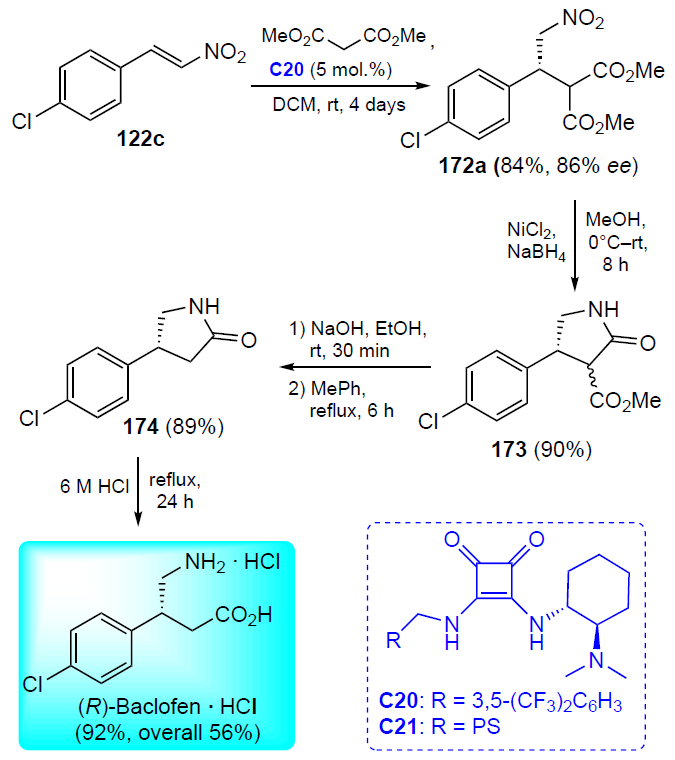
Kobayashi and co-workers[158] developed continuous-flow synthesis of (S)-enantiomer of Baclofen hydrochloride from trans-4-chloro-β-nitrostyrene (122a) and dimethylmalonate using chiral heterogeneous polystyrene-supported catalyst CaCl2/PS-(S,S)-Ph2PyBOX at the key Michael addition step (Scheme 56). Adduct (S)-172a was produced under the proposed flow conditions in quantitative yield with enantomeric enrichment 92% ee. Then, chemoselective hydrogenation–cyclization of 172a was carried out in another flow column reactor, containing specially designed achiral platinum catalyst (DMPS-Pt/AC-CP) modified with dimethylpolysilane (DMPS) and supported on activated carbon (AC)/calcium phosphate (CP) layer. The overall yield of chiral γ-lactam (S)-173 over the two continuous-flow steps was 93 – 96% with enantioselectivity 92% ee. The latter was converted to target (S)-Baclofen by the reported method.[159]
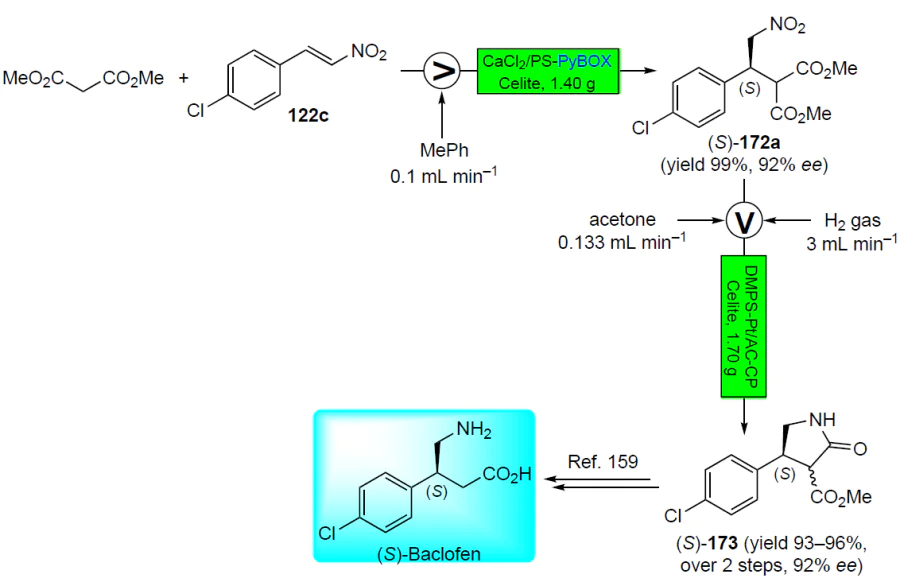
The bifunctional amphiphilic squaramide C22, bearing covalently tagged hydrophilic imidazolium cation along with hydrophobic PF6– anion, developed by Zlotin and co-workers,[160] was identified as a robust recyclable organocatalyst for the conjugate addition reactions of nitroolefins with C-nucleophiles in aqueous environment. In the presence of this catalyst, β-dicarbonyl compounds or malononitrile added enantioselectively to α-nitroolefins 122 to give the corresponding Michael adducts 172 in nearly quantitative yield with enantioselectivities up to 99% ee (Scheme 57). Due to poor solubility in water and in organic solvents used for extraction of adducts 172 from the reaction mixture (Et2O/n-hexane, 8 : 2 vol./vol.), the catalyst could be recovered and reused 30 times without a significant loss of activity or selectivity of the catalytic reaction. Most likely, catalyst C22 is located in the interfacial region, where the amphiphilic contact ion pair protects the transition complex from unfavorable influence of water via Coulombic and hydrophobic interactions and maintains high selectivity of the catalytic reaction. The developed ‘on-water’ protocol was successfully applied for the asymmetric synthesis of chiral precursors to pharmaceutically important chiral β-amino acids, in particular, anticonvulsant Pregabalin of high enantiomeric purity (98% ee). Later, Kramer and co-workers[161] obtained the same chiral precursor 172b to Pregabalin from dimethylmalonate and the corresponding nitroalkene 122 in toluene in the presence of polystyrene-supported Ni complex. However, enantioselectivity of this reaction (90% ee) and recyclability of the heterogeneous organometal catalyst NiI2/(L13)2 (3 cycles) were inferior to those obtained with ionic liquid-supported squaramide C22 under ʻon-water’ conditions. Similar non-immobilized dibenzylated chiral nickel complexes were also applied for the asymmetric addition of diethyl malonate to 1-nitropent-1-ene to afford a key precursor for the antiepileptic drug (R)-Brivaracetam (91% ee)[162] and for the enantioselective synthesis of adamantyl GABA analogs with potential neurotropic activity.[163]
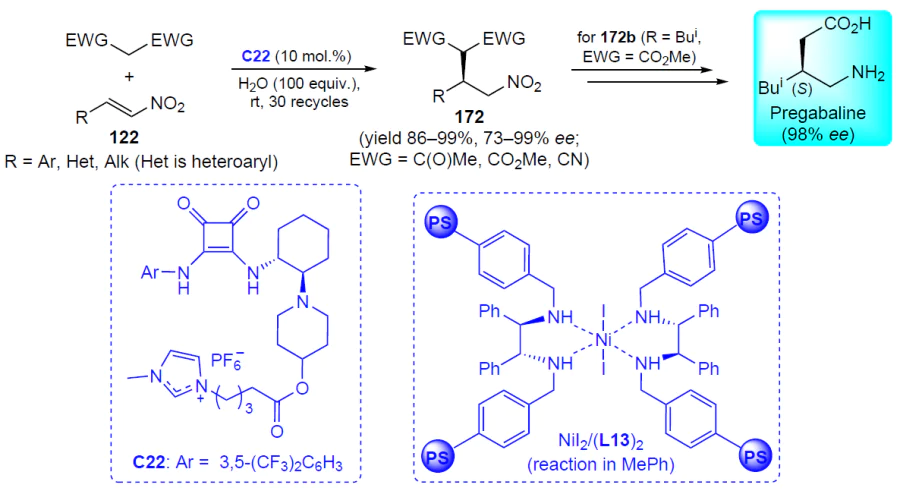
Water enables catalytic reactions for otherwise unreactive substrate systems. In 2017, Sim and Song[164] discovered that commonly inactive β,β-disubstituted nitroalkenes 175 smoothly added to dithiomalonates 176a in the presence of chiral hydroquinine-squaramide organocatalyst C23 in the brine medium, affording highly enantioenriched Michael adducts 177 bearing all-carbon quaternary center (Scheme 58). A minor amount (7 equiv.) of hydrophobic organic co-solvent, such as o-xylene, enhanced the reaction rate and selectivity. Interestingly, the reverse order of solvent mixing (i.e., brine as an additive (7 equiv.) in o-xylene) did not promote the reaction, indicating the hydrophobic hydration effect on the rate acceleration. To demonstrate the synthetic utility of the catalytic ‘on-water’ protocol, the authors performed gram-scaled one-pot syntheses of chiral GABA analogs bearing chiral quaternary carbon centers. After separation of the organic layer from the biphasic filtrate and evaporation under reduced pressure, the crude products 177a–c were subjected to reduction – lactamization with Zn/TMSCl, affording corresponding chiral γ-lactam thioesters 178a–c. Subsequent hydrolysis of crude γ-lactam thioesters 178a and 178b with 6 N HCl provided the corresponding β,β-disubstituted γ-amino acids 179a and 179b, which are β-methylated analogs of antidepressant drugs Phenibut and Baclofen, respectively, in 83 – 86% yields over 3 steps. Furthermore, β-methylated analog 180 of phosphodiesterase IV inhibitor Rolipram, was prepared with 91% ee by hydrolysis of crude 178c, followed by thermal decarboxylation of α-carboxylactame intermediate.
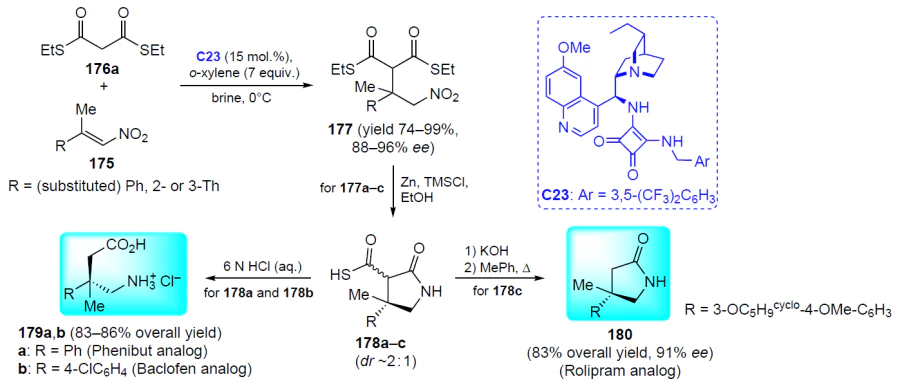
In 2024, Zhang and co-workers[165] found that similar hydroquinine – squaramide C23 catalyzed asymmetric ‘on-water’ Michael reaction between compounds 122h and 176b can be accelerated by pulsed ultrasonic irradiation with on-off modulation, though, at the expense of reduced enantioselectivity (84% vs. 92% ee). In addition, using organocatalytic ‘on-water’ methodology and β-nitrostyrenes 122 as starting materials, the authors[166] accomplished enantioselective syntheses of Baclofen itself and a new herbicidal mode-of-action inhibitor (3S,4S)-Tetflupyrolimet.[167] Quinine squaramide C24 performed best in this case allowing preparation of the key γ-nitrocarbonyl precursor 181 in nearly quantitative yield and with excellent enantiomeric purity in the presence of only 0.5 mol.% of the catalyst (Scheme 59).
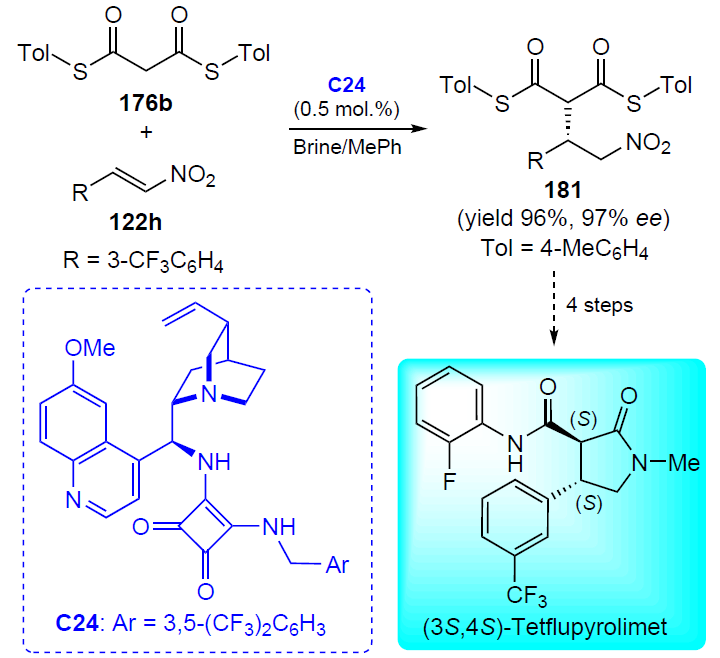
Many natural products and biologically active agents contain cyclopropane structural motif.[168] Among these, nitrocyclopropanes occur in Nature as an integral part of specific peptidolactone hormones such as hormaomycin[169] and serve as precursors for the broad-spectrum antibiotic Trovafloxacin.[170] Zhang and co-workers[171] developed a two-stage protocol for accessing nitrocyclopropanes that bear a thioester group and three stereogenic centers (Scheme 60). This protocol is based on the enantioselective Michael addition of α-bromo-monothiomalonate 182 to nitroalkenes 122 catalyzed by quinidine-derived squaramide C25. In the presence of only 0.5 mol.% of this catalyst, the reaction proceeded faster under biphasic ‘on-water’ conditions than in organic solvent (PhCl) to afford the corresponding Michael adducts 183 in nearly quantitative yield with high diastereoselectivity and excellent enantioselectivity. Afterwards, compounds 183 were stereoselectivly converted to the corresponding nitrocyclopropanes 184 via a one-pot sequence of deprotection, decarboxylation and cyclopropanation reactions.
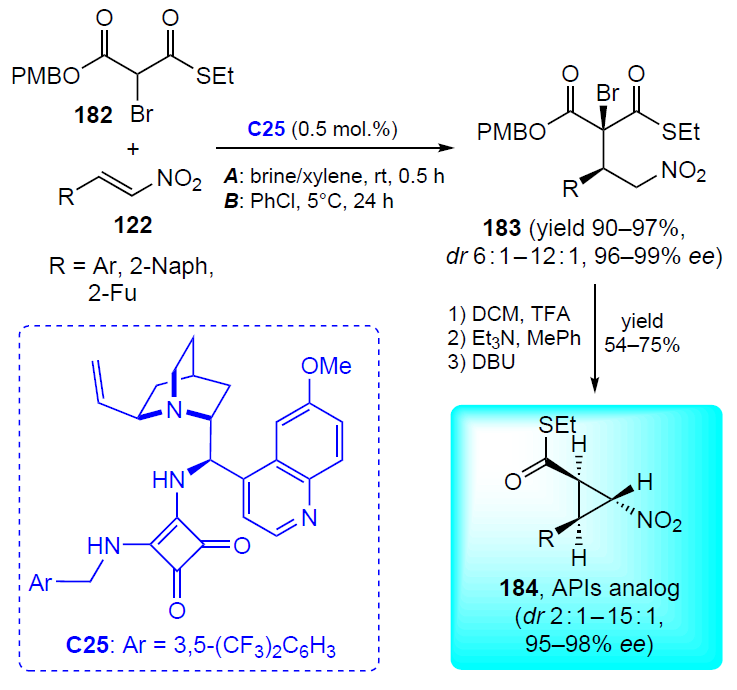
Xu et al.[172] developed a convenient asymmetric synthesis of heterocyclic dipeptidyl peptidase IV (DPP-4) inhibitor 186, a representative of antihyperglycemic agents for the treatment of type 2 diabetes mellitus.[173] The synthesis is based on the enantioselective (95% ee) Michael addition of dimethyl malonate to polyfluorinated β-nitrostyrene 122i catalyzed by demethylated quinine C26 (Scheme 61). A unique three-component cascade cyclization of the reaction product 172c involving aza-Henry, amidation, hydrolysis and decarboxylation steps afforded a functionalized piperidinone skeleton cis-25b, which was epimerized in a one-pot fashion to the corresponding trans-isomer in the presence of base. Further RuCl3-catalyzed deallylation of compound trans-25b, catalytic hydrogenation of the nitro group and Cu(I)-catalyzed coupling–cyclization of N-Boc-protected γ-amino piperidone 185b with 4-amino-3-bromopyridine allowed for the stereoselective formation of the DPP-4 inhibitor 186 in 23% overall yield. Importantly, the reported procedure is readily scalable and suitable for the large-scale preparation of the target fused tricyclic molecule 186.
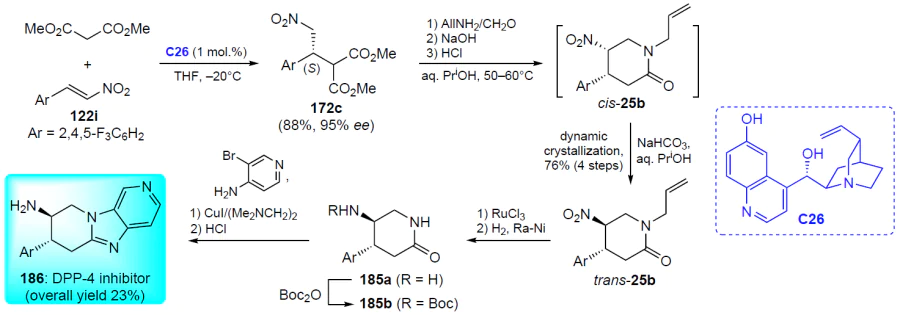
Wennemers and co-workers[174] suggested the use of fluorinated monothiomalonate 187 as a building block for the stereoselective synthesis of organofluorine compounds. Conjugate addition of compound 187 to nitroolefins 122 proceeded under mild organocatalytic conditions and provided access to α-fluoro-γ-nitro thioesters 188 with adjacent quaternary and tertiary stereogenic centers (Scheme 62). Only 1 mol.% of epi-cinchonine – urea catalyst C27 was needed to obtain the addition products 188 in excellent yields and stereoselectivities. The authors explored the synthetic potential of the resulting α-fluoro-γ-nitro thioesters 188 for accessing fluorinated lactams, in particular, fluorinated analog of the proteinase-activated receptor-2 (PAR-2) agonist AC-264613. The PAR-2 agonists have therapeutic potential as gastro-protective agents and drugs for the treatment of pulmonary inflammation and asthma.[175][176] The synthetic route involves an initial reductive cyclization of 188a followed by hydrolysis of the corresponding cyclic methyl ester to carboxylic acid 189. Activation of the acid with N-hydroxysuccinimide (NHS) – dicyclohexylcarbodiimide (DCC) system and subsequent reaction with hydrazine afforded hydrazide 190, which was converted to the target fluorinated analog of AC-264613 (191) by condensation with 3'-bromoacetophenone.
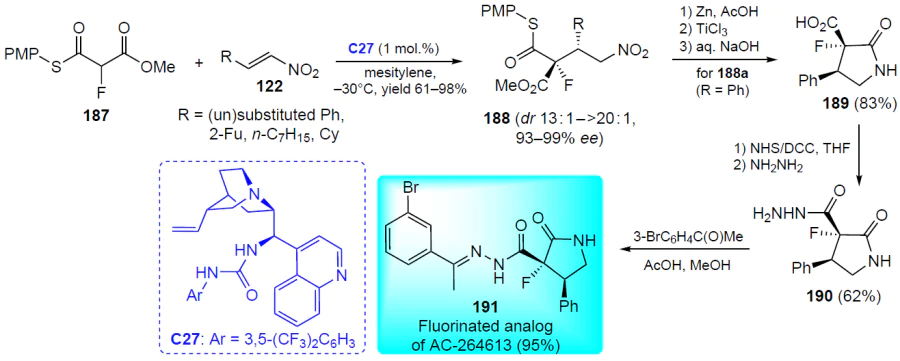
Dixon and co-workers[127] reported preliminary synthetic efforts toward stereoselective synthesis of the densely functionalized piperidine core of Keramaphidin B, a marine alkaloid first isolated by Kobayashi in 1994 from the Okinawan marine sponge Amphimedon sp. This natural compound exhibits cytotoxicity against KB human epidermoid carcinoma cells (IC50 0.28 μg mL–1) and P388 murine leukemia cells (IC50 0.28 μg mL–1).[177] The proposed synthetic approach started with the organocatalyzed Michael addition of the cyclic β-ketoester 192 to substituted furanyl nitroolefin 122j under the control of cinchonine-derived thiourea catalyst ent-C1 (Scheme 63). This reaction proceeds diastereo- and enantioselectively to give adduct 193 (92% yield, dr 95 : 5). Treatment of the major diastereomer syn-193 with hept-5-yn-1-amine (194) and formaldehyde in boiling methanol afforded the lactam 195 in 56% yield as a virtually single diastereomer with 82% ee. Subsequent reductive cleavage of the nitro group using tributyltin hydride and 2,2'-azobisisobutyronitrile (AIBN) followed by lactonization under Lewis acidic conditions afforded spirocyclic malonamide 196 possessing the correct relative stereochemistry for Keramaphidin B, in 60% yield over the two steps. Aminolysis with hex-5-en-1-amine (197) under neat conditions gave the primary alcohol 198 (67% yield). The latter was subjected to a Swern oxidation to the corresponding aldehyde, which was converted to bisalkene 199 by treatment with the Petasis reagent. Sequential Z-selective ring-closing metathesis and cis-selective hydrogenation reactions may furnish Keramaphidin B.
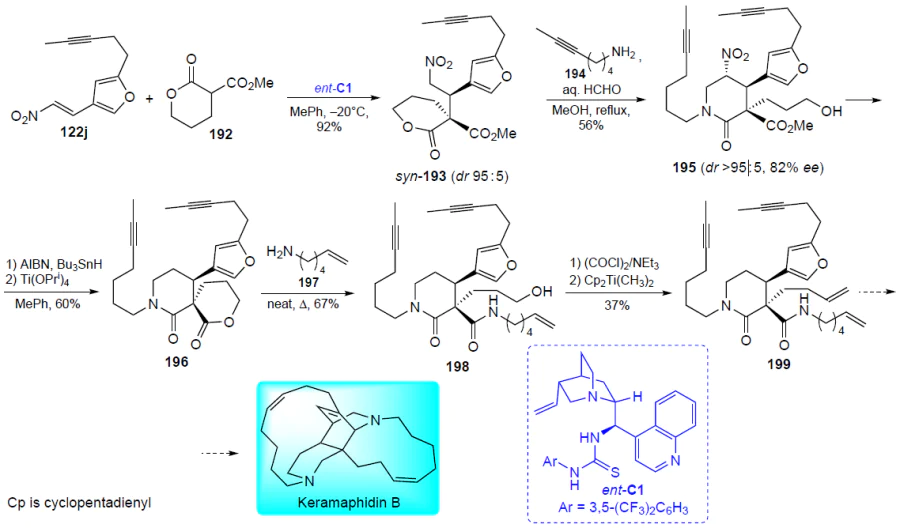
Cruz-Aguilar and Hernández-Rodríguez[178] described the first enantioselective synthesis of highly functionalized 1-azabicyclo[3.3.1]nonanes (1-isomorphans) 202. The proposed methodology is based on the asymmetric organocatalytic Michael addition of N-protected piperidine-derived ketoesters 200 to nitroalkenes 122 in the presence of the squaramide catalyst C28 bearing cinchonine and tetraline units, followed by stereoselective intramolecular nitro-Mannich reaction of chiral adducts 201 of high enantiomeric purity with various aldehydes (Scheme 64). The reaction sequence required only two purification steps and provided enantioenriched polysubstituted compounds 202 containing five contiguous stereogenic centers in 49 – 83% overall yield. The 1-isomorphan scaffold is present in natural products and biologically active compounds, the two of which, Nelonicline and Renzapride, are currently under clinical studies.
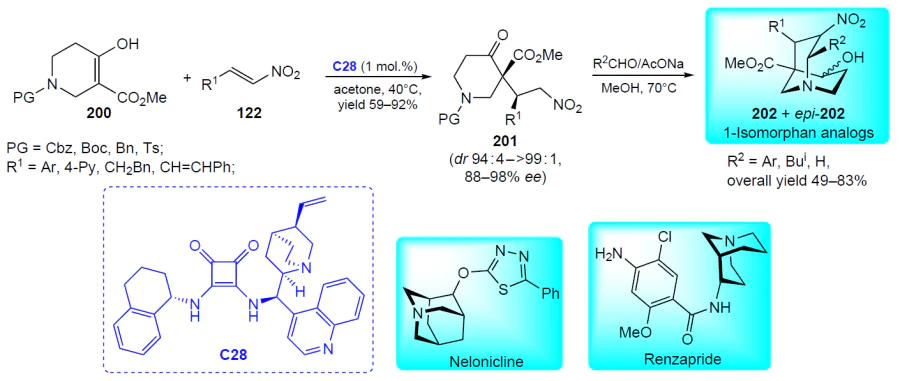
In some cases, metal complexes with chiral ligands may serve as efficient catalysts for pharmacology relevant enantioselective Michael reactions of nitroalkenes with 1,3-dicarbonyl compounds. Zhang and Anderson[128] reported a total synthesis of representative members of the Schizozygine alkaloids via asymmetric Michael addition of diethylmalonate to ortho-bromo-nitrostyrene (122k), affording Michael adduct 172d. This reaction showed good enantioselectivity and excellent scalability in the presence of a simple chiral Ni(II)/trans-diaminocyclohexane-derived complex NiBr2/(ent-L12)2 (1 mol.%), developed by Evans and Seidel[179] (Scheme 65). The adduct 172d was subjected to nitro-Mannich/lactamization cascade followed by decarboxylation of the crude reaction mixture to afford the nitrolactam 203 in 84% overall yield as a mixture of two diastereomers in a 5 : 1 ratio. Subsequent palladium-catalyzed Tsuji – Trost allylation, reduction of the nitro group and methoxycarbonylation of the amino group furnished compound 204 bearing fused rings A, B and C in 86% yield over three steps. Further installation of the ring E followed by the removal or modification of the auxiliary functional groups in compounds 205 and 206 completed total synthesis of the Schizozygine alkaloids (+)-Vallesamidine and (+)-14,15-Dehydrostrempeliopine.
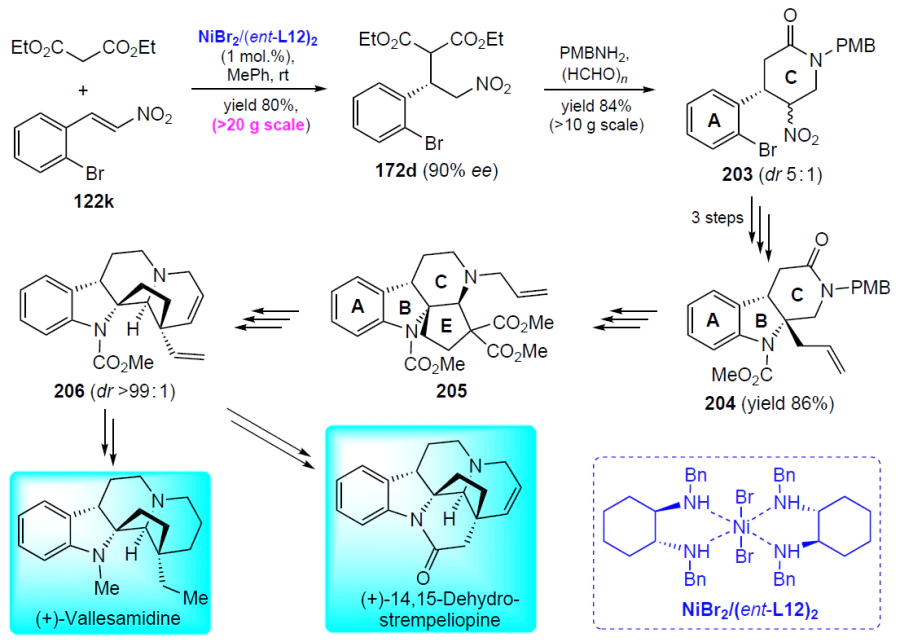
3.1.3. Addition of other C-nucleophiles to α-nitroolefins
Some carbon nucleophiles that do not belong to carbonyl or 1,3-dicarbonyl compounds could also react with α-nitroolefins in a highly diastereo- or enantioselective manner in the presence of chiral auxiliary groups, metal complexes with chiral ligands or metal-free organocatalysts. Such nucleophiles include organometallic compounds, esters, heterocyclic compounds, aromatic compounds bearing electron-withdrawing groups, α-amino acid derivatives, and fluorinated (sulfoximidoyl)methyl anions.
Liu and co-workers[180] took advantage of diastereoselective Michael addition of deprotonated esters to nitroalkenes for the assembly of alkaloids belonging to Amaryllidaceae family (Scheme 66). In the synthesis of racemic β-Lycorane, acyloxy-substituted nitrocyclohexene 208 was the key intermediate that was involved in a sequential double Michael addition. In the first stage, treatment with aryllithium reagent generated from bromide 207 in the presence of a catalytic amount of CuI afforded nitroalkene 209 resulting from Michael addition/acetate elimination in 91% yield. In the next stage, nitroalkene 209 reacted with deprotonated ethyl acetate to give nitrocyclohexane 210 in 81% yield and excellent diastereoselectivity (only one of the four possible diastereomers was obtained). Treatment of 210 with Zn/AcOH resulted in reduction of the nitro-group, acetal deprotection and reductive cyclization thus assembling the octahydrophenanthridine skeleton 211. Lactamization followed by hydride reduction of 212 completed the synthesis of β-Lycorane.
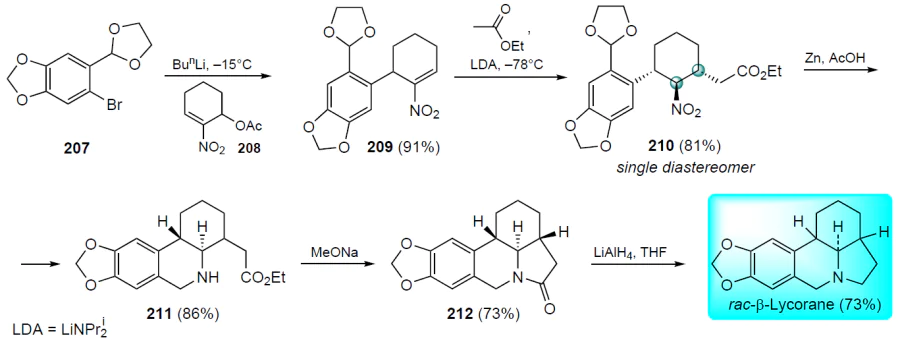
In the total synthesis of alkaloid (+)-Pancratistatin, Liu and co-workers[181] employed a diastreoselective Michael addition of aryllithium to a nitroalkene followed by an intramolecular Henry reaction to assemble the cyclohexane ring (Scheme 67). The required nitroalkene 214 was prepared by the Henry reaction of nitromethane with chiral aldehyde 213 available from α-methylglucoside. Reaction of this nitroalkene with aryllithium reagent 215 delivered Michael adduct 216 as a single stereoisomer. In the next stage, deprotection of the primary alcohol and oxidation gave nitroaldehyde 217 that quantitatively cyclized to nitrocyclohexanol 218 upon treatement with NaHCO3. Notably, only one stereoisomer was formed in this stage. NMR monitoring of the intramolecular Henry reaction revealed that the observed stereoisomer is a thermodynamic control product. Final synthetic steps toward target (+)-Pancratistatin involved the reduction of nitro group to give intermediate 219, Bischler – Napieralski reaction to asseble the piperidinone ring and global deprotection.
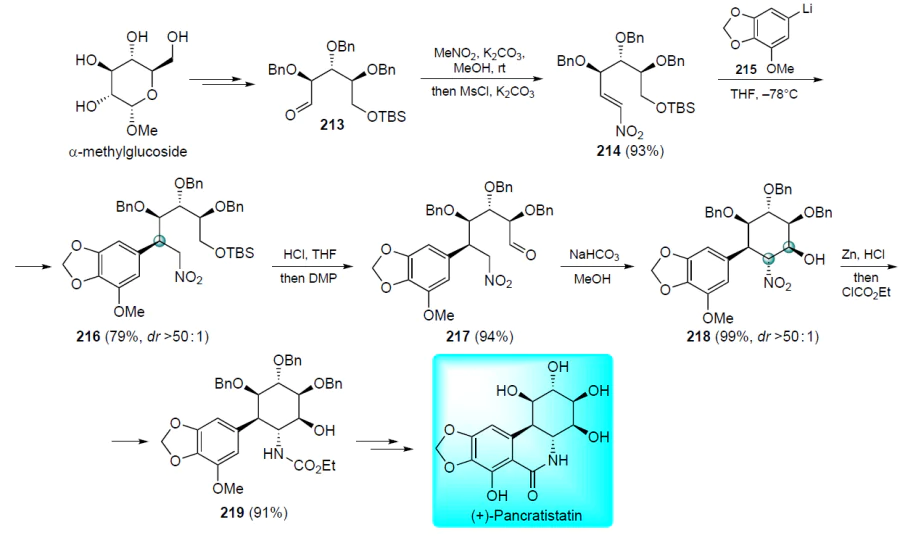
Nakamura et al.[182] found that the α,α-dithioacetonitrile derivative 220 undergoes a highly enantioselective conjugate addition reaction with nitroalkenes 122 in the presence of the chiral bis(imidazoline)-palladium pincer-type complex PdL14, affording Michael adducts 221 with quaternary stereogenic center (Scheme 68). The reaction product 221a with properly designed aryl group obtained over the catalytic reaction in 88% yield and 95% ee was used in the asymmetric synthesis of (R)-Rolipram, anti-inflammatory and antidepressant drug, a family member of GABA derivatives. The three-step transformation included InCl3 · 4 H2O-catalyzed hydrolysis of the nitrile group in 221a with acetaldoxime, reduction of the nitro group accompanied by lactamization, and reductive desulfurization of lactame 222a to afford enantioenriched (R)-Rolipram.
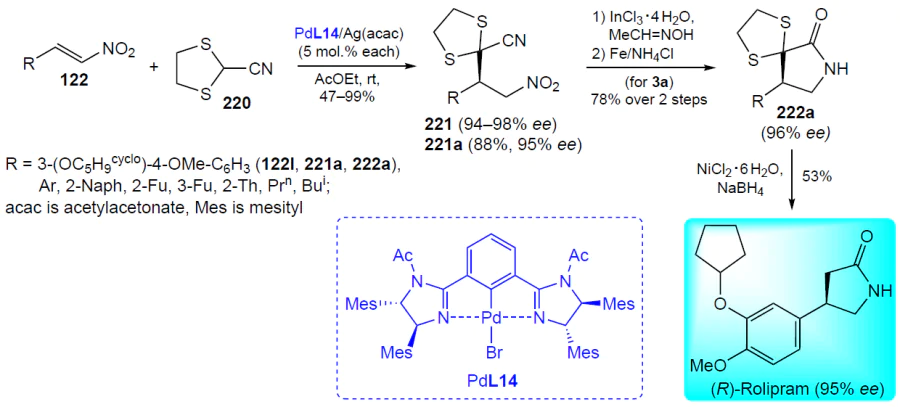
Pyrazolones represent pharmacologically important class of C-nucleophiles for the conjugate addition reactions with α-nitroolefins. However, highly enantio- and diastereoselective versions of these reactions providing pharmacologycally relevant products with adjacent quaternary and tertiary stereocenters still remain elusive.[183] Peters and co-workers[184] presented a new polyfunctional Cu(II)-1,2,3-triazolium-aryloxide catalyst CuL15 which enables the asymmetric 1,4-addition of C(4) – substituted pyrazolones 223 to nitroolefins 122 with wide scope, high enantioselectivity and yields and usually good to high diastereoselectivity (up to dr 99 : 1) (Scheme 69). The adducts 224 were subjected to chemoselective C=N reduction with the borane-dimethylsulfide complex to form pyrazolidinones 225, valuable precursors to β,γ'-diaminoamides, a compound class of great medicinal importance.[185] Furthermore, morphological profiling using the Cell painting assay identified biological activities for the pyrazolidinones 225 themselves and suggested modulation of DNA synthesis as a potential mode of their biological action. Indeed, pyrazolidinone 225a showed biological similarity to Amsacrine and Campthotecin, known topoisomerase I inhibitors.[186]
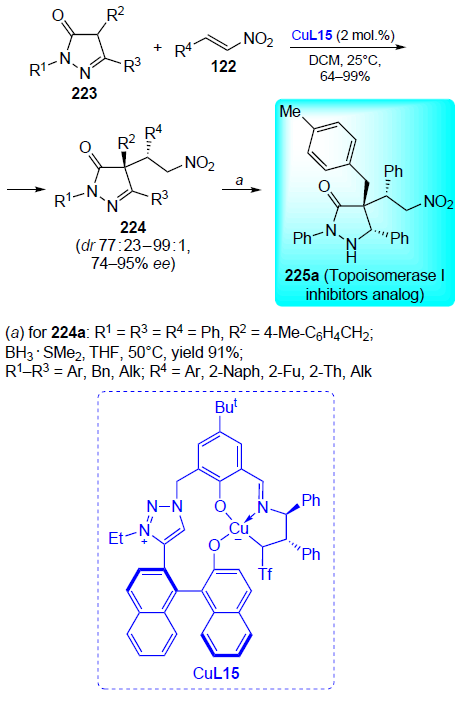
Jiang and co-workers[187] identified diarylthiazolidin-2,4-diones 226 as promising С-nucleophiles in asymmetric Michael reactions. In the presence of 10 mol.% of L-amino acid-derived bifunctional Brønsted base organocatalyst C29, diarylthiazolidin-2,4-diones 226 reacted with nitroolefins 122 under mild conditions affording chiral 5-aryl-5-substituted thiazolidin-2,4-diones 227, which structurally feature vicinal thia-quaternary and tertiary stereogenic centers, in 63 – 97% yields, with high enantio- and diastereoselectivities (up to >99% ee and dr >19 : 1) (Scheme 70). Importantly, several prepared chiral adducts exhibited inhibitory effects on the H22 human cancer cell line with IC50 values in the range of 9.9 – 25 μM and showed weaker inhibitory activity (IC50 = 30 – 39 μM) with respect to the HCT116 and K562 human cancer cell lines in in vitro experiments.
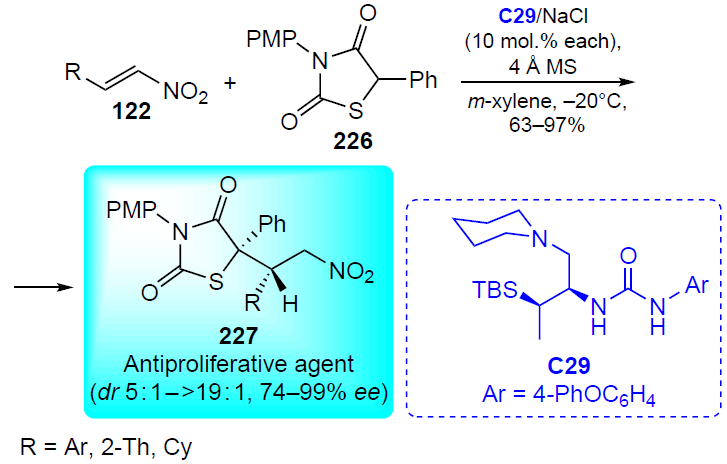
Zlotin and co-workers[188] applied 3-hydroxypyranones 228 (natural kojic acid derivatives) as available C-nucleophiles for asymmetric organocatalytic reaction with nitroalkenes 122 (Scheme 71). This conjugate addition was efficiently catalyzed by C2–symmetric tertiary amine C30 — a simple and readily available member of the squaramide organocatalytic family which do not contain lipophilic fluorinated aryl groups. In the presence of only 1 mol.% of this catalyst, corresponding Michael adducts 229 can be obtained under green conditions (96% EtOH medium) in a nearly quantitative yield with up to 99% ee. The quite different solubility of catalyst C30 and products 229 in organic solvents significantly simplified workup and purification of the products. Moreover, due to the extremely low solubility in organic solvents, the catalyst C30 could be readily separated and 7-fold reused in the catalytic reaction that reduced efficient catalyst loading by nearly an order of magnitude (to 0.15 mol.%). The synthetic utility of Michael adducts 229 was demonstrated by selective acylation of 229a with bioactive acids, namely, (E)-5,9-dimethyldeca-4,8-dienoic acid (230a) which is a cholesterol-lowering agent[189] and lipoic acid (230b), a cofactor of many enzyme complexes,[190] in the presence of DCC/DMAP. Products 231aa and 231ab containing two privileged pharmacophoric motifs are likely to selectively bind to human cellular receptors and have unusual pharmacological profiles (the ‘twin drugs’ concept[191]).
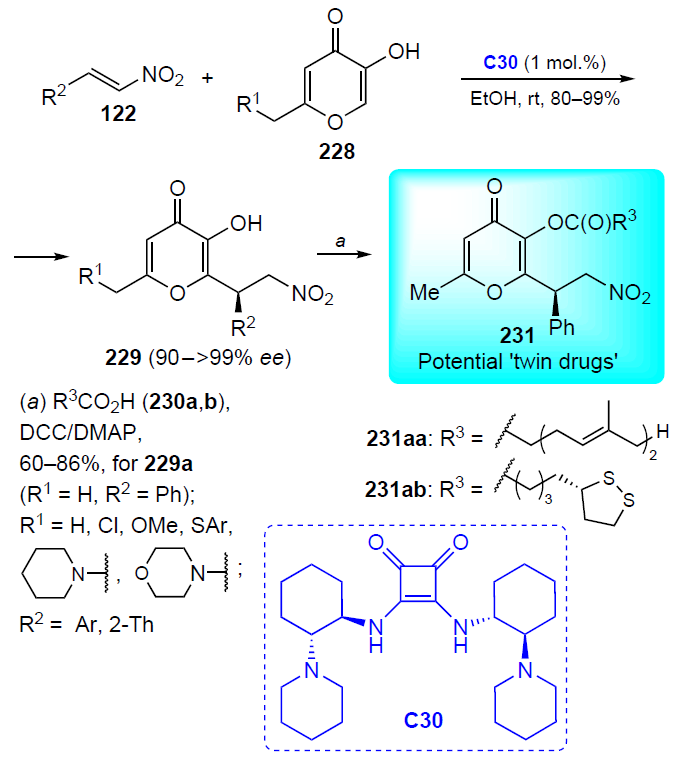
In 2024, Bisai and co-workers[192] proposed a common approach to piperidinoindoline and pyrrololidinoindoline alkaloids based on bifunctional Cinchona-thiourea catalyzed sequential conjugate addition of bis-oxindole 232 to nitroethylene 122m. The (S,S)- or (R,R)-enantiomers of Michael adducts 233 were obtained in the presence of pseudo-enantiomeric organocatalysts C10 or C1 in high yields with excellent diastereo- and enantioselectivities under mild conditions (Scheme 72). Importantly, the reaction is scalable and allows obtaining adducts 233 in gram quantities. This strategy proposes total syntheses of both enantiomers of Calycanthaceae alkaloids exhibiting anticonvulsant, antifungal, antiviral, analgesic, antitumor, and melanogenesis inhibitory properties.[193] Among them, natural alkaloids 234 and 235, such as (−)-Chimonanthine (234a), (−)-Folicanthine (234b), and (+)-Calycanthine (235) were obtained starting from the common precursor (S,S)-233.
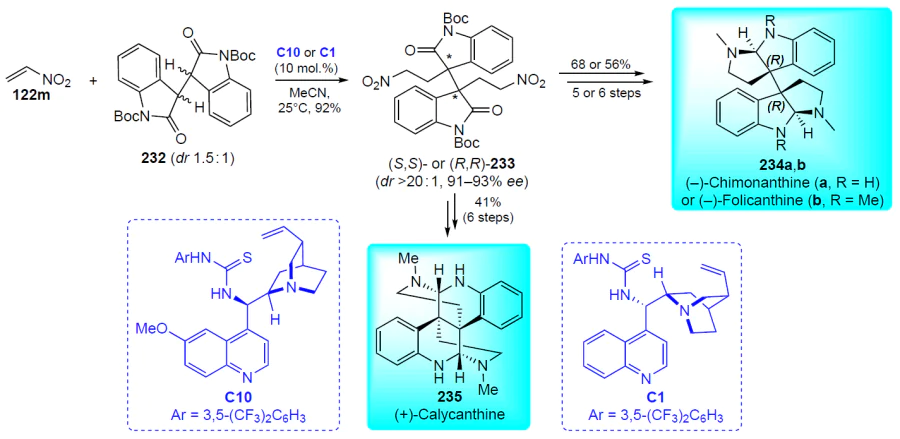
Nitroethylene (122m) was elegantly used by Zhu and co-workers[129] as a simple and highly reactive substrate for the total synthesis of (+)-Stephadiamine, a natural product isolated from the plant Stephania japonica.[194] This unique cage-like compound contains an aza[4.3.3]propellane scaffold which bears four stereocenters, including one quaternary carbon and two α-tertiary amine centers along with a δ-lactone moiety bridging across the 5- and 6-membered rings. A key stereocontrolling step of the synthetic strategy was the enantioselective Michael addition of allylated β-hydroxynaphthalin derivative 236 to nitroethylene (122m) in the presence of Takemoto’s catalyst (1R,2R)-C12, which provided α,α-disubstituted β-naphthalenone 237 with required configuration of stereogenic center and 94% ee (Scheme 73). Then, the adduct 237 was oxidized via the Lemieux – Johnson procedure to deliver rather unstable aldehyde, which was found to be prone to an intramolecular Henry reaction when purified by column chromatography on silica gel. Therefore, the crude aldehyde was directly subjected to organocatalytic reductive Knoevenagel condensation with Meldrum acid, and subsequent 1,4-reduction of the enone with L-Selectride generated α,α-disubstituted β-tetralone 238. Treatment of this compound with Eschenmoser salt afforded α-substituted acrylate methyl ester 239. Reductive cyclization of compound 239 with an excess of Na2S2O4 allowed regioselective construction of polycyclic nitrone 240, which was transformed to the target natural product (+)-Stephadiamine over 9 additional synthetic steps.
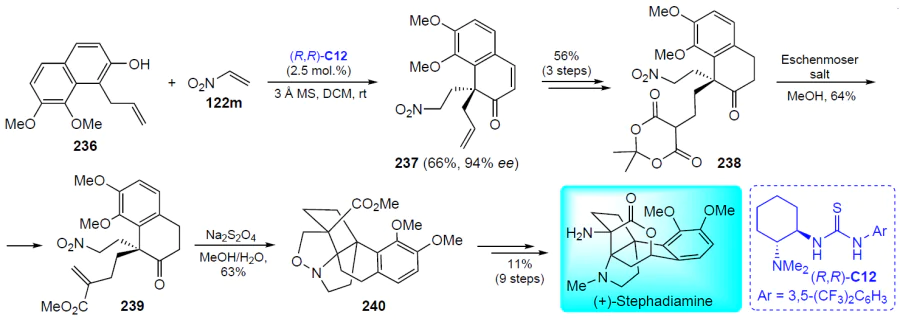
In 2025, Zhao and co-workers[195] have developed an unprecedented direct asymmetric α-C conjugate addition of glycinate 241 to nitroalkenes 122 by utilizing a pyridoxal C30/Nd(III) catalytic system, which successfully switched the chemoselectivity from inherently preferred N-addition to α-C addition. As a result, a series of chiral γ-nitro-α-amino acid esters 242 with electron-donating or electron-withdrawing groups at the ortho, meta, and/or para position of the aromatic ring were synthesized in 52 – 98% yields with excellent diastereo- and enantioselectivities under mild conditions (Scheme 74). Remarkably, when utilizing nitroalkenes containing biologically active moieties derived from isoxepac[196] and estradiol,[197] the reaction successfully delivered the corresponding chiral products 242. In addition, it is applicable for quick enantioselective synthesis of 3-amino-2-pyrrolidone derivative 243, a FPRL1 agonist with anti-HIV activity.[198] The reaction between glycinate 241 and nitroalkenes 122 was proposed to proceed via a carbonyl catalysis pathway, which includes condensation of the pyridoxal catalyst C30 with glycinate 241 to form the corresponding imine. The imine deprotonated by the base (LiOH) attacks the C=C bond of the nitroalkene activated by Nd(OTf)3 in the transition state TS1 to afford chiral γ-nitro-α-amino acid esters 242. This study offers a highly efficient approach to biologically significant GABA analogs 243 and expands the chemistry of vitamin B6-based biomimetic catalysis.[199-201]
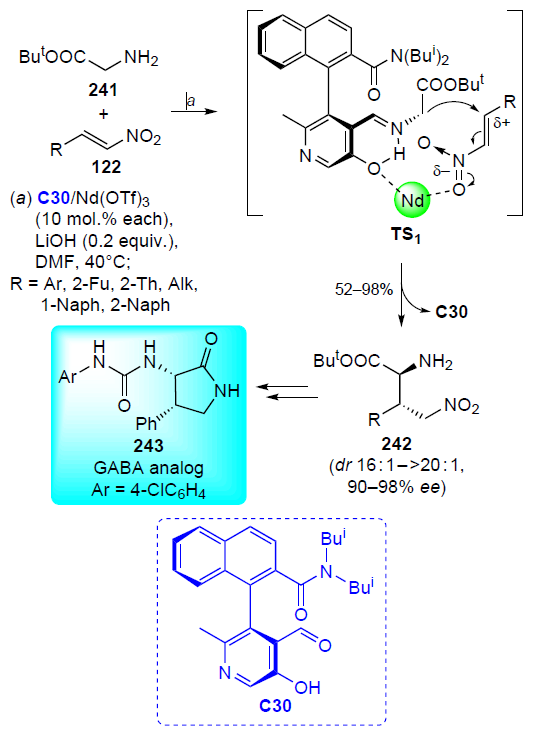
Hu and co-workers[202] developed an efficient and easy-to-handle protocol for the highly stereoselective nucleophilic di- and monofluoromethylation of nitroalkenes enabling an easy excess to optically pure γ-fluorinated alkylamines of high value in medicinal chemistry.[203-205] The proposed methodology is based on chemo- and diastereoselective addition of chiral-at-S fluorinated (sulfoximidoyl)methyl anions derived from compounds 244 or 245 to electron-deficient C═C bond attached to the nitro group. This reaction proceeds efficiently in THF in the presence of potassium bis(trimethylsilyl)amide (KHMDS) as a deprotonating agent, affording corresponding adducts 246 or 247 bearing aromatic, heteroaromatic and aliphatic groups in moderate to high yields with good to excellent diastereoselectivity (Scheme 75). The mechanistic experiments and density functional theory (DFT) calculations suggested that the coordination of the nitro group to the potassium ion could facilitate the stereoselectivity control. Remarkably, the difluoromethyl sulfoximidoylation reaction is applicable for the late-stage modification of complex molecules to afford bioinspired compounds 246 containing Ebastine, Combretastatin, Cholesterol, or (+)-δ-Tocopherol units. Moreover, facile removal of a chiral auxiliary from products 246 or 247 by simple reduction followed by Boc-protection performed in one pot afforded γ-fluorinated amines 248 or 249 of high enantiomeric purity. The resulting compounds 248 include precursors to important phytopathogenic fungi inhibitors, such as TRPC6 and CDK11 inhibitors.[205][206]
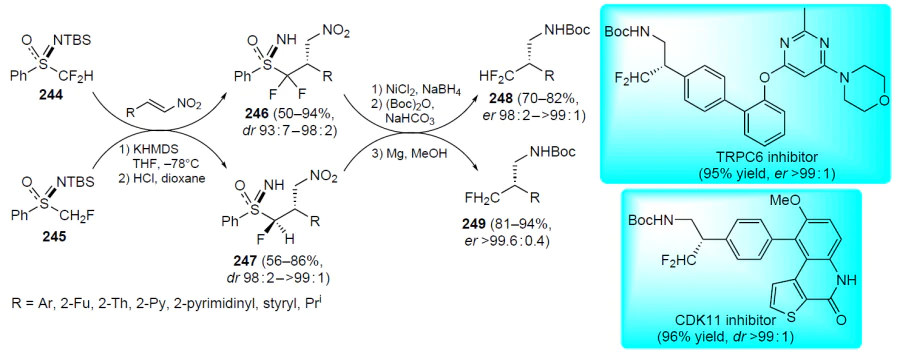
3.1.4. Addition of hetero-nucleophiles to α-nitroolefins
Among numerous Michael reactions of nitroalkenes with heteroatom-based nucleophiles, addition of amines represent special interest in the context of pharmaceutical synthesis. Thus, Gil and co-workers[207] reported the development of potent antiproliferative compounds using the Michael addition of aliphatic/aromatric amines to sugar-derived nitroalkenes (Scheme 76). In the case of D-galacto-nitroalkene 122n, the process was stereospecific, yielding single stereoisomers of adducts 250. The stereochemistry is consistent with the model, in which the nucleophilic attack occurs on the less-hindered Si-face of the nitroalkene moiety in the dominant conformation. Unlike D-galacto-nitroalkene 122n, reactions with D-manno-nitroalkene were less stereoselective. The resulting Michael adducts 250 show potent activity toward human solid tumor cell lines A549 (non-small cell lung), HBL-100 (breast), HeLa (cervix), SW1573 (non-small cell lung), T-47D (breast) and WiDr (colon) with GI50 values in the range 1.7 – 19 mM.
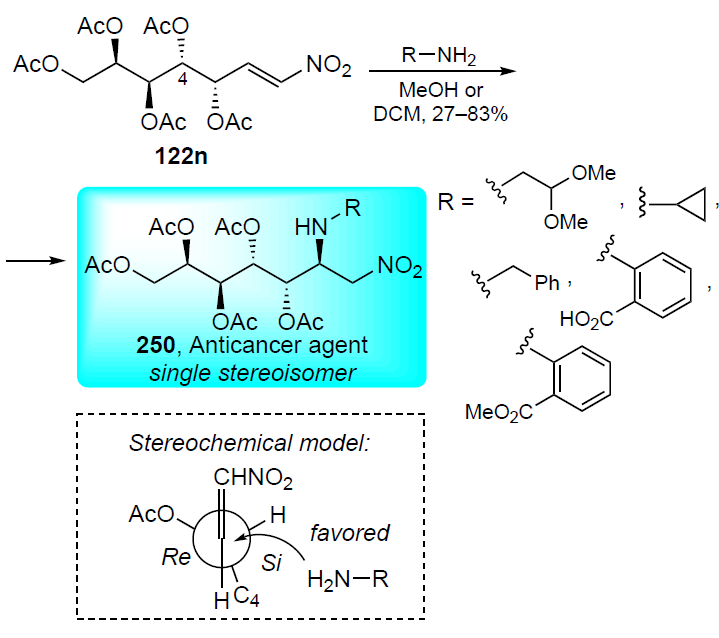
Piperazines are among the top heterocyclic scaffolds used in small-molecule pharmaceuticals.[208] However, stereoselective synthesis of C – substituted piperazine derivatives still remains a challege. Sakakura and co-workers[209] developed a simple access to 3,5-disubstituted piperazinones by Michael addition of a-amino acid esters to conjugated nitroalkenes followed by reduction of the nitro group and lactamization (Scheme 77). All three steps were performed without the purification of intermediate products. The Michael addition step exhibited moderate stereocontrol which depended on the structure of the amino acid. Best results were obtained with dimethyl L-glutamate 251, which gave the Michael adduct 252 from nitrostyrene 122o with dr 3 : 1. Subsequent reduction with Zn and double lactamization afforded bicyclic piperazinone derivative 253. Using the developed strategy, marine alkaloid 6',6''-Didebromo-cis-3,4-dihydrohamacanthin B and its epimer were synthesized from indole-derived nitroalkene 122p and 3-indolyl-glycine ethyl ester 254.
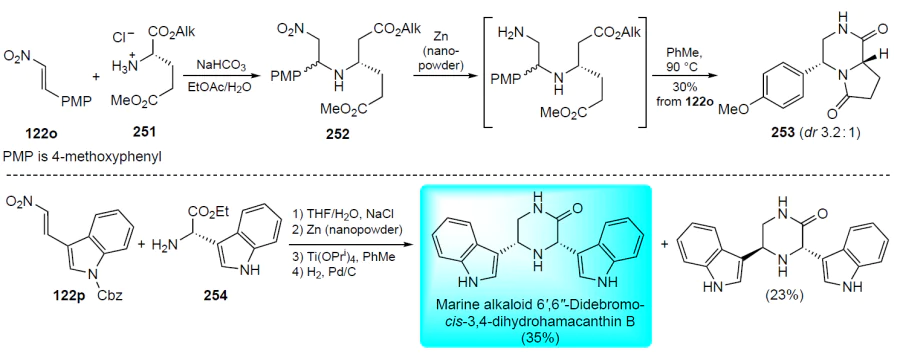
3.2. Friedel-Crafts reactions of α-nitroolefins
Ellman and Potter[210] reported an elegant synthesis of (+)-Pancratistatin, an alkaloid of Amaryllidaceae family. The key stage of this synthesis was the diastereoselective Rh(III)-catalyzed C – H bond addition of substituted benzamide 255 to D-glucose-derived nitroalkene 122q, leading to the formal Friedel – Crafts adduct 256 (Scheme 78). Importantly, this process tolerates the amide function that is not compatible with organometallic reagents often used in nucleophilic addition to nitroalkenes.[211] The developed Rh(III)-catalyzed C – H activation is distinguished by high diastereoselectivity (dr > 20 : 1) and mild reaction conditions (40°C). Deprotection of adduct 256 followed by treatment of the resulting crude furanose 257 with aqueous NaHCO3 gave compound 258 via an intramolecular Henry reaction. Remarkably, the cyclization was also stereoselective and provided 258 as a 10 : 1 mixture of diastereomers in 66% overall yield from 256. Final synthetic steps toward (+)-Pancratistatin included catalytic removal of the O-benzyl moiety, reduction of the nitro group and lactamization.
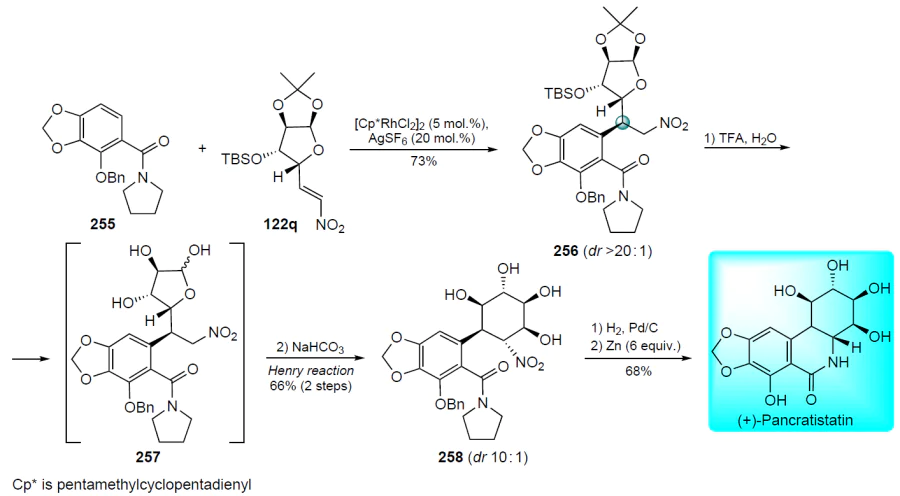
The enantioselective Friedel – Crafts reaction was used by Nagasawa and co-workers[212] as a suitable methodology for inducing chirality in the total synthesis of (+)-trans-Dihydrolycoricidine. This compound is the minimum pharmacophoric structural fragment responsible for antitumor activity of Amaryllidaceae alkaloids.[213] Indeed, sesamol (259) enantioselectively reacted with racemic nitroolefin 122r bearing a siloxy group at the δ carbon atom, in the presence of chiral guanidine/bis-thiourea organocatalyst C30 to give adduct 260 as an inseparable mixture of two diastereomers with up to 93% ee (Scheme 79). Operationally, this organocatalytic reaction was simple and applicable to a large-scale experiment without decrease of the enantioselectivity. After protection of the phenolic hydroxyl group in 260 with the triflic group, the exo-olefin double bond was cleaved with OsO4/NaIO4 and the resulting aldehyde was converted to a separable equimolar mixture of diastereomeric compounds 261a and 261b via an intramolecular Henry reaction. After successive protection of the hydroxyl group in diastereomer 261a containing (R)-configurated δ-C atom with triisopropylsilyl (TIPS) group, reduction of the nitro group with Zn/TMSCl reagent system followed by palladium-catalyzed CO insertion/ring closing reaction, the lactam 262 bearing the A,B,C ring system of (+)-trans-Dihydrolycoricidine was obtained. Subsequent regio- and stereoselective installation/transformation of functional groups in the ring C completed total synthesis of (+)-trans-Dihydrolycoricidine.
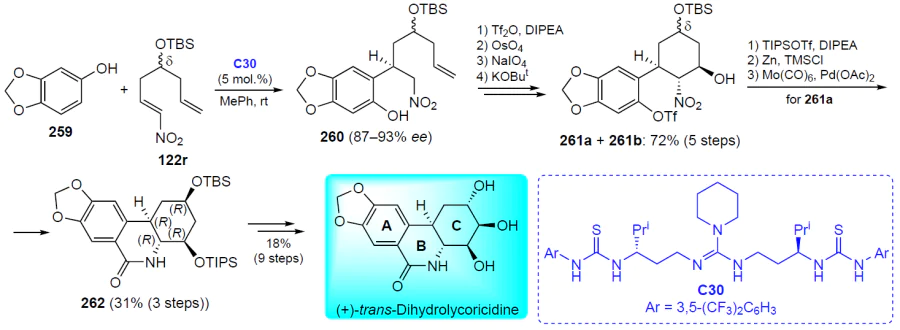
3.3. Domino, tandem and multicomponent reactions of α-nitroolefins
Domino and cascade reactions open excellent opportunities for the efficient asymmetric synthesis of complex organic molecules bearing several stereogenic centers from readily available precursors by simple experimental procedures.[214][215] They often proceed stereoselectively[216][217] and can be successfully employed for the synthesis of bioactive natural products containing complex carbocyclic and/or heterocyclic frameworks as well as synthetic compounds of therapeutic use.[218][219] The one-pot tandem transformations are also very promising as they significantly reduce the number of time-consuming laboratory operations such as isolation and purification of intermediates. Furthermore, they save reagents and solvents, minimize the generation of chemical waste and thus, can be viewed as ‘green’ processes.[220-222]
Trauner and co-workers[130] developed a concise synthesis of (–)-Tetrodotoxin employing a diastereoselective cascade involving Michael addition to nitroalkene, nitrile oxide generation and intramolecular [3 + 2]-cycloaddition. In their strategy, a glucose-derived building block 263 served as a starting compound, which was converted into iodide 264 in six steps (Scheme 80). Treatment of 264 with ButLi generated aldehyde 265, which simultaneously reacted with nitromethane through the Henry reaction and mesylation/elimination of nitroalcohol 266 to give nitroalkene 122s. The latter was involved in a diastereoselective oxy-Michael addition with 4-methoxybenzyl alcohol (PMBOH). The resulting nitronate anion 267 was intercepted with Boc2O to generate the nitrile oxide intermediate 268 that simultaneously underwent intramolecular [3 + 2]-cycloaddition to give bicyclic isoxazoline 269 as a single stereoisomer. Notably, the developed domino process allowed the assembly of the central cyclohexane core of Tetrodotoxin in a highly diastereoselective fashion on a decagram scale. Subsequently, PMB deprotection and introduction of the ethynyl moiety gave fused isoxazolidine 270, which was converted into the target (–)-Tetrodotoxin in 12 steps.
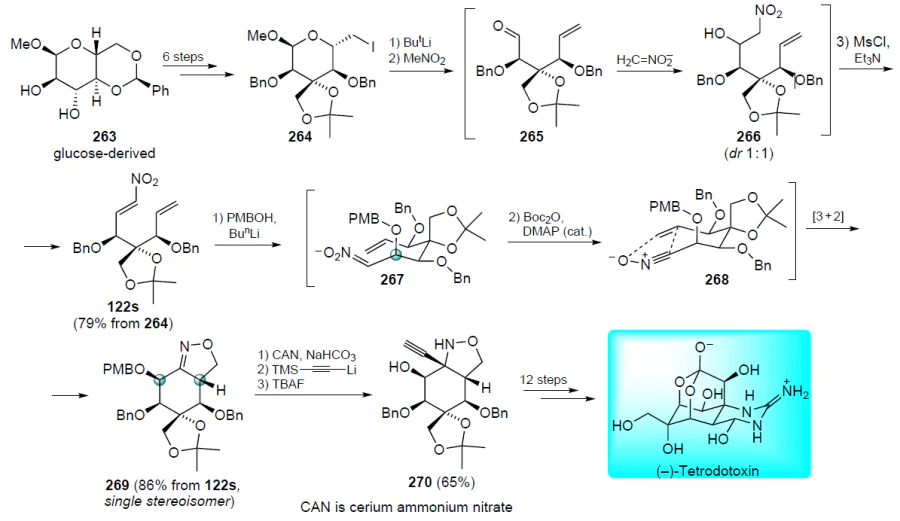
Hayashi and co-worker[223] developed an efficient one-pot enantioselective synthesis of compound ABT-341, a highly potent, selective, and orally bioavailable inhibitor of Dipeptidyl peptidase IV useful for therapy of type 2 diabetes.[224] This synthesis started with the enantioselective addition of acetaldehyde to nitrostyrene 122i bearing three fluorine atoms in the aromatic ring in the presence of the diphenylprolinol silyl ether organocatalyst (R)-C13a. Under optimized conditions corresponding Michael adduct 12h was obtained in 93% yield with 97% ee (Scheme 81). Treatment of the crude adduct 12h with vinyl phosphonate 271a in the presence of Cs2CO3 afforded cis-substituted cyclohexene cis-272 via the second Michael addition/intramolecular Horner – Wadsworth – Emmons reaction sequence. Isomerization of cis-272 to the required trans-272 proceeded quantitatively in the presence of Pri2EtN. After removal of accumulated volatile materials from the crude tert-butyl ester trans-272 it was transformed into carboxylic acid 273 by treatment with TFA and DCM. The coupling reaction of carboxylic acid 273 with heterocyclic amine 274 followed by a reduction of the nitro group to an amine with Zn and AcOH in AcOEt provided ABT-341. Importantly, the target API with the correct configuration of stereocenters was obtained from nitrostyrene 122i in a single flask over six synthetic steps and the total yield of the product was 63% after purification by acid – base extraction followed by column chromatography.
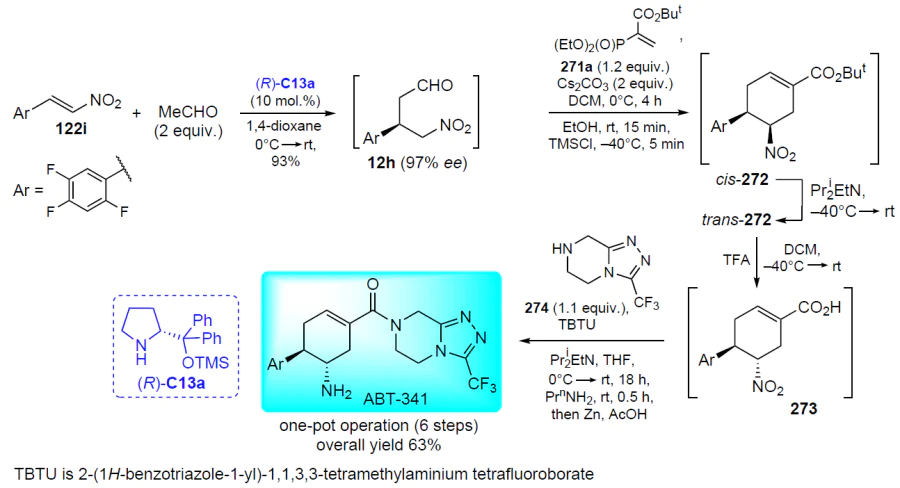
Later, Hayashi and Ogasawara[113] proposed a time-economical one-pot total synthesis of (−)-Oseltamivir, a neuraminidase inhibitor as an effective drug for the treatment of influenza.[225] The peculiarity of this five-step synthesis, which distinguishes it from one-pot syntheses of this medication reported earlier by the same[226] or other research groups[227-229] is optimization of all involved reactions to achieve maximal yield and selectivity with minimum reaction time. An asymmetric Michael addition of α-alkoxyaldehyde 275 to Z-β-acetylamino nitroethylene 276 proceeded smoothly in the presence of the catalytic system consisting of diphenylprolinol silyl ether (R)-C13b, thiourea C31, and formic acid at 20°C for 30 min to afford the Michael product 277 with good diastereoselectivity and high enantioselectivity (Scheme 82). Subsequent Michael/Horner – Wardsworth – Emmons domino reaction of adduct 277 with olefin 271b proceeded in the same vessel under the action of ButOK in EtOH affording the undesired 5R isomer of nitrocyclohexene 278 (5R/5S ~ 5 : 1). The amount of needed 5S isomer was enhanced to 5R/5S ~ 1 : 1 by treatment with TBAF under microwave (MW) irradiation conditions, although complete epimerization was not achieved. The last step involved the reduction of the nitro group to an amine using Zn and microwave irradiation. As a result, the total time for the (−)-Oseltamivir (3R,4R,5S-279) one-pot synthesis was reduced from 57 h to 1 – 3 h with 14% overall yield. In a follow-up study,[114] the authors accomplished the multistep continuous-flow synthesis of (–)-Oseltamivir from the same precursors without isolating any intermediates.
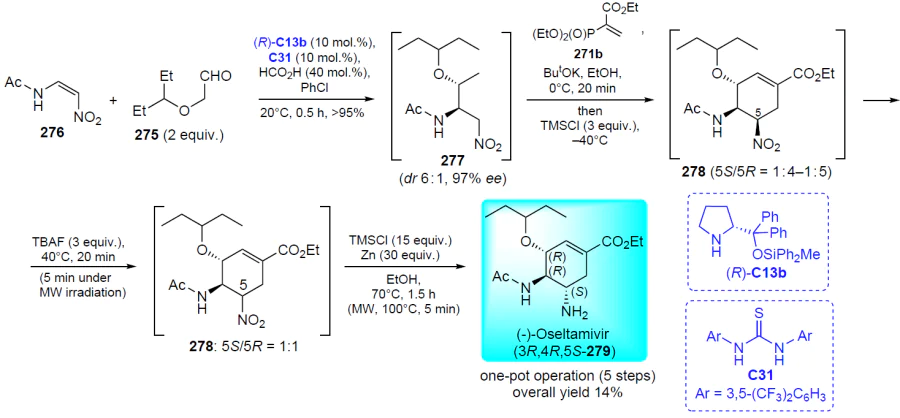
Šebesta and co-workers[115] applied similar synthetic methodology comprising stereoselective organocatalytic Michael addition, cyclization and reduction steps to multi-pot synthesis of three other stereoisomers of (–)-Oseltamivir. The anti-influenza activities of the prepared compounds tested in in vitro virus-inhibition assay in a hope that the stereoisomers would interact with the viral neuraminidase differently showing an improved antiviral activity. Although, the isomers displayed lower antiviral activity than that of (–)-Oseltamivir, one of them, (3S,4R,5S)-279, showed in vitro potency towards the Tamiflu-sensitive influenza viral strain A/Perth/2009/H1N1 comparable to Tamiflu.
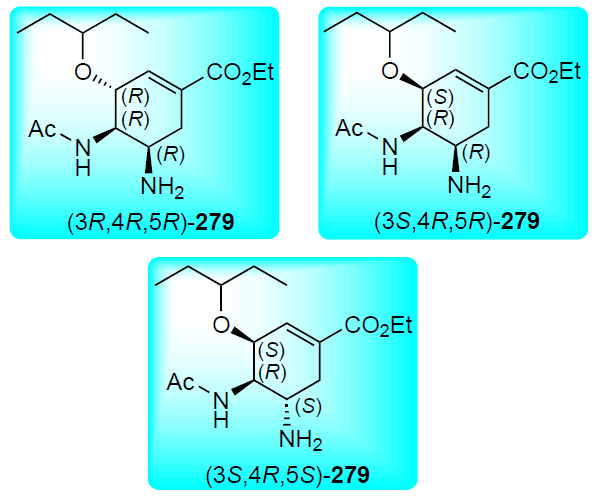
In 2025, Yang and co-workers[230] reported a concise enantioselective total synthesis of (+)-Lucidumone, a caged polycyclic meroterpenoid with a bicyclo[2.2.2]octane skeleton isolated from the fruiting bodies of G. lucidum, a mushroom commonly used in traditional Chinese medicine.[231] The key step of the synthesis is organocatalytic double Michael domino addition reaction between nitroalkene 280 and β-ketoester 281 that constructs the essential chiral bicyclo[2.2.2]octane framework with five contiguous stereocenters found in atisine-type and denudatine-type alkaloids and some other compounds with significant pharmacological activities. Benzoyl – quinine derivative C32 appeared optimal catalyst for this formal [4 + 2] annulation, delivering product 282 in 88% yield with excellent enantioselectivity and diastereoselectivity on a gram scale after brief treatment with TBAF (Scheme 83). Subsequent transformations including the Nef reaction on sterically congested compound 282, a TfOH-mediated tandem cyclodehydration/hydroalkoxylation cascade to install the indane and tetrahydrofuran ring systems and late-stage functional group manipulations afforded (+)-Lucidumone in 8.5% overall yield.
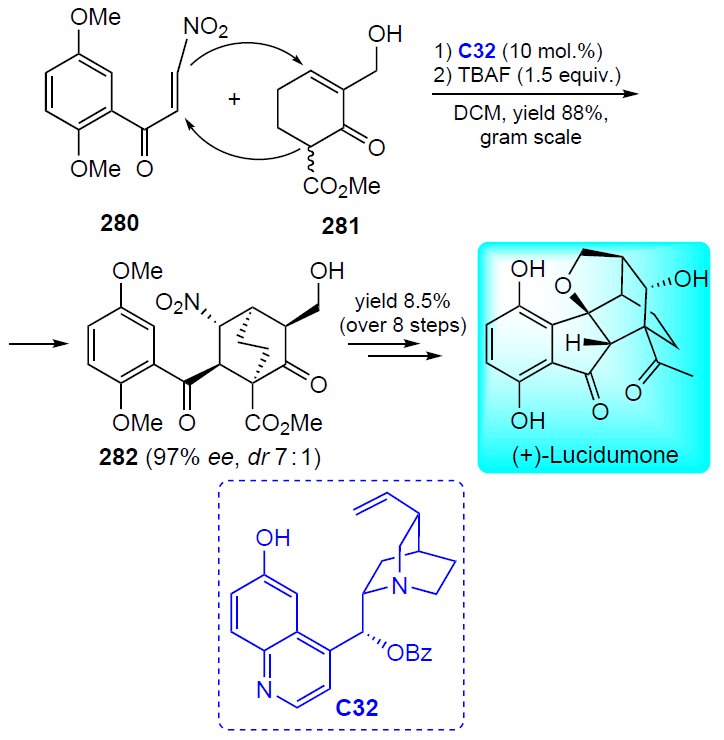
Cascade and domino reactions enable simple and straightforward stereoselective assembling various heterocyclic bioactive molecules, particularly those bearing fused and spiro-conjugated rings. Han and co-workers[232] described a simple and flexible organocatalytic cascade reaction involving a Michael – amination – hemiaminalization relay and used it to prepare a densely functionalized chiral hexahydropyridazine scaffold. Aliphatic aldehydes 152 reacted with nitroolefins 122 under mild conditions in the presence of a chiral secondary amine (R)-C13a/Brønsted acid catalytic system to afford enantioselectively intermediate adducts Int4 (Scheme 84). Adding azodicarboxylate and DBU to the reaction mixture in a one-pot operation mode resulted in successive amination and hemiaminalization. The tandem reaction proceeded smoothly to afford the desired hexahydropyridazines 284 with good diastereoselectivity and good to excellent enantioselectivity. Moreover, the introduction of an olefin moiety (R1 = –CH=CMe2) into the hexahydropyridazine core 284 allowed subsequent iodine-mediated tandem cyclization to access more structurally complex chiral natural product mimics, octahydrofuro[2,3-c]pyridazines 285, with nearly complete enantioselectivity. Both aromatic and heteroaromatic nitroolefins proved effective in this four-step cascade strategy. Importantly, one of the compounds synthesized by this method showed promising antiproliferative activity against MCF-7 breast cancer and HCT116 colon cancer cell lines.
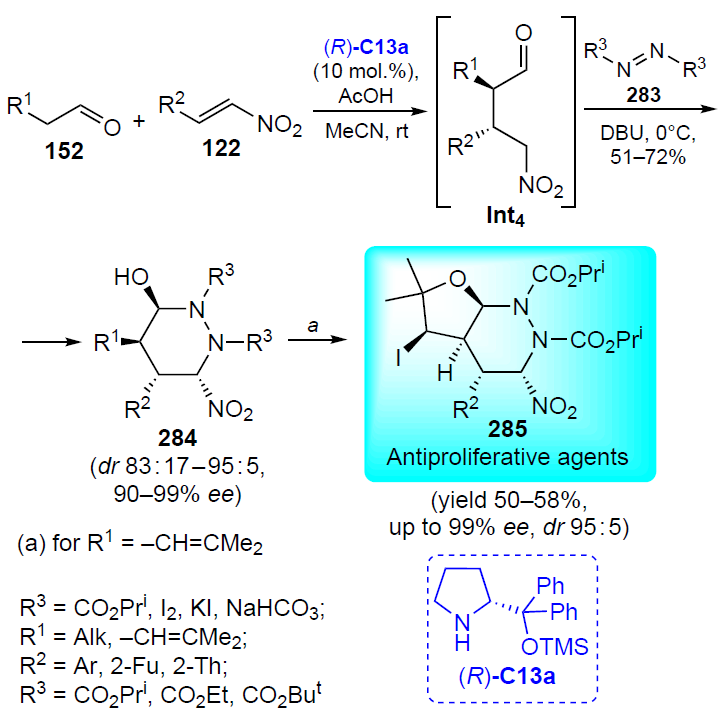
The same research group[233] used the organocatalytic cascade reaction in the asymmetric synthesis of novel chroman-fused spirooxindoles that potently inhibit cancer cell proliferation. The drug-like spirooxindole chroman scaffold was generated via a four-step organocatalytic relay cascade. The protocol started with the secondary amine (R)-C13a catalyzed oxa-Michael-Michael domino reaction of ortho-hydroxy nitrostyrenes 122t with β,β-disubstituted enal 135b (Scheme 85). The resulting chiral intermediates Int5 were then involved without isolation in the second catalytic process as a donor to induce base-promoted (K2CO3) asymmetric Michael reaction with the electron-deficient olefinic oxindoles 111. Subsequent cyclization via an intramolecular aldol reaction afforded the desired polycyclic fused and spiro-conjugated products 286. Finally, removal of the N-protecting groups in the oxindole ring and transformation or elimination of the nitro group gave compounds 287 and 288 having several hydrogen bonding sites capable of receptor/donor binding and a favorable combination of lipophilic and hydrophilic properties. The most potent compound 288b (R2 = 5-Cl) induced caspase-independent apoptosis and cell cycle arrest in MCF-7 breast cancer cells by interfering with the p53-MDM2 interaction and downstream pathways at the lowest IC50 value of 1.7 mM.
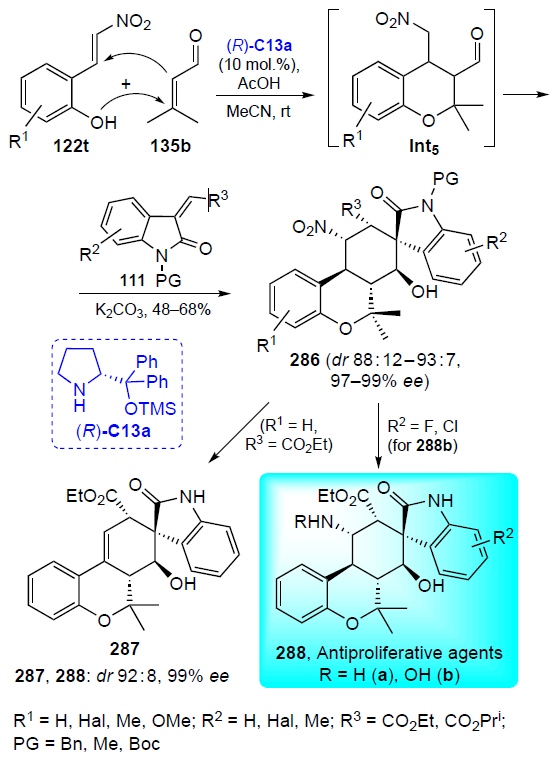
C3-Modified spiro-oxindoles with a rigid nitrogen heterocyclic system may be even more effective in inhibiting cancer cell proliferation providing a hydrophobic moiety for insertion into the Leu26 and Phe19 pockets binding sites.[234][235] To attain this goal, Han and co-workers[236] developed an asymmetric synthesis of pharmacologically interesting piperidine-fused spiro-oxindole derivatives via an organocatalytic Michael/aza-Henry/hemiaminalization cascade reaction sequence. At first, nitrostyrenes 122 reacted with enolizable aldehydes 152 in the presence of Hayashi – Jørgensen secondary amine catalyst (R)-C13a in toluene at room temperature providing chiral γ-nitroaldehyde intermediate Int4 (Scheme 86). Subsequent addition of N-protected isatin ketimine 289 and DBU as a base to the reaction mixture in a one-pot operation resulted in successive aza-Henry and hemiaminalization reactions to afford spiro-oxindolo-α-hydroxypiperidines 290 in moderate yield but with high diastereo- and enantioselectivity. The reduction of the obtained products 290 with Et3SiH followed by deprotection resulted in spiro-oxindole piperidine derivatives 291 and 292. The most potent compound 292 (R1 = Me, R2 = 4-ClC6H4, R3 = 6-Cl) was found to inhibit the interaction between MDM2 and p53 peptide with an IC50 of 0.91 ± 0.12 μM thereby inducing cell cycle arrest and suppressing proliferation of five breast cancer lines: MCF-7 (IC50 2.5 μM), ZR-75-1 (3.3 μM), BT-474 (35.5 μM), MDA-MB-231 (47.3 μM), and SKBR-3 (41.8 μM).
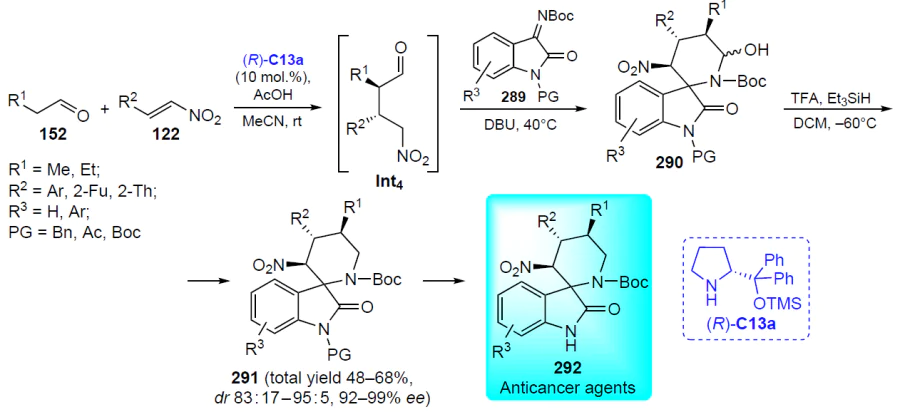
A year later, similar organocatalytic methodology was applied for the asymmetric synthesis of chiral spirocyclic pyrazolone – ferrocene organometallic hybrids 294 and 295, bearing up to six contiguous stereogenic centers, from nitroolefins 122, aldehydes 152, and ylidene-pyrazolones 293 (Scheme 87).[237] Docking studies suggest that ferrocene containing hybrids could fit well inside the large hydrophobic pocket between helices α2 and α3 in the RalA (Ras-related protein) allosteric site. The experimentally proved inhibitory effect towards recombinant RalA and two pancreatic cancer cell lines (PANC-1 and HPAF-II) was higher for compounds 294 with ferrocenyl group at position 4 of the cyclohexane ring, than for compounds 295 in both types of assays. The most active compound 294 (R1 = Me, R3 = Ph, R4 = 4-MeC6H4) showed an IC50 of 1.20 ± 0.19 μM in the RalA binding assay and IC50 values of 1.6 μM against PANC-1 and 4.8 μM against HPAF-II cells in MTT assays. Moreover, it triggered apoptotic fragmentation of nuclei in PANC-1 cells in a concentration-dependent manner.
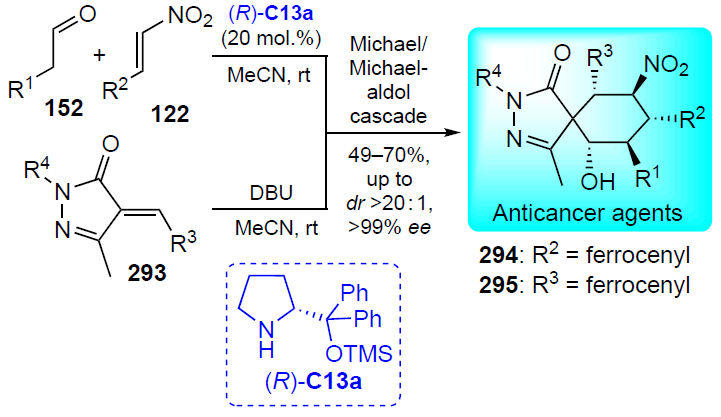
Another useful application of the cascade methodology to stereoselective preparation of fused heterocycles interesting for drug discovery is an efficient synthetic approach to bicyclic fused imidazoline derivatives.[238] In the presence of the Lewis base-catalyst (DABCO), readily available Morita – Baylis –Hillman carbonates 296 acting as C3-electrophiles undergo [3 + 3] annulation with heterocyclic β-nitroketene aminals 297a (N,C-dinucleophiles) to afford fused heterocyclic products 298 in good to excellent yields with diastereoselectivities up to 14 : 1. Most likely, these reactions proceed via a domino sequence of SN2' substitution and intramolecular Michael addition reactions (Scheme 88). The method also appeared suitable for highly diastereoselective synthesis of optically pure bicyclic imidazolines 299 using (S,S)-2-(nitromethylene)-4,5-diphenyl-imidazolidine 297b as a chiral building block. Some of the prepared compounds interfere with the MDM2-p53 interaction in cancer cells inhibiting their proliferation. The most potent compound 299 (R1 = 4-BrC6H4) inhibited proliferation to the greatest extent, giving IC50 values of 0.76 against HCT116 cells and 2.87 μM against MDA-MB-231 cells.
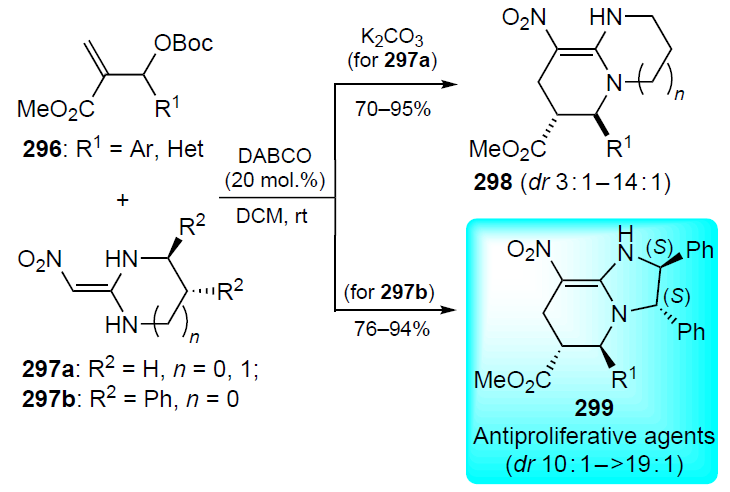
3.4. α-Nitroolefins as dipolarophiles
Nitroalkenes are reactive dipolarophiles in [3 + 2]-cycloaddition processes. This reactivity enables a rapid increase in molecular complexity providing access to valuable cyclic amino-substituted scaffolds. Thus, the synthesis of racemic 3,4-trans-pyrrolidinyl amine 302, a common precursor to drug candidates with antimalarial and anticancer activities, was achieved through a stereoselective 1,3-dipolar cycloaddition of nitrostyrene 122u with azomethine ylide (Scheme 89).[239] The ylide was generated in situ from N-(methoxymethyl)-N-(trimethylsilylmethyl) benzylamine 300 in the presence of TFA. The [3 + 2]-cycloadduct 301 was formed as a single trans-isomer in 79% yield. Conversion of the nitro group to the primary amine was accomplished using SnCl2 or Fe/NH4Cl system. Subsequent amide coupling and reductive debenzylation was used to prepare a series of derivatives with antimalarial activity or hERG blocking Akt inhibitors.[240]
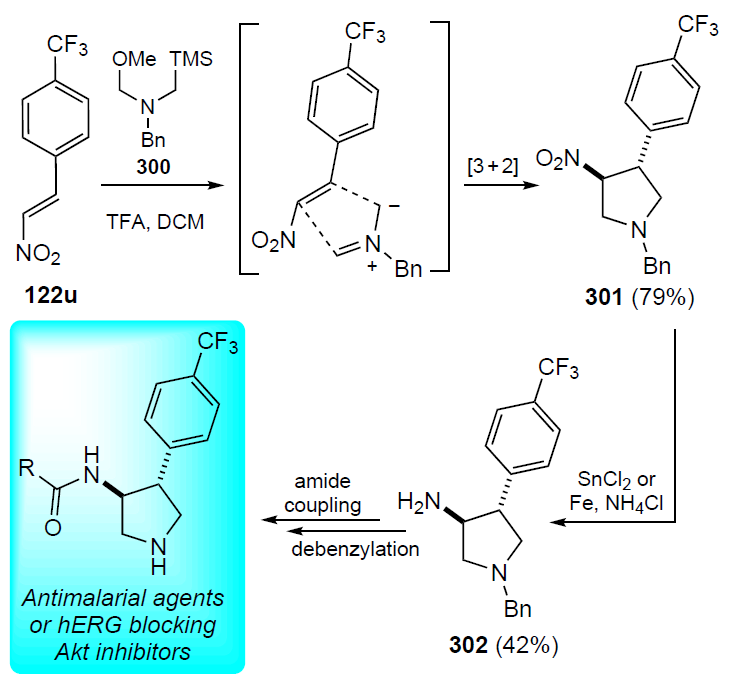
Hu and co-workers[100] developed a one-pot synthesis of spirocyclic oxoindole-tetrahydrofurochroman motif from nitroalkenes via a highly stereoselective [3 + 2]-cycloaddition/cyclization cascade (Scheme 90). In this approach, Rh-catalyzed reaction of 3-diazooxindole 303 with o-functionalized aromatic aldehydes 55d generates 1,3-dipoles that undergo [3 + 2]-cycloaddition with nitrostyres 122 in a regio- and diastereoselective fashion. Treatment of adducts 304 with DBU initiates intramolecular Michael addition that finishes the assembly of the pentacyclic core 305. Notably, the products were obtained with dr > 99 : 1 and high yields in most cases (except for 4-chloro-substituted diazooxindole, R2 = 4-Cl). A similar process was realized by a Rh-catalyzed reaction of diazooxindoles 303 with aldehydes and nitrostyrenes 122v bearing an acrylate fragment in the ortho-position. As a result, adducts 306 (isomeric to 305) were formed in 40 – 90% yields, again with very high levels of diastereocontrol (dr > 99 : 1). The reason for the observed stereochemistry for the initial cycloaddition products is the formation of trasition state TS2 with anti-orientation of nitrostyrene and oxindole aryl moieties. Biological studies showed that the obtained oxindole – tetrahydrofurochroman derivatives could act as a new class of proteintyrosine phosphatase 1B (PTP1B) inhibitors.
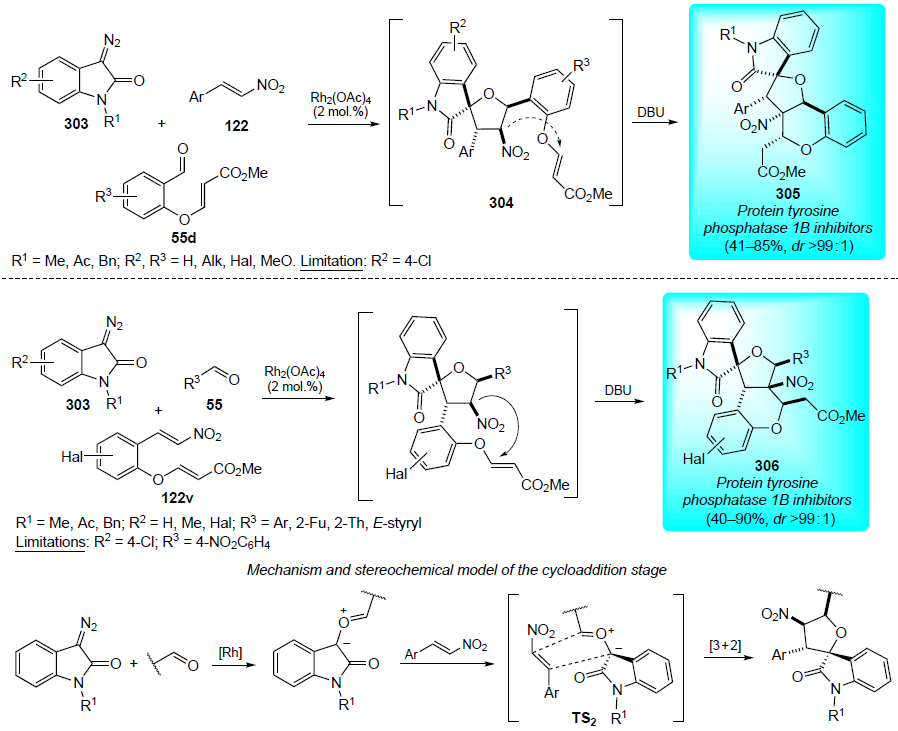
4. Other nitro compounds and their derivatives in pharmacology-oriented stereoselective synthesis
Apart from nitroalkanes and nitroalkenes, some other nitro-derivatives, such as nitro-substituted heteroarenes, nitronates, and N,N-bis(siloxy)enamines, are useful substrates and intermediates in stereoselective reactions leading to pharmaceutically relevant molecules.
4.1. Nitro-substituted arenes and heteroarenes
In 2024, Yuan and co-workers[241] reported a novel palladium-catalyzed asymmetric decarboxylative [3 + 2] cycloaddition reaction between 5-vinyloxazolidine-2,4-diones 307 and 3-nitroindoles 308 in the presence of a chiral phosphoramidite L16/Pd2(dba)3 · CHCl3 catalyst system (Scheme 91). A key step was the asymmetric decarboxylation of 5-vinyloxazolidine-2,4-diones 307 to in situ generate amide-containing aza-π-allylpalladium 1,3-dipoles Int6. The latter gave rise to a dearomatizative [3 + 2] cycloaddition of 3-nitroindoles 308 for the formation of a series of highly functionalized pyrroloindolines 309 containing three contiguous stereogenic centers in 55 – 99% yields with high to excellent diastereo- and enantioselectivity. Indole alkaloids that contain a pyrroloindoline structural core are frequently associated with useful biological activities, including anticancer and antibacterial effects and cholinesterase inhibition.[242]
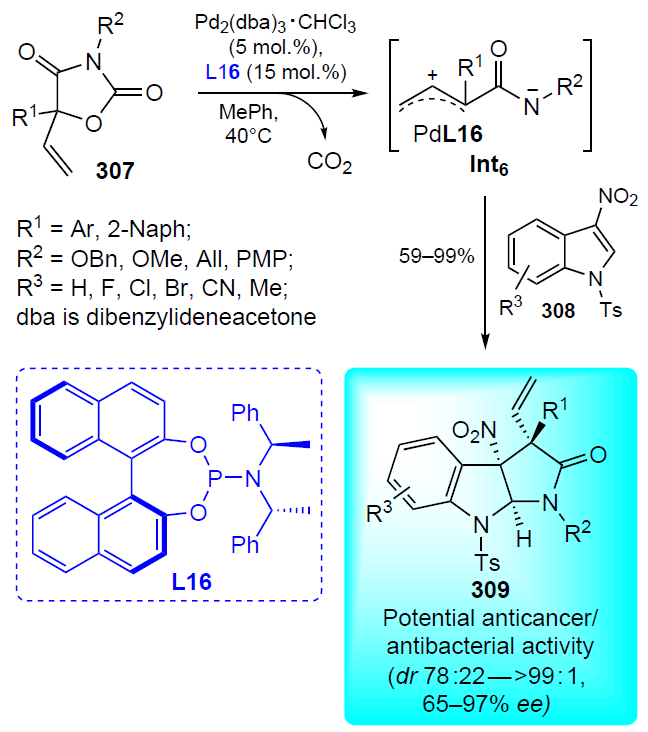
In a follow-up study,[243] a general copper(I)/biphosphine L17 catalytic system has been developed for the enantioselective heteroarylation of α-fluoro pyridinyl acetates 311 with 2-nitrobenzofurans 310. This reaction proceeds via a dearomatization – denitrative re-aromatization process enabling to produce enantioenriched α,α-diheteroaryl-α-fluoroacetates 312 or 312' featuring a fluorinated quaternary stereocenter (Scheme 92). Importantly, the developed protocol facilitates late-stage modification of certain bioactive molecules, such as inflammatory drugs Indomethacin and Oxaprozin, with fluorinated 2-nitrobenzofurans affording products 312'a,b with 92 – 94% ee. Furthermore, the protocol demonstrated robustness with 2-nitrobenzofuran-incorporated biologically active molecules such as Isoxepac (anti-inflammatory) and Gemfibrozil (blood triglyceride-lowering drug), as well as Linoleic acid, delivering the corresponding hibrid products 312'c–e in good yields and 97 – 98% ee. Additionally, substrates derived from chiral drug molecules and natural products, such as (S)-(+)-Ibuprofen, Naproxen, and (−)-Camphorsulfonic acid, were also applicable for the developed methodology, providing products 312'f–h in high yields and excellent stereoselectivities.
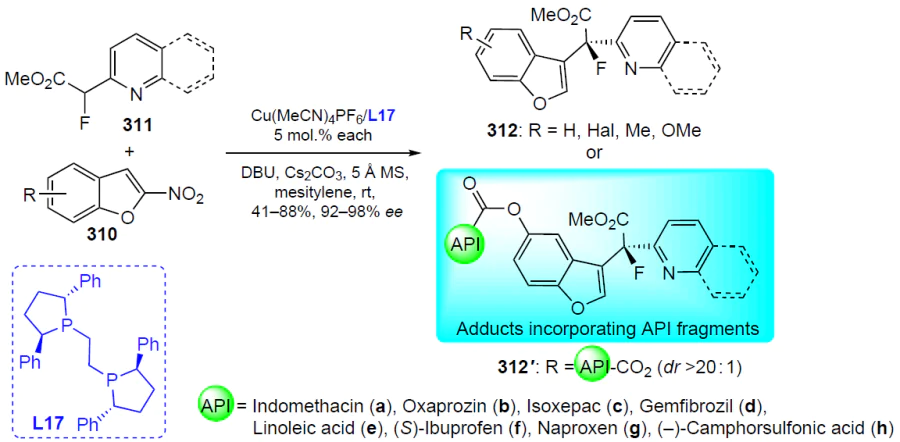
Transition metal-catalyzed hydroamination of alkenes recently emerged as a useful strategy to access complex amine-containing frameworks. Baran and co-workers[244] demonstrated that olefin hydroamination can be performed with nitroarenes using an abundant Fe(acac)3 as a catalyst, and PhSiH3 and zinc metal as reducing agents.[244] The reaction is believed to proceed through a radical mechanism involving the formation of alkyl radical from olefin followed by its addition to the nitrosoarene generated by the reduction of the nitro group as key steps. Gao and co-workers[245] successfully employed this method to modify the C – 5 position in dehydroepiandrosterone (DHEA) 313 (Scheme 93). Despite the structural complexity of the DHEA molecule, hydroamination of the alkene moiety went smooth affording the desired 5α-arylamino-DHEAs 314 in 53 – 72% yield. Importantly, the process was stereoselective that is rare for radical reactions. The resulting modified DHEAs showed antiproliferative activity against MCF-7 cells in micromolar concentrations.
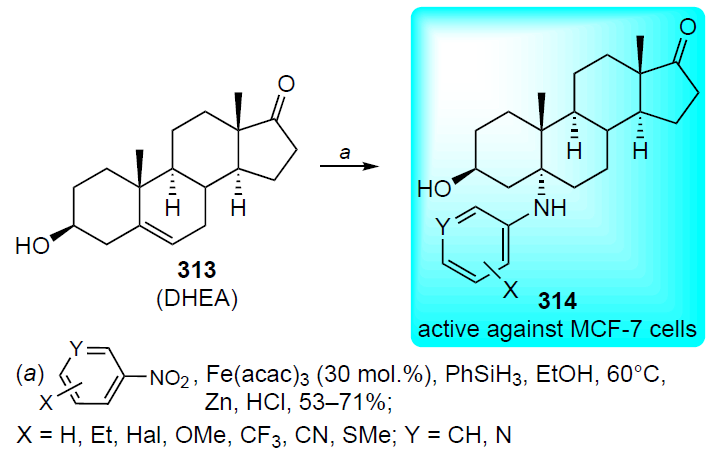
4.2. Nitronates and N,N-bis(oxy)enamines
The reactivity of nitronates, ethers of tautomeric aci-nitroalkanes, significantly differs from that of common nitroalkanes resembling the reactivity of 1,3-dipoles, N-oxides and imines.[246][247] Silyl nitronates are readily accessible through direct silylation of aliphatic nitro compounds. Ioffe and co-workers[248][249] demonstrated the ability of silyl nitronates to react as C-electrophiles upon activation with TMSOTf. In these reactions, silyl ketene acetals act as nucleophiles providing access to precursors of β-amino acids. Later, List and co-workers[250] developed an asymmetric version of this transformation using chiral imidodiphosphorimidate-based catalysts (IDPi) (Scheme 94). The proposed mechanism involves the formation of silylated IDPi C33 through a silyl group transfer from the silyl ketene acetal 316. The resulting ‘activated’ Si-IDPi silylates nitronate 315 generating N,N-bis(siloxy)iminium cation 317 that reacts with silyl ketene acetal to give nitroso acetal 318. The reaction is highly enantioselective (er >95 : 5 in most cases) with low catalyst loadings and broad substrate scope tolerating electron-rich aromatics and various reactive functionalities (double and triple C,C-bonds, ketones, primary halides, etc.). Starting from commercially available 1-nitrohexane, an asymmetric gram-scale synthesis of protected 3-aminooctanoic acid 319 was accomplished. The required nitroso acetal precursor 318a was prepared by addition of 316 to silyl nitronate 315a in quantitative yield and er 96 : 4 with only 1000 ppm of the catalyst C33. Notably, 3-aminooctanoic acid (D-BAOA) is part of some cytotoxic cyclic peptides, such as hormothamnin A.[251] Thus, the synthesis of a novel tripeptide 320 containg D-BAOA, proline and phenylalanine residues was successfully demonstrated by the authors from the protected derivative 319. A pecularity of this IDPi-catalyzed approach is that it can afford products having a chiral center on the N-atom.[252]
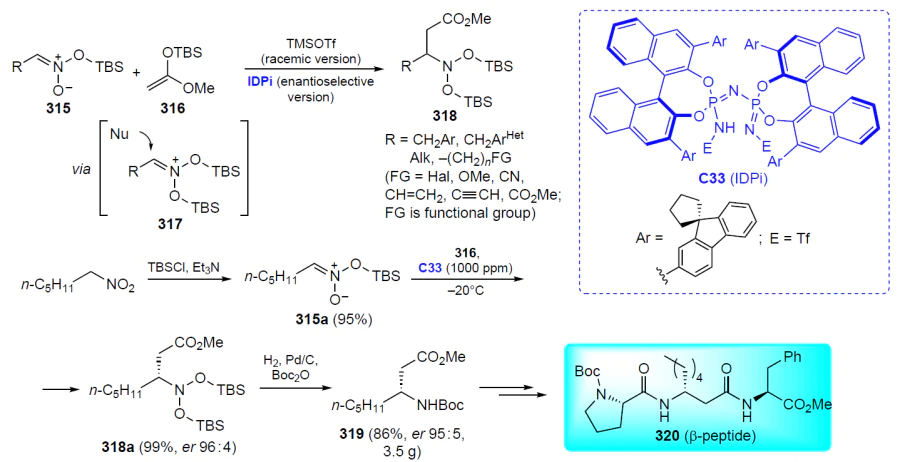
Cyclic nitronates are also promising intermediates in synthetic strategies enabling fast generation of molecular complexity. Importantly, the formation of cyclic nitronates is often diastereoselective thus making them convenient intermediates in the synthesis of stereochemically complex pharmaceutically relevant molecules.[124][253][254]
In the past decade, the synthesis and applications of five-membered cyclic nitronates (isoxazoline N-oxides) have been extensively developed.[255-258] One general approach relies on the [4 + 1]-annulation of nitroalkenes with synthetic equivalents of carbenes, such as ylides and α-haloketones.[246] This process was exploited to access isoxazoline 324, a known precursor of alkaloids of Clausenamide family (Scheme 95).[259] Thus, [4 + 1]-annulation of nitroalkene 321a with CO2Et-substituted sulfur ylide 322 gave isoxazoline N-oxide 323 in 69% yield as a sole 4,5-trans-isomer. Subsequent Boekelheide reaction (benzoylation/[3,3]-rearrangement) involving the treatment with p-nitrobenzoyl chloride/AgOTf afforded the desired product 324 as a separable mixture of C-1' epimers.
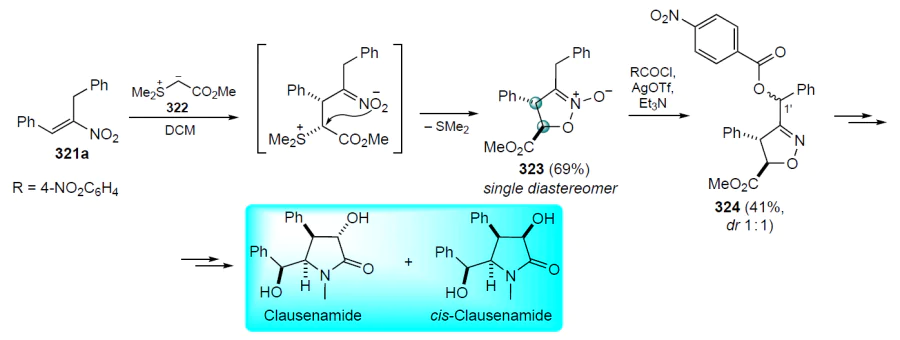
In 2021, Myers and co-workers[260] developed a stereoselective synthesis of an amino sugar fragment of the lincosamide antibiotics, in particular Methylthiolincosamine and its structural modifications, via an isoxazoline N-oxide intermediate (Scheme 96). The isoxazoline ring was assembled by a Cu-catalyzed condensation of primary nitro compound 326 with the epoxy-substituted aldehyde 325 that involved the Henry reaction followed by recyclization of the resulting nitronate anion 327. The process proved inefficient with inorganic base catalysis, while the use of catalytic system Cu(II)/cyclohexanediamine ligand L18 led to a diastereoselective formation of isoxazoline N-oxide 328 in 88% yield on a decagram scale. This product was then converted to isoxazolidine 329 through reduction of the nitronate moiety and manipulating protecting group. Next, tungsten(0)-catalyzed glycal formation and epoxidation of 330 afforded oxirane 331, which was converted into the Methylthiolincosamine by epoxide ring opening with methyl thiolate and N – O bond cleavage. Interestingly, in this strategy, the isoxazolidine ring served as a masked 1,3-aminoalcohol moiety throughout almost all the synthetic route. Another advantage of the isoxazoline N-oxide intermediate was a complete stereocontrol at C-6 during the reduction of the C=N bond.
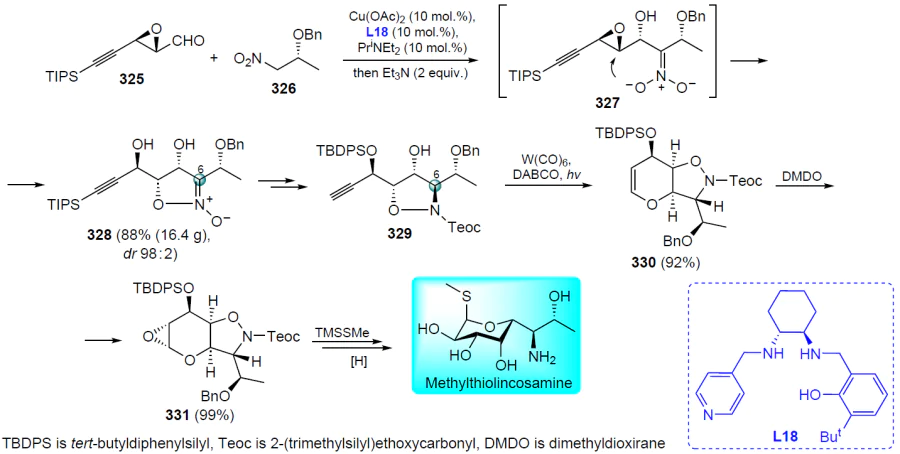
A common synthetic route to six-membered cyclic nitronates (5,6-dihydro-4H-1,2-oxazine N-oxides) consists in the [4 + 2] cycloaddition of nitroalkenes with olefins,[246] albeit other strategies have also been developed.[261-263] The use of these intermediates in total synthesis and modification of natural molecules has been demonstrated previously by Denmark et al.,[124] Sukhorukov[254] and other researchers.[264-266] In 2020, an efficient route to asymmetric synthesis of MSD’s potent antagonists of human neurokinin 1 receptor hNK1 (biological target associated with antiemetic activity[267]) has been developed through a diastereoselective [4 + 2]-cycloaddition of nitrostyrenes with chiral vinyl ethers.[125][268] In particular, a SnCl4-promoted cycloaddition of nitrostyrene 321b with dienophile 332 bearing Whitesell’s chiral auxiliary delivered 1,2-oxazine N-oxide 333 in 97% yield and dr 12 : 1 (Scheme 97). Subsequent hydrolysis of the propionate ester and catalytic hydrogenation of the nitronate moiety resulted in a tandem 1,2-oxazine ring reforming to give pyrrolizidinone 334 in a completely stereoselective fashion with regeneration of the chiral auxiliary alcohol. In the last stage, 6-hydroxy-substituted pyrrolizidinone 334 was coupled with trichloroimidate 335 to give target hNK1 antagonist (+)-336.
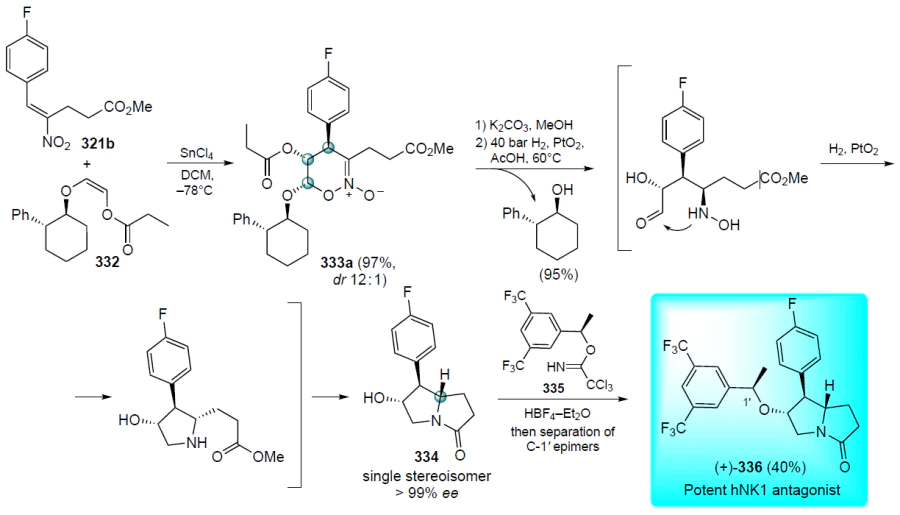
To access another hNK1 antagonist 339, 1,2-oxazine N-oxide 333b was subjected to Boekelheide rearrangement with PivCl/Et3N to introduce a protected hydroxyl group in the side chain (Scheme 98).[268] Subsequent hydride reduction and catalytic 1,2-oxazine ring contraction in 337 afforded protected prolinol 338 that was converted into the desired pyrrolooxazolidinone 339. Via this strategy, both (+)-339 and (–)-339 were successfully prepared by using different enantiomers of Whitesell’s chiral auxiliary 332. A similar strategy was also utilized to access phosphodiesterase 4 inhibitors structurally related to 339.[269][270]
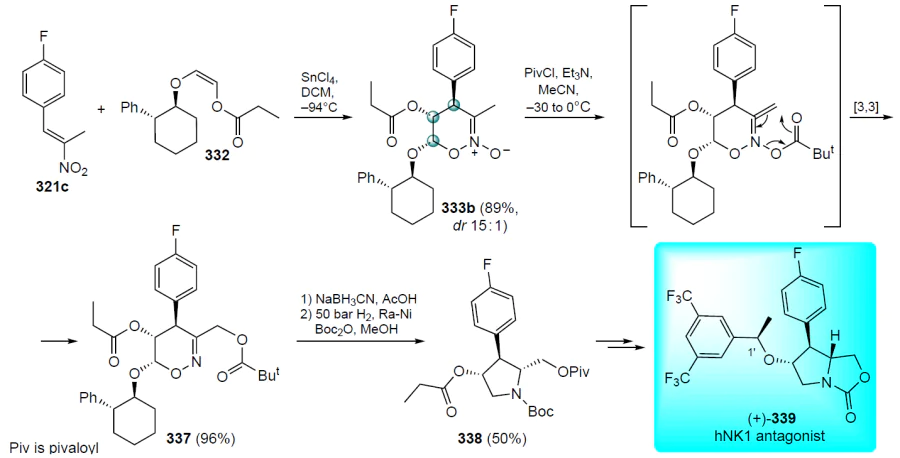
N,N-Bis(oxy)enamines are yet other derivatives of nitroalkanes with versatile reactivity and high synthetic potential. These intermediates can be accessed through silylation of nitroalkanes or nitronates. Remarkably, N,N-bis(oxy)enamines possess an activated β-position that exhibits chameleonic behavior being able to react both with electrophiles and nucleophiles.[254][271] In 2019, the reaction of N,N-bis-(siloxy)enamines 340 with carbonyl-stabilized sulfur ylides 322b leading to the assembly of isoxazolines 341 has been reported by Sukhorukov and co-workers[272] (Scheme 99). This strategy redesigns the classical [3 + 2]-cycloaddition approach to isoxazolines via nitrile oxides[273][274] to a more regioselective [4 + 1]-annulation. The [4 + 1] process is diastereoselective resulting in the 4,5-trans-arrangement of substituents in the isoxazoline ring. Catalytic reduction of isoxazolines 341 provides a route to valuable 3-hydroxypyrrolidine scaffolds via a ring reconstruction process (cleavage of the N – O bond and intramolecular reductive amination). Using this method, a diastereoselective synthesis of Merck’s potent neurokinin NK1 receptor antagonist 345 was accomplished in only 5 steps from nitroethane. Double silylation of nitroethane followed by [4 + 1]-annulation with ylide 322b afforded isoxazoline 342 in high yield. Catalytic hydrogenation of 342 led to 3-hydroxypyrrolidine 343 in a completely diastereoselective fashion. Subsequent benzylation with mesylate 344 and deprotection finished the synthesis of the target NK1 receptor antagonist 345.
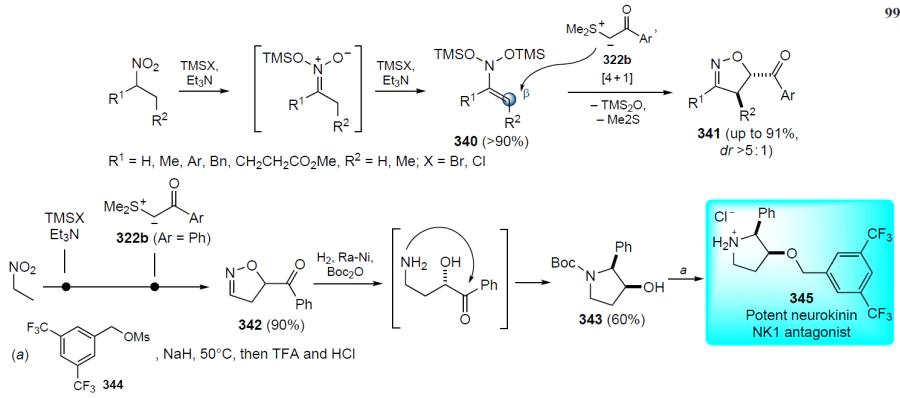
5. Pharmacology-oriented enantioselective nitration reactions
Along with asymmetric Michael or cycloaddition reactions of nitroalkenes mediated by transition-metal catalysis or organocatalysis, new perspective approach to enantioselective preparation of functionalized aliphatic nitro compounds useful for pharmacology based on asymmetric nitration of prochiral aliphatic sp3 centers has emerged over the past decade. Lv and Li[275] presented the Ni(II)/chiral PyBox – catalyzed direct asymmetric nitration of 3-substituted oxindole derivatives 346 with tert-butyl nitrite (TBN) under oxygen, providing an easy and efficient access to various chiral tertiary 3-nitro oxindoles 347 with good enantioselectivities under mild conditions (Scheme 100). Based on the control experiments and DFT calculations, the authors proposed a plausible nitration mechanism involving a single-electron transfer (SET) induced radical process. The TBN could undergo homolitic dissociation to give the ButO and NO radicals, while the NO radical is inclined toward oxidation to NO2 radical by O2. Meanwhile, oxindole 346 coordinates with chiral Ni(II) complex forming intermediate Int7, which underdoes a hydrogen atom transfer process mediated by the ButO radical to generate the key chiral oxindole radical Int8. Enantioselective coupling the latter with the NO2 radical followed by elimination of the organometal catalyst NiCl2L19 afforded enantimerically enriched 3-nitro oxindoles 347. The synthetic potential of this asymmetric nitration method was demonstrated by constructing Cipargamin (a potent antimalarial agent) analogs.
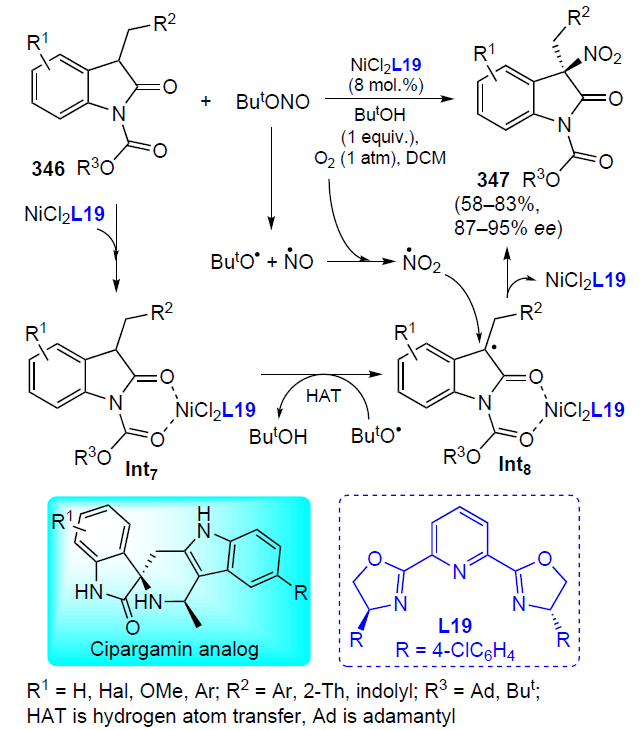
Another recently emerged methodology for the enantioselective preparation of functionalized aliphatic nitro compounds is based on biocatalytic nitration reactions. Zheng and co-workers[276] discovered that unusual halohydrin dehalogenase, HHDHamb from the Acidimicrobiia bacterium, can promote bio-nitration of epoxides with sodium nitrite as a nitrating agent under very mild conditions. The bio-nitration proceeded at 0.5°C with high chemo-, regio- and enantioselectivity via kinetic resolution of various racemic styrene epoxides rac-348 to enantiopure β-nitroalcohols 349 bearing nitro group at the stereocenter in up to 41% isolated yield and > 99% ee (Scheme 101). Chiral β-nitroalcohols are essential precursors to important pharmaceuticals, and fine chemicals. The proposed bio-catalytic approach is complementary to the asymmetric Henry reaction (see Section 2.2). However, it eliminates usage of nitroalkanes conventionally produced by harmful for the environment traditional nitration methods.
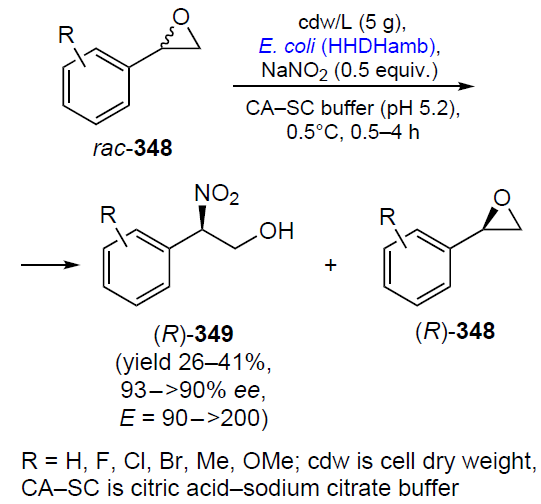
A year later,[277] a similar biocatalytic approach was applied for nitrative kinetic resolution of racemic phenyl glycidyl ether derivatives 350. Remarkably, the authors engineered the HHDHamb variants RM and SM which exhibit significant R- or S-stereoinduction, respectively, in the deracemization via bio-nitration of epoxides rac-350 with NaNO2. As a result, β-nitroalcohols (R)-351 were produced in 20 – 43% yields with 90 – 99% ee in the presence of HHDHamb-RM, whereas enantiomeric β-nitroalcohols (S)-351 were preferably generated in 35 – 45% yield with 90 – 99% ee in the SM catalyzed bio-nitration reactions (Scheme 102). Importantly, the bio-nitration method retains efficacy even at a high substrate concentration (up to 150 g/L). Some of the prepared enantiomeric β-nitroalcohols 351 are direct precursors to chiral β-adrenergic blockers, such as Xibenolol, Propranolol, Moprolol, Alprenolol, Toliprolol, Metoprolol, and Esmolol. Furthermore, representative synthesis of Metoprolol enantiomers from enantiomeric precursors 351a (R = 4-(CH2)2OMe) was accomplished through simple chemical transformations, yielding (R)- or (S)-Metoprolol in good yields with excellent optical purity. These results further demonstrate the utility of the biocatalytic nitration strategy for medicinal chemistry.
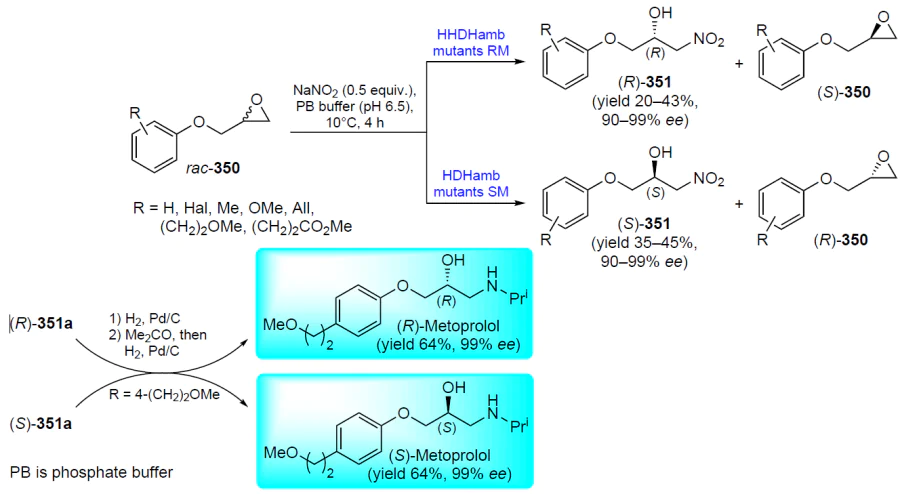
6. Nitro compound-sourced asymmetric bioactive molecules described in the review
This section provides a list of the natural compounds and pharmaceutical substances discussed in the review, as well as the stereoinduction methods used for their synthesis; it indicates where more detailed information can be found and lists main references to the original articles (Table 1).
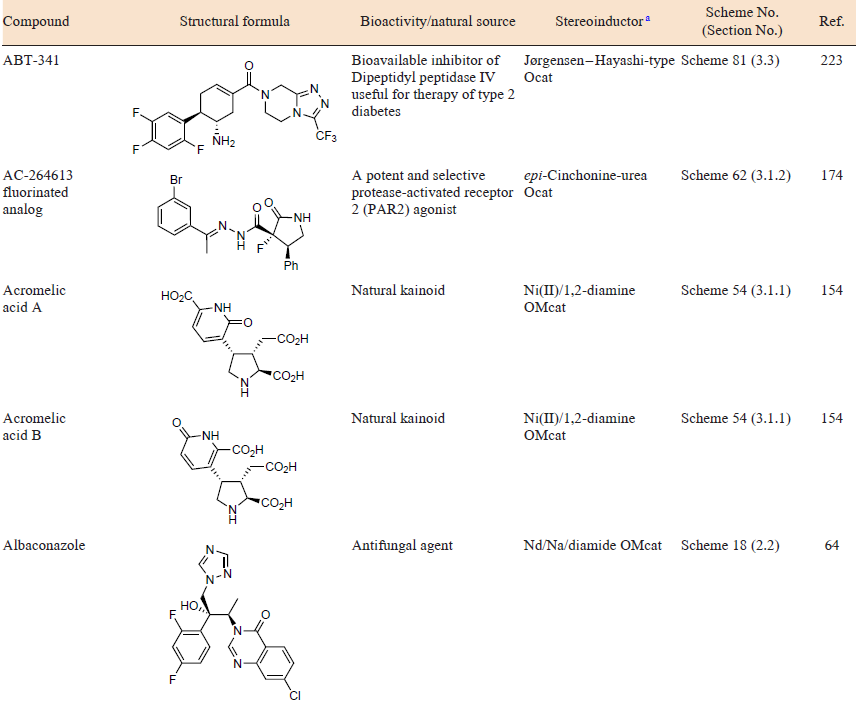
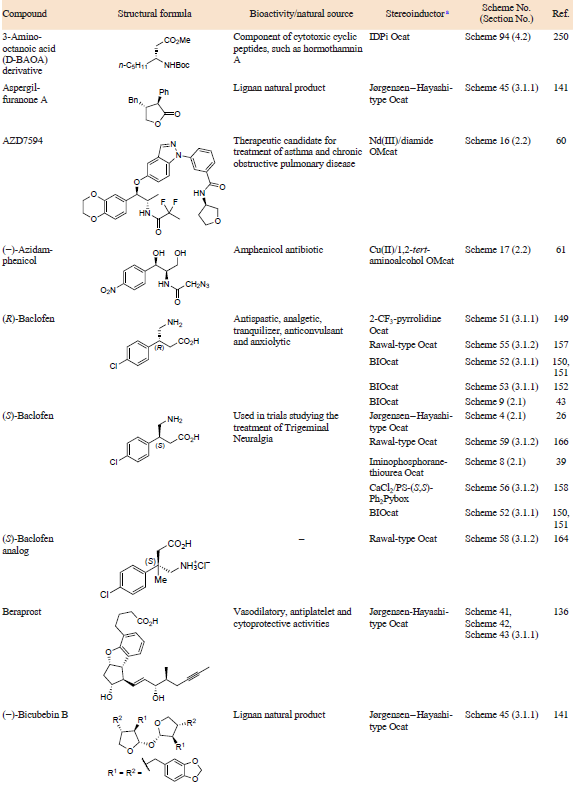
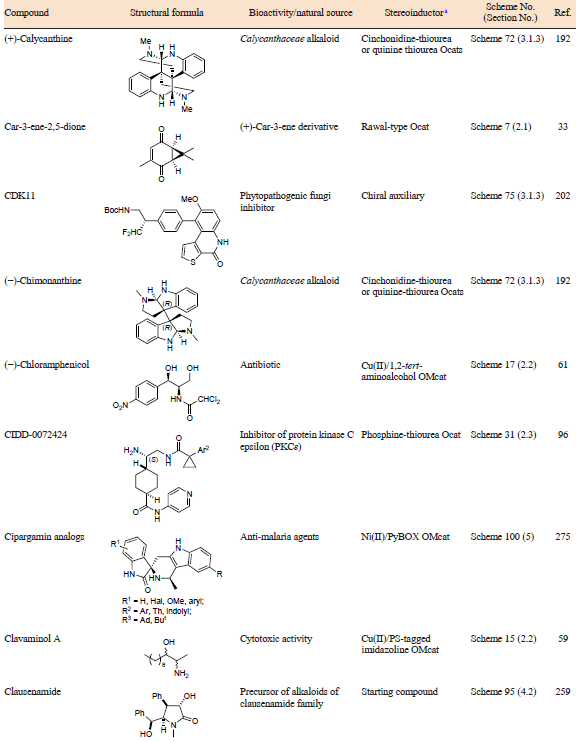
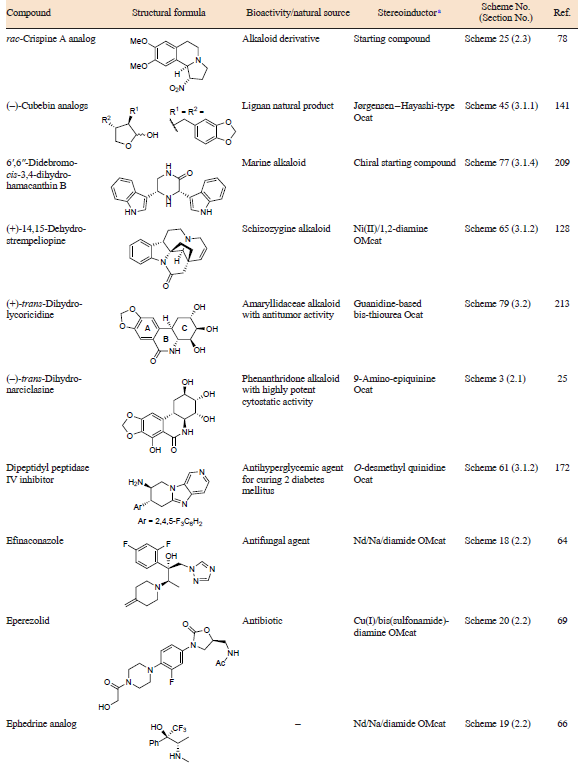
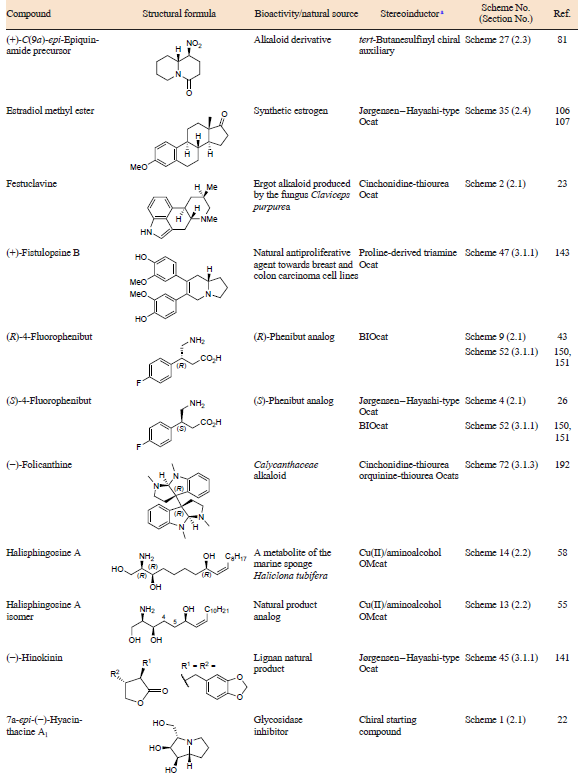
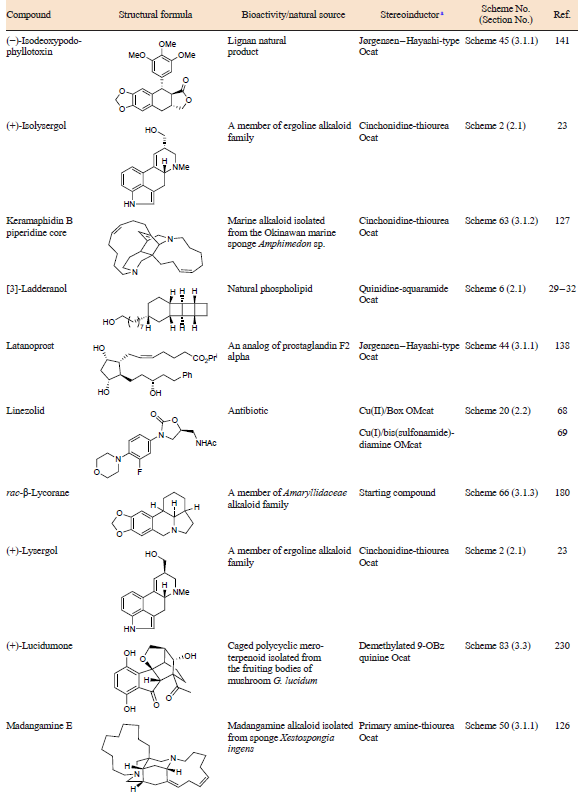
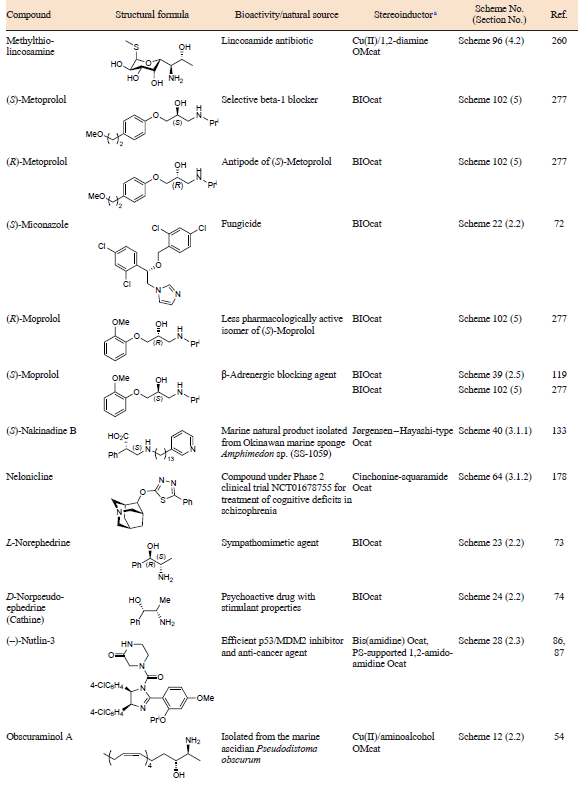
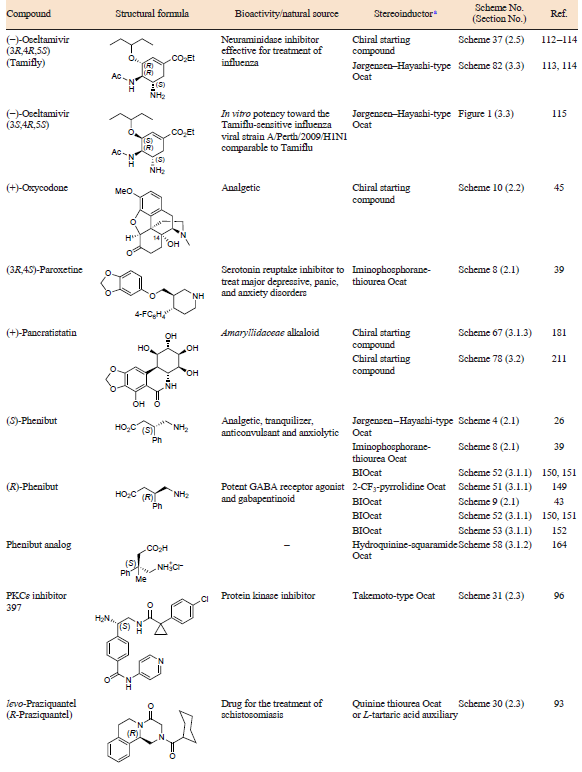
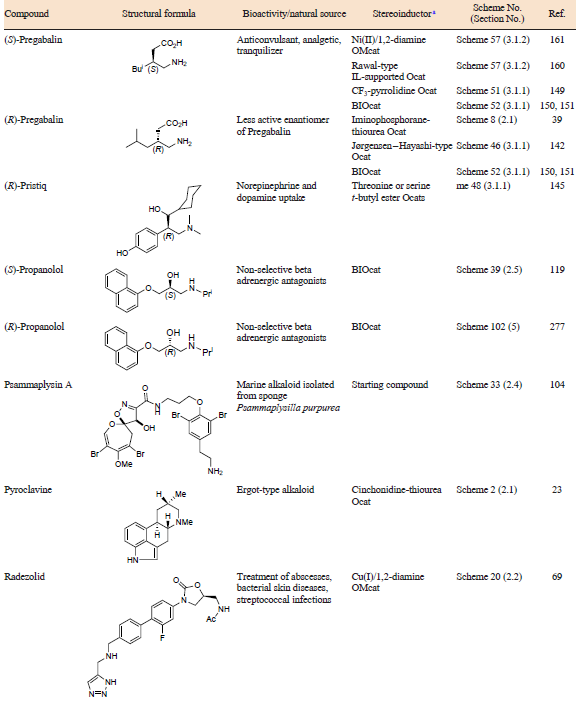
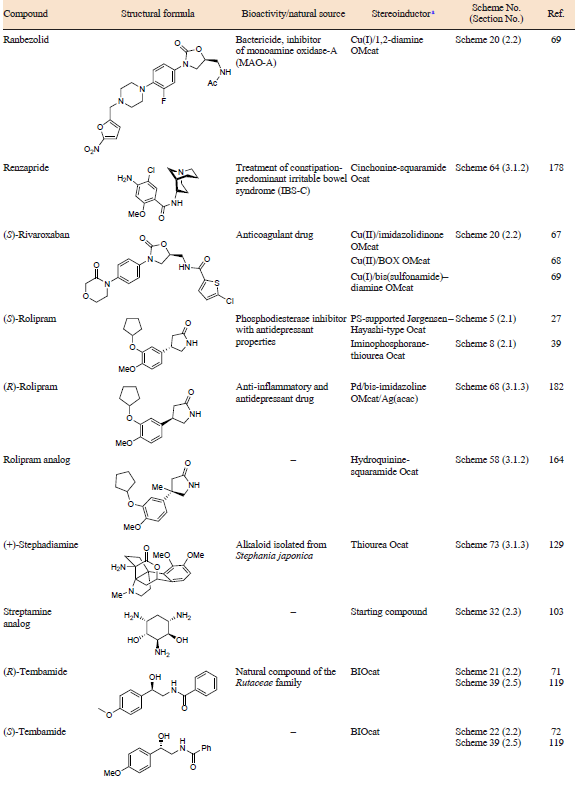
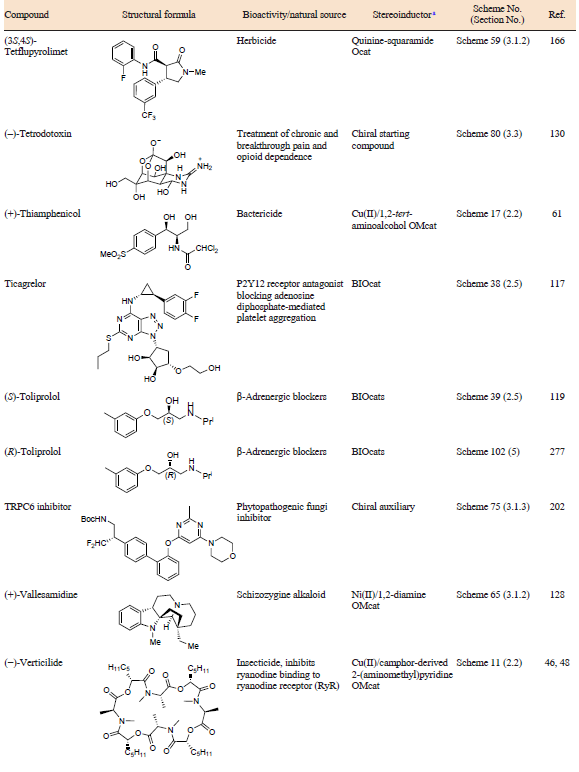
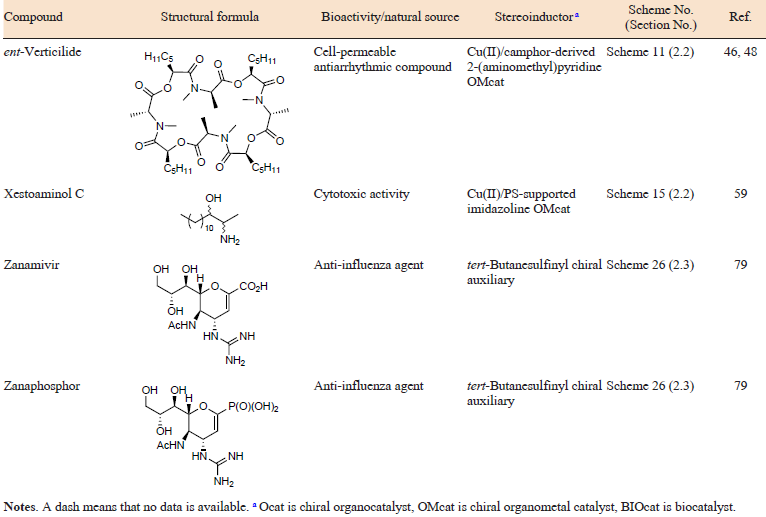
7. Conclusion
Nitro compounds have maintained a pivotal role in the stereoselective synthesis of natural products and pharmaceutically active compounds over the past decade. This is supported by a substantial number of recent academic works on total synthesis of complex natural products, as well as by publications from industry researchers dealing with scalable routes to active pharmaceutical ingredients. Compared to the data presented in our 2016 review,7 a noticeable increase in the structural complexity of total synthesis targets can be observed. It is well demonstrated by the syntheses of structurally and stereochemically intricate natural molecules such as Madangamine E, Keramaphidin B, (+)-Vallesamidine, (+)-Calycanthine, (+)-Stephadiamine, and (+)-Lucidumone, all obtained using asymmetric organocatalytic reactions of nitro compounds as the key steps.
The main advantages of methods based on the transformations of nitro compounds are their good compatibility with various types of organo- and metal-based catalysts, high enantioselectivity, broad functional group tolerance, mild reaction conditions, and the possibility of engaging a wide array of both electrophilic (for reactions with nitroalkanes) and nucleophilic (for nitroalkenes) reaction partners. Furthermore, the resulting functionalized nitro derivatives serve as direct precursors to many important classes of pharmacologically active substances (e.g., GABA derivatives, γ-lactams, etc.). Nonetheless, these methodologies are associated with some persistent challenges. One of the most significant is the low diastereoselectivity encountered when α-substituted nitro compounds are used as nucleophiles. For instance, in Henry and nitro-Mannich reactions, moving from nitromethane to primary nitroalkanes typically affords products as mixtures of diastereomers (see Scheme 2, Scheme 11, Scheme 13, Scheme 15, etc.). A similar problem arises with α-substituted and β,β-disubstituted nitroalkenes, which in addition exhibit diminished reactivity compared to less substituted derivatives. The construction of quaternary stereocenters in such reactions constitutes a particular difficulty. In some cases, the issues of low reactivity and diastereoselectivity can be solved through the careful selection of the catalytic system and the use of novel types of organocatalysts (see, e.g., Scheme 16, Scheme 17, Scheme 18, Scheme 19, Scheme 58 and their discussion). Nonetheless, general approaches addressing these problems have yet to be developed.
The predictable behavior of nitro compounds in condensation reactions creates ample opportunities for the design of cascade/domino reactions that lead to a rapid increase in molecular complexity. However, examples of stereoselective total synthesis based on cascade transformations of nitro derivatives are still rather scarce. Another challenge is a problematic transfer of the described methods to a larger scale and the development of their more economical and environmentally friendly embodiments. In this respect, current innovation is largely focused on the design of new efficient organocatalysts, the development of asymmetric flow synthesis using solid-supported organocatalysts, multi-step one-pot processes, advances in enzymatic and biocatalytic methods involving nitro compounds, and novel strategies for the asymmetric introduction of the nitro group. Active research into API-oriented stereoselective reactions of nitro compounds, enabled by biocatalysis, flow chemistry, and mechanochemical activation, demonstrates their potential transition toward semi-industrial applications.
Looking forward, we anticipate significant growth in several key areas. Organocatalytic cascade and multicomponent reactions of nitro derivatives will receive further development as powerful tools for a rapid generation of molecular complexity and diversity. Furthermore, the emerging field of asymmetric photocatalysis,[278] while still largely untapped in nitro chemistry, offers considerable potential for new, pharmaceutically-oriented methodologies.[279-283] Another promising frontier is the catalytic asymmetric transformation of nitro-derivatives like nitronates and nitrile oxides. This is highlighted by the recent pioneering works from List and co-workers[150][152] on chiral IDPi-catalyzed reactions of O-silyl nitronates forming stereogenic centers on nitrogen atoms. We anticipate that future researches in these and related areas will bring further impressive advances in the chemistry and application of nitro compounds.
8. List of abbreviations
Ac — acetyl;
All — allyl;
API — active pharmaceutical ingredient;
AtHNL — Arabidopsis thaliana hydroxynitrile lyase;
BmHNL — Baliospermum montanum hydroxynitrile lyase;
Bn — benzyl;
Boc — tert-butyloxycarbonyl;
Cbz — carboxybenzyl;
CPB — citrate – phosphate buffer;
Cy — cyclohexyl;
DABCO — 1,4-diazabicyclo[2.2.2]octane;
D-BAOA — 3-aminooctanoic acid;
DBU — 1,8-diazabicyclo[5.4.0]undec-7-ene;
de — diastereomeric excess;
DCC — dicyclohexylcarbodiimide;
DCM — dichloromethane;
DHEA — dehydroepiandrosterone;
DIPEA — N,N-diisopropylethylamine;
DMAP — 4-dimethylaminopyridine;
DMP — Dess – Martin periodinane
DPP-4 — dipeptidyl peptidase IV;
dr — diastereomeric ratio;
ee — enantiomeric excess;
EWG — electron-withdrawing group;
Fu — furyl;
GABA — γ-aminobutyric acid;
GI50 — concentration of drug causing 50% inhibition of cell growth;
HEPES — N-(2-hydroxyethyl)piperazine-N'-(2-ethanesulfonic acid);
Het — heteroaryl;
HHDHamb — halohydrin dehalogenase from the Acidimicrobiia bacterium;
HNL — hydroxynitrile lyase;
HP — human proteasome;
IDPi — imidodiphosphorimidate-based catalyst;
IC50 — half-maximal inhibitory concentration;
KRED — ketoreductase;
Mes — 1,3,5-trimethylphenyl (mesityl);
MOM — methoxymethylene;
Ms — methanesulfonyl (mesyl);
MS — molecular sieves;
NADH — nicotinamide adenine dinucleotide hydrogen;
Naph — naphthyl;
NBS — N-bromosuccinimide;
NIS — N-iodosuccinimide;
4-OT — 4-oxalocrotonate tautomerase;
PMB — 4-methoxybenzyl;
PS — polystyrene resin;
Py — pyridyl;
TBAF — tetra-n-butylammonium fluoride;
TBAI — tetra-n-butylammonium iodide;
TBHP — tert-butyl hydroperoxide;
TBN — tert-butyl nitrite;
TBS — tert-butyldimethylsilyl;
TES — triethylsilyl;
Tf — trifluoromethanesulfonyl (triflyl);
TFA — trifluoroacetic acid,
Th — 2-thienyl;
TIPS — triisopropylsilyl;
Ts — toluenesulfonyl;
TON — turnover number;
TTN — total turnover number.
References