Abstract
A key innovation suggested by the open science intellectual movement emerged dur-ing the early 2000s is that the research impact of published research is measured not only by citations in other academic research papers and books, but also by alternative metrics (“alt-metrics” or “altmetrics”) indicators, including news in mass media outlets and posts in social media. This study investigates altmetrics in Chemistry. Besides being of direct relevance to today’s research chemists working in the digital era, its outcomes may further inform new education of undergraduate students and young faculty in the chemical sciences on scientific communication in the open science era.
The bibliography includes 42 references.
Keywords
1. Introduction
Evaluation of researchers in science, technology, engineering and mathematics (STEM) disciplines for hiring and promotion is usually based on research impact measured by citation-based metrics.[1] A major idea of the open science intellectual movement emerged during the early 2000s,[2] is the need for metrics for assessing research impact going beyond (or alternative to) citation-based metrics.
In 2010, an alt-metrics (or ‘altmetrics’) manifesto was published online by four researchers:[3] a PhD student at a university in the USA (Priem), a postdoctoral researcher in computer science at a university in the Netherlands (Groth), a researcher at a foundation owning an online encyclopedia (Taraborelli), and a biophysicist from a public research organization in Great Britain (Neylon). Presenting the new approach, the team wrote:
‘With alt-metrics, we can crowdsource peer-review. Instead of waiting months for two opinions, an article’s impact might be assessed by thousands of conversations and bookmarks in a week. In the short term, this is likely to supplement traditional peer-review’.[3]
In 2011, the proponents of the new metrics removed the dash in ‘alt-metrics’. Today, the website (altmetrics.org) where they published their manifesto no longer exists, and users typing the old URL for accessing the manifesto are redirected to Zenodo, an online repository enabling researchers to share and preserve their research works. Yet, the idea of altmetrics was met by broad scholarly and commercial interest. For instance, ‘altmetrics’ by late 2025 was mentioned in 6436 documents indexed by research database Scopus: 4350 research articles, 624 conference papers, 586 reviews, 302 book chapters, and 96 books.[4]
In brief, the research impact of published research item is measured not only by citations in other academic research papers and books, but also by mentions in blogs, patents, online encyclopedias, policy documents, articles in newspapers and magazines, posts in social media, and bookmarks on websites such as Mendeley or CiteULike. The idea was (and is) to supplement citation-based indicators for research assessment.[5]
In 2011 Adie, a product manager at Nature Publishing Group, founded in London an internet company aiming to track online ‘conversations’ concerning research papers and other research outputs.[6] Using funding from a competition in digital science, the company released its Altmetric Explorer software in early 2012. Six months later, the firm was acquired by Digital Science. Similarly, in early 2012 Michalek in the USA co-founded Plum Analytics, a company gathering altmetric parameters. Since 2017, the company is owned by Elsevier.[7] Today, altmetric scores and links to the mentioning sources provided to subscribers by Altmetric or PlumX enable readers to identify the ‘altmetric’ impact of the tracked research output.
This study investigates altmetrics in Chemistry, namely in the basic scientific discipline with the lowest uptake of open science principles and tools. From the limited uptake of preprints[8] through self-archiving (or ‘green’ open access),[9] researchers in the chemical sciences have been the most reluctant amid those in the natural sciences in the uptake of open science principles and tools. All major publishers in Chemistry, however, quickly adopted altmetric score tools.
In 2013, the Royal Society of Chemistry (RSC), partnered with Altmetric, displaying the Altmetric Attention Score (AAS) for research articles originally in five journals. Three years later, the American Chemical Society (ACS) adopted the AAS for all articles published across its research journals. Today nearly all main publishers owning Chemistry journals display an altmetric score next to the article title published online.
This study answers two research questions:
How does altmetrics in Chemistry differ from altmetrics in other STEM disciplines?
Why a research chemist should be interested in altmetrics?
To answer the study’s research questions we conducted a search in the scholarly literature dealing with altmetrics in Chemistry using Scopus, a research database of peer-reviewed scientific publications owned by a large academic publisher. In detail, we conducted a Boolean search at scopus.com with the query ‘altmetric + chemistry’ within ‘All Fields’ limiting the search to ‘Article’ and ‘Review’ published in English.[10]
Conducted on October 23, 2025, the search returned 302 documents published between 2013 and late October 2025 indexed by Scopus. Documents were individually inspected by reading the article and review titles to identify outcomes relevant to this study. After a brief introduction to altmetric scores and the digital infrastructure used to obtain said scores, this study aggregates and connects previous observations and explores the underlying reasons for various findings. The conclusions identify trends and propose future research directions.
2. Digital infrastructure for Altmetrics
As mentioned in the introduction, altmetric scores and links to the mentioning sources provided by altmetric data digital companies enable readers of scientific article to identify the altmetric impact of the tracked research output. The digital infrastructure for altmetrics relies on automated data collectors, persistent identifiers, and commercial or open software platforms that, using different methods and algorithms, aggregate mentions from sources such as news media, policy documents, blogs, social media sources, online encyclopedias, patents and reference managers. Different platforms, however, track different sources and so altmetric scores and coverage vary between platforms. For example, a comparison conducted in 2024 between the social impact of ‘hot papers’ through the alternative metrics data offered by PlumX and Altmetric.com showed that PlumX offered broader coverage of hot papers.[11]
Describing the actual development of the main altmetric platforms and referring to the 2013 NISO (National Information Standards Organization) Altmetrics Initiative[12] in the USA, Fors and co-workers[13] recently highlighted how the proprietary nature of many altmetric platforms restricts transparency of the methods used to calculated attention scores and made them public. For example, focusing just on news mentions, in 2022 Altmetric reported to track more than 7000 sources in over 165 countries, with the list of news sources being continually updated.[14] However, a comparison between manual content analysis of 400 science news stories with research mentions quickly found by the company’s ‘Explorer’ found that Altmetric’s news mention data were relatively accurate, with very high precision (0.95) and acceptable recall (0.70, proportion of actual successfully identified).[14] Over the past four years, the advent of Large Language Models (LLMs) to automatically read and synthesize large amount of online attention data has made possible to quickly generate concise, and highly readable narrative summary of a research output’s attention and influence. Furthermore, the same company since early 2026 provides subscribers to access to Altmetric Attention Digest (AAD), a new online artificial intelligence (AI)-powered tool that converts attention data into a clear, concise summary that instantly allows a researcher to learn who is mentioning her/his work, where it is being shared and how it is being received.[15]
In general, Altmetric and PlumX are the two main proprietary platforms for accessing updated alternative metrics data. To date, most open-source platforms publishing altmetric data ceased to exist, most likely due to lack of financial revenues and thus of economic sustainability. Likewise to what happened to bibliometric databases, however, where prominent examples of freely accessible databases exist, it is likely that with the aforementioned advent of LLMs, new digital companies specializing in AI will soon launch AI-based tools that will allow users to obtain more inclusive, accurate and reliable altmetric data. For instance, these new providers might include coverage of several social media platforms in place of the few covered by the two prominent proprietary platforms, and more content from non-English sources.[16]
3. Altmetrics in Chemistry and other disciplines
Showing the study’s title, principal result along with year of publication and publishing venue, Table 1 summarizes findings from available studies (in English) on Altmetrics in Chemistry identified till late 2025.
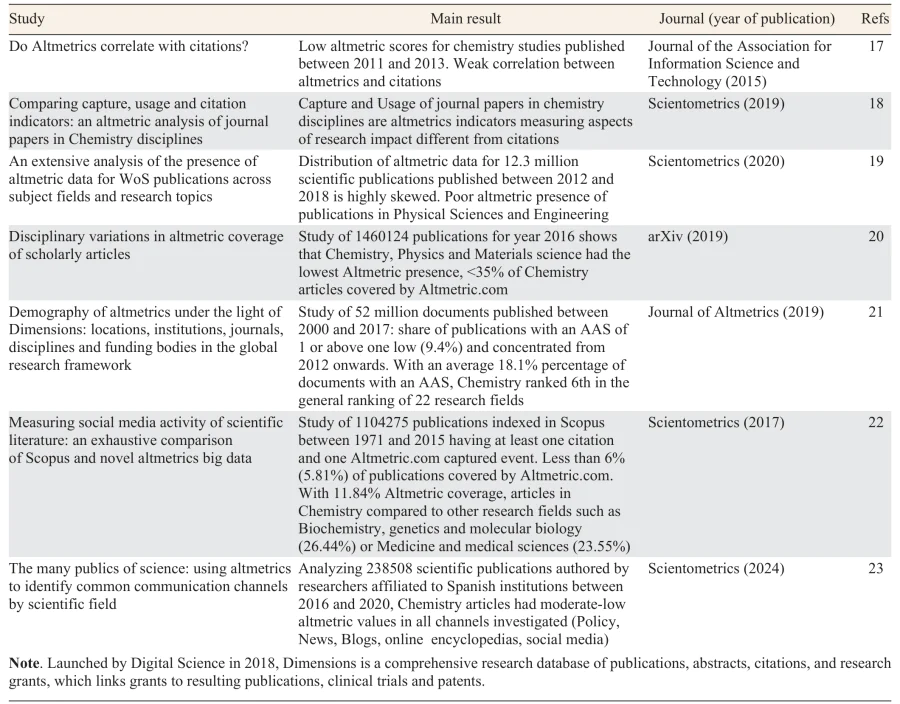
Studying a population of 500229 publications (articles and reviews) published between July 2011 and late October 2013 indexed by Web of Science (WoS) research database, Costas et al.[17] found that 75569 (15%) had at least one altmetric score. The fields with the highest share of publications with altmetric scores were the Biomedical and Health Sciences and Social sciences and Humanities, with more than 22% of the publications having at least one altmetric score. Natural Sciences and Engineering (including Chemistry) with 8.89%, and Mathematics and Computer Science (with 5.39%) had less than 9% of their publications with altmetrics.
In 2019, Glänzel and co-workers[18] published the first altmetrics analysis of journal papers in Chemistry disciplines using articles indexed by WoS and PlumX data. Results showed that capture and usage indicators measure aspects of research impact different from citations. For example, the most downloaded article out of all papers published in 2013 in analytical chemistry, indexed in a collection of papers from the highest impact journals, had a very low citation impact in the subsequent four years.
Similarly to what happens with citations, studying the presence on Altmetric.com (and Mendeley) up to 2019 of 12.3 million scientific publications published between 2012 and 2018, Costas et al.[19] found that the distribution of altmetric data is highly skewed. The vast majority of publications receive no or very few altmetric mentions, and a few publications earn a disproportionately high share of mentions. The team confirmed that, even though publications in the fields of natural sciences and medical and health sciences receive more citations, most altmetric data concentrate on publications from the fields of Biomedical and Health Sciences, Social Sciences and Humanities, and Life and Earth Sciences, with Physical Sciences and Engineering publications performing weakly in altmetric data presence as Mathematics and Computer Science publications do.
In 2019, Mayr and co-workers[20] reported the results for the six main disciplines out of 14 categorized by WoS concerning 1460124 publications with digital object identifiers for year 2016. Chemistry, Physics and Materials science had the lowest Altmetric presence. Less than 35% of Chemistry articles were covered by Altmetric.com and only about 25% in Material science and Physics. A main online venue where scientific articles were discussed online was Mendeley. For Chemistry, out of 90959 articles published, 31331 articles were mentioned, e.g., on Mendeley. Again, research papers in Biology and Medical science were the most frequently discussed online in non-academic venues.
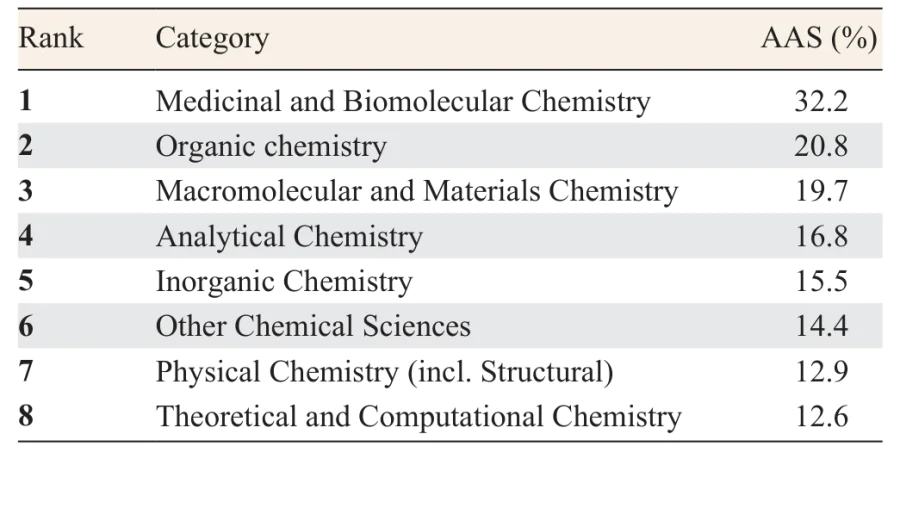
Similarly, studying the AAS share for 52048103 documents published between 2000 and 2017 and subsequently indexed by Dimensions, the most inclusive research database, Orduna-Malea and Delgado López-Cózar[21] found that the percentage of publications with AAS (an AAS of one or above one) was low (9.4%) and concentrated from 2012 onwards. The outcomes in terms of publications with AAS for each of the 22 fields in which Dimensions organizes research categories reinforced previous findings (high values for medicine and life sciences disciplines; low results for mathematics, engineering, and computer sciences). With an average 18.1% percentage of documents with an AAS, in the general ranking of the 22 fields, Chemistry (‘Chemical sciences’) was ranked 6th.
Table 2 shows the ranking in terms of publications with AAS between 2000 and 2017 for the eight categories comprising Chemical sciences according to Dimensions.[21] Followed by Organic chemistry with AAS percentage (20.8%), Medicinal and Biomolecular Chemistry has the highest AAS percentage (32.2%). Theoretical and computational chemistry has the lowest (12.6%). Once again, no correlation was identified between citations and altmetrics. In detail, out of 4 574 758 research documents in the Chemical sciences published between 2000 and 2017, by October 2018 82.5% had been cited and only 18.1% had an AAS.
In 2017, Hassan et al.[22] reported the altmetric outcomes for 1104275 publications indexed in Scopus between 1971 and 2015 having at least one citation and one Altmetric.com captured event. Less than 6% (5.81%) of publications were covered by Altmetric.com (chiefly during 2011 – 2015). Articles in Chemistry received less attention (11.84% Altmetric coverage) when compared to other research fields such as Biochemistry, genetics and molecular biology (26.44%) or Medicine and medical sciences (23.55%).
Finally, analyzing 238508 scientific publications (articles, editorial material, letters and conference proceedings) authored by researchers affiliated to Spanish institutions between 2016 and 2020, Arroyo-Machado et al.[23] recently found that Chemistry articles had moderate-low values in all channels investigated (Policy, News, Blogs, popular social media, and online encyclopedias).
4. Altmetric scores and social influence
Chemistry scholars should be interested in raising the altmetric impact of their research papers because said scores are a proxy for societal impact of research work, though online attention measured by altmetric scores should not be confused with true social influence. The low altmetric scores of chemical research studies indicate that chemical research receives limited online attention. Given the broad societal impact of the chemical industry, which was entirely originated from research in Chemistry,[24] this outcome does not indicate lower societal impact of chemical research, but rather points to modest societal interest measured by online attention in chemical research.
For example, as mentioned above, reviewing the top 100 research articles ranked by Altmetric.com in terms of AAS between 2015 and 2020,[25] shows that Chemistry was rarely present in the top 100 annual ranking (Table 3).
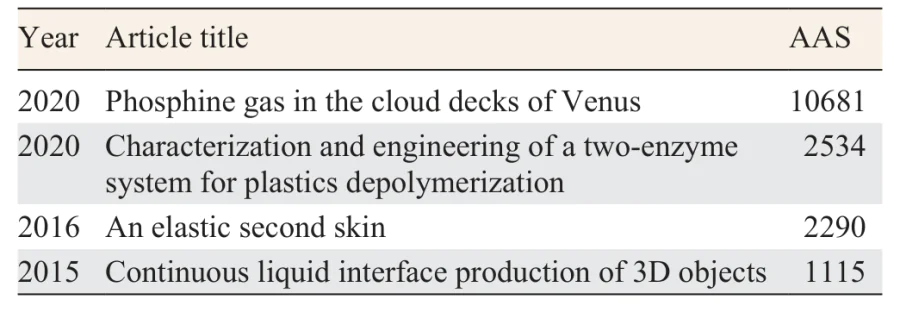
As can be seen from Table 3, during the period from 2015 to 2020, societal interest for chemical research findings focused either on advanced new technology of broad societal relevance, or with space chemistry research.
Interest of today’s research chemists in raising the altmetric impact of their research stems from the fact that the impact of chemical research has never been limited only, to paraphrase Canadian cognitive scientist S. Harnad, ‘to reach the eyes of his peers, his fellow esoteric scientists... so that they can build on one another’s work in that collaborative enterprise called learned inquiry’.[26] Findings in Chemistry very often have significant economic, health, and environmental potential, and are therefore relevant to numerous societal stakeholders. Indeed, a survey conducted in the mid 2010s on behalf of the Royal Society of Chemistry to learn what the British public really thinks about Chemistry showed that the public has ‘a hugely positive response to engagement materials around the concept of everyday chemistry’.[27]
Improved engagement with the public is required also to attract talented students. With the noticeable exceptions of China and India, the number of students enrolling in Chemistry is rapidly declining. In Great Britain, for example, the number of Chemistry bachelor student application between 2015 and 2018 has fallen by over 23%.[28] Similarly, in Germany the number of bachelor enrolments has dropped from over 7000 in 2015 to less than 5000 in 2023.[29] Along with other reasons, this drop in undergraduate applications as well as the poor societal interest in chemistry may be ascribed to the poor public image of Chemistry.[30]
Research in the chemical sciences, on the other hand, has the potential to address many environmental and health issues causing societal concern in both economically developed and developing countries. For example, research in Green Chemistry has developed new biobased solvents of little toxicity with which to replace neurotoxic hexane employed at 1.1 million tonne per year annual rate as oilseed extraction solvent.[31] It may therefore not be surprising to learn that the 2022 study from Cravotto et al.[32] entitled ‘Towards substitution of hexane as extraction solvent of food products and ingredients with no regrets’ by early October 2026 had an AAS of 214, namely in the top 5% of all research studies (34447360 articles) ever tracked by Altmetric.
In brief, fifteen years after the introduction of altmetrics (in 2011) to complement citation-based metrics for assessing research impact,[3] the outcomes of this study may further inform the curriculum of undergraduate students in the chemical sciences provided with education on scientific communication in the digital era.[33]
Altmetrics has evolved into a metrics informing the scholarship of service to society.[34] Societal and academic impacts of research are different and both important objectives of today’s scientific research.[35]
One reason explaining why altmetric scores of research in Chemistry are substantially lower than in disciplines such as Biology, Medicine, or the Social sciences may be the well- known professional conservatism of researchers in Chemistry. Put simply, disciplinary communication norms in Chemistry simply do not include the public amid the recipients of the scholarly communication process. This was shown, amid other outcomes, from the limited uptake of preprints[8] and ‘green’ self-archiving[9] as well as by limited use of social media,[36] this cultural trait of research chemists has limited (and still limits, at least for papers published until the early 2020s) accessibility of published Chemistry studies.
The advent of the first two generations of researchers belonging to ‘digital natives’ (those born after 1980 and those born after 1996, according to Electronic Frontier Foundation), coupled to the central issue of sustainability in the chemical sciences, is eventually leading to positive change. For example, using social media, research chemists contribute to improve the social standing of Chemistry, a discipline whose public image is associated to negative aspects such as ‘pollution’, ‘danger’, ‘toxicity’, and many other beliefs about chemistry comprising chemophobia.[30]
Chemistry is different from all other STEM disciplines because the creation and application of new knowledge originated the world’s largest industrial sector: the chemical industry.[37] Driven by societal megatrends concerning the environment, health, and energy which permeate societies on a global scale, this industry is currently undergoing profound changes.[37] Changes include the shift to decentralized production using relatively small, continuous manufacturing plants relying on clean chemical technology, and use of readily available biological resources as feedstock rather than oil-based feedstocks.
Effective communication of innovation to the public is an important component of research and technology management through which researchers can collect valued feedback and use it to better align the innovation process and its outcomes with societal goals.[38] Besides offering an example of responsible innovation in Chemistry, the example of publication by Cravotto et al.,[31] which addresses how and why toxic n-hexane can be replaced with safe and eco-friendly solvents such as 2-methyltetrahydrofuran shows how a research article of wide societal relevance will quickly achieve a high altmetric score.
In brief, altmetrics is a metric that complements, rather than reinforce, existing hierarchies and statistically biased indicators resulting from highly skewed citation distributions such as the Journal Impact Factor (JIF). Indeed, the altmetric attention score does not correlate with the JIF.[13, 17] Offering one example of this fact is the study ‘Citric acid: Emerging Applications of a Key Biotechnology Industrial Product’ published in Chemistry Central Journal in 2017.[39] Established in 2006 as one of the first ‘gold’ open access (OA) publishing venues in Chemistry, the journal received its first JIF of 0.82 in 2009. In the subsequent ten years, its impact factor never exceeded 2.6 before the journal’s publisher was purchased by Springer Nature and the journal name in early 2019 changed to BMC Chemistry. Yet, the aforementioned study has an AAS of 247,[40] stemming from 1 blogs, 29 news outlets, 3 Redditors, 759 Mendeley, and a few mentions on social media, which posits it in the top 5% of all research outputs ever scored by Altmetric.
5. Conclusion
Based on analysis of previous scientometric studies on alternative metrics for research impact, this study shows that altmetrics in Chemistry differs from altmetrics in other science, technology, and engineering disciplines for the lower attention when compared to other research fields.
On the other hand, research chemists should be interested in altmetrics because altmetrics has evolved into a metrics informing the scholarship of service to society. Proactive engagement with societal actors (citizens, policy makers, business, third sector organizations, etc.) provides numerous benefits both to researchers and to the public. Enhanced altmetric impact of research in Chemistry, for example, is needed both to publicly show the central role of the discipline in resolving the environmental crisis, as well as to attract talented students to study Chemistry.
Like any other study, the present investigation has limitations. First, altmetric scores measure online attention rather than true social influence. Many other dimensions of societal impact of research exist, such as policy influence, industrial adoption, or educational outcomes, that may not be reflected in a Social Web metrics such as altmetrics.
Furthermore, the study treats Altmetrics as if it were a discipline using unambiguous and unbiased indicators. However, this is clearly not the case. Biases affecting current altmetric indicators include the limited set of social media taken into account (just one in the case of one of the two main altmetric providers); heavy reliance on automated application programming interfaces (APIs) to parse web mentions leading altmetric providers to favor certain online encyclopedias while ignoring alternative digital encyclopedias, localized knowledge bases, and non-Western educational encyclopedias; heavy reliance on research items and news outlets, blog posts, and policy documents published in English and far lower coverage of research items and related news and policy documents in widely used languages other than English,[41] such as Chinese, Spanish or Portuguese.
Being part of the digital economy, however, this domain of contemporary scientometrics is rapidly evolving. We forecast that with the advent of LLMs, new digital companies specializing in AI will soon launch AI-based tools that will allow users to obtain concise altmetric reports on research items based on inclusive and accurate altmetric data. First evidence of said changes, that might form the topic of future research on altmetrics in Chemistry, can be drawn from the recent introduction of web sentiment analysis integrated into altmetric platforms, providing researchers with a more nuanced qualitative insight on of how research is received and discussed by society.[42]
Funding
No funding was received to conceive and write this study.
Data availability statement
All data are available in the text.
Competing interests
The authors declare no competing interests.
6. List of abbreviations
AAD — altmetric attention digest;
AAS — altmetric attention score;
AI — artificial intelligence;
alt-metrics — alternative metrics;
API — application programming interface;
Dimensions — a research database of publications, abstracts, citations, and research grants, which links grants to resulting publications, clinical trials and patents;
JIF — journal impact factor;
LLMs — large language models;
NISO — National information standards organization;
STEM — science, technology, engineering and mathematics;
WoS — Web of Science.
References